To avoid these ads, REGISTER NOW!

Anyone have or use an Coolant Refractometer?

To avoid these ads, REGISTER NOW!

RCman

Well-known member
Joined
Nov 25, 2010
Messages
252
I'm not sure they are worth the money if you are using them for personal use only with only a few engines. $66 buys a lot of coolant.
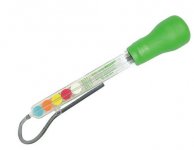
I've got one of the <$9 ball type testers and it works well.
 

hydramatic

Well-known member
Joined
Jun 26, 2009
Messages
510
Location
Alabama
1 Qt of distilled water per 1 gal of coolant will take you down to well below 25 below zero...here in alabama we mix it 50/50..
 

treasureseeker

Well-known member
Joined
Aug 1, 2010
Messages
996
Location
Michigan
I had to use one when I was at Roush for prototypes on Fords. I think they are over a hundred for a tool truck one. We used them to get the exact freezing point of coolant they required.
 

jay50

Banned
Joined
Oct 28, 2007
Messages
3,894
I've had a refratometer over 10 years; accurate to +/- 1F.
If you get one, make sure it is temperature compensating or you readings will not be accurate.:thumbup:
 

j6508

Member
Joined
Nov 23, 2010
Messages
10
Location
Superior wi
I use one almost every day now that it has got cold. they work great, the little balls never stop working lol. The one we have dosent use baterys but I think their are ones that have a onbord light source. Oh ya ours is 12 + years old
 

Sh1thead

Well-known member
Joined
Nov 1, 2010
Messages
271
Location
Philly :(
our shop provides us with accustrips but thinking about picking one up just for peice of mind.
 
To avoid these ads, REGISTER NOW!

DrkMtnDew

Well-known member
Joined
Sep 24, 2010
Messages
1,465
the disk type hydrometer from thexton is my personal favorite. refractometers are nice but don't like much abuse. disk types are just as accurate as the refractometers, little more forgiving about rough handling and cost only a fraction the price of you do break it. they are about $17 on the Cornwell truck. :thumbup:
 

Attachments

  • BEEM.jpg
    BEEM.jpg
    13.4 KB · Views: 13

shampoop

Well-known member
Joined
Jul 12, 2009
Messages
1,947
Location
SW Washington
yea, i really don't understand the appeal of refractometers. I mean, if floating ball/disk type ones didn't exist then yea great. But much more expensive, much more fragile, take more time to use, and the floating disk/ball ones are more than accurate enough. Refractometers don't really offer much.
 

Stick

Well-known member
Joined
Dec 12, 2007
Messages
2,302
Location
Alaska
I think four out of the six mechanics in our shop have one. Mine is a nice backlit Misco one that does automatic temperature compensation.

Why use a refractometer instead of a hydrometer (disc or ball type tester)?

Consistancy, accuracy (within +/-1* for a refractometer vs +/- 8* for a hydrometer), the ability to measure both propylene glycol and ethylene glycol, and most refractometers will also do state of charge tests for battery acid.

In addition, in a good refractometer you don't need to do temperature compensation to get a valid reading, which is something that is very important for they hydrometer style testers to get accurate readings.
 
Last edited:

Danglerb

Well-known member
Joined
Sep 6, 2007
Messages
9,736
Location
SoCal
Dunno, I wanted one, found a good one on ebay cheap, a Misco, now I have one.
 

Stick

Well-known member
Joined
Dec 12, 2007
Messages
2,302
Location
Alaska
what is the advantage in being accurate to 1 degree instead of 8?

Because that +/- 8 degrees can become pretty significant, especially in cold climates.

A hydrometer isn't actually measuring the freeze protection of the antifreeze, it's measuring the specific gravity of the solution of water and glycol. Those ball or disc type testers that everybody loves so much are meant to be used at around 68 degrees. What's the big deal about temperature?

Leica said:
A reading for a 50 percent ethylene glycol solution at 100 degrees F would give a specific gravity of 1.056. This same 50 percent solution at 150 degrees F would read 1.038 specific gravity. If that hydrometer were calibrated for 100 degrees F, it would read as 50 percent only if the reading were taken at a fluid/instrument temperature of 100 degrees F. If the reading were taken at a fluid/instrument temperature of 150 degrees F, the instrument would measure the specific gravity as 1.038, which at the instrument's standard reference temperature of 100 degrees F corresponds to a 35 percent concentration. The person taking the reading would think that the solution was 35 percent ethylene glycol. As a reference, the freeze point protection level for a 50 percent mixture is -32 degrees F. The freeze point protection for a 35 percent mixture is approximately -2 degrees F.

Add the approximately 30 degree difference to the +/- 8 degree error of the ball/disc style hydrometer, and you have a range of 22 to 38 degrees that the hydrometer style of tester can be off by. How many of you take the time to reference manufacturer charts to calculate for temperature shift when taking a reading with a ball/disc style hydrometer?

I don't know about you, but that seems pretty significant to me, especially if you are working in a shop environment where not every reading is going to be taken at 68* coolant/tool temp.
 

shampoop

Well-known member
Joined
Jul 12, 2009
Messages
1,947
Location
SW Washington
Because that +/- 8 degrees can become pretty significant, especially in cold climates.

A hydrometer isn't actually measuring the freeze protection of the antifreeze, it's measuring the specific gravity of the solution of water and glycol. Those ball or disc type testers that everybody loves so much are meant to be used at around 68 degrees. What's the big deal about temperature?


Add the approximately 30 degree difference to the +/- 8 degree error of the ball/disc style hydrometer, and you have a range of 22 to 38 degrees that the hydrometer style of tester can be off by. How many of you take the time to reference manufacturer charts to calculate for temperature shift when taking a reading with a ball/disc style hydrometer?

I don't know about you, but that seems pretty significant to me, especially if you are working in a shop environment where not every reading is going to be taken at 68* coolant/tool temp.

That is very interesting. I had no idea that the differece in temp could change the specific gravity enough to change the readings. That does make a big difference. Luckily the reading is usually taken at the overflow tank which is not going to be that hot. I'm gonna try measuring the difference between the same coolant at 70ish degrees (overflow) with coolant at 150-180 degrees(radiator) every time for a while to see if the difference shows. Luckily where i live the temperature is rarely below 40 or above 90, and since the overflow temp will probably be about the same as the ambient temp, i should be pretty good.
 

Stick

Well-known member
Joined
Dec 12, 2007
Messages
2,302
Location
Alaska
That is very interesting. I had no idea that the differece in temp could change the specific gravity enough to change the readings. That does make a big difference. Luckily the reading is usually taken at the overflow tank which is not going to be that hot. I'm gonna try measuring the difference between the same coolant at 70ish degrees (overflow) with coolant at 150-180 degrees(radiator) every time for a while to see if the difference shows. Luckily where i live the temperature is rarely below 40 or above 90, and since the overflow temp will probably be about the same as the ambient temp, i should be pretty good.

Here's another good chart that shows the relationship between specific gravity and strength of solution. Notice that at 120 degrees the specific gravity is 1.038 in a 30% solution, now take a look at 200 degrees and 1.038 shows up again at a 50% solution, a difference of 80 degrees in temp shows a 20% difference in solution strength. Now keep in mind this is for a generic "ethylene glycol", but each antifreeze manufacturer has their own additive packages that change the numbers slightly so you need to compensate with the manufacturer's own chart.
 
To avoid these ads, REGISTER NOW!
Top Bottom