jd5000
Well-known member
On a pulley on an old motor, there is a little metal rod. Anyone know what it is called and how to remove it?
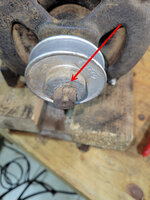


there should be a set screw pressing that key, is there one in the valley of the groove ? it needs to be loosened . and yes, heat the pulley will help to pull itis there no set screw?
Most press fit keys I've seen don't have a set screw. I see no indication in the OP's pic that a set screw is there. That appears to be a press fit pulleythere should be a set screw pressing that key, is there one in the valley of the groove ? it needs to be loosened . and yes, heat the pulley will help to pull it
-What the OP has is a standard type square key, the keyway is the giveaway. A woodruff key has no noticeable keyway until the pulley is off. The slot a woodruff key seats in is made with a somewhat specialized cutter in a milling machine that matches the radius of the key. A visual and a few applications are below.Woodruff key is what I've always called the,keeps pulley from spinning on crank.
So tell us how you got it off and whether it did or didn't have a set screw.Thanks everyone, I got it off.
There were two set screws on the pulley itself, but no set screws on the key.So tell us how you got it off and whether it did or didn't have a set screw.
Confusing to me too I'd throw it out.On a pulley on an old motor, there is a little metal rod. Anyone know what it is called and how to remove it?
i usually do a combination of the two, but everything i've touched has a set screw or two. one for the key, the other 90 degrees off if present.There were two set screws on the pulley itself, but no set screws on the key.
To remove it, I gave it a quick squirt with some PB blaster and after a while, just pulled it off with my bearings puller. Came off easy.
Now, going back on my will probably be more difficult. I'm not sure if I put the key on shaft and then press the pulley on, or if I put the pulley on and then kind of bang the key in, or some other way.
Key on shaft, then install pulley.There were two set screws on the pulley itself, but no set screws on the key.
To remove it, I gave it a quick squirt with some PB blaster and after a while, just pulled it off with my bearings puller. Came off easy.
Now, going back on my will probably be more difficult. I'm not sure if I put the key on shaft and then press the pulley on, or if I put the pulley on and then kind of bang the key in, or some other way.
I'd agree.You may want to dress the end of that key to knock the edges off the outside edge before reinstalling. Looks like you gave it some love taps.
This is a square cut key, and I've had bad luck installing them key first, but it depends on how the slot was made.Key on shaft, then install pulley.

