To avoid these ads, REGISTER NOW!

Are 'Cable Pass Through Wall Grommets' Code Compliant?

bad_idea

Well-known member
Joined
Jun 11, 2011
Messages
4,332
Location
Pasquotank, NC
Cable Pass Through Wall Grommet

I would like to install one of these through the wall between my master bedroom and a closet. I want to put a projector on the wall of the master bedroom and locate the power outlet and Apple TV in the closet. The power cable to the projector and the HDMI from the Apple TV would pass through the grommet. Thanks all!
 
To avoid these ads, REGISTER NOW!
OP
B

bad_idea

Well-known member
Joined
Jun 11, 2011
Messages
4,332
Location
Pasquotank, NC
I would prefer to install a single outlet with a keystone HDMI in the bedroom wall by the projector, but that seems to be a difficult device to find.
 

Innovate1

Well-known member
Joined
Jul 28, 2014
Messages
4,274
Location
Illinois near St. Louis, Missouri
I would prefer to install a single outlet with a keystone HDMI in the bedroom wall by the projector, but that seems to be a difficult device to find.
When you say single outlet I take it you mean not a standard duplex outlet but a true single receptacle (outlet is commonly used but receptacle is the term used in the code)? They make single receptacles that go into a 1 gang box but guessing you have already found those. They also make box divider plates to separate a two gang box into high voltage and low voltage or a single gang box and a open back ring for low voltage next to it. Those both take the space of two boxes. That would meet your brief description. If that's not what you want you need to add more detail.
 

dave*99

Well-known member
Joined
May 5, 2009
Messages
4,248
Location
Coastal NJ
Arlington LVDR2.
This and a Decora cover plate will accommodate a power receptacle and HDMI.


1767615926484.png
 

mike93lx

ALLIANCE MEMBER
Joined
Dec 9, 2013
Messages
37,385
Location
Richmond, VA
Between a bedroom and closet for low voltage? I'd install one of those without a second thought.

Onto the real issue, a projector in your bedroom?
 

MovingAlong

Well-known member
Joined
Aug 17, 2013
Messages
1,197
Cords and cables cannot be run in walls.
See NEC 400.8 (2) Uses not permitted

Frustrating trying to find an online reference for NEC, do you have a good link?

This was clipped from another electrical forum:

400.8 Uses Not Permitted.
Unless specifically permitted in 400.7, flexible cords and cables shall not be used for the following:
(1) As a substitute for the fixed wiring of a structure
(2) Where run through holes in walls, structural ceilings, suspended ceilings, dropped ceilings, or floors
(3) Where run through doorways, windows, or similar openings
(4) Where attached to building surfaces
Exception: Flexible cord and cable shall be permitted to be attached to building surfaces in accordance with the provisions of 368.8.
(5) Where concealed by walls, floors, or ceilings or located above suspended or dropped ceilings
(6) Where installed in raceways, except as otherwise permitted in this Code


I don't read these everyday and could use some assistance interpreting, but isn't 400.8 (1) the prohibited item and (2-6) examples of "where" this prohibition applies? 🤷‍♂️

From yet another site:

400.7 Uses Permitted.

(A) Uses. Flexible cords and cables shall be used only for the following:

(1) Pendants.
(2) Wiring of luminaires.
(3) Connection of portable luminaires, portable and mobile signs, or appliances.
(4) Elevator cables.
(5) Wiring of cranes and hoists.
(6) Connection of utilization equipment to facilitate frequent interchange.
(7) Prevention of the transmission of noise or vibration.
(8) Appliances where the fastening means and mechanical connections are specifically designed to permit ready removal for maintenance and repair, and the appliance is intended or identified for flexible cord connection.
(9) Connection of moving parts.
(10) Where specifically permitted elsewhere in this Code.
(11) Between an existing receptacle outlet and an inlet, where the inlet provides power to an additional single receptacle outlet. The wiring interconnecting the inlet to the single receptacle outlet shall be a Chapter 3 wiring method. The inlet, receptacle outlet, and Chapter 3 wiring method, including the flexible cord and fittings, shall be a listed assembly specific for this application.


Their graphic shown was:

1767624256644.png

Appreciate the education. (y)

Also wondering about my old phone cable and TV/Internet coax, all run inside the walls...
 
Last edited:

MovingAlong

Well-known member
Joined
Aug 17, 2013
Messages
1,197
They were rated for the purpose

Yeah, my doorbell, thermostat, Cat 5 all run "in wall" too. But that was my point, the blanket statement that Cords & Cables cannot be run "in wall" cannot be correct. From the advertising for an HDMI cable on Amazon:

1767625369387.png

I'm not an electrician, never even played one on TV, but do have a curiosity to learn and understand the rules of the game... ;)
 

dscheidt

Well-known member
Joined
Apr 26, 2017
Messages
2,882
Yeah, my doorbell, thermostat, Cat 5 all run "in wall" too. But that was my point, the blanket statement that Cords & Cables cannot be run "in wall" cannot be correct. From the advertising for an HDMI cable on Amazon:

1767625369387.png

I'm not an electrician, never even played one on TV, but do have a curiosity to learn and understand the rules of the game... ;)

those are low voltage, and such use is allowed, as they are not a fire or shock hazard. Line voltage is another matter.
 

MovingAlong

Well-known member
Joined
Aug 17, 2013
Messages
1,197
those are low voltage, and such use is allowed, as they are not a fire or shock hazard. Line voltage is another matter.

Can you help me with the relevant NEC code section where the two applications (high vs low voltage) are differentiated? Again, not wanting to be argumentative, just trying to learn what the code actually says and how it is applied.
 
To avoid these ads, REGISTER NOW!

mm08822

Well-known member
Joined
Jan 13, 2012
Messages
5,856
Location
NJ
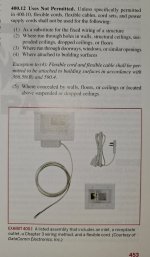
NEC 2023/2026 article 400.12 "Uses Not permitted" specifically excludes power supply cords from within or passing thru holes in walls/ floors, etc. The only exception is for a listed assembly where it includes all components for: entry into, through/within, and exit from the wall/floor.

Notice there is no UL listing or ETL confirmation for this Amazon product. The parent website of this product looks like somebody who got himself a 3D printer and is brain storming ideas. Also note, they are pushing this item for passing through table tops....i.e. - portable furniture, which is different than the building structure. Anybody can snap a pic......we're all entitled!
1767638229257.jpeg
 
Last edited:

billconner

Well-known member
Joined
Jul 20, 2021
Messages
6,930
Location
Thousand Islands NYS
There is no mention of a voltage exception in the Code.
I've been avoiding trying to explain this because it deep in the swamp of code writing. While I can hold my own with building and fire codes, I don't live in the NEC like I do the others.

Unless specifically referenced by Chapter 8, Communications Systems, (phones, data, CCTV, antennas, etc.) nothing in chapters 1 through 7 apply to those systems.

Some of this depends on the distinction between cords and wire or cable. I think that is why low voltage is allowed. It's not a "cord".

I'm not defending code writing, just trying to help clarify.
 
OP
B

bad_idea

Well-known member
Joined
Jun 11, 2011
Messages
4,332
Location
Pasquotank, NC
I appreciate the information all. I'll keep looking for a good method to power a projector and get the signal from the Apple TV to it. I'm not real keen on a grommet passing through the wall, kind of cheesy looking. But I really don't want a double gang behind the projector with a duplex outlet and a single keystone for the HDMI. A single outlet with a HDMI keystone above it is my ideal, though I am having trouble finding such an item.

I personally don't like a tv or projector in the bedroom, but the wife wanted one. A tv didn't fit in the room very well, but the projector works well as the screen rolls up out of the way and the projector is mounted up high on the wall. I currently have a small shelf on the wall with a cheap projector and an Apple TV. I installed a 120v outlet for the two. I want to upgrade to a quality projector and relocate the Apple TV to the adjacent closet for a cleaner install.
 

duneslider

Well-known member
Joined
Jan 20, 2013
Messages
2,245
Location
Riverton, Utah
So, lets be real here. Is the apple tv power cord going through an interior wall through grommets for roughly 5 inches going to be a problem, I highly doubt it. The letter of the code says not to run cords in walls but I don't think this situation is necessarily what they were trying to avoid. I think it is more like what my neighbor did, he ran a 14g orange extension cord from a plug in the basement up through the walls to the attic to power a house fan. That was one of his safer DIY projects.
 

billconner

Well-known member
Joined
Jul 20, 2021
Messages
6,930
Location
Thousand Islands NYS
Is it a safety hazard? I don't think so or at least not one that would bother me. Is it's code violation? I'm pretty sure it is, based on asking inspectors. I didn't get an answer when I asked how big it had to be before it was ok. Like 12 inches square? 12 feet square?

In my career, I designed a lot of cable pass throughs in theaters. Planning for portable cables, very ordinary event. Usually 4" steel pipe with threads caps on a chain at either side. Fussy fire narshal and we'd provide these little intumescent sand bags so they could pack those around the cables to maintain the fire rating of the wall.
 

MovingAlong

Well-known member
Joined
Aug 17, 2013
Messages
1,197
I didn't see anyone mention it, but NFPA has free online access to their codes, the NEC is NFPA 70.

Thank you! Using this link, I had to scroll down just a little to find the button with Free Access.

1768003330528.png

Gave them my email, confirmed it was good, then created an account.

Looking at 1005 pages of the code now! ;) (y)
 

Reborn

Well-known member
Joined
Dec 31, 2017
Messages
113
Location
SoCal
Your best code compliant bet is to run nm-b from your existing outlet up to the ceiling space to place an electrical box in the ceiling in the vicinity of the projector. The apple tv and projector could plug into, it, and the apple tv itself is easily concealed on the projector. This also eliminates the need to do anything at all regarding HDMI. Just get a 1ft or 3ft cord and plug into the projector. I get the sense you want to locate the apple tv in the closet, which should be easy if you can just flip your box around to the other wall (sounds like its sharing the wall with the closet). But how are you planning to power the projector itself?
 
Last edited:

American Locomotive

Well-known member
Joined
Jan 8, 2017
Messages
10,929
Location
Rhode Island
Do you actually care if its code compliant?

The intent of these rules originally was to stop people from permanently burying an extension cord in a wall as a replacement for nm-b or wiring permanent building fixtures with a cord entombed in a drywall ceiling that ends up plugging into some random outlet in a room.

You have a projector, which can easily be moved, that you want to run a power cord and HDMI cable through the wall into a closet. It's fine. No one is going to blink an eye, and it's not even remotely unsafe.
 
OP
B

bad_idea

Well-known member
Joined
Jun 11, 2011
Messages
4,332
Location
Pasquotank, NC
Do you actually care if its code compliant?

The intent of these rules originally was to stop people from permanently burying an extension cord in a wall as a replacement for nm-b or wiring permanent building fixtures with a cord entombed in a drywall ceiling that ends up plugging into some random outlet in a room.

You have a projector, which can easily be moved, that you want to run a power cord and HDMI cable through the wall into a closet. It's fine. No one is going to blink an eye, and it's not even remotely unsafe.

You're right, I don't care if it's code compliant. I care if it's safe, this is the home my family and I live in. The code provides guidance to make the house safe, so typically I learn it first and then work from there.

I think I'll put a low voltage old work bracket on each side of the wall, like inphx suggested a couple replies up, with a brush plate on each side. Locate the Apple TV in the closet, route the HDMI and power cord for the projector from the closet, through the brush plates, into the bedroom to the projector.
 

American Locomotive

Well-known member
Joined
Jan 8, 2017
Messages
10,929
Location
Rhode Island
The way I look at it is like this: Tons of entertainment stands (remember those?), desks, and other furniture meant to hold appliances have holes for cables to pass through. There is no safety concern there for some reason? What's the difference between a wire going through a 2" hole in MDF vs drywall?

You have a large diameter hole, passing through what is probably an uninsulated interior wall into your closet with just two cable, neither of which will ever see a lot of power.

Your solution to use the brush plate I think will work well too.

I'm sure this statement will ruffle some feathers, but the NEC is slowly becoming a design and construction manual, because they're running out of safety things to improve upon.
 

mike93lx

ALLIANCE MEMBER
Joined
Dec 9, 2013
Messages
37,385
Location
Richmond, VA
The way I look at it is like this: Tons of entertainment stands (remember those?), desks, and other furniture meant to hold appliances have holes for cables to pass through. There is no safety concern there for some reason? What's the difference between a wire going through a 2" hole in MDF vs drywall?
Really?

A fire in an entertainment stand cant spread inside your walls and into another floor where you can't see it.

That said, I would also do this project as described with no hesitation.
 

American Locomotive

Well-known member
Joined
Jan 8, 2017
Messages
10,929
Location
Rhode Island
Really?

A fire in an entertainment stand cant spread inside your walls and into another floor where you can't see it.

That said, I would also do this project as described with no hesitation.
I get and acknowledge your point, and that is a potential concern ....but a fire, so localized to JUST the 3" section of cable, going through a 2" diameter tube, passing through a wall into a closet, such that you would not be able to smell or see anything?

It's the letter vs. spirit of the code. It's obvious the intent or spirit of this section in the NEC was originally to stop complete hackery. They're trying to stop someone taking a 16-3 orange cord, cutting the female end off, wiring it up to a 20A duplex outlet in their attached garage, fishing the cord through the walls of the house and plugging it into an outlet in their basement. If we're realy worried about hidden wall fires, we shouldn't be using plastic-jacketed nm-b in walls. Shoot, we shouldn't even be putting any wiring in walls at all - what if the wire inside a metal conduit burns, and the conduit gets so hot it sets the framing on fire? Mandatory exposed surface-mount conduit coming in NEC 2030?

...plus, have you seen those listed, "code-compliant" in-wall wiring kits for TVs? They're goofy as hell. It's literally a piece of 14-2 nm-b with a molded plug on the end. https://www.amazon.com/Q-HT22U2WHR6-Concealer-Kit-Top/dp/B07TQ8VR15?tag=atomicindus08-20 ...a piece of 14-2 that the NEC will hapilly allow you to plug into a 20A outlet, serviced by 12-2 nm-b on a 20A breaker....
 
Last edited:

PCustoms

Well-known member
Joined
Jul 23, 2011
Messages
22,326
Location
VT
You're right, I don't care if it's code compliant. I care if it's safe, this is the home my family and I live in. The code provides guidance to make the house safe, so typically I learn it first and then work from there.

I think I'll put a low voltage old work bracket on each side of the wall, like inphx suggested a couple replies up, with a brush plate on each side. Locate the Apple TV in the closet, route the HDMI and power cord for the projector from the closet, through the brush plates, into the bedroom to the projector.

How is that better/different then the grommet?
 

mike93lx

ALLIANCE MEMBER
Joined
Dec 9, 2013
Messages
37,385
Location
Richmond, VA
I get and acknowledge your point, and that is a potential concern ....but a fire, so localized to JUST the 3" section of cable, going through a 2" diameter tube, passing through a wall into a closet, such that you would not be able to smell or see anything?

It's the letter vs. spirit of the code. It's obvious the intent or spirit of this section in the NEC was originally to stop complete hackery. They're trying to stop someone taking a 16-3 orange cord, cutting the female end off, wiring it up to a 20A duplex outlet in their attached garage, fishing the cord through the walls of the house and plugging it into an outlet in their basement. If we're realy worried about hidden wall fires, we shouldn't be using plastic-jacketed nm-b in walls. Shoot, we shouldn't even be putting any wiring in walls at all - what if the wire inside a metal conduit burns, and the conduit gets so hot it sets the framing on fire? Mandatory exposed surface-mount conduit coming in NEC 2030?

...plus, have you seen those listed, "code-compliant" in-wall wiring kits for TVs? They're goofy as hell. It's literally a piece of 14-2 nm-b with a molded plug on the end. https://www.amazon.com/Q-HT22U2WHR6-Concealer-Kit-Top/dp/B07TQ8VR15?tag=atomicindus08-20 ...a piece of 14-2 that the NEC will hapilly allow you to plug into a 20A outlet, serviced by 12-2 nm-b on a 20A outlet.....
I can't smell or see a fire when I'm not home....


Again I get the intent, and this kind of thing really wasn't it.
 
To avoid these ads, REGISTER NOW!
Top Bottom