To avoid these ads, REGISTER NOW!

Are there Quick Release fastners for threads?

pwschuh

Well-known member
Joined
Jun 29, 2012
Messages
240
Location
Mid-Atlantic
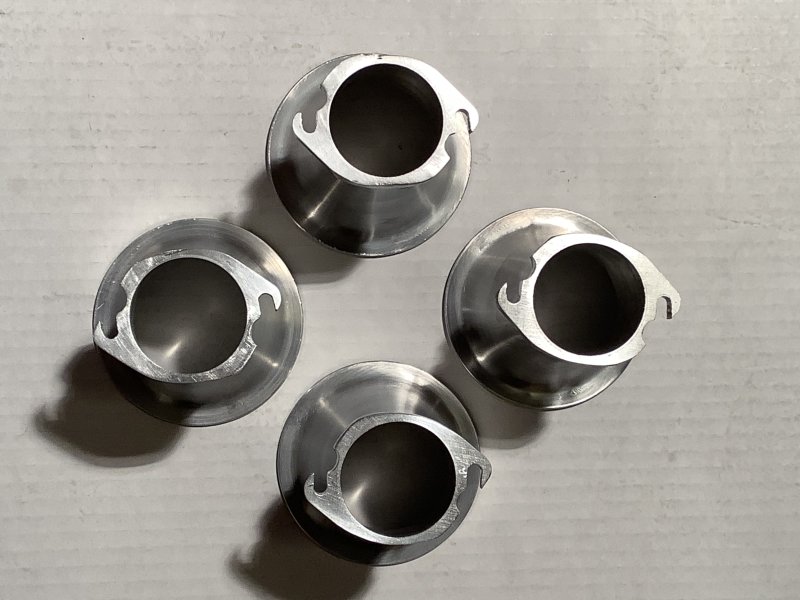
I need to secure intake trumpets/stacks inside of a sealed plenum. There is very little room to access the area at the base of the trumpets where they attach to the throttle bodies.

Right now each trumpet is attached with four small nuts to studs coming out of the TB's and passing through their base. It's very hard even to get my hands in place to get the nuts started and then reaching them with a nut driver (even with swivel joints) is also very difficult. What should be a five minute job takes an hour and involves hand cramps and many dropped nuts.

There are four nuts on four trumpets and these sixteen small nuts are they only thing holding the plenum assembly to the intake.

Is there some type of alternate fastener, or fastening system, that would replace a nut on these threads? Something that goes on and off easily but still holds just as securely? Perhaps something that clamps on? Or shouild I ditch the studs and nuts altogether for a different system?

Thanks.
 
To avoid these ads, REGISTER NOW!

4xdog

Well-known member
Joined
Aug 18, 2012
Messages
5,595
Location
Santa Fe, NM
I’ve made a lot of “handsheets” in the paper industry over the years. There are test methods for evaluating pulp, additives, process changes and so on involving single sheet production on a lab bench. One of the more common equipment types is the “British Standard sheet mould”. After draining the pulp the handsheet has to be pressed and dried.

Pressing involved making a stack of wet handsheets and dry blotter paper and putting it in a manual hydraulic press. On the older, less automated versions of this equipment the press was loaded from below and the top platen was a heavy cast iron piece bolted to four heavy studs for each cycle. Heavy, as in like 1” studs.

The standard nuts were modified to be quick release. This is probably something machinists know well and have a name for, but it’s the only time I’ve encountered them.

The nuts had a hole drilled downward trough the threads that was slightly larger than the OD of the threaded stud. Normally that would mean the threads on the nut would no longer have any grab on the stud. But the enlarging hole was drilled slightly at an angle, so it overshot the threads on one position of the top face on the nut, preserving the full thread opposite that. The diagonal continued to the bottom face of the nut where it removed all the thread again, but 180° different from the top.

Sorta like this, which might make more sense than my awkward description:
i-sjNhS5P-XL.jpg


The nut could be rapidly brought close by dropping it oriented with a tilt to follow the diagonal hole and the brought square to engage the threads for tightening. Worked beautifully for an operation done many times a day.

The nuts themselves had a short rod mounted on one of the hex faces so give a way to hand tighten each one. They didn’t need to be super-tight because the hydraulic press took up any slack, and it was convenient for the press to give that slack back when the pressure was released so they could come off again by hand.

I’ve always wondered what that system is called in engineering terms, and although I’ve looked for a place to use it outside of hand papermaking for decades, I’ve never found one...
 
Last edited:

APEowner

Well-known member
Joined
Oct 2, 2009
Messages
4,164
Location
Sunny, New Mexico
You can switch to a shorter stud with a courser thread but I take another look at how the whole system goes together. Maybe band clamps to hold the trumpets on or long studs that do through the whole assembly. If you post some pictures it would be easier to help.
 
OP
P

pwschuh

Well-known member
Joined
Jun 29, 2012
Messages
240
Location
Mid-Atlantic
4xdog - That is a fascinating design but far beyond my ability to implement. It would take a well-equipped machine shop just to drill out the nuts and then I would still have to fiddle to get them started and to tighten, in my application.

APEowner - Your solution would require removing the TBs and redrilling them for new studs as well. I am willing to take the plenum off and on but don't want to mess with the TBs and the throttle linkages for a solution that still ultimately requires me to maneuver and tighten small nuts on these threads. And of course going to band clamps would require major re-engineering of the whole set-up. Long studs are not an option for many reasons. They would not clear the mouth of the trumpet on the way up and even if they did, they would not secure the base of the trumpet to the TBs if they secure outside the top of the plenum.

Here is the base of the plenum out of the car:

https://photos.google.com/share/AF1...?key=VHZ5UXZGbGFpTllabUZWYWJkTDBfb0RTbnNYUlVB


Here is the top when it is all installed:

https://photos.google.com/share/AF1...?key=X1N6c25kcy1pSWhTYU51QnEtbDJkNWZJaXZSS0hn

As you can see, the trumpets take up most of the space in the plenum. With the pressure lid off to install or remove the trumpets, there is precious little working room.
 

bdbecker

ALLIANCE MEMBER
Joined
Nov 18, 2015
Messages
5,551
Location
Iowa
This is about the only "quick release" nut I know of. I'm not sure I follow what you are saying (even with the pics) so I'm not sure if they'd work for you or not.

https://www.mcmaster.com/nuts/slip-on-twist-close-nuts/

EDIT:
Okay... I think I understand what's going on now. Basically you need to reach down past the trumpets to secure the plenum to the throttle bodies. Perhaps its not the attachment system but the tools that are the issue?

Would a magnetic socket help?
https://www.amazon.com/dp/B00HV2OMJA/?tag=atomicindus08-20

Or maybe an extra long magnetic nut driver?
https://www.amazon.com/dp/B00093GEC6/?tag=atomicindus08-20

Or you could swap over to allen nuts and use an long ball end key?
https://www.mcmaster.com/nuts/socket-nuts/
http://bondhus.com/pages/ball-ends

One trick I've used it dab a little grease onto the nut to hold it in the socket when I need to access tight areas. Just some ideas...
 
Last edited:
OP
P

pwschuh

Well-known member
Joined
Jun 29, 2012
Messages
240
Location
Mid-Atlantic
bdbecker = you're on the right track, but... Because of the angles involved, I have to reach down and start the nuts by hand, since you can't really go straight down to any of them. Usually the "dropped nut" has fallen out of my hand while trying to get it started, not out of a socket. Once I have it threaded on and turned a few threads, then I go at it with a socket on a jointed driver of some kind. The allen nuts, if they were tall enough to go down over the stud, might be easier to tighten but still hard to get started.
 

MrSurly

Well-known member
Joined
Jan 15, 2014
Messages
1,671
Location
East Texas
Save yourself at least *half* the difficulty with a quick mod:
I assume the bottom of each trumpet has a flange as in pic A.
Trim each to look like pub B, install plenum with no trumpets, tighten eight nuts on the diagonals, then loosely install eight nuts on the other disgonals.
Then install the trumpets as a 1/10 turn operation and tighten the other two on each.97b35849628f2365d7d86687cc708b24.jpg

A more permanent fix would be to have the trumpets affixed to the outer “X-screen” cover plate such that the trumpets would be held against the TBs by that outer plate.

The problem is not how the plenum attaches, it is with how the trumpets attach.

Sent from my iPhone using Tapatalk
 

Attachments

  • 97b35849628f2365d7d86687cc708b24.jpg
    97b35849628f2365d7d86687cc708b24.jpg
    70.5 KB · Views: 3
Last edited:
OP
P

pwschuh

Well-known member
Joined
Jun 29, 2012
Messages
240
Location
Mid-Atlantic
Awesome Mr Surly! :thumbup: That's exactly the kind of inspiration that I was hoping to get here. It's not a perfect solution but it is at least an 80% solution.
 

ren71

Well-known member
Joined
Feb 9, 2011
Messages
92
Location
L.A. CA
94358a330c1-b01-digitall1563565694-p9@halfx_636991445241192291.png
Or a hex drive threaded stud with nut on lower half.. then use a ball end Allen
 

Graham08

Well-known member
Joined
Dec 10, 2007
Messages
713
Location
Iron Station, NC
How about changing the studs out for something like these from ARP?

https://arp-bolts.com/kits/arpkit-detail.php?RecordID=751

Having no threads on the first 1/4" or so, and the end radiused helps tremendously in getting the nut started. You can drop it on, which aligns it, then worry about getting it started on the threads. Much better than trying to align the nut and turn it in an awkward spot.
 
OP
P

pwschuh

Well-known member
Joined
Jun 29, 2012
Messages
240
Location
Mid-Atlantic
All good ideas. I had never heard of the carb studs or the push-button nuts before. Since these live in an intake, I just need to be assured that they are very secure fitting, since the last thing I need is to have one vibrate loose and get sucked into the engine.
 
To avoid these ads, REGISTER NOW!

Graham08

Well-known member
Joined
Dec 10, 2007
Messages
713
Location
Iron Station, NC
Loctite can be your friend for this. Loctite 290 is wicking and can be applied once the fasteners are tightened. I used this on the screws that secure the butterflies to the throttle shafts on my sprint car. I have seen the aftermath of a butterfly screw falling into the engine and it's not pretty!
 

4xdog

Well-known member
Joined
Aug 18, 2012
Messages
5,595
Location
Santa Fe, NM
Yep -- thanks, wasfast. That's a useful description and their drawings show the concept better than my rough sketch from very old memory.
i-WTPPxsw.jpg


i-VsSLC7m-M.jpg


The larger ones I used weren't knurled. That's a good idea for a smaller quick-release nut.
 
Last edited:

matt_i

Well-known member
Joined
Mar 14, 2008
Messages
10,724
Location
SE Michigan
I'd try something like a tapping plate where you have 3 tapped holes per side of each trumpet. Total of 8 plates. Plates are canted in thru the large holes.

Two of the holes would have studs coming up thru the clearance holes. The third would be a screw that installs from the top to hold the plate in position, after its canted in. Once all of this is made and installed then its just 4 nuts per trumpet from the top.

It should be all safe if the double-threaded studs have an upset in the center of it so it can't drop into the plenum.

I recall having to clean some kind of a splash shield that sat under the intake lower of a big block 454 when I was changing motors. It had rivets originally and I needed to brush-clean to get it to the cleanliness level I wanted so the rivets got drilled. I of course had to tap it for #10-24 socket head screws and anything dropping loose into the lifter valley would have been very bad. I thought about red loctite and used it but also cross-drilled and safety-wired the screws so they are in there until the next motor change :D Its been 16 years of trouble free trucking so I think it worked as intended.
 
Last edited:

SDF

Member
Joined
Jun 11, 2020
Messages
16
Location
Louisville
is a Camloc, or Dzus a feasible modification?
or Nutsert or Rivnut like ToplessHO mentioned
 
OP
P

pwschuh

Well-known member
Joined
Jun 29, 2012
Messages
240
Location
Mid-Atlantic
Could you utilize 1/4 turn fasteners and their retainer nuts?

Modifying the ITBs themselves is WAY beyond the scope of what's required here. Each ITB offers up 4 M5 studs. The plenum sits over these 16 studs. Using something like a 1/4 turn fastner would require modifying the entire plenum attachment scheme, which is not necessary.

Several posts got deleted from this thread. One included a photo of the plenum. Here it is again:

https://s87.photobucket.com/user/pwschuh/media/Presentation2_zpsu8z0zvg1.jpg.html?sort=3&o=1

There is NO ROOM to get my hands into the plenum (past the bellmouths of the trumpets). I can only fit 1/4" ratchet extension with an 8mm socket to tighten or loosen the 16 M5 nuts.

As I mentioned before, I have already decided to use MrSurly's idea to modify the base of the trumpets. This will allow me to pre-install all 16 nuts (8 fully tightened and 8 just started a few threads) before any of the trumpets are installed.
 
To avoid these ads, REGISTER NOW!
Top Bottom