To avoid these ads, REGISTER NOW!

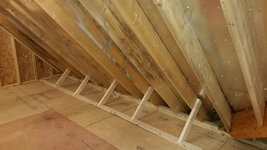
Are these hurricane ties?

dvo

Well-known member
Joined
Dec 25, 2012
Messages
48
Location
Raleigh,NC
Anyone know what these are for?

Everyone is getting off track on the rafter stuff so I got more pictures without the odd framing. This is not my house but new construction I see in every house in NC.
 

Attachments

  • 20191006_140339_resize.jpg
    20191006_140339_resize.jpg
    110 KB · Views: 404
  • 20190928_140643_resize.jpg
    20190928_140643_resize.jpg
    123.3 KB · Views: 115
  • 20190928_140707_resize.jpg
    20190928_140707_resize.jpg
    117.3 KB · Views: 113
  • 20190928_140901_resize.jpg
    20190928_140901_resize.jpg
    113.8 KB · Views: 113
Last edited:
To avoid these ads, REGISTER NOW!

Jeff C

Well-known member
Joined
May 22, 2021
Messages
637
Location
Durham, NC
Rafter ties or braces since the floor joist are perpendicular to the rafters. The rafters are spliced at this point. The extra 2x4 plates (along with maybe a ripped sheet of osb?) are to line up the top and bottom half of the roof so everything is in the same plane.
 
To avoid these ads, REGISTER NOW!

firebirdparts

Well-known member
Joined
Jun 8, 2016
Messages
10,578
Location
Kingsport, TN
It looks like somebody sawed the rafters off randomly and I feel shocked even suggesting that. Then they tacked up that stuff to try to get new ones installed. They were saving the birdmouth/overhang part of it just to make it easier.

Maybe a tree fell on the house. That would sort of explain it.
 
Last edited:

mv213

Well-known member
Joined
Sep 29, 2014
Messages
660
Location
Dallas, OR (the OTHER "Big D")
It looks like somebody sawed the rafters off randomly and I feel shocked even suggesting that. Then they tacked up that stuff to try to get new ones installed. They were saving the birdmouth/overhang part of it just to make it easier.

Maybe a tree fell on the house. That would sort of explain it.
That’s the best explanation, I think. It would explain it, but it’s still **** work.
 

mcbane

Well-known member
Joined
Jul 23, 2017
Messages
794
Location
California
That doesnt look like it would be good for any significant snow or wind load. If your whole attic is done that way you should have a local engineer familiar with snow and wind loads in your area take a look at it and design a repair.
 

3onthetree

Well-known member
Joined
Nov 14, 2018
Messages
191
Those are rafter ties. If you don't have them then your roof will push out at the rafter heel. Typically, these kickers are only installed this way when your ceiling joists run perpendicular to the rafter direction. Code requires 2x4 and at each rafter to tie the roof into the ceiling diaphragm.

However in the 3 different examples, you are forced to use the kickers no matter which direction the ceiling joists run, because the builders have chosen to build the floor platform first, then set the roof up on top of that. So by doing that the ceiling joists cannot connect directly to the rafters to prevent the pushout. So they used kickers. But with that, there are certain fastening requirements, like say (4) 16d's into these ties, that none of these examples look to meet. They would have been better choosing a balloon framing method.
 

billconner

Well-known member
Joined
Jul 20, 2021
Messages
6,930
Location
Thousand Islands NYS
Those are rafter ties. If you don't have them then your roof will push out at the rafter heel. Typically, these kickers are only installed this way when your ceiling joists run perpendicular to the rafter direction. Code requires 2x4 and at each rafter to tie the roof into the ceiling diaphragm.

However in the 3 different examples, you are forced to use the kickers no matter which direction the ceiling joists run, because the builders have chosen to build the floor platform first, then set the roof up on top of that. So by doing that the ceiling joists cannot connect directly to the rafters to prevent the pushout. So they used kickers. But with that, there are certain fastening requirements, like say (4) 16d's into these ties, that none of these examples look to meet. They would have been better choosing a balloon framing method.
So, those kickers and 2x4 plate are in tension and tieing rafters to the floor plate?

A floor at mid rafter span is a bit unusual in my experience - like in A-frames I suppose - but I guess doable and I can see the reason for the above floor top plate and birds mouth. Also insulation nearly full rafter depth. The floor being mid span of rafters forces the perpendicular joists, supported on usually non-load bearing gable end walls. A full building section would explain a lot.

Tried to find a picture, a rectangle plan with ridge the short dimension and 2 or even 3 floors above the eave/ top of first floor walls.
 
OP
D

dvo

Well-known member
Joined
Dec 25, 2012
Messages
48
Location
Raleigh,NC
Those are rafter ties. If you don't have them then your roof will push out at the rafter heel. Typically, these kickers are only installed this way when your ceiling joists run perpendicular to the rafter direction. Code requires 2x4 and at each rafter to tie the roof into the ceiling diaphragm.

However in the 3 different examples, you are forced to use the kickers no matter which direction the ceiling joists run, because the builders have chosen to build the floor platform first, then set the roof up on top of that. So by doing that the ceiling joists cannot connect directly to the rafters to prevent the pushout. So they used kickers. But with that, there are certain fastening requirements, like say (4) 16d's into these ties, that none of these examples look to meet. They would have been better choosing a balloon framing method.

Ahh that make sense now. Thanks for the very good explanation.
 
To avoid these ads, REGISTER NOW!
Top Bottom