
You are using an out of date browser. It may not display this or other websites correctly.
You should upgrade or use an alternative browser.
You should upgrade or use an alternative browser.
Are you smarter than Elroy?
- Thread starter Elroy
- Start date


toolnut
Well-known member
Some kind of filter?
tatra
Well-known member
new kinda sushi?.......................
JeremyManning
Well-known member
what is it made out of?
z28snksknr
Well-known member
stupid guess:
pepper shaker
non-stupid guess:
some sort of restricting orifice? - looks like it's made out of rubber, so I'll stab in the dark at some sort of heater / coolant bypass
pepper shaker
non-stupid guess:
some sort of restricting orifice? - looks like it's made out of rubber, so I'll stab in the dark at some sort of heater / coolant bypass
what is it made out of?
Now that's the magic question
moronmountain
Well-known member
Sharpening stone with holes cut in it to put water through. =p
Frank The Plumber
Well-known member
Air compressor intake filter.
danski0224
Well-known member
Button hole layout stamp
Frank The Plumber
Well-known member
That would be a rule though a lot of people wrongly call it a scale.
lg
no neat sig line
Not so fast there lad. Did you see the opposite side?
Amitygravel
Well-known member
Kind of looks like carbon fiber on the outside.
BQuicksilver
Well-known member
- Joined
- Aug 25, 2006
- Messages
- 560
Do YOU know what it is?
Is this a test for us or a question you need answered?
Is this a test for us or a question you need answered?
Not so fast there lad. Did you see the opposite side?
General’s rules are precision-made with etched fine black graduations for easy reading and long life.
ADDITIONAL DETAILS
· Flex ruler, 6 inches long, with a satin chrome finish
· Inch graduations by 8th and 16th are on one side, 32nd and 64th on the other
· Rule is ¾” wide
Yes Frank I do know of what I speak.
lg
no neat sig line

kams1973
ALLIANCE MEMBER
Is it electically conductive?
Blacknwhitepit
Well-known member
MI Cable?
-BWP
-BWP
TOOL MASTER
Well-known member
- Joined
- Apr 25, 2011
- Messages
- 458
trash
I can fix anything
Well-known member
A fuse
tadg
Member
A gunpowder grain, probably for a naval cannon.
I recall reading somewhere that you used to be able to get long extrusions of this, then bend them into a cane, but the internet is failing me now.
Tad
I recall reading somewhere that you used to be able to get long extrusions of this, then bend them into a cane, but the internet is failing me now.
Tad
z28snksknr
Well-known member
do the holes go all the way through? does it look the same on both ends?
demographic
Well-known member
A gunpowder grain, probably for a naval cannon.
I recall reading somewhere that you used to be able to get long extrusions of this, then bend them into a cane, but the internet is failing me now.
Tad
Could well be...
Powder Grain - An individual unit of propellant. Commonly used in the form of strips by France, cords (strings) by Britain and Japan, hollow tubes (single perforation) by Germany and Italy, and in multi-perforated cylinders by the USA, as shown at right. A propellant grain with a decreasing burning surface will tend to generate less propellant gas as it burns while a propellant grain with an increasing burning surface will tend to generate more propellant gas as it burns. Propellant grains whose total burning surface area decreases as they burn are known as degressive or regressive grains. Propellant grains formed in balls, cords, pellets and thin sheets burn degressively. Degressive grains are best used in weapons having a short barrel length as there is less need to maintain a steady pressure as the round travels up the barrel. A neutral burning grain is one whose total burning surface remains approximately constant as it burns. Single perforated grains and star perforations are examples of neutral burning grains. Technically, grains formed in sheets or strips burn degressively, but the change in burning surface is so small that these may be considered to be effectively neutral burning. A progressive grain is one whose total burning surface increases as it burns. Grains with multiple perforations and those in rosette shapes burn progressively. A progressively burning grain has an advantage in a longer-caliber gun as more gas is generated to fill the increasing volume as the projectile travels down the barrel.
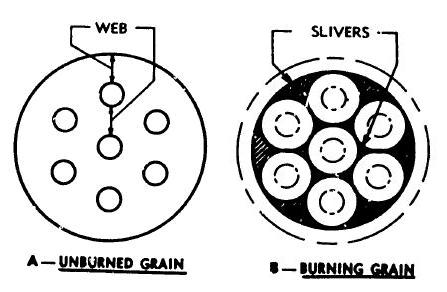
Last edited:
A gunpowder grain, probably for a naval cannon.
Excellent!!
 That's exactly what it is.
 This example was manufactured at the Indiana Army Ammunition Plant during WWII.
NJHandyGuy
Well-known member
Can we still tell elroy where to go j/k
Can we still tell elroy where to go j/k
Sure you can as I understand from Elroy everyone needs a little direction in thier life.

Eagle Point
Well-known member
Darn it, I thought it was one of those things that you flip over and it makes a moooo sound...............remember those???
hotsam
Well-known member
Are you smarter than Elroy?
I can speak in the first person, so I may be.
Damn you guys beat me to it. I used to bring up bags of the stuff from a wreck of the east coast. The cordite will burn when it drys out. It was stored on board in 6 or 7 inch around and 3 feet long metal canisters that were made from steel with brass ends and a brass lid. The steel rusted out leaving the cordite in about the same shape it was in when contained. The cordite was in silk like bags in the steel/brass tubes. One area of the wreck looked like like it was covered in cig butts.
The brass ends clean up well and make great picture frames. I still have a couple 5 gal buckets full of uncleaned ones.
The wreck is the USS Schurz it was a WW1 german gunboat that we took over re fitted with our cal guns and renamed (long story) Good looking well built boat with lots of cool stuff to find. After 80 years underwater it was reduced to a long rubble pile with a bit of hull here and there. I found the tool and parts storage area and spent many a dive digging up spare parts like big split seals, 6 inch ID bronze bearings and brass gasket punches and the like.
The brass ends clean up well and make great picture frames. I still have a couple 5 gal buckets full of uncleaned ones.
The wreck is the USS Schurz it was a WW1 german gunboat that we took over re fitted with our cal guns and renamed (long story) Good looking well built boat with lots of cool stuff to find. After 80 years underwater it was reduced to a long rubble pile with a bit of hull here and there. I found the tool and parts storage area and spent many a dive digging up spare parts like big split seals, 6 inch ID bronze bearings and brass gasket punches and the like.
Last edited:
I can speak in the first person, so I may be.
The key word here being "may"
Elroy wouldn't bet if he was you.
Lump
Well-known member
Vicegrip,Damn you guys beat me to it. I used to bring up bags of the stuff from a wreck of the east coast. The cordite will burn when it drys out. It was stored on board in 6 or 7 inch around and 3 feet long metal canisters that were made from steel with brass ends and a brass lid. The steel rusted out leaving the cordite in about the same shape it was in when contained. The cordite was in silk like bags in the steel/brass tubes. One area of the wreck looked like like it was covered in cig butts.
The brass ends clean up well and make great picture frames. I still have a couple 5 gal buckets full of uncleaned ones.
The wreck is the USS Schurz it was a WW1 german gunboat that we took over re fitted with our cal guns and renamed (long story) Good looking well built boat with lots of cool stuff to find. After 80 years underwater it was reduced to a long rubble pile with a bit of hull here and there. I found the tool and parts storage area and spent many a dive digging up spare parts like big split seals, 6 inch ID bronze bearings and brass gasket punches and the like.
Wow, that's an incredible story! How deep down was that wreck? Were/are you allowed to keep the stuff you find in situations like that? When I was young and dreamed of diving for treasures and lost artifacts, I understood marine law to be that anyone who found anything on the ocean floor and brought it up had "salvage rights" to the items, period. But recent discoveries of gold and silver have been challenged by Spain, who claims sovereign rights to the booty, even though it is in international waters...and even though the Spaniards murdered, raped, and destroyed the native Americans they stole it from!
Fascinating.
Lump
Well-known member
Excellent!!
This example was manufactured at the Indiana Army Ammunition Plant during WWII.
Elroy,
You sure do come up with some wild stuff. Very cool and interesting. Thanks for that.
DRP6833
Well-known member
Here's a little hint:
It was manufactured under government supervision
AH! Then it's way overpriced!
nate379
Banned
Smart enough to know that normal people don't write in 3rd person.
Tim Cowan
Well-known member
Looked like a piece of sheath for seven strans of fiber-optic cable to me
