To avoid these ads, REGISTER NOW!

Areating groundwater inside wellhead... contemplating

skeer

Well-known member
Joined
Sep 14, 2021
Messages
1,042
Location
Standish, MI Area
So this post is not intended to get into our water composition, softeners and the like. I'm verbally exploring an idea I've had for a while and hoping for constructive feedback.

So one of the many ways to deal with iron in groundwater is aeration. For those unaware, exposing water with a higher than normal iron content to oxygen causes the iron to oxidize and clump. Then you are more able to filter those clumps out down stream.
Not only for helping to lower the iron content, oxidation also helps ward off organics (info here).
Most all commercially available solutions to aerating water is post well pump.. my idea is pre-pump. basically the thought is to run a long hose down inside the casing and pump bubbles like your aquarium bubbler does. If the bubbler hose can terminate a good 5, 6, 10ft below the pump I think that'd be effective.
Not effective in that it'd fully replace a "proper" post-pump, aeration and filtration tank(s).. but perhaps impactful?

So there it is.. shoot it full of holes!
 
Last edited:
To avoid these ads, REGISTER NOW!

gregs

Well-known member
Joined
Mar 16, 2007
Messages
1,607
My thought would be about the volume of usable water. The systems I have seen fill a very large tank and aerate that while water is drawn off. How much water would be "stored" inside the casing and how long does it have to be aerated for?
 

dcg9381

Well-known member
Joined
Jun 20, 2018
Messages
11,883
Location
Austin, TX
I've never seen anyone aerate a cased well. So I have no idea how well that would work for treating iron. Course our wells are 400-600 feet, so it's not exactly an easy thing to do here. What we do see is people pumping up to a storage tank and aerating the tank - which is essentially the same thing (perhaps).
 

Boogerman

Well-known member
Joined
Jan 28, 2021
Messages
833
Location
aspen cove hill
Sphere of influence is too large on a well drawdown cone to aerate from a point at the well casing. Best way to remove iron is pump up to open air, trickle down over an open tray where it is in a thin film to maximize air exposure, run through manganese greensand to precipitate the iron, and then into a holding tank. Re-pressurize from the holding tank using a VFD constant pressure pump and very small (3 gallon or so) pressure tank. Use a canister filter system (screen, pleated filter, and AC filter in series) between the pump and the pressure tank to take out particulates. I'd also use an UV disinfection right after the canister filters; they can harbor bacteria.

The manganese greensand needs regenerated with potassium permanganate periodically; best way is to have a good water conditioning place make you up a water softener with KMNO3 as media, so that is automated.

A well is too valuable to clog it up with precipitated iron; and when you stop aerating or the pumping exceeds the aeriation capability, the iron would re-mobilize back and the water quality would be even worse.
 

dcg9381

Well-known member
Joined
Jun 20, 2018
Messages
11,883
Location
Austin, TX
<sorry wrong thread>
 

Attachments

  • 1697128965921.png
    1697128965921.png
    876.1 KB · Views: 195
Last edited:
OP
S

skeer

Well-known member
Joined
Sep 14, 2021
Messages
1,042
Location
Standish, MI Area
Yup, all good points. And yeah normally there's a 'treated' holding tank and secondary pressure pump/tank setup just for that. That's something that there just is not room for here.

But one point that I did not think of was the draw down.

With regards to potentially clogging the pump, one thing I have not found is the size (likely in micron) of the now clumped iron molecules. I wouldn't expect visible clumps but more like perhaps in the 10-50 micron range. Anyone have ideas on that?
 

Copymutt

Well-known member
Joined
Sep 3, 2016
Messages
3,404
Location
Colorado
Concerns, constant flowing water over iron casing, aeration in a confined poorly ventilated cavity minimizes aeration.
 
OP
S

skeer

Well-known member
Joined
Sep 14, 2021
Messages
1,042
Location
Standish, MI Area
Concerns, constant flowing water over iron casing, aeration in a confined poorly ventilated cavity minimizes aeration.
Constant water flowing over iron casing.. I don't understand this one. The casing is vented in the cap however yeah.. might be too small of a vent opening.

Cast iron is a pretty bad material choice for water well IMO.
 
OP
S

skeer

Well-known member
Joined
Sep 14, 2021
Messages
1,042
Location
Standish, MI Area
A slight variation on this idea, that I had forgotten about.. Using a small pump to lift water from a few feet below the pump up towards the top of the casing then having it dumped out so it'd fall 10-20ft back to the water level thereby aerating itself.
 
To avoid these ads, REGISTER NOW!

dcg9381

Well-known member
Joined
Jun 20, 2018
Messages
11,883
Location
Austin, TX
Sphere of influence is too large on a well drawdown cone to aerate from a point at the well casing. Best way to remove iron is pump up to open air, trickle down over an open tray where it is in a thin film to maximize air exposure, run through manganese greensand to precipitate the iron, and then into a holding tank.
Not disagreeing.. But what's your experience with oxidizing water filters that basically expose the water to compressed air (water pressure psi)? They back-flush.. Modern ones are fleck valve... That's what I've used before. Here a big holding tank is a better option (perhaps) but we don't get much freezing weather.
 

Boogerman

Well-known member
Joined
Jan 28, 2021
Messages
833
Location
aspen cove hill
Not disagreeing.. But what's your experience with oxidizing water filters that basically expose the water to compressed air (water pressure psi)? They back-flush.. Modern ones are fleck valve... That's what I've used before. Here a big holding tank is a better option (perhaps) but we don't get much freezing weather.
Depends on degree of removal you want do. And, how much residence time for air to dissolve in the water. Tray aeration and manganese greensand have high removal rate and operate in real time; not require residence time. Large holding tank under air pressure would work; gives long residence time for oxygen transfer and reaction. High water use would short circuit the removal and iron would carry through.
 

u3b3rg33k

Well-known member
Joined
Dec 18, 2017
Messages
4,048
pushing dirty air into the water table with custom home made stuff vs off the shelf iron curtain system, I know which option gets my vote.
 

MWitte

Well-known member
Joined
Nov 27, 2012
Messages
77
Location
St Louis, Mo
I would be concerned about pump cavitation with that scenario. My house has a pressurized aeration tank, after my holding tank and before filtration. The aerated water carries a lot of small air bubbles with it. If I feed aerated/treated water to a pressure washer, it will cavitate and stop pumping water. I have to connect my pressure washer to a hose bib with un-treated water. (I have a hose bib in my garage with treated water for car washing.)
 

pcmeiners

Well-known member
Joined
Aug 13, 2009
Messages
7,952
Location
In the only town in Pennsylvania, Bloomsburg.
"The manganese greensand needs regenerated with potassium permanganate"

Katalox Light instead, it needs back washing though, but not need regen. It is also a lot lighter than green sand, so far less water flow during back washing cleans it a lot better .

Aeration down a well is a method for iron/manganese reduction. If you have a steel casing it will increase pipe rust but not on a SS pump. Also you would need a considerable amount of air, and if you have sufficient air, you would need a circuit to stop air bubbles before the pump starts, or you would get air lock and air in your pipes. ....basically impractical

Also you can not use anything with small holes to form bubbles as the holes will clog with iron/manganese quickly (like aeration stones stones). I have an aeration tank, 14"x 60" feed by a small oil free compressor and (2) Katalox Light tanks for the the remainder of iron/manganese, then (2) charcoal tanks.
 
Last edited:

mrpizza

Well-known member
Joined
Nov 1, 2011
Messages
2,935
Location
IL
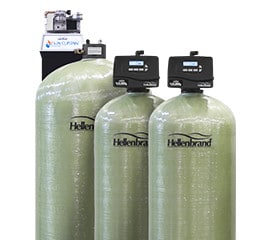
I had a well on my last house with iron in the water. I cured it with an iron filter that backwashed every day. It kept a pocket of air at the top. It was similar to this one, same company.

http://apluswater.org/AIO IRON FILTERS 2510 FLECK.html

The nasty rusty **** that it would backwash out every day was crazy. I followed this filter with a softener and then a 20" carbon block for the whole house. Worked a treat, but used a lot of water to do the daily backwash, up to 50 gallons or so.
 

u3b3rg33k

Well-known member
Joined
Dec 18, 2017
Messages
4,048
I had a well on my last house with iron in the water. I cured it with an iron filter that backwashed every day. It kept a pocket of air at the top. It was similar to this one, same company.

http://apluswater.org/AIO IRON FILTERS 2510 FLECK.html

The nasty rusty **** that it would backwash out every day was crazy. I followed this filter with a softener and then a 20" carbon block for the whole house. Worked a treat, but used a lot of water to do the daily backwash, up to 50 gallons or so.
To keep the odor at bay, we've got our system set to pump air every day, but the main filter is every 2 or 3 days.

the air isn't really necessary daily, but it depends on usage. every few years the aerator/diffuser needs to be replaced. ours had clogged up and sounded like it was pressure washing the wall of the tank. it might use more than 50 gallons/cycle, but that's life.
 

paredown

Well-known member
Joined
Jan 12, 2012
Messages
545
Location
Pomona, NY
We're on round 2 of dealing with iron/manganese in our water. First installation was a Fleck head/green sand/pot perm injection for regeneration. What I will say about that--the pot perm stains like crazy, and is hard on the injection mechanism. We got only a few years of good service before the pot perm caused one of the screens on the injector to disintegrate, which occasioned a tear-down of the Fleck head. Then it was time to replace the green sand--major PITA because you are wrestling with a 54" tall tank filled with wet sand, gravel, water and **** and trying to empty and clean it. Then despite my best efforts with the pump, the injection stopped working properly and a whole lot of other issues started up, including overflow from the pot perm tank. I would never put in a system like that unless it was done by a professional and I could afford to pay for regular maintenance.

We are now trying a simpler system that uses air injection at the tank, rather than chemical injection. So far it is working well enough that the water is drinkable, and there is no messy purple staining going on. Time will tell if this works long term...

Any system that backwashes uses a fair amount of water as has been said, and a full system ought to include a prefilter, and a post-wash filter (we also use a carbon filter) and in our case we have a UV light since we have some e coli bacteria contamination, depending on the season.

I think treating at the intake end is likely a fool's errand, since you have no way of knowing how big the aquifer is that you well is drawing from, or whether your well pump pickup will grab the water you have 'treated"...
 
Last edited:
To avoid these ads, REGISTER NOW!
Top Bottom