

You are using an out of date browser. It may not display this or other websites correctly.
You should upgrade or use an alternative browser.
You should upgrade or use an alternative browser.
Astro Hi-Vis Sockets
- Thread starter cjarvis
- Start date
javyLSU
Well-known member
Deep vs shallow has nothing to do with lead-in chamfer. The lead-in chamfer is the same across all the Gearwrench sockets. What's more important is comparing the same size socket.Comparing deep vs shallow?
The safer conclusion is GearWrench deep is longer than SO shallow.
Shop-hound
Well-known member
This is a really good post. Just so happens I was upgrading my 1/4 stuff and had bought a set of Gearwrench to save a bit of $$… already returned and USA Williams on the way.
ive had that issue with short nuts (and specifically self tapping screws) and it’s a pain. Would also be a big help even when wrenching hard on a full depth nut/bolt as you maximize contact area with the flank/“corner” of the fastener. Same force over larger area = less stress to deform the fastener. Snap on engineers know what they’re doing!
ive had that issue with short nuts (and specifically self tapping screws) and it’s a pain. Would also be a big help even when wrenching hard on a full depth nut/bolt as you maximize contact area with the flank/“corner” of the fastener. Same force over larger area = less stress to deform the fastener. Snap on engineers know what they’re doing!
Odd-job
Well-known member
Anyone get frustrated enough to grind down their sockets slightly to get rid of the lead in chamfer?

javyLSU
Well-known member
Correct. The way I see it, the slope doesn’t really matter because regardless of what that is, there is is still X amount of distance that is not being engaged by the socket because of the chamfer. All the slope would do is change the thickness of the socket.Just to be clear, you're measuring where I have drawn the red circles, correct?
Would not slope/angel of this "chamfer" be of more importance, rather than it's thickness?
Shop-hound
Well-known member
I believe the depth to be the key dimension (from face of socket to where the taper ends/engagement starts. The length of the chamfer (as measured) takes into account both the depth and width (ie if blank is oversized etc).
thinking a guy could use play dough to make a negative of the profile then hit it with the caliper…
thinking a guy could use play dough to make a negative of the profile then hit it with the caliper…
Ramblin Man
Well-known member
I'm with javyLSU on the lead in chamfer issue. There have been a few times when that deeper chamfer caused me problems, especially in 1/4 inch drive.
Shop-hound
Well-known member

Play dough didn’t work (stuck to socket). Took depth measurements from the face to the lowest edge of chamfer (pointing to it with my scribe above. I noticed my Wera sockets had a particularly deep chamfer so compared them to my Mastercraft Max socket which looks to be closest to the optimal Snap On (both 13mm 1/4 drive). Results below


good call JavyLSU. Had no idea how pronounced this could be. Helps justify the upgrade. Who wants to buy some 1/4” dr Wera sockets?

Correct. The way I see it, the slope doesn’t really matter because regardless of what that is, there is is still X amount of distance that is not being engaged by the socket because of the chamfer. All the slope would do is change the thickness of the socket.
Hmm... Interesting. It's something I've honestly never thought or had an issue with (at least that I've noticed). I've always focused on overall size (how deep vs how shallow), wall thickness and broaching depth. Those are things that have caused me problems.
Has anyone compared the Astro hi-vis sockets yet? I didn't see it.
I have their hi-vis 10mm set, but not the full set. I also have Snap On impacts and Gearwrench chromes. Plus a few others. When I get a chance, I will have to try taking some measurements of my own and see what I come up with.
javyLSU
Well-known member
Just to be clear, you're measuring where I have drawn the red circles, correct?
Would not slope/angel of this "chamfer" be of more importance, rather than it's thickness?
I just realized that my previous answer to you needs clarification. I measured the size of vertical “step” from the edge of the socket to the end of the lead-in chamfer (which is where engagement with the fastener begins) using the step gauge function of my calipers, shown as “A” in the image below.Correct. The way I see it, the slope doesn’t really matter because regardless of what that is, there is is still X amount of distance that is not being engaged by the socket because of the chamfer. All the slope would do is change the thickness of the socket.

I did NOT measure the size of the chamfer itself (shown as “B” in the image above) as that’s irrelevant and entirely dependent on the socket’s wall thickness. This is what I wanted to convey in my earlier response, but in reading it again I don’t think it was clear enough. Hope this makes sense…
Shop-hound
Well-known member
Thanks javyLSU. I was measuring that same dimension as well. Good call on the section view!
People created chamfer for a reason. Lower chamfer does not mean the socket is superior. It just means it is harder to put on the fastener and probably saves some space in extreme scenario. For most people, the extra grip does not worth the loss of convenience. Just think how hard it would be to do less work and remove less steel? Any tool makers can do that.
I looked around in my socket sets and I can see that the Astro Pneumatic stubby sockets pretty much have no chamfer at all. If lower chamfer means Snap-On is better than GearWrench, does it also mean AP is better than SO? The blind admiration of SO is alarming. You guys have to stop. Higher price does not equal to better tools. It just means Snap-On does a good job separating your money from you. Look at this yourself. I put a blade on top to get a flat surface and a dime on top to show the depth. (The other socket is a GearWrench 3/8 drive 19mm deep one.)
Hand tools use dinosaur technology. You got to be delusional to think that Snap-On etc has any technology the others don't. They MIGHT be able to afford expensive steel which will make some difference in scenarios where the strength of steel actually counts (think about Malco's vise grip pliers). But in normal hand sockets, there is no advantage whatsoever. If you think there is, you are only fooling yourself.


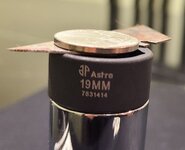
I looked around in my socket sets and I can see that the Astro Pneumatic stubby sockets pretty much have no chamfer at all. If lower chamfer means Snap-On is better than GearWrench, does it also mean AP is better than SO? The blind admiration of SO is alarming. You guys have to stop. Higher price does not equal to better tools. It just means Snap-On does a good job separating your money from you. Look at this yourself. I put a blade on top to get a flat surface and a dime on top to show the depth. (The other socket is a GearWrench 3/8 drive 19mm deep one.)
Hand tools use dinosaur technology. You got to be delusional to think that Snap-On etc has any technology the others don't. They MIGHT be able to afford expensive steel which will make some difference in scenarios where the strength of steel actually counts (think about Malco's vise grip pliers). But in normal hand sockets, there is no advantage whatsoever. If you think there is, you are only fooling yourself.
javyLSU
Well-known member
I'd say your comparison is a bit flawed for a few reasons. I also have set of those stubby sockets, and they are a specialty socket, specifically designed to have the lowest profile possible - so it stands to reason that the chamfer would be reduced to achieve the lowest overall profile possible. Also, it's an impact socket - it's not really fair to compare a chrome socket to an impact socket, as they're literally made from different metals, with different coatings, for different purposes.
Chamfer is a convenience feature, and like anything else, if taken to the extreme it can become detrimental. I wouldn't say that "for most people the extra grip does not worth the loss of convenience," I'd say that for most people the extra grip is not worth the loss of money," as Snap-on sockets are stupidly expensive. I only have a few Snap-on sockets that I bought for specific reasons - that 24mm I showed earlier is one I bought specifically for Toyota rear differentials. The drain plug bolt only has about 3mm to grab onto, and is inside a ring circling the plug that won't allow for the thickness of an impact socket. I bought the Snap-on because it was the thinnest socket with the lowest amount of lead-in chamfer I could find, and it's worked perfectly.
I get what you're saying, there's a lot of baseless Snap-on worshipping here, but I wouldn't call this discussion "blind admiration." We're not talking about the magical-special-unique-unicorn metal that Snap-on sockets are supposedly made from, we're talking about one specific feature that many of us see a big advantage from. If that's of no value to you, that's fine - there's a million different style sockets to buy. For me there is a difference, as that image of the rounded bolt that @Tools4Me posted earlier was my picture, taken of a 12mm bolt that my Gearwrench sockets rounded off because they couldn't fully engage the bolt and slipped off.
I personally have been replacing my Gearwrench sockets with Icon sockets as sales come up. The sizing, features, price, and ease of warranty of those sockets won me over. They have a smaller lead-in chamfer much like the Snap-on sockets, which is something I've been seeking out.
Chamfer is a convenience feature, and like anything else, if taken to the extreme it can become detrimental. I wouldn't say that "for most people the extra grip does not worth the loss of convenience," I'd say that for most people the extra grip is not worth the loss of money," as Snap-on sockets are stupidly expensive. I only have a few Snap-on sockets that I bought for specific reasons - that 24mm I showed earlier is one I bought specifically for Toyota rear differentials. The drain plug bolt only has about 3mm to grab onto, and is inside a ring circling the plug that won't allow for the thickness of an impact socket. I bought the Snap-on because it was the thinnest socket with the lowest amount of lead-in chamfer I could find, and it's worked perfectly.
I get what you're saying, there's a lot of baseless Snap-on worshipping here, but I wouldn't call this discussion "blind admiration." We're not talking about the magical-special-unique-unicorn metal that Snap-on sockets are supposedly made from, we're talking about one specific feature that many of us see a big advantage from. If that's of no value to you, that's fine - there's a million different style sockets to buy. For me there is a difference, as that image of the rounded bolt that @Tools4Me posted earlier was my picture, taken of a 12mm bolt that my Gearwrench sockets rounded off because they couldn't fully engage the bolt and slipped off.
I personally have been replacing my Gearwrench sockets with Icon sockets as sales come up. The sizing, features, price, and ease of warranty of those sockets won me over. They have a smaller lead-in chamfer much like the Snap-on sockets, which is something I've been seeking out.
Iridium rand
Well-known member
- Joined
- Sep 23, 2021
- Messages
- 218
I was just gonna say, couldn’t you get the same short/nonexistent chamfer on any socket just by grinding the end off? Not ideal since the chrome would be lost there and might start chipping or peeling and of course the chamfer does make it much faster/easier to get the socket onto the fastener, but wouldn’t mind doing so as needed to a cheaper socketAnyone get frustrated enough to grind down their sockets slightly to get rid of the lead in chamfer?
Shop-hound
Well-known member
Reduced lead-in chamfer is part of the whole package where a higher quality tool shows better design and tighter tolerances. Heavy lead in will cause more rounded fasteners and lost time, reduced quality of work. The metal composition and heat treatment used in snap on are more tightly controlled and most importantly to me the dimensional tolerance (ie how tight the fit is on fastener).People created chamfer for a reason. Lower chamfer does not mean the socket is superior. It just means it is harder to put on the fastener and probably saves some space in extreme scenario. For most people, the extra grip does not worth the loss of convenience. Just think how hard it would be to do less work and remove less steel? Any tool makers can do that.
I looked around in my socket sets and I can see that the Astro Pneumatic stubby sockets pretty much have no chamfer at all. If lower chamfer means Snap-On is better than GearWrench, does it also mean AP is better than SO? The blind admiration of SO is alarming. You guys have to stop. Higher price does not equal to better tools. It just means Snap-On does a good job separating your money from you. Look at this yourself. I put a blade on top to get a flat surface and a dime on top to show the depth. (The other socket is a GearWrench 3/8 drive 19mm deep one.)
Hand tools use dinosaur technology. You got to be delusional to think that Snap-On etc has any technology the others don't. They MIGHT be able to afford expensive steel which will make some difference in scenarios where the strength of steel actually counts (think about Malco's vise grip pliers). But in normal hand sockets, there is no advantage whatsoever. If you think there is, you are only fooling yourself.
Is it worth full sticker price, heck no, but when I buy barely used Snap on sockets and wrenches at 50% of MSRP and I'll use them the rest of my life (core "hardline" tools") to me they are worth that cost.
To say there is no benefit to having the engineering, experience and R&D of Snap on implemented in a tool means you gotta get your hands on some to try them and you will see
. As a mechanical engineer, fabricator and machinist I can say first hand, there is a difference. If you're willing to pay the premium is entirely a personal decision.
Last edited: