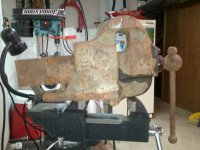
I have an old 323 1/2 that was my grandpas,he bought it new in 1903 that has beenbolted to an old mesquite stump since before i can remember. I use the hell out of it and finally the jaws are slick. They appear to be poured in place separate from the main forging. Its pipe jaw inserts are in pretty good shape but its main jaw wear has forced me to use a vise i made from ibeam and a jack screw when i was a teenager. Does anyone have any experience making new jaws plates or machining some? Got a bridgeport mill but i figured i would get some input. Maybe mill some tool steel knurled plate and then drill and tap some bolt holes in the existing jaw plates for installation.
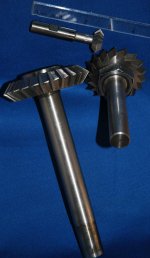
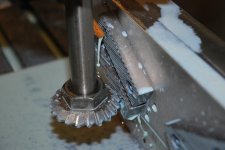
I can help you, I build jaws for Wilton vises out of A-2 tool steel. You can use your Bridgeport but you will need to build a fixture plate to hold the jaw inserts while you cut the serrations. I have found that the coarse serrations are cut with a pitch of .100 and around .030-.040 deep depending on your sharpness of the 90 degree cutter (see my photo). The Wilton jaws are set at 30 degrees on the fixture plate (second photo). One thing nice with Wilton jaws are they are all nominal dimensions meaning they are in fraction numbers. I just made a set for a Starrett 926 (Athol) and these dimensions were also in fractions by a 1/16th but the serrations were not at 30 degrees, they were parallel, you can see them in the last picture. After they are finished I would suggest heat treating the tool steel to 54 Rockwell +or- 2 points. If you do this the jaw serrations will last if not abused like gripping something hard and really snugging the grip. Another steel type is S-7 which is a air quenched tool steel like A-2 (I use A-2 because it is cheaper)or you can get by with 4140 and have it oiled quenched up to 52 Rockwell. Look at my pics and you can see what I wrote about and the last picture is what I just finished for heat treat last week.
As for cutting teeth in existing jaws, my issue would be the hardness of the jaw insert and if the jaw plane is flat. If it is hard then a carbide cutter would be the only choice and they are real expensive, and if the face is wore beyond the serrations at one end that means it is not flat. This makes it hard to serrate the jaws. I would have to machine the face before cutting serrations and this makes some jaws thinner.
I have met some gun smiths that are very good at using a chisel to cut steel like a checkerboard pattern on guns, they could re shape serrations but it is very time consuming. Just my two cents.
Kevin
wiltonviseparts.net