I recently got an Atlas H54 lathe. It has been upgraded to a Timken bearing head making it a TH54. It works fairly well with the collets, but with either chuck on it it's not so good; chattery finish, etc. I have checked the bearings for end play and looseness in any direction and it's really good. I want to just go ahead and replace the tapered main bearings and am trying to identify them. The parts call outs say 10A11C, and 10A9C, but I haven't been able to convert that into something I can order. Any help with those modern parts numbers would be appreciated!

You are using an out of date browser. It may not display this or other websites correctly.
You should upgrade or use an alternative browser.
You should upgrade or use an alternative browser.
Atlas 10f th54
- Thread starter tengraver
- Start date
WisJim
Well-known member
Join the bunch at the groups.io Atlas/Craftsman forum, there have been bearing discussions there from time to time.
https://groups.io/g/atlas-craftsman
https://groups.io/g/atlas-craftsman
paulsomlo
Well-known member
Your "chattery" finish may not have anything to do with bearings - could be your chuck jaws are bellmouthed and the part is not being securely held near the end of the jaws.
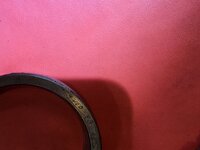
All true, but the likelihood of the same issue with BOTH chucks and several different tools is pretty slim, especially since the 4 jaw is virtually unused. I can also see the same signs with the collets, but just at a much lesser degree. However, I have resolved the reason for my post by just disassembling the spindle and getting the numbers directly off of the bearings - it's not that hard to do, took me about 30 minutes. I was SO pleased to find the hand written date on the front main bearing proving it to be the original bearing race (and very likely to be the original SET). I had thus far been unable to date my machine any closer than the era, but now I know at least the precise age of the TH head. Very cool. (It's dated 9-10-43, making it almost exactly 81 years old, and 16 years older than me!) But, back to the point: I've got both bearings ordered, and (like I figured) it will take a couple weeks to get them, but they are exact Timken replacements (also very cool, although it will be a shame to not have that dated race in there anymore. Each bearing and race (or "cone" and "cup", as they call them) has its own number so I will list all four numbers in the next post.
Attachments
Boogerman
Well-known member
Unlikely to be bearings. More likely just harmonics in lathe. One way to check is to take a heavy lead bar and put it on the work to dampen vibration while you do a cut. If the chatter goes away, it really points to harmonics in the machine.
How is it mounted? A good solid laminated wood base helps, mounted securely to the stand, and then the stand solidly mounted to the floor. The stand should be solid with full bracing (either sheet metal or plywood) and should be entirely rigid. I used to have my Atlas 10x54 mounted on a wood base laminated with alternating high density particle board and plywood and OSB, to a thickness of about 4 inches. That was on a well designed and braced stand made of 2x2 tubing, and having plywood panels over the back and sides, securely bolted to the tubing in numerous locations. The stand legs were anchor bolted to the floor, and the bottom of them set in grout. When I went to that stand most of my chatter problems disappeared.
Another source of chatter is if you're running 120/240 volt single phase induction motor and belts, the pulses of the induction generate harmonics in the belts that translate to spindle vibration and chatter. Going to segmented belts and a 3 phase motor and an inverter/VFD will greatly help that. Not over extending your cutting tool, and keeping the compound and cross slides in the solid middle of their travel also cuts down on chatter. This is a continual fight with the Atlas lathes, they're really not solid and heavy and rigid enough to get away from it easily.
How is it mounted? A good solid laminated wood base helps, mounted securely to the stand, and then the stand solidly mounted to the floor. The stand should be solid with full bracing (either sheet metal or plywood) and should be entirely rigid. I used to have my Atlas 10x54 mounted on a wood base laminated with alternating high density particle board and plywood and OSB, to a thickness of about 4 inches. That was on a well designed and braced stand made of 2x2 tubing, and having plywood panels over the back and sides, securely bolted to the tubing in numerous locations. The stand legs were anchor bolted to the floor, and the bottom of them set in grout. When I went to that stand most of my chatter problems disappeared.
Another source of chatter is if you're running 120/240 volt single phase induction motor and belts, the pulses of the induction generate harmonics in the belts that translate to spindle vibration and chatter. Going to segmented belts and a 3 phase motor and an inverter/VFD will greatly help that. Not over extending your cutting tool, and keeping the compound and cross slides in the solid middle of their travel also cuts down on chatter. This is a continual fight with the Atlas lathes, they're really not solid and heavy and rigid enough to get away from it easily.