To avoid these ads, REGISTER NOW!

Attached Garage Concrete Thickness

SeanD

Member
Joined
Mar 15, 2014
Messages
20
Location
Windsor, ON, Canada
Hi,

I am building a house with a 26' 11" wide by 28' 1" deep garage. I want to have a MaxJax 2 post lift in the garage in the future. I have been talking to the builder about concrete thickness. We originally were planning on doing 5" throughout with wire mesh. The concrete will be 32 mpa strength, which is about 4641 mpa. I then asked about maybe doing foam board under the concrete to help insulate it, since they do not want to do vapour barrier. Is it okay to have foam board under the concrete in the location of the lift areas? Or should I have them pour a 4' x12' section where the lift will be and have that poured without foam, but have it 6" deep there instead. Then I could pour the other areas at just 4" to maybe save some money?

I need to tell them soon about my final decision as they will probably be pouring within a few weeks.


Sean
 
To avoid these ads, REGISTER NOW!

sublimate

Well-known member
Joined
Aug 4, 2010
Messages
776
Location
Colorado
Why no vapor barrier?
Without it you probably won't have good luck if you decide to epoxy the follr.

Foam is fine under the lift.
 
OP
S

SeanD

Member
Joined
Mar 15, 2014
Messages
20
Location
Windsor, ON, Canada
The builder said the concrete company recommended against it or wouldn't do it. I have heard that it can cause the concrete finishers grief when laying the floor.

I am going to be doing epoxy on floor after it cures.
 

c4cruiser

Well-known member
Joined
Oct 8, 2012
Messages
359
Location
Lacey WA
I would tell the concrete guy to pour a thicker pad in the area where you want the MaxJax to be installed. While the lift comes with WejIt anchors for a 4" floor, I would get epoxy anchors that are at least 6" long and the pour depth should be a few inches more than that.

Wire mesh will be OK for the basic floor, but I would add rebar in that part of the floor where the lift will be installed. The concrete guys need to know exactly where you will be installing the lift so that rebar will not be in the way of the anchors. Work with the contractor to show the location of the lift on a garage plan and include the exact location of the holes. The MaxJax website should have install instructions that will provide the specs for locating the 5 holes per post. Also pre-determine the distance between the posts.

And make sure that they pour the slab in the depth that they spec. There is another thread that has pics of a large slab that was poured after part of the garage floor was removed. IIRC it was 4'x12'x 12" deep.

As far as the vapor barrier, what does the building code state? Check with the city or province to see what the requirement is. Temperatures and moisture levels in your area might be a factor in using a vapor barrier and/or insulation under the slab.
 
OP
S

SeanD

Member
Joined
Mar 15, 2014
Messages
20
Location
Windsor, ON, Canada
That sound like a lot of work. I was just planning on 6" depth for the lift pad, so wouldn't the included 4" anchors be fine then? They were going to put rebar in that pit area. Pre-planning the location of the rebar is going to be too much for me to do with the builder. I thought the rebar wouldn't be a problem when drilling out the holes later. I would just use a bit that could drill through steel?
 

CNGsaves

Well-known member
Joined
Sep 26, 2012
Messages
13,233
Location
KS and OK
The builder said the concrete company recommended against it or wouldn't do it (ie Vapor Barrier). I have heard that it can cause the concrete finishers grief when laying the floor.

I am going to be doing epoxy on floor after it cures.

Concrete sub in Canada that is refusing to put in vapor barrier ??

I think it's time to LOOK for NEW concrete subcontracter !! :D

Get information / best practices from your local inspector . . . . but remember that YOU are the customer and paying the bill !! Knowing that you are going to put on epoxy later, is critical deciding factor for you. Don't get screwed by lazy GC or concrete sub - - - do it right the first time !!

OP . . . you consider adding radiant heat to floor?? Would be more planning to ensure loops are not in lift locations.
 
Last edited:

c4cruiser

Well-known member
Joined
Oct 8, 2012
Messages
359
Location
Lacey WA
That sound like a lot of work. I was just planning on 6" depth for the lift pad, so wouldn't the included 4" anchors be fine then? They were going to put rebar in that pit area. Pre-planning the location of the rebar is going to be too much for me to do with the builder. I thought the rebar wouldn't be a problem when drilling out the holes later. I would just use a bit that could drill through steel?
The 6" depth cold work assuming that the concrete sub will guarantee that the pour in that area will be 6". When my house was built, the specs called for a minimum of a 4" pour. When I started to drill holes form my MaxJax, I found places where the depth was 1-1/2".:willy_nil

I got a local concrete company to bust out two 4'x4' sections and then dug down 12". The dirt was compacted at that point and a 5000psi mix was poured in. Rebar was used thru the new slabs and also connected to the old floor. It was a simple job to draw lines on the existing floor to show where the anchors would be placed. The contractor had no problems in laying out the rebar so there would be no issue with drilling holes later. If you hit the rebar when drilling, it is a PITA to deal with that. Try to avoid that if at all possible.

Also, you should wait for about 30 days for the concrete to cure before drilling and installing the lift. The concrete will strengthen during that period of time and that will avoid any possibility of anchors coming loose or pulling out. I went with the epoxy anchors because they are stronger than the wedge style.
 

wssix99

Well-known member
Joined
Mar 2, 2011
Messages
5,155
Location
Chicago, IL
Concrete sub in Canada that is refusing to put in vapor barrier ??

I think it's time to LOOK for NEW concrete subcontracter !! :D

I think this sums it up well. The ONLY justification I've seen not to put a vapor barrier in is for commercial floors that have worries with curling. (A residential garage wouldn't have such concerns.


That sound like a lot of work. I was just planning on 6" depth for the lift pad, so wouldn't the included 4" anchors be fine then?

You should be all set going this way. You will loose some depth at the lift during the pour. The base under your foam will not be perfectly even, etc. so you will bet a maximum of 6" if you tell the contractor to "plan" for that. If you keep this contractor, and... if they are competent, you should be able to point out where you need the minimum depth and they can put some spikes there (pulling the out during the pour) to make sure they get you the full depth you need.

You are fine without rebar, particularly if you are going to 6".


I would tell the concrete guy to pour a thicker pad in the area where you want the MaxJax to be installed.

You can do this if you taper it gradually to the ticker portion. Abrupt thickness changes could cause cracking.


but I would add rebar in that part of the floor where the lift will be installed.

You definitely don't want to do this. There is a high chance something like this could cause cracking all around the reinforced section. Reinforcement should be uniform across the entire slab section to avoid differential shrinkage stresses that cause tracking.
 

rburke65

Well-known member
Joined
Nov 10, 2007
Messages
12,349
Location
Canfield, Ohio
You need to go and find a concrete contractor that knows what in the hell he is talking about! No vapor barrier because it causes the finishers grief!!! So what...that's why they get paid. You WILL be sorry. Insulate under your slab.if you thinks Lynne sounds like a lot of work now wait till later. Do your home work.
 
OP
S

SeanD

Member
Joined
Mar 15, 2014
Messages
20
Location
Windsor, ON, Canada
I am getting different reasons now to not put down the vapour barrier. The company I have dealt with in the past that will be putting down my epoxy floor, is telling my not to put down the vapour down as it will cause moisture to be trapped between the epoxy side and the vapour barrier.

I cannot choose a different concrete contractor as the builder deals with who they want too and I do not want to take on this task of trying to find someone myself to do it.
 

wssix99

Well-known member
Joined
Mar 2, 2011
Messages
5,155
Location
Chicago, IL
I am getting different reasons now to not put down the vapour barrier. The company I have dealt with in the past that will be putting down my epoxy floor, is telling my not to put down the vapour down as it will cause moisture to be trapped between the epoxy side and the vapour barrier.

I cannot choose a different concrete contractor as the builder deals with who they want too and I do not want to take on this task of trying to find someone myself to do it.

:headshake I suppose its too late to get a new builder?
Here's the authority on this thing: http://www.cement.org/for-concrete-...rete-construction/vapor-retarders-in-concrete

You'd use it to protect the epoxy. If you have a space that gets wet, you wouldn't use a barrier, but if you are going to put a floor covering down - you will want one there.
 

Denwood

Well-known member
Joined
Sep 22, 2014
Messages
4,180
Location
Thunder Bay, Ontario, Canada
We did a 4500 sq ft over-pour existing with 2" foam, thermal reflective vapour barrier, followed by 2" concrete to host PEX. This entire floor is epoxied. Definitely insulate your floor. Rebar, not mesh would be a better choice to actually reinforce, mesh as I understand it is more to reduce cracks. Definitely leave more depth, 8" at the lift pad locations. This will ensure your anchor holes don't blow through the slab. Use the epoxy anchors.

My Maxjax slab thread is here: http://www.garagejournal.com/forum/showthread.php?t=265806
 
OP
S

SeanD

Member
Joined
Mar 15, 2014
Messages
20
Location
Windsor, ON, Canada
Hey Dennis. I told the contractor to put in a 4' x 12' pad 6" thick with #4 rebar 12" on centre. Should I really be adding 2 more inches to the thickness? MaxJax documentation states 4-1/4" required.
 

Denwood

Well-known member
Joined
Sep 22, 2014
Messages
4,180
Location
Thunder Bay, Ontario, Canada
Sean, there are a few things Danmar doesn't tell you about the Wej It anchors they include with the MaxJax hoist.

1. The minimum hole depth for the 5/8 UNC mechanical anchors is 5" http://www.toggler.com/wejit/techspecs_power_drop.html
2. This allows the 4" anchor to drop down, and then set mechanically via the integrated wedge as thread a bolt into the anchor to force it upwards, "wedging" it into the hole.
3. So if you follow instructions, you'll drill through your 4 1/4" slab, then run the risk of spalling the underside of the slab (breaking it out) as the anchor wedge compresses the concrete around it.
4. A "true" 7/8" hole is not likely given most are hand holding a 7/8" bit in a hammer drill. This means many are likely trying to set anchors in hole that's larger than spec. The nature of the wedge anchor means a hole larger than 7/8" will compromise the anchor's ability to resist pull out.

That's why I suspect so many folks are reporting issues putting mechanical anchors into existing slabs.

I decided to go with epoxy and guess what...the anchors are 6" long, and require a slightly deeper hole. When installing epoxy anchors, the hole is filled about 50%, then the anchor hammered in. If you blow through the slab, guess where the epoxy ends up? The suggestion to stuff a coffee filter in the hole if you blow through makes little sense to me as the epoxy will never be forced up around the anchor as it should be with a closed hole.

Spec'ing the slab 8" deep (just in 3'x3' area you plan the host to sit) makes sure you have none of the issues mentioned above :) Make sure the rebar is routed around your hole locations so you don't hit them when dropping anchor holes. Your maxjax will likely be 125" to the outside of each plate. So rebar should not be placed in two "windows" (assume the base is 14"x14") where the holes will go. If you do go 8" deep, it's a good idea to run rebar 1 to 2" from the bottom of the column slab to prevent cracking. I used 2 rebar webs, one at the surface (arranged to avoid holes) and one at the base for full coverage. This is the "right" way to do this IMHO. It should not add more than $150 to your slab spec.

The above may seem like overkill, but if you're pouring a new slab, you can avoid any compromises, and make it as safe as possible :) MaxJax is pretty clear you don't need the full tensile strength of a properly installed fastener, however I'd rather error on the side of caution when working under a vehicle.
 
Last edited:
OP
S

SeanD

Member
Joined
Mar 15, 2014
Messages
20
Location
Windsor, ON, Canada
Is it bad to just have them lay the rebar through out the slab say 12" on center? I don't think I have the patience to get them to follow a special layout design. I know I can get special drill bits to drill through rebar. Will I have any issues with the epoxy anchors after drilling through rebar?
 
To avoid these ads, REGISTER NOW!

wssix99

Well-known member
Joined
Mar 2, 2011
Messages
5,155
Location
Chicago, IL
I was planning originally n having them put in wire mesh. Should I just for-go the wire mesh and have them put in rebar?

With a very few exceptions for commercial/industrial floors, rebar and mesh do the exact same thing - they resist shrinkage cracking.

The resistance to cracking is proportional to the cross section area of steel in the slab. Closely spaced rebar will have a greater cross section area than mesh, so people will conciser this "better." This is pretty easy to calculate to see how the two options compare. For example, #4 rebar spaced 12" oc, will give you 0.2 in2 psf while 14 ga mesh 6" oc will give you 0.01 in2 psf of area. So this rebar example will withstand 20 times the shrinkage stresses.

That being said, the rebar slab above can still crack - the chances of that happening will just be much less. The other factor that impacts this is the spacing of your saw cut control joints. The further away those are, the higher your chance of cracking becomes.


Hey Dennis. I told the contractor to put in a 4' x 12' pad 6" thick with #4 rebar 12" on centre.

This will cause you problems and will cause cracking around the pad. You can do a pad for a retro-fit, where you pin or key the pad to the slab. This is much more difficult to do for new construction.

You are far better off by pouring a contiguous slab with the same reinforcement throughout.


If you do go 8" deep

If you go deeper under the lift, its important to gradually taper to that depth so large differential shrinkage stresses don't build up.


Is it bad to just have them lay the rebar through out the slab say 12" on center?

No. A good hammer drill will go through the rebar. It just takes a little longer and can make the top of the hole bigger while this happens. Since the wedge anchors will grab the pad below the rebar, it shouldn't be an issue for you.


I was planning originally n having them put in wire mesh. Should I just for-go the wire mesh and have them put in rebar?

This choice depends on how far your contraction joints will be spaced, but rebar will give you added cracking insurance, regardless.
 
Last edited:

Denwood

Well-known member
Joined
Sep 22, 2014
Messages
4,180
Location
Thunder Bay, Ontario, Canada
Sean, just talk to the fellow doing the work. You will see conflicting opinions here.

The bits I used for drilling were about $60 each, and they sure as heck don't go through rebar. You can just switch to a metal bit if you hit metal, so no issue.

Once you hit rebar, the mechanical anchors will require you to abandon the hole, not so with epoxy anchors.

To keep it simple, consider this:

1. Do your slab 3" thick, and reinforce with mesh right across the board.
2. Do a 4'x12' section of that slab 8" deep. Reinforce 1" from the base of this deeper slab with 1/2" rebar on a 12"x12".
3. Use epoxy anchors

Done. It will be plenty strong.
 
OP
S

SeanD

Member
Joined
Mar 15, 2014
Messages
20
Location
Windsor, ON, Canada
Thanks Dennis. I was originally planning on 5" thick all around. I am going to just drop that down to 4" which saves a little concrete and then increase the lift section thickness to 8". I will be saving a few bucks, since it is still less concrete than the whole floor being 5" thick.

I will for sure use the epoxy anchors. Which ones did you get and from where?

If I am ever up in Thunder Bay, I will have to look you up and buy you a beer!

Thanks,

Sean
 

wssix99

Well-known member
Joined
Mar 2, 2011
Messages
5,155
Location
Chicago, IL
I am getting so confused on what is the correct thing to do now. I am about to give up on even considering doing a lift now.

It only gets confusing if you stray away from the manufacturers' recommendations. If you do a slab, with a common thickness, and a consistent reinforcing method throughout (like they recommend) - you are fine and its easy. No need to over-think things.

If you start deviating away from the simple slab guidance and create "footers" or add rebar in special places, or change the thicknesses, then you need engineering to figure things out. (Engineering reinforced concrete is a lot more complicated than selecting a simple steel or wood beam made of a single material.)


The bits I used for drilling were about $60 each, and they sure as heck don't go through rebar. You can just switch to a metal bit if you hit metal, so no issue.

It's not the bits that you need - its the tool. I just put 26 1/2" wedge anchors in one of my walls this past weekend and hit #4-#7 rebar. It took some extra time, but in the end it was no big deal and all of them bit perfectly in to the concrete. I've used cheap drills in the past and invested in a great chipper/hammer drill for my concrete house and its been a night and day difference.
 

wssix99

Well-known member
Joined
Mar 2, 2011
Messages
5,155
Location
Chicago, IL
2. Do a 4'x12' section of that slab 8" deep. Reinforce 1" from the base of this deeper slab with 1/2" rebar on a 12"x12".

This will greatly increase the likelihood of cracking. If you think I'm making this up, you can check out an authoritative reference, (not the internet) like one of the concrete institutes. They will call out expansion joints for this type of construction due to the cracking. Obviously, expansion joints or cracks are not something one would want here.
 

Denwood

Well-known member
Joined
Sep 22, 2014
Messages
4,180
Location
Thunder Bay, Ontario, Canada
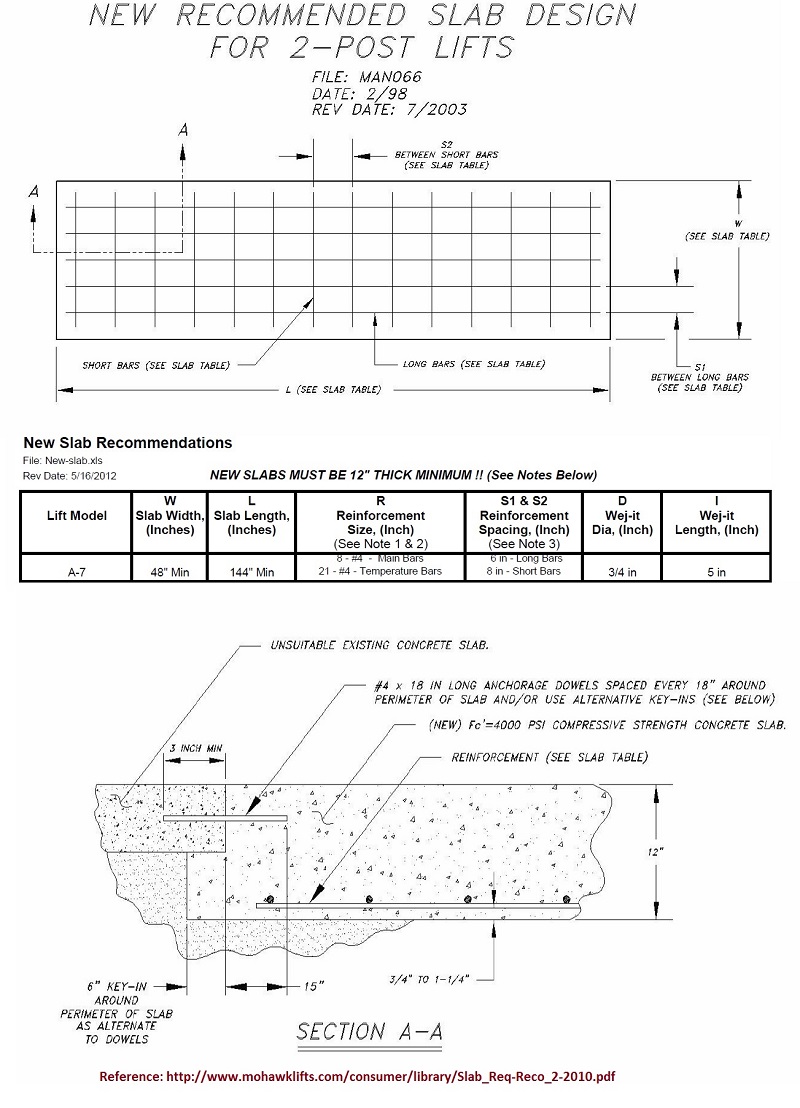
Thanks Sean..the beer is always cold. Just for reference, I used this basically as my slab reference: http://www.mohawklifts.com/consumer/library/Slab_Req-Reco_2-2010.pdf I believe you can consider the slab spec from a lift manufacturer as authoritative :)

The retro slab information assuming their A7 (7000lb, asymetric lift) is parsed out below from that doc:

mohawk_slab.jpg


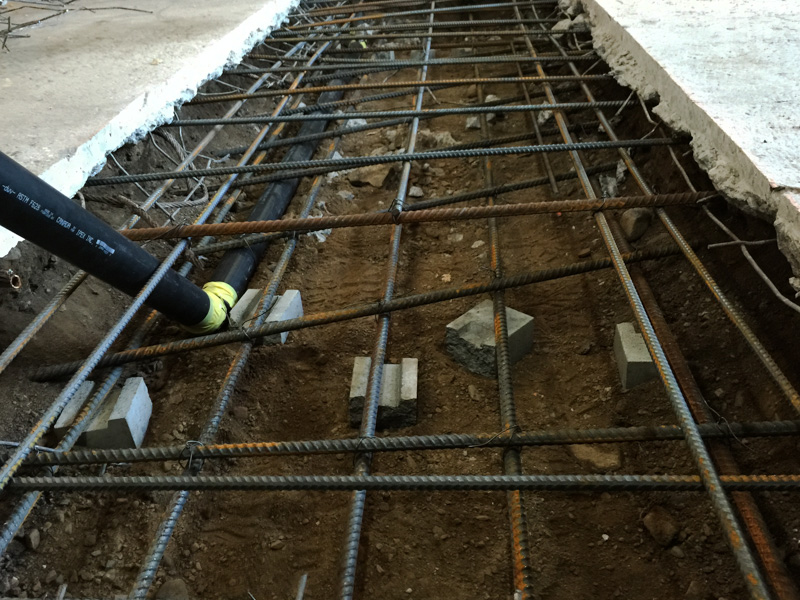
The 2nd layer of rebar was spec'd by the engineer at Harris rebar (industrial rebar supplier), and my overall plan in the slab thread was spec'd by my buddy Bob, a civil engineer who does QC on bridge repair/construction in this region. Overkill yes, but I won't be too worried about the slab or lift safety :)
 
Last edited:

wssix99

Well-known member
Joined
Mar 2, 2011
Messages
5,155
Location
Chicago, IL
Thanks Sean..the beer is always cold. Just for reference, I used this basically as my slab reference: http://www.mohawklifts.com/consumer/library/Slab_Req-Reco_2-2010.pdf I believe you can consider the slab spec from a lift manufacturer as authoritative :)

^ You misread this document and took the rebar spec out of context. You need to read pages 2 and 3. There, you will find that the manufacturer recommends a "contiguous single slab" with the same reinforcement throughout. They also state that reinforcement is not required.

If you an existing slab doesn't meet their specs... then they recommend the detail above as a retrofit. Their spec also calls out a keyed and pinned connection. Using this reinforcement scheme in the middle of a new construction floor will cause cracking around the reinforcement and one would be left with out the keyed detail. This is a potentially dangerous situation.

The Mowhawk manual and specs are consistent with the advice I have put in this thread.
 

Denwood

Well-known member
Joined
Sep 22, 2014
Messages
4,180
Location
Thunder Bay, Ontario, Canada
Yes, my application was a retrofit slab...I parsed out the retrofit doc data in my build thread and uploaded the image. Hopefully the diagram with "unsuitable adjoining concrete" will precipitate a look at the original for anyone following my build thread. That's why I included a link to the original doc. You certainly don't need a 12" contiguous slab to put in a hoist :) My rebar setup was definitely beyond the spec as well. I went with the engineer's recommendation at Harris rebar here in town. No cracks yet. Yes, overkill...but the rebar was cheap.

There's a very good reason to go at least 7" at the hoist anchor locations (if you're using epoxy anchors) that became apparent during installation. The epoxy install procedure is to fill the holes 1/3 to 1/2 full, then hammer in the insert. The last few inches of the anchors are an interference fit. As you tap them in, excess epoxy travels up a machined flat surface on each anchor and "vents" out the top of this hole. This pressure is also likely important to make sure the epoxy travels up the bore to properly secure the anchor. Not sure how this works if you've blown through the slab as there'd be zero pressure on the epoxy at the hole base.

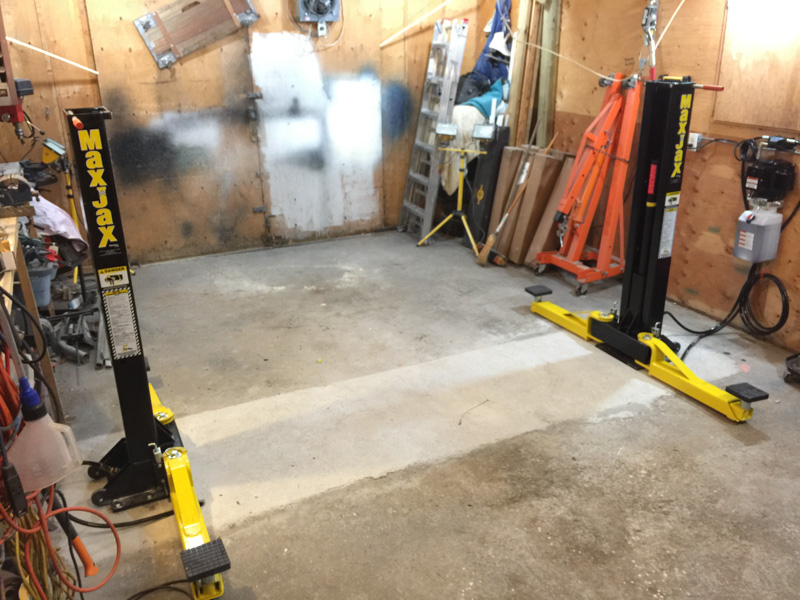
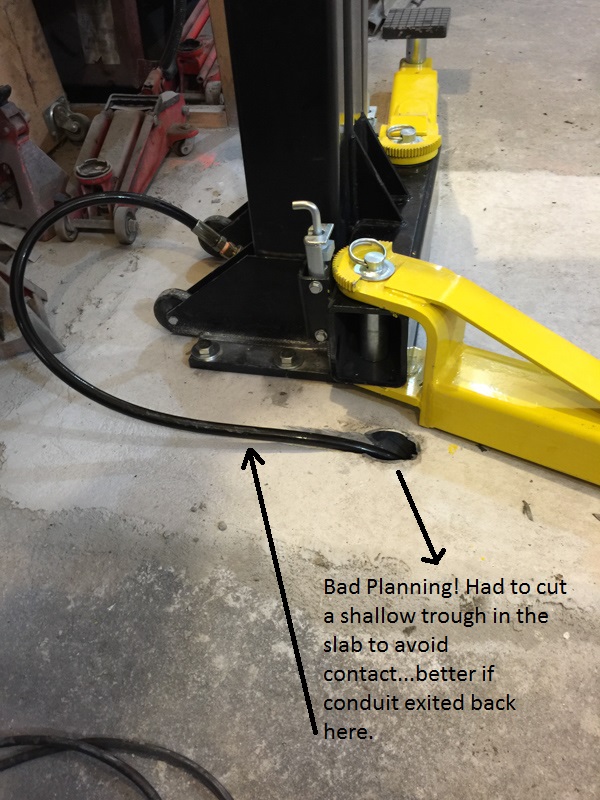
Sean, you may want drop conduit in as well so you can have the option to wall mount your power unit as I did. Make sure you're at least 120" on center to the conduit exit if you decide to do this.

rebar1.jpg


The hydraulic hose the far post goes under...

max6.jpg


Here's why you want 120" on center...oops.

max5.jpg
 
Last edited:

wssix99

Well-known member
Joined
Mar 2, 2011
Messages
5,155
Location
Chicago, IL
Right. This is perfectly fine for retrofitting an existing slab. It just creates problems if applied to only a small area of a new pour, like the OP is doing.

For a new pour, the Mohawk guide gives some good options for reinforcing/thicknesses for contiguous slabs.
 
OP
S

SeanD

Member
Joined
Mar 15, 2014
Messages
20
Location
Windsor, ON, Canada
What do you mean, this will greatly increase the likelihood of cracking.


This will greatly increase the likelihood of cracking. If you think I'm making this up, you can check out an authoritative reference, (not the internet) like one of the concrete institutes. They will call out expansion joints for this type of construction due to the cracking. Obviously, expansion joints or cracks are not something one would want here.
 

wssix99

Well-known member
Joined
Mar 2, 2011
Messages
5,155
Location
Chicago, IL
What do you mean, this will greatly increase the likelihood of cracking.

With the exception of a few wildly exotic (ie: expensive) exceptions, all concrete cracks because it shrinks as it cures. This causes tension in the slab (concrete is weak in tension) and it breaks off in to smaller chunks that pull away from each other, causing cracks. (Think of ocean ice, breaking away in to chunks.) This cracking happens randomly, so you can't deal with 100% certainty. You can only increase your chances of the slab doing what you want it to do:

To manage the cracking, your contractor will use methods to either control or minimize the crack width.

To control the cracking, your contractor will put in expansion/isolation joints or create saw-cut control joints. If you have a simple rectangle, they will probably use 100% the later. The saw cut joints encourage the cracking to happen in those areas, which makes things less unsightly and allows you to fill in those cracks easily, if you want.

^ I'd recommend talking with your contractor about their saw-cut control joint plan early to determine of any of these will create a problem for your lift. MaxJax should have guidance on how far you need to keep away from these with the bases.

To minimize the crack widths, your contractor will use reinforcing, like the mesh you mentioned. The mesh is strong in tension and will hold the random cracks, that occur outside the control joints, to smaller widths - many of them will be so small you won't be able see them. If you want more reinforcing and smaller random cracks (or cracks inside the control joints for that mater) you can move up to reinforcing bar, which can handle more of the tension that builds up. (Extra reinforcing can also allow you to space your saw-cut joints further away from each other.)

^ Crack width control may not be a big issue for you if you are going to put down epoxy, since the epoxy will fill in and deal with these tiny cracks.


When you put extra-strong reinforcing in one small part of a continuous slab, it creates a small section (the over-reinforced part) of the slab extra-resistant to cracking. So, as the random cracking forms, and the floor breaks in to "chunks" it will be most likely to happen along the boundary of the over-reinforced area, where it meets the weaker, "normal" area.


You can also visualize the effect as the concrete having a tug-of-war with itself. The rods of the reinforcing are the "ropes" of this game and the curing concrete is pulling with even force from all directions. If the tug-of-war is going to be lost somewhere on the floor, its most likely going to happen where the weak "rope" meets the strong section "rope."
 
Last edited:

Denwood

Well-known member
Joined
Sep 22, 2014
Messages
4,180
Location
Thunder Bay, Ontario, Canada
Sean,the MaxJax guys will tell you they want the bases to be at least 12" from a crack, or slab edge. If your concrete guy is cutting controls, make sure he's no closer.
 
To avoid these ads, REGISTER NOW!
Top Bottom