To avoid these ads, REGISTER NOW!

Attic loading

going88mph

Member
Joined
Sep 19, 2012
Messages
23
Hello,

My new 24x30 garage is up. In trying to determine what I could put in the attic, I reviewed the truss plans. I have:

top chord live load: 30 psf
top chord dead load: 10 psf
bottom chord dead load 10psf
bottom chord live load 0 psf

They are 2x6 chords at 24" OC, spanning 24'.

Does this give me any useful attic storage (a desk? a transmission? boxes?)? If not, what could I do to increase the strength?

thank you.
 
To avoid these ads, REGISTER NOW!

KELLHAMMER

Well-known member
Joined
Nov 20, 2006
Messages
222
Location
south eastern pennsylvania
Where it says 0 psf for live load on bottom chord that means it is not designed to carry live load, such as storage items, furniture, people etc. Certainly it could probably handle the occasion worker climbing around for maintenance and maybe just empty cardboard boxes. Other than that a sustained load could have negative effect.

Also, trying to modify the existing trusses should only be done after a review by the truss company that manufactured them. Without doing so could have a negative effect on your brand new, expensive building
 
Last edited:
OP
G

going88mph

Member
Joined
Sep 19, 2012
Messages
23
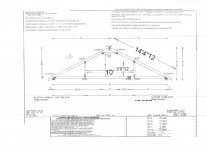
Thought that I'd add the drawing, just in case I missed something here. So, you're telling me I ordered a garage with an attic, that is incapable of storing anything?
 

Attachments

  • trussplanweb.jpg
    trussplanweb.jpg
    134.1 KB · Views: 220

BD1

Well-known member
Joined
Mar 18, 2007
Messages
4,602
Location
north side
Contact the builder or truss manufacture and see what they say. Is the garage ceiling drywall??
 

Stuart in MN

Well-known member
Joined
Sep 8, 2005
Messages
23,141
Location
Minneapolis
Thought that I'd add the drawing, just in case I missed something here. So, you're telling me I ordered a garage with an attic, that is incapable of storing anything?

If you look in the upper left corner of the drawing it has a live load of 40 psf for the attic floor.
 

Kevin C

Well-known member
Joined
Aug 4, 2011
Messages
1,653
Location
Portland OR
If you look in the upper left corner of the drawing it has a live load of 40 psf for the attic floor.

From what i can tell that's a listing of the requirement that a floor would need to be used for storage, not what the floor is capable of.

A continuous A 2 x 8 at that length would only support a ceiling load ( at that it would need to be 12" OC). While it is a truss, its not a continuous member and its spaced at 24" OC. It does have two supports 10' apart, in my experiance its not enough to carry 40 PSF.
 
Last edited:

mmhouse

Well-known member
Joined
Aug 31, 2008
Messages
754
Location
Desert Southwest
The BC LL = 0 and note of floor load is very confusing to me. But the fact is that a LL = 0 means you shouldn't be storing anything up there until you take the design sheet to the truss manufacturer/designer and discuss it with them IMO.

Maybe the middle 10' section is considered the "attic floor" and beyond that are considered "bottom chords" and that would explain the apparently conflicting notes but I wouldn't assume that. I'm sure you know what ***-u-me spells.

Edit: See post#15 below. You found the note and you are correct....the design load for the center ten feed is 40 lbs/sq ft. You're good!
 
Last edited:
To avoid these ads, REGISTER NOW!

mothgrey

Well-known member
Joined
Feb 6, 2010
Messages
366
So I'm not trying to hijack the thread but seeing as there are several here way more knowledgeable than me. Here are my truss plans they are 4 ft OC do you think I will have an issue adding a steel liner ceiling?
 

Attachments

  • 120400546-unsealed.pdf
    25.9 KB · Views: 22

ydna

Well-known member
Joined
Jul 23, 2012
Messages
66
To the OP. The way I interpret the notes, the bottom chord is good for a dead load 10lbs/sq.ft. which is things that don't move. Like drywall and stored items. (Light stored items).

Live loads are people and other moving objects. You can have zero of those.

The top chord is not really in the equation as far as storing things in your attic space so forget about those numbers.
 
OP
G

going88mph

Member
Joined
Sep 19, 2012
Messages
23
The note says 40 psf between 7 and 17 ft. This corresponds to the ten foot marked area in the middle. I believe this area to be the designated storage area. Storage is a live load.

Thanks to everyone for their help. I will contact the truss mfg just to be sure.
 

mmhouse

Well-known member
Joined
Aug 31, 2008
Messages
754
Location
Desert Southwest
So I'm not trying to hijack the thread but seeing as there are several here way more knowledgeable than me. Here are my truss plans they are 4 ft OC do you think I will have an issue adding a steel liner ceiling?

Your bottom chord deal load design load is 5 lbs./sq. ft. Figure the weight per square foot of the steel plus the connectors to attach it (if that's all that goes on the ceiling) and if it's no more than that then you're okay.

Actually it should be slightly less because the 5 lbs. includes the weight of the trusses according to note 6.
 

mmhouse

Well-known member
Joined
Aug 31, 2008
Messages
754
Location
Desert Southwest
The note says 40 psf between 7 and 17 ft. This corresponds to the ten foot marked area in the middle. I believe this area to be the designated storage area. Storage is a live load.

Thanks to everyone for their help. I will contact the truss mfg just to be sure.

You're absolutely right. I missed that note. You're fine. 40psf is typical design load for a residential floor.
 

bob15

Well-known member
Joined
Dec 8, 2011
Messages
6,863
Location
Northeasten, CT
The note says 40 psf between 7 and 17 ft. This corresponds to the ten foot marked area in the middle. I believe this area to be the designated storage area. Storage is a live load.

Thanks to everyone for their help. I will contact the truss mfg just to be sure.

One catch, live load also includes snow, wind, rain (the elements). There is also a 30 lb/LL snow figure there. If the OP was to put 40 psf in a ceiling and then gets a couple feet of wet heavy snow, it could collaspe.

And yes, the best thing to do is to contact the engineer or firm who designed this and ask them.

bob
 

PAToyota

Well-known member
Joined
Jan 20, 2006
Messages
4,366
Location
South Central Pennsylvania, USA
To the OP. The way I interpret the notes, the bottom chord is good for a dead load 10lbs/sq.ft. which is things that don't move. Like drywall and stored items. (Light stored items).

Live loads are people and other moving objects. You can have zero of those.

Nope. Dead load is building structure - anything that is a built part of the structure. Live load is any temporary load. You could store something up there for 500 years and it would still be a live load.
 

mmhouse

Well-known member
Joined
Aug 31, 2008
Messages
754
Location
Desert Southwest
One catch, live load also includes snow, wind, rain (the elements). There is also a 30 lb/LL snow figure there. If the OP was to put 40 psf in a ceiling and then gets a couple feet of wet heavy snow, it could collaspe.

And yes, the best thing to do is to contact the engineer or firm who designed this and ask them.

bob

No. Snow load would be on the top chord. His attic storage is bottom chord load. The only loads that apply to the bottom chord would be the weight of the ceiling material on the bottom (probably drywall) and flooring material on the top (probably plywood), which are both dead loads, and the weight of stuff that comes and goes like stored items and him walking around from time to time, which are live loads.

Top chord dead loads would typically be roof sheathing, ice and water shield and shingles or metal. The most significant top chord live load would be snow which comes and goes.

As far as I know wind loading is considered separately.
 
Last edited:

ydna

Well-known member
Joined
Jul 23, 2012
Messages
66
Nope. Dead load is building structure - anything that is a built part of the structure. Live load is any temporary load. You could store something up there for 500 years and it would still be a live load.

I stand corrected. You are right.
 

kert

Well-known member
Joined
May 31, 2009
Messages
371
Location
Franklin, MI
Nope. Dead load is building structure - anything that is a built part of the structure. Live load is any temporary load. You could store something up there for 500 years and it would still be a live load.

One way to look at it is a live load is something that is likely to move. Items stored are likely to move at some point, otherwise there wouldn't be much point in keeping them (though that may be up for debate). You are likely to notice an under-designed live load as cracks in your sheetrock or bounciness in the floor.

A dead load is something that is a part of the building and isn't subject to change. You are likely to notice an under-designed dead load as sagging in the ceiling/floor; although a live load can cause this too. A dead load will not cause cracks in your sheetrock because the movement is already there before mud and tape.
 
To avoid these ads, REGISTER NOW!
Top Bottom