To avoid these ads, REGISTER NOW!

Attic trusses on a mono pour?

Baw335

Active member
Joined
Nov 5, 2016
Messages
38
Location
NW Minnesota
I'm starting to plan a 24 or 26 x 48 with 10 foot walls garage build for the spring. It's cold up here but our soils are pretty sandy and it seems that quite of few people do a mono pour on their detached buildings. I searched quite a bit but haven't had much luck finding many examples of attic trusses without full blown frost footings. If anyone has done this, have you had any issues over time with your build? I guess I'm just curious if taller structures are more susceptible to movement over time. Thanks for any help.
 
To avoid these ads, REGISTER NOW!

DougWil

Well-known member
Joined
Dec 29, 2015
Messages
545
Location
NW Montana
I am not a fan of monoslabs with high load bearing wall loads.
Soil basically acts as a mat of springs, and deforms under load.

Since the footing is loaded and the slab isn't you get a crack around the perimeter, which if you have installed rebar or heavy mesh it won't get huge, but still a crack and allows water, salty water off the car etc to get down there and work it's rusting magic.
 

Ray-CA

Well-known member
Joined
Jan 6, 2007
Messages
3,451
Location
San Diego CA
I have these trusses on our 28x30. Granted, I don't have to deal with snow loading, but it may give you an idea.....

Ray
 

Attachments

  • Truss-02.jpg
    Truss-02.jpg
    110.3 KB · Views: 83
OP
B

Baw335

Active member
Joined
Nov 5, 2016
Messages
38
Location
NW Minnesota
Doug-that's a good point that I never really considered, I appreciate the insight. I was initially thinking that I was going to stick frame it but this has me rethinking my plan a little as I don't have the budget for footers. The house we purchased doesn't have a basement so I am pretty set on attic trusses as we are short on storage space. I'm wondering how pole framing on concrete/anchors would work with attic trusses. That would allow me pour the slab at a later date if I was short on cash for a little while.

Ray - I appreciate the info on trusses, I will have to go talk with the local truss maker to see what they think.
 
Last edited:

matt_i

Well-known member
Joined
Mar 14, 2008
Messages
10,730
Location
SE Michigan
I would either do trenched footings with the mono-pour or else research the "frost protected shallow foundation" and follow the prep to a "t". As mentioned above, a traditional pad footing also has the advantage of reducing the bearing pressure on the soil.

Imo, you get into the need for reducing pressure on the ground when you have 2 stories as its more or less like building 2 buildings stacked on top of each other; OR you know the soil is heavily organic that deep.
 

73RR

Blank Email
Joined
Dec 13, 2016
Messages
300
Location
Central Ory-Gun
Two years ago I built a 30x30 garage on a mono and have a 12x30 'attic' above the
10'-8" plate. The trusses are 5:12 pitch so not exactly a short peak.
The walls are 6"ICF, so a fair bit of weight at the perimeter. No cracks other than the saw cut joints at centerline, each way.
Some key factors are size and design of the footing (go well below published frost depth), how well the base material is compacted and the amount of insulation under the slab and/or around the footing.

If adding some insulation protects the building, then why not? It is cheap in the long run and certainly easier to install now. Same with extra deep footings, hard to add concrete later.
 

Radix2

Well-known member
Joined
May 28, 2014
Messages
1,853
Location
the thumb!, MI
Doug-that's a good point that I never really considered, I appreciate the insight. I was initially thinking that I was going to stick frame it but this has me rethinking my plan a little as I don't have the budget for footers. The house we purchased doesn't have a basement so I am pretty set on attic trusses as we are short on storage space. I'm wondering how pole framing on concrete/anchors would work with attic trusses. That would allow me pour the slab at a later date if I was short on cash for a little while.

Ray - I appreciate the info on trusses, I will have to go talk with the local truss maker to see what they think.

Search for "Frost Protected Shallow Foundation". The issue with loading is not depth but stability. Stability from settling and stability from frost heave. conventional foundations are designed to address both - depth for frost protection footing size and placement on deep undisturbed soil for settling.

A FPSF can be designed to address both problems using less material and excavation and are common in many (cold) parts of the world. The do required careful attention to detail and are not what most contractor are used to...so you will have to step in to make it happen. With proper insulation, compaction and edge design, you can accomplish your goal. The thickened edge on a FPSF has as much or more bearing area than a conventional deep footing. You don't get the easy undisturbed soil or insulation that is inherent in a deep foundation is all...
 
To avoid these ads, REGISTER NOW!

Stuart in MN

Well-known member
Joined
Sep 8, 2005
Messages
23,135
Location
Minneapolis
My garage is 24 x 40 on a slab, with attic trusses. There's one row of blocks on the slab, with 8 foot studs in the walls, so the total ceiling height is around 9 1/2 feet. It's about 20 years old now, no issues.

attachment.php
 
Last edited:

DougWil

Well-known member
Joined
Dec 29, 2015
Messages
545
Location
NW Montana
Search for "Frost Protected Shallow Foundation". The issue with loading is not depth but stability. Stability from settling and stability from frost heave. conventional foundations are designed to address both - depth for frost protection footing size and placement on deep undisturbed soil for settling.

A FPSF can be designed to address both problems using less material and excavation and are common in many (cold) parts of the world. The do required careful attention to detail and are not what most contractor are used to...so you will have to step in to make it happen. With proper insulation, compaction and edge design, you can accomplish your goal. The thickened edge on a FPSF has as much or more bearing area than a conventional deep footing. You don't get the easy undisturbed soil or insulation that is inherent in a deep foundation is all...

I am not talking about frost protection or frost heaving.
I am talking about the differential load on a load bearing wall, with a 2nd floor and probably some serious snow loads in MI and the attached slab which basically has zero load on it.

That load puts the concrete slab surface in tension and right at the mono footing edge and slab you get a crack because concrete has very little tension capacity and the rebar is not engaged in tension until you do have a crack.

This is compounded by the soil or base under a shallow footing being subject to ever changing moisture content.

Having a conventional footing with a floating slab, no forces are transferred from the footing to the much thinner and structurally weaker slab.

Of course any footing has to be wide enough for the loads and on stable soil or fill.
 

Kaizen

Well-known member
Joined
Jan 9, 2015
Messages
6,948
Location
New England
I also didn't want a footer and walls due to price. 30x36 11 foot stick frame walls on one foot knee wall. 6 inch 4K slab with two foot deep thickened edge. My inspector won't allow any second floor with this setup. That includes attic trusses. If I need room I believe I can make a mezzanine later. I will be using normal 30 foot trusses with a 10/12 pitch


Sent from my iPhone using Tapatalk
 

Kaizen

Well-known member
Joined
Jan 9, 2015
Messages
6,948
Location
New England
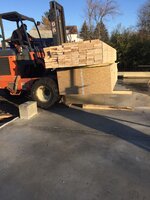
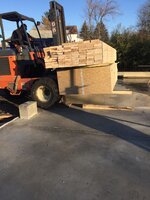
Oh and here is some serious weight that it took without any cracking. Full lift of ply and the weight of the moffit 9b3ebccaad7c71eae5dd5665b2b80f4f.jpg


Sent from my iPhone using Tapatalk
 

Attachments

  • 9b3ebccaad7c71eae5dd5665b2b80f4f.jpg
    9b3ebccaad7c71eae5dd5665b2b80f4f.jpg
    656 KB · Views: 3
OP
B

Baw335

Active member
Joined
Nov 5, 2016
Messages
38
Location
NW Minnesota
Stuart - do you by chance know what you/they did as far as rough edge thickness or insulation? I 'm just curious as it's held up great over the years.

Kaizen - did you pour your stemwalls separately after the slab?
 

Stuart in MN

Well-known member
Joined
Sep 8, 2005
Messages
23,135
Location
Minneapolis
My slab isn't insulated. As for edge thickness, to tell the truth I don't exactly remember - I'm thinking it's 12" thick at the edges but I could be wrong.
 

Kaizen

Well-known member
Joined
Jan 9, 2015
Messages
6,948
Location
New England
Yes about a week later. Attached with rebar. Wanted two feet so I could just use ten foot studs but after seeing how it looked decided to stick to one foot. Forgot to mention I used mesh and no rebar in field. Very unconventional but went on recommendation of my concrete guy
 
Last edited:
To avoid these ads, REGISTER NOW!
Top Bottom