To avoid these ads, REGISTER NOW!

Attic Vent Confusion for the Soffit

Joined
Dec 1, 2017
Messages
15
I'm a bit of a DIY novice. Trying to insulate and drywall just the first floor of my 40x30 detached garage.

I'm planning on batting the first floor (R-38 in the ceiling and R-19 in the walls) and then drywalling. However, I'm confused on the attic vents that need to vent to the soffit. Since I'm not insulating in the attic portion and there should be no insulation blocking the soffit - I can get away with not using these, right? https://www.homedepot.com/p/Owens-C...ft-R-Mate-Attic-Vent-70-Pieces-70RM/204853491

Or should the insulation stretch towards the soffit and then use the attic vents?

My head is spinning with all the stuff I need to do before putting in the insulation.

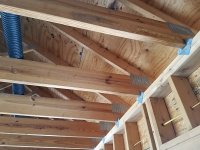
Here are pics of what I'm dealing with.
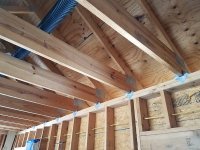
 

Attachments

  • i-qRHJjsg-M.jpg
    i-qRHJjsg-M.jpg
    86.4 KB · Views: 94
  • i-rzgwm6G-M.jpg
    i-rzgwm6G-M.jpg
    77.4 KB · Views: 74
To avoid these ads, REGISTER NOW!

PCustoms

Well-known member
Joined
Jul 23, 2011
Messages
22,439
Location
VT
Do you have a soffit vent? I don't see one, could just be the angle of your pics.

If there is one, you need to keep the insulation from blocking it, which will happen if you stuff the r38 all they way in.
 

soj

Well-known member
Joined
Dec 3, 2007
Messages
729
Location
North Georgia
Short answer: YES you need the vents.

Are you using fiberglass batts? If so, R38 is 12" thick, and they should go all the way to the outside of the top plate, which will block any airflow from the soffit. Same situation with blown in. Only way to keep the vent system intact is something to keep the insulation pushed down away from the roof decking.
jp
 

Bretny

Well-known member
Joined
Jul 31, 2017
Messages
3,918
Location
Dutchess county NY
Make sure you get enough of a hole in the upper wall area above the wall plate. There a real PITA to make bigger later. Theres a spec on how big they need to be.
 

casmurbax

Well-known member
Joined
Sep 25, 2012
Messages
2,756
Location
Wilton, NY
To the best of my knowledge, you should use those attic vent inserts.

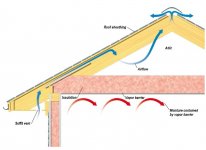
something like this is what it should look like.

insulate.jpg
 
OP
B
Joined
Dec 1, 2017
Messages
15
Thanks guys. I'm a little unclear on the terms, but I do believe the soffits are vented.

I counted 36 openings between the ceiling joists. So I'll need to staple in 36 of the attic vent inserts and then get the insulation as deep as possible (without compressing it) towards the soffit?

Here's what it looks like from above:
 

Attachments

  • i-RWkfvWK-L.jpg
    i-RWkfvWK-L.jpg
    77.3 KB · Views: 100
OP
B
Joined
Dec 1, 2017
Messages
15
Short answer: YES you need the vents.

Are you using fiberglass batts? If so, R38 is 12" thick, and they should go all the way to the outside of the top plate, which will block any airflow from the soffit. Same situation with blown in. Only way to keep the vent system intact is something to keep the insulation pushed down away from the roof decking.
jp


Yes, R-38 fiberglass batts for the 1st floor ceiling. Planning on leaving the attic uninsulated.
 

Toolfool

Well-known member
Joined
Aug 22, 2011
Messages
4,981
Location
Tallahassee, FL
OP
B
Joined
Dec 1, 2017
Messages
15

larry4406

Well-known member
Joined
Jan 27, 2006
Messages
19,089
Location
Northern Virginia
As mentioned, when you install those baffles make sure they are pushed to the exterior to vertically align with the wall exterior sheathing so you can ensure full insulation on top of wall. These are commonly not installed correctly in the production homes I oversee requiring rework.

There are several types of these baffles. I mostly see the cardboard version.
 
To avoid these ads, REGISTER NOW!

Highbeam

Well-known member
Joined
Feb 15, 2011
Messages
2,292
Location
Mt Rainier foothills, WA
With those baffles stapled in place you can then do all blown-in insulation and only be sure that you don't blow any between the roof sheathing and the foam baffle.
 

yeldogt

Well-known member
Joined
Jan 2, 2012
Messages
18,184
Make sure you seal the the ceiling well -- with a ventilated attic space a lot of heat can be lost through any leaks.

I never do ventilated attic's -- or crawl spaces.
 

D45

Well-known member
Joined
Mar 21, 2014
Messages
4,834
Location
NW INDIANA
Thanks guys. I'm a little unclear on the terms, but I do believe the soffits are vented.

I counted 36 openings between the ceiling joists. So I'll need to staple in 36 of the attic vent inserts and then get the insulation as deep as possible (without compressing it) towards the soffit?

Here's what it looks like from above:

Are you wanting to install baffles and then install insulation between the ceiling joists (up against these battles) against the sheathing?
 
OP
B
Joined
Dec 1, 2017
Messages
15
As mentioned, when you install those baffles make sure they are pushed to the exterior to vertically align with the wall exterior sheathing so you can ensure full insulation on top of wall. These are commonly not installed correctly in the production homes I oversee requiring rework.

There are several types of these baffles. I mostly see the cardboard version.

That's what I planned to do...against the sheathing. I ordered the below ones since it seems the least likely I can screw it up...looks like it gets stapled to the top plate and then the sheathing.

https://www.homedepot.com/p/Amerima...y-and-Soffit-Vent-in-Black-ACCUVENT/202962730

With those baffles stapled in place you can then do all blown-in insulation and only be sure that you don't blow any between the roof sheathing and the foam baffle.

I've already purchased batt insulation per my first post. And there's no floor on half the second floor. I would just be blowing insulation onto the first floor floor unless I put a ceiling up first.

Are you wanting to install baffles and then install insulation between the ceiling joists (up against these battles) against the sheathing?

The main goal is to use the first floor and then keep the loft area unheated/uninsulated for storage. So the plan was to insulate between the ceiling joists, but not against the roof sheathing.

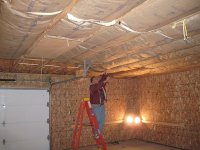
The insulation of the first floor would be similar to this:
 

Attachments

  • i-BkLMTS7-M.jpg
    i-BkLMTS7-M.jpg
    107.7 KB · Views: 45

Toolfool

Well-known member
Joined
Aug 22, 2011
Messages
4,981
Location
Tallahassee, FL
That's what I planned to do...against the sheathing. I ordered the below ones since it seems the least likely I can screw it up...looks like it gets stapled to the top plate and then the sheathing.


I gave you the earlier HD link because those baffles don't get stapled to the sheathing, allowing airflow AND avoiding problems with your roofing nails sticking through.
 
OP
B
Joined
Dec 1, 2017
Messages
15
I gave you the earlier HD link because those baffles don't get stapled to the sheathing, allowing airflow AND avoiding problems with your roofing nails sticking through.

Darn. I thought they were pretty much the same thing and the black ones I ordered got much better reviews.
 

yeldogt

Well-known member
Joined
Jan 2, 2012
Messages
18,184
Why not insulate the roof deck and be done with it -- storage will be in conditioned space
 

yeldogt

Well-known member
Joined
Jan 2, 2012
Messages
18,184
Smaller space to heat, I don't need the storage to be conditioned, etc.

In our area of the country they are now closing off all attics -- It's a requirement of the NJ clean energy program. They actually add to heat loss ... you capture the lost heat with a sealed attic.

Raised truss design will solve any ice dam issues -- even in Maine w/ conventional batts.

Rigid foam everywhere else.
 
OP
B
Joined
Dec 1, 2017
Messages
15
In our area of the country they are now closing off all attics -- It's a requirement of the NJ clean energy program. They actually add to heat loss ... you capture the lost heat with a sealed attic.

Raised truss design will solve any ice dam issues -- even in Maine w/ conventional batts.

Rigid foam everywhere else.

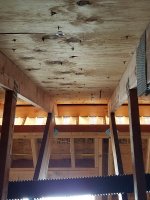
Okay - now I'm confused again. Here are photos of my attic and then the openings between the two floors. Are you saying close off attic and close off the lower space? Or just close off the attic? Would I put batts right up against the ceiling sheathing or rigid foam? I'm not understanding.
 

Attachments

  • i-Q9rkS5p-M.jpg
    i-Q9rkS5p-M.jpg
    84.8 KB · Views: 35
  • i-MrJzSNS-M.jpg
    i-MrJzSNS-M.jpg
    68.1 KB · Views: 32
Last edited:

yeldogt

Well-known member
Joined
Jan 2, 2012
Messages
18,184
With all that attic space -- in PA .. I would want to be able to use it. And yes -- you can insulate the the roof deck. For many years the typical way would be to install the rafter baffles from the soffit vents up to a point into the space under the ridge vent -- installs batts to cover all. You can also place some in the floor to slow the stack effect.

Today -- many more buildings are being down with no vents -- where the whole building is being sealed. Spray foam has changed many things and one of them is how a sealed building performs (regardless of insulation type)


You want to do two things with any building -- stop air movement and create a thermal bridge. What people don't understand is that air movement is a huge factor in a buildings heat cool cycle needs.

Air movement also brings moisture with it -- if you stop the air movement you stop this water movement.

Obviously -- vents aid in air movement and bring in moisture. Batts of fiberglass don't control air movement. That's what plastic was used for some time as a VB -- and it's proven to be a problem in many climates.

Do some more research -- investigate the different ways. Fiberglass insulation is is cheap to buy and DIY install -- doing a bit of what some will call "overkill" with give you a long term payback and a better more usable building -- greater comfort and less cost to heat.
 
To avoid these ads, REGISTER NOW!
Top Bottom