To avoid these ads, REGISTER NOW!

Attic ventilation plan-photo heavy

bluedog225

Well-known member
Joined
Jan 31, 2012
Messages
3,296
Location
Texas
Good morning,

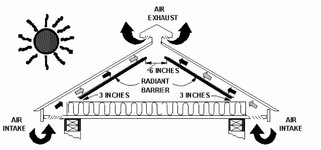
My goal is to have a traditional soffit vent setup with ventilation over 14” of insulation and avoid any condensation issues. Air conditioned space. Texas climate. Complicated by a gently sloped flat roof so no ridge vent.

I need to finalize some decisions and start installing insulation and interior walls. I got injured and wasn’t able to insulate above the roof deck. Now I’m working on plan B. I’m not willing to foam and risk trapping moisture.

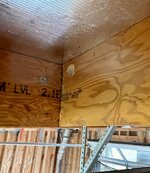
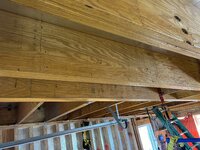
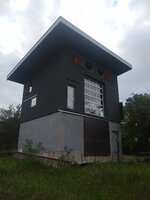
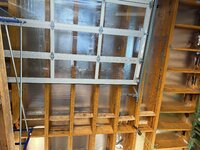
The roof is 16” LVL rafters covered by 3/4 ply, rain shield, and double lock metal. 1:12 roof slope.

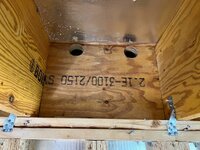
I’ve opened up every “chamber” of the LVL rafters with a minimum two 3” holes. Lots of work but it’s done. Each eave has hardiplank ventilated soffit (all the way around the 25’x25’ building). And I calculated that the two 3” holes have a greater area than the associated vented soffit.

I’m on the fence about whether to use R-49 (14”) paper faced batts or blown in cellulose. The batts would be installed and done. Simple. The blown in will need me to block off the top 2” of the LVL to make sure we don’t fill it up and block air flow to the bottom of the deck. That will require cutting and fitting foam boards with spacers. A fair amount of work.

A couple of questions.

Do you think this plan will keep the deck ventilated enough to avoid issues with condensation and rot?

What’s the latest on blown in insulation versus batts? The R-49 will be much easier and “fool proof.” The blown in will settle some though. So maybe it can’t be screwed up?

This is the best plan I can think of. My overriding goal is to avoid condensation and rot up there once it’s sealed up.

Any thoughts appreciated.

Thanks



IMG_9901.jpeg

IMG_9897.jpegIMG_9898.jpeg


IMG_0445.jpeg

IMG_8474.jpeg

4E110CE3-CFBB-4A17-B326-49555BB9E3DE.jpeg
 
To avoid these ads, REGISTER NOW!

Hank11

Well-known member
Joined
Aug 19, 2019
Messages
1,153
Location
Tennessee
I think you may have insufficient flow to gain the benefits of a typical vented roof system. That system depends not only on the temperature of the air, but also on the fact that hot air rises. You don’t have much rise in your system. It would probably work if you had continuous straight line openings from the low side to the high side. It doesn’t look like to me that you have that now.
 
Last edited:
OP
B

bluedog225

Well-known member
Joined
Jan 31, 2012
Messages
3,296
Location
Texas
Thanks for the reply. That’s what I’m afraid of.

I do have continuous front to back through the middle say 15 feet. But the outriggers on each side run the other way.

I have put 3 inch holes front to back on those as well hoping to catch the flow.

I’m fresh out of other ideas at this point.

I don’t have a great photo of the slope. I’m hoping it’s enough.

Maybe I’ll install an access panel to inspect the deck from below. Or a moisture meter.

IMG_9836.jpeg


3AEDBE53-DEFD-47B6-A8C9-36C023386B17.jpeg
 

Hank11

Well-known member
Joined
Aug 19, 2019
Messages
1,153
Location
Tennessee
You could put in powered ventilation. That’s not a big space so won’t cost much to put in or run.

Even though you don’t want foam, this might be the place for open cell spray foam. Then maybe an open or lattice type ceiling covering. Or paint it all black like a restaurant. If it gets wet it will show and it can dry out.
 
OP
B

bluedog225

Well-known member
Joined
Jan 31, 2012
Messages
3,296
Location
Texas
You could put in powered ventilation. That’s not a big space so won’t cost much to put in or run.

Even though you don’t want foam, this might be the place for open cell spray foam. Then maybe an open or lattice type ceiling covering. Or paint it all black like a restaurant. If it gets wet it will show and it can dry out.
I’m glad you brought up foam.

I guess it would keep the condensation off the bottom of the deck, right?

I’ve been trying to find out if open cell will dry out. A leak from above is unlikely, but would be pretty destructive over time.

How does open cell work in that situation if you know.

Thanks
 

Hank11

Well-known member
Joined
Aug 19, 2019
Messages
1,153
Location
Tennessee
Not expert at this subject. Open cell breathes, absorbs water and dries out. It’s like a sponge. Water from roof leaks will show through and you can find a leak and fix it. I just did my shop roof deck in open cell. This at the suggestion of my installer who has been in the insulation business for 40 years and still attends industry training regularly. He stays on top of the business. Came to me through a friend who builds 10 million dollar plus homes. Nearly everything he builds uses open and closed cell where appropriate and other systems as needed. Conditioned attics and crawl spaces, all very high end finishes.
 

Denwood

Well-known member
Joined
Sep 22, 2014
Messages
4,192
Location
Thunder Bay, Ontario, Canada
With that roof structure, I'd take a serious look at a non-vented assembly and just using close cell spray foam directly to the deck. You could likely do 4" of closed cell directly to the roof deck, then blow in cellulose for the rest. Your roof in that climate and low slope would have been a good candidate for external insulation. I'd spend some time on https://www.greenbuildingadvisor.com/qa to see how others have approached this challenge.
 
OP
B

bluedog225

Well-known member
Joined
Jan 31, 2012
Messages
3,296
Location
Texas
Agreed. Exterior foam would have been good. Been up and down the low slope insulation articles. Sometimes it seems like black magic.
 

Denwood

Well-known member
Joined
Sep 22, 2014
Messages
4,192
Location
Thunder Bay, Ontario, Canada
I'd summarize it like this:

1. Vented attics work great, and have been around for a long time. Make sure the attic is air sealed, vents are open and all is good.

2. External insulation is great, but not necessarily cheap. You need a vapour barrier on the deck to prevent interior air/vapour from getting to the insulation. If you do exterior insulation then created a vented gap of 1 1/2" or so is a really good idea between your insulation and the roof sheathing itself so that sheathing has a drying path if it gets wet...just like a rainscreen for siding.

1709065737976.png

You can do this from the inside basically with closed cell foam..it's just more expensive.
 

Hank11

Well-known member
Joined
Aug 19, 2019
Messages
1,153
Location
Tennessee
You could vent your attic (under roof deck space) into the interior. That would solve your concerns about humidity in the attic space and have no adverse effect on the living space.

You’d lose all the work you’ve done with the 3” holes but worth it, IMO. Spray the roof deck with open cell foam, strap across the rafters to attach the ceiling. The space created by the strapping gives you a ventilation plane for the whole roof system. Use vent grills with a low powered vent fan and its good to go. Look at the fans sold for room to room ventilation.
 

tool_scrounge

Well-known member
Joined
Jul 20, 2010
Messages
4,205
Location
Southern California
I can say from a user perspective, , BAC (before air conditioning), we put a gable vent fan in our attic and it made a definite difference on the temperature in the house on hot days. The attic fans came with a thermostat so they only turned on when needed. If you are in wild fire county, consider adding a fire stat in series with the thermostat power to turn off the fan if the temperature gets too high as the neighborhood is on fire. Keeps you from sucking hot embers inside your attic.
 
OP
B

bluedog225

Well-known member
Joined
Jan 31, 2012
Messages
3,296
Location
Texas
With our temps, I can’t see venting the attic into the living space.

Since it’s off-grid, powered ventilation is a little difficult but maybe later.
 

Hank11

Well-known member
Joined
Aug 19, 2019
Messages
1,153
Location
Tennessee

billconner

Well-known member
Joined
Jul 20, 2021
Messages
6,970
Location
Thousand Islands NYS
I assume you have more days that you use air conditioning than heat. Isn't the concern moist exterior air condensing on the roof framing - cooled by the night time temps and/or the ac - that is above your insulation? I usually am solving Yankee climate problems, but don't you need a vapor barrier on the exterior/warm side of the insulation, so the warm moist air doesn't settle into and through the insulation and condense on the inner surfaces?
 
OP
B

bluedog225

Well-known member
Joined
Jan 31, 2012
Messages
3,296
Location
Texas
You would only ventilate the INSULATED portion of the under roof area. It would become part of the conditioned envelope that you live in.


Interested. Is the idea that I’ve would put foam board against the deck, then fill the rest of the 16” cavity with say cellulose. And no vapor barrier. The inside air would freely mingle with the cellulose? Both importing moisture and letting it dry?

I can see the advantage of foam board (over spray foam) in that and leaks would be apparent.

The roof deck is solid. One chimney and one hatch.
 
OP
B

bluedog225

Well-known member
Joined
Jan 31, 2012
Messages
3,296
Location
Texas
I am in the “hot/humid” category. Maybe 100 miles from the Gulf Coast. No hurricane danger. Moderate tornado zone.

AC in the summer. Lots. Some heat in the winter.

Under the traditional vented soffit and ridge vent scenario, I think I’d put a good vapor barrier on the ceiling. And let any condensing moisture under the deck evaporate with the cross flow air.

For example, a cool night with a warm humid morning. The exterior moisture could condense on the underside of the cool deck.

In there, there would not be any interior most air getting past the ceiling.

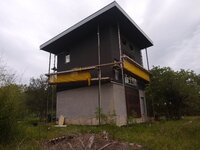
This is a 3 story workshop with possible living area above. 25’x25’. Open interior with a loft.

I’m open to any ideas.

Thanks
 

Fav Onefour

Well-known member
Joined
Jul 14, 2022
Messages
709
Location
MN cold and hot
What type of hatch?
Solar powered attic fans work fairly well. I wonder if you could mount it on your hatch and not create another roof intrusion.

In our cold areas we don't like doing a two layer insulating system for attic space. Without good consistent ventilation, the hot-cold contrast points create problems. I'm having a hard time to figure out why a two layer system is a good idea with your climate. My biggest concern would be the rafter channels all getting consistent vent flow. I get the idea of keeping radiant heat out, but that should be done close to the outer layer. If the attic area is treated as a single space, ventilation I.E. cross ventilation would be easier to manage. Passive ventilation would do the trick.
 

Hank11

Well-known member
Joined
Aug 19, 2019
Messages
1,153
Location
Tennessee
Read this:


Keep in mind that what is appropriate for cold climates is not appropriate for hot climates. You are in a hot humid climate and will be conditioning the inside of your building mostly by cooling the air. You will be making cool dry air most of the year and circulating that through the conditioned space.
 
To avoid these ads, REGISTER NOW!

billconner

Well-known member
Joined
Jul 20, 2021
Messages
6,970
Location
Thousand Islands NYS
The moist air drawn into the vented space will just as likely condensed on the cool vapor barrier on the ceiling as it will on the cool deck. The deck will warm and dry. The vapor barrier won't.
 
OP
B

bluedog225

Well-known member
Joined
Jan 31, 2012
Messages
3,296
Location
Texas
Read this:


Keep in mind that what is appropriate for cold climates is not appropriate for hot climates. You are in a hot humid climate and will be conditioning the inside of your building mostly by cooling the air. You will be making cool dry air most of the year and circulating that through the conditioned space.

Thanks Hank.

Intersting read but I didn’t see where he closed the loop.

Here is what I’ve got (crude drawing below):

1—metal roof
2—ice and water shield
3—Three quarter ply
4–16” lvl as in photo above

I’d have to put closed cell or foam blocks up against the decking. Well sealed. Then some other breathable insulation below the foam. Then leave that whole area uncovered to be part of the conditioned space.

I guess I could do that will cellulose and a netting. But then how to finish off the ceiling so it can get the circulation he is recommending. Each of those lvl’s forms a chamber. A mesh ceiling would not work from an aesthetic point of view.

The only solution I can see is seal the whole deal up with closed cell. And hope for no leaks. Ever.

Or a vented space above the insulation.

I believe I can seal the ceiling. I was thinking nickel gap pine with a moisture barrier above it. All my electrical and lights will be surface mount conduit. Other than the nails holding up the wood, not much in the way of penetrations.

The hatch is contained on all 4 sides by the 16” lvl. There is no central place to ventilate.

The option there is to run 3” pipe to each “chamber” and pipe air in. That’s going to get weird.

IMG_0481.png
 
OP
B

bluedog225

Well-known member
Joined
Jan 31, 2012
Messages
3,296
Location
Texas
The moist air drawn into the vented space will just as likely condensed on the cool vapor barrier on the ceiling as it will on the cool deck. The deck will warm and dry. The vapor barrier won't.

I want to make sure I follow Bill.

The original (and current) plan is to blow in cellulose (or use batts). Leaving a 2” gap above for air flow.

I think the only cool surface for condensation will be the bottom of the roof deck. Mostly after a cool night with a warm humid morning. This currently happens on bare metal in the barn. Drips like heck on occasion.

When this occurs, I’m hoping I have enough air flow to allow it to dry. I have a mildly south facing roof. And I believe cellulose can accommodate, and release, quite a bit of moisture.

With 14” of insulation over the ceiling, I don’t think any of the air conditioned cool air will reach the warm humid under the deck.

Am I understanding your comment?
 

Hank11

Well-known member
Joined
Aug 19, 2019
Messages
1,153
Location
Tennessee
Thanks Hank.

"I’d have to put closed cell or foam blocks up against the decking. Well sealed. Then some other breathable insulation below the foam. Then leave that whole area uncovered to be part of the conditioned space."

No.
Spray the roof deck with open cell foam thick enough to get the R value you want. Leave the bottom of it open in the "attic" space. The attic space is connected to your living space, so it is heated, cooled and de humidified. There is no unconditioned air in the attic. Its dry and nice. It would be the same as if you left the ceiling wide open. That was another suggestion I made. or a ceiling of any kind that allowed inside conditioned air to freely pass to the bottom of the insulation

Sealing the ceiling is exactly what you don't want.

Any moisture on the inside of the living space (and attic if its connected) will come from combustion of gas in a gas heater, cooking, showering, washing. Control that and its fixed. A mini split in your building will do that. (along with proper venting at those sources).
 
OP
B

bluedog225

Well-known member
Joined
Jan 31, 2012
Messages
3,296
Location
Texas
Thanks Hank. This is where the article you linked wasn’t all that clear to me.

I can see open cell throughout and paint it black. That could work. But if the place is alternatively empty, heated, and cooled, I’m not sure how it would do in terms of keeping the deck dry.


IMG_0485.jpeg
 

Hank11

Well-known member
Joined
Aug 19, 2019
Messages
1,153
Location
Tennessee
Thanks Hank. This is where the article you linked wasn’t all that clear to me.

I can see open cell throughout and paint it black. That could work. But if the place is alternatively empty, heated, and cooled, I’m not sure how it would do in terms of keeping the deck dry.


IMG_0485.jpeg
Figure out a way for the mini split to run some every day.

When you’re gone and the building is shut, there won’t be much of a moisture issue but what comes through the floor. If you have a proper vapor barrier there its not a problem.

But any building that is well sealed and left closed up will be unpleasant if left with no air moving. Can you generate enough solar to run a mini split for an hour or two each day? Or just a demidifier?
 

Fav Onefour

Well-known member
Joined
Jul 14, 2022
Messages
709
Location
MN cold and hot
Dang it.
@bluedog225 , I misunderstood that you had an actual attic space and ceiling below. Earlier comments don't help. I can delete those if it helps clean up the thread.

I have one roof portion that is a vault lean to setup. The trusses are 2X10 and the top end is open into the traditional attic space. Crossflow is achieved by soffit venting at the bottom edge. The vault section is insulated with 2" foam board set in the cavities with a layer of 2X4 fiberglass batt laid on top of the foam. The bottom half of the cavity is insulation.

With snow on a roof it was easy to see where it didn't work. I could see where some cavities melted snow while the adjoining cavity was still cold, (properly insulated). The snow melt pattern was inconsistent. I found that sections of the fiberglass had slid down the cavity and essentially blocked crossflow. It was not easy to fix. I used a long pole with a small hood fed from the top and pulled the fiberglass back up. That opened the cavities again. The roof hot spots were eliminated.

The info doesn't help much to come up with a simple answer to your insulation and venting. Your truss system creates a challenge to achieve true crossflow. I can tell you that anything besides a hot roof setup will need crossflow.
 

billconner

Well-known member
Joined
Jul 20, 2021
Messages
6,970
Location
Thousand Islands NYS
I think the only cool surface for condensation will be the bottom of the roof deck. Mostly after a cool night with a warm humid morning. This currently happens on bare metal in the barn. Drips like heck on occasion.
I believe warm moist air will infiltrate through cellulose or fiberglass and condense on the top of ceiling or vapor barrier which is cooled by ac.

Here's one article, but you'll find many similar and few saying on the interior cooler side.


Denwood

Well-known member
Joined
Sep 22, 2014
Messages
4,192
Location
Thunder Bay, Ontario, Canada
If you do closed cell on the decking, at least according to Martin Holliday at GBA, you will see a water leak through at some point if you have a leak. It’s the safest approach for you in my opinion.

I did this to my shop roof (much colder climate) and it has worked out perfectly now over 5-6 years. My guess is that with that low slope roof you already have full underpayment under the roofing, correct?

With your depth, you could likely meet code for vapor barrier with open cell..and in that case a leak will be much quicker to detect.
 
OP
B

bluedog225

Well-known member
Joined
Jan 31, 2012
Messages
3,296
Location
Texas
Yes. Full ice and water shield under double lock standing seam metal. Leak unlikely.

Tempted by closed cell foam on the deck. Still researching. I didn’t know that closed cell would eventually let water through. Thanks
 

Hank11

Well-known member
Joined
Aug 19, 2019
Messages
1,153
Location
Tennessee
You’re in a hot and humid climate. What works up north for roof decks won’t work for you.
 

billconner

Well-known member
Joined
Jul 20, 2021
Messages
6,970
Location
Thousand Islands NYS
If you do closed cell on the decking, at least according to Martin Holliday at GBA, you will see a water leak through at some point if you have a leak. It’s the safest approach for you in my opinion.

I did this to my shop roof (much colder climate) and it has worked out perfectly now over 5-6 years. My guess is that with that low slope roof you already have full underpayment under the roofing, correct?

With your depth, you could likely meet code for vapor barrier with open cell..and in that case a leak will be much quicker to detect.
I'm not disagreeing and makes a lot of sense when there is an attic you can see into, but in this nearly flat roof with ceiling attached to rafters, can you really see this before it's damaged ceiling? I just wonder in this case if it matters?

I think this is already built, correct? And roof is on. I'm pretty sure rigid foam on top of roof deck would have been best but too late. SIPs might be a good choice as well. Apologizes for the hindsight.

I think your plan to create a vented space with rigid foam is good. I might go 3". And I'd undercut foam to allow sealing to rafters with spray foam. I'd count on the ventilation and heat to keep the wood around the vent space dry. And for simplicity use batts under the foam, and a ceiling that would allow drying in. (You could get a little better insulation and leak tolerance with senses pack cellulose between rigid foam and ceiling, but more work.) T&G good but drywall with a permeable paint OK. No interior vapor barrier. The rigid foam would be the warm side vapor barrier.
 
OP
B

bluedog225

Well-known member
Joined
Jan 31, 2012
Messages
3,296
Location
Texas
Yes, it’s built.

Agreed on the 3”. I was thinking of a moisture barrier or retarder on the ceiling to keep living space moisture out of the insulation. And let it dry to the top.

Sounds like you are thinking dry to the bottom.
 

billconner

Well-known member
Joined
Jul 20, 2021
Messages
6,970
Location
Thousand Islands NYS
As I understand it, there will be more moisture at the top or exterior of thermal barrier, so yes, barrier there and let rest of it dry to inside. Lower temperature inside, lower humidity I side.
 

Denwood

Well-known member
Joined
Sep 22, 2014
Messages
4,192
Location
Thunder Bay, Ontario, Canada
The problem is the low slope and a vented space. It won’t do much as convection will also be low.

As far as cold vs warm climates, the only essential difference is where your vapor barrier is going. On hot/humid you want your air and vapor barrier on the outside, with drying potential inward. Reverse for cold.
 
OP
B

bluedog225

Well-known member
Joined
Jan 31, 2012
Messages
3,296
Location
Texas
That’s really what it’s coming down to at this point. Where I put the vapor barrier top or bottom.

I will read up on what you have suggested and do some more research.

Thanks guys.
 
To avoid these ads, REGISTER NOW!
Top Bottom