To avoid these ads, REGISTER NOW!

Attic venting

250

Well-known member
Joined
Oct 16, 2014
Messages
537
Location
West of the Sierras
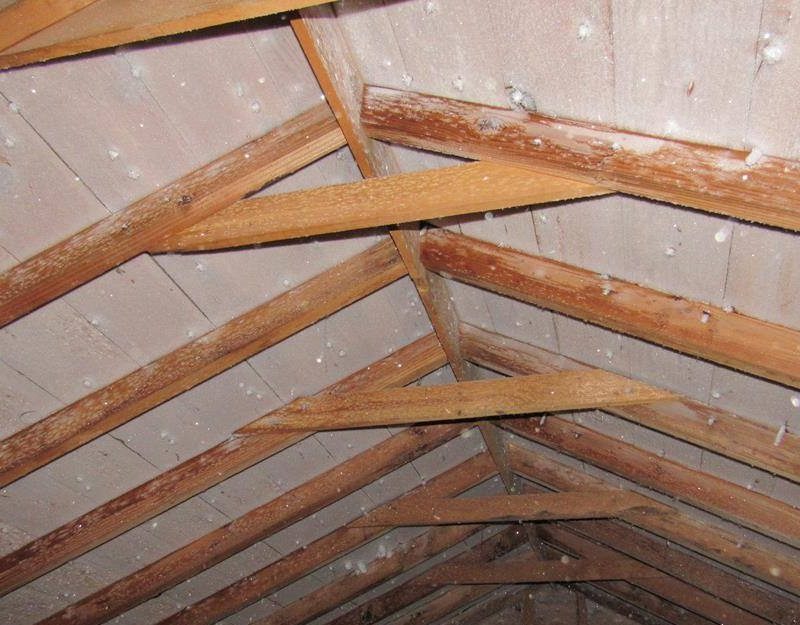
This question really pertains to the house we've been in about a month, which shares a common attic with the garage. I always seem to end up in the attic of every house we buy/rent with in the first couple weeks, so when I was up in the attic of our new to us house, I became suspicious/concerned that it doesn't have the necessary venting. And in the central California foot hills, you need venting.

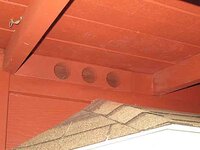
We have rafter blocking vents, like these. (picture from the internet)TDhyE.jpg

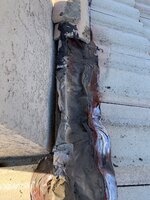
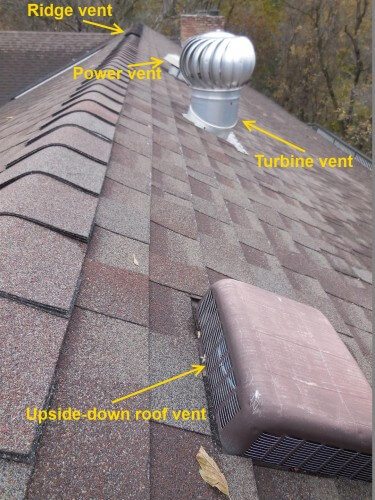
It seemed like we didn't have very many so I set about to see what the recommended amount is. If my scrubby math is correct we have about 1/3 the recommended amount. Then it clicked that I didn't remember seeing anything that looked like ridge venting. There are no fans or spinny things penetrating for ventilation and we have hip roofs all around. I needed to fix a couple slipped tiles, so these are the pictures I took this afternoon. Doesn't look like a ridge vent to me.IMG_4429.jpegIMG_4430.jpegIMG_4431.jpegIMG_4432.jpeg
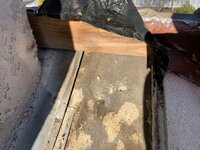
Assuming there isn't a ridge vent, anyone have any insight on how hard it would be for me to add? Or, how expensive it might be to hire out?
 
To avoid these ads, REGISTER NOW!

egdede

ALLIANCE MEMBER
Joined
Dec 20, 2009
Messages
2,063
Looks like you have a concrete roof that mimics clay tiles. those usually will vent to some degree. If I'm seeing it right you are missing a cap piece. Someone tried to flex-seal that **** : ) You need a new cap and you can scrape that sealant out.

You could drill more holes in the blocking if you want, but I'm not sure how'd you figure out if the caps are venting enough to make a difference (you might not need the extra holes at the bottom).
 
OP
2

250

Well-known member
Joined
Oct 16, 2014
Messages
537
Location
West of the Sierras
I'm not missing any tiles. They're sitting off frame. Concrete S tiles with some sort of pink paint originally on them that's bleached to what you see.

I guess I don't understand how with solid sheathing, tar paper, and that sticky layer is going to breath at all. It seems like it would hit 140+ up there in the summer.
 

FMB4

Well-known member
Joined
Jan 19, 2017
Messages
2,926
Quote: "This question really pertains to the house we've been in about a month, which shares a common attic with the garage."

By "common attic" do you mean that there is no partition between the garage attic and the house attic? Code requires a partition between the two (depending on when the house was built).
 

racecougar

Well-known member
Joined
Jan 26, 2021
Messages
4,976
Location
Missouri
Agreed that improving the ventilation of that space is worth doing, and that you should have a firewall separating the garage attic and house attic spaces.

Adding a ridge vent is a fair bit of work, but it is completely doable. Look up "dry ridge for tile roof" and you'll find a number of kits available.
 
OP
2

250

Well-known member
Joined
Oct 16, 2014
Messages
537
Location
West of the Sierras
Correct, I can pass directly from the house, over the breeze way and into the garage while in the attic.

I don't see any obvious problems related to moisture. I've always been under the impression that the hot air that collects up there in the summer needs a way out for better HVAC function and roof preservation.
 

ycgoat

Well-known member
Joined
Mar 28, 2020
Messages
971
Location
S.E. Va
I'm not a fan or believer in attic venting and find the roofing manufactures and contractors are the primary advocates, not surprising. Ignore my views and look at some of the information and research at Building Sciences Corporation. Here's one: https://www.buildingscience.com/documents/reports/rr-0411-vent-on-venting/view
Here most houses have A frame plywood roofs, vented using either ridge vent and soffit vents, or gable end fans and louvers. I have seen more than 1 residence have to replace most or all of the plywood from dry rotting because a home owner added insulation and covered up the vents, blocking air flow.
 

billconner

Well-known member
Joined
Jul 20, 2021
Messages
6,928
Location
Thousand Islands NYS
And where do you think that moisture that leads to dry rot comes from? I think in a heating climate - not what this thread is about but what you offer - the moisture is from inside and that's because detailing for a vapor barrier is poorly done.

Curious if the failure you note had ducts in the uninsulated attic?
 

racecougar

Well-known member
Joined
Jan 26, 2021
Messages
4,976
Location
Missouri
And where do you think that moisture that leads to dry rot comes from? I think in a heating climate - not what this thread is about but what you offer - the moisture is from inside and that's because detailing for a vapor barrier is poorly done.

Curious if the failure you note had ducts in the uninsulated attic?
With the construction detailed in the OP, would you really expect there to be a vapor barrier present in the ceiling?
 

billconner

Well-known member
Joined
Jul 20, 2021
Messages
6,928
Location
Thousand Islands NYS
Since as I understood it he was more concerned about cooling cost and the radiant heat from the roof deck, I didn't think about it. Can't tell from photos of roof or virtually any other info on the house.

If the attic does get hot in cooling season, a gable fan on a thermostat would make sense to me, as opposed to messing with roof.

As far as garage separated from house, 5/8 gwb on ceiling (as I presume there is on the wall) would meet code as I interpret it. Seems easier than building wall in attic (and maybe it's there now - who knows.)

I don't have a lot of interest in discussing attic venting. For heating climates, I've read a lot on it, gone to conferences on house weatherization, listened to and asked questions of Lstiburek and other experts, and believe venting is a heavily marketed product that's a poor bandaid for building defects. Stop warm inside air relatively loaded with water from blowing into the attic, and save money on heating while preventing condensation in the attic and avoiding the cost of venting, which helps **** the warm moist air out of the house.
 

ycgoat

Well-known member
Joined
Mar 28, 2020
Messages
971
Location
S.E. Va
The Attic vents are for Summer where high temperatures and High humidity cause the rot. The attic is an unconditioned space and needs dehumidification.
 

FredWanaker

Well-known member
Joined
Mar 27, 2021
Messages
1,470
Location
NorCal
so California foothills equals fire danger. You'll want to look at some eave vents that seal if a fire gets too close. New codes, California Building code SFM 12-7A, cover it in some urban areas. California foothills also equals bats. blue jays, and squirrels. Make sure there are no ways in.

vulcan-eave-lg.jpg
 
OP
2

250

Well-known member
Joined
Oct 16, 2014
Messages
537
Location
West of the Sierras
so California foothills equals fire danger.
Indeed it does. I've got some screens already ordered to replace the wide open mesh that's there.

The insulation looks like my pre-schooler sprayed it in. Large bare patches out towards the exterior walls. A huge pile in the middle of the family room. No protection for the vents, so that's getting remedied as well.


Since as I understood it he was more concerned about cooling cost and the radiant heat from the roof deck, I didn't think about it. Can't tell from photos of roof or virtually any other info on the house.

If the attic does get hot in cooling season, a gable fan on a thermostat would make sense to me, as opposed to messing with roof.

As far as garage separated from house, 5/8 gwb on ceiling (as I presume there is on the wall) would meet code as I interpret it. Seems easier than building wall in attic (and maybe it's there now - who knows.)

I don't have a lot of interest in discussing attic venting. For heating climates, I've read a lot on it, gone to conferences on house weatherization, listened to and asked questions of Lstiburek and other experts, and believe venting is a heavily marketed product that's a poor bandaid for building defects. Stop warm inside air relatively loaded with water from blowing into the attic, and save money on heating while preventing condensation in the attic and avoiding the cost of venting, which helps **** the warm moist air out of the house.
The Attic vents are for Summer where high temperatures and High humidity cause the rot. The attic is an unconditioned space and needs dehumidification.
Correct, its the potential for really hot temps that I'm most concerned. This house doesn't have any gables, hips on every side, otherwise I'd agree that a fan would be the path of least resistance. I also read through the link up thread. I found it good for definitions but not really any further.

There is 5/8ths in the garage.

I shot this from the back yard when I got home, to help illustrate the picture. Garage is on the right.
IMG_4433.jpg
 

Hank11

Well-known member
Joined
Aug 19, 2019
Messages
1,137
Location
Tennessee
I think adding some "spinny things" might be in order. Or there might be a way to vent the ridge - look around locally for that idea. One problem with asking here is that a guy from Alabama or Wisconsin might know a lot about their area and nothing about yours. In California, you also likely have very strict requirements for what you can and can't do. And you have a pretty dry climate to start with, so humidity may be manageable just as it is now.
 

rayra

Well-known member
Joined
Dec 1, 2014
Messages
4,724
Location
Escaped from Los Angeles
Since as I understood it he was more concerned about cooling cost and the radiant heat from the roof deck, I didn't think about it. Can't tell from photos of roof or virtually any other info on the house.

If the attic does get hot in cooling season, a gable fan on a thermostat would make sense to me, as opposed to messing with roof.

As far as garage separated from house, 5/8 gwb on ceiling (as I presume there is on the wall) would meet code as I interpret it. Seems easier than building wall in attic (and maybe it's there now - who knows.)

I don't have a lot of interest in discussing attic venting. For heating climates, I've read a lot on it, gone to conferences on house weatherization, listened to and asked questions of Lstiburek and other experts, and believe venting is a heavily marketed product that's a poor bandaid for building defects. Stop warm inside air relatively loaded with water from blowing into the attic, and save money on heating while preventing condensation in the attic and avoiding the cost of venting, which helps **** the warm moist air out of the house.

I'm sure that is reasonable for upstate NY. It's completely worthless for the heat and relative lack of humidity in central CA or much of the desert southwest.
115F last summer here in Vegas. The heat soak in my under-ventilated and under-insulated attic/ceiling meant my AC was kicking on at 0300 when outside temps were 50deg cooler than my attic.
Nor do I care to have to pay for electricity for a thermostat-controlled gable vent to run practically 24/7 in the summer months, if I can achieve better cooling thru passive means.
Not sure what point you think you are supporting with that BSC article link, but "So, an unvented attic means the same thing as a sealed attic" is complete and utter garbage. Because if an attic is not deliberately sealed and intended to conditioned space, then it IS 'venting', albeit in a vastly insufficient manner.
I'm sure there are articles there about solar insolation, passive heat exchange / ventilation. And we can be sure they don't support your blithe and picayune and regionally-circumscribed dismissal of attic ventilation.
 
Last edited:

rayra

Well-known member
Joined
Dec 1, 2014
Messages
4,724
Location
Escaped from Los Angeles
I think adding some "spinny things" might be in order. Or there might be a way to vent the ridge - look around locally for that idea. One problem with asking here is that a guy from Alabama or Wisconsin might know a lot about their area and nothing about yours. In California, you also likely have very strict requirements for what you can and can't do. And you have a pretty dry climate to start with, so humidity may be manageable just as it is now.
It's going to be difficult and costly to retrofit a high mount vent solution in that kind of roof. I've got the same problem here in Vegas. Totally inadequate soffit vents and no ridge or turbine vents. And my gable vents are also undersized. I've been trying to find decent solutions for a year and it is going to come down to enlarging my gable vents and adding two turbines in a small inset of asphalt shingling which underpins my rooftop HVAC package. Set as high in the upper corners as I can fit them. And massively upgrading the insulation layer at the ceiling. AND possibly some radiant barrier on the roof rafters, under the decking.

I retrofitted our Los Angeles house using a hole saw in the blocking boards, 3 holes to a section, every other section. By my math I quadrupled the amount of open area. I stapled aluminum screen mesh across the holes and repainted with an HVLP sprayer and they mostly disappeared from notice without clogging the screens. Then I added an additional turbine. There were 2 already. Dropped our summer electricity bill by about $125 / mo. Also put down a layer of encapsulated R19 over the master suite to further reduce the heat radiating down from the ceiling.
 

Attachments

  • soffitnew.jpg
    soffitnew.jpg
    32.4 KB · Views: 13
To avoid these ads, REGISTER NOW!

ycgoat

Well-known member
Joined
Mar 28, 2020
Messages
971
Location
S.E. Va
If heat soak is the primary concern and moisture reduction is a secondary concern, I would add a perforated radiant barrier under the roof which should greatly reduce the attic temps and if installed properly would not interfere with the air flow you have now.
 

billconner

Well-known member
Joined
Jul 20, 2021
Messages
6,928
Location
Thousand Islands NYS
The title of this thread is "Attic venting". Attic venting is the whole point of this discussion.
I should have said I don't have a lot of interest in discussing my opinions of attic vents. I tried to understand the op's issue - which is heat not moisture - and referred him to a good source.
 

Hank11

Well-known member
Joined
Aug 19, 2019
Messages
1,137
Location
Tennessee
It's going to be difficult and costly to retrofit a high mount vent solution in that kind of roof. I've got the same problem here in Vegas. Totally inadequate soffit vents and no ridge or turbine vents. And my gable vents are also undersized. I've been trying to find decent solutions for a year and it is going to come down to enlarging my gable vents and adding two turbines in a small inset of asphalt shingling which underpins my rooftop HVAC package. Set as high in the upper corners as I can fit them. And massively upgrading the insulation layer at the ceiling. AND possibly some radiant barrier on the roof rafters, under the decking.

I retrofitted our Los Angeles house using a hole saw in the blocking boards, 3 holes to a section, every other section. By my math I quadrupled the amount of open area. I stapled aluminum screen mesh across the holes and repainted with an HVLP sprayer and they mostly disappeared from notice without clogging the screens. Then I added an additional turbine. There were 2 already. Dropped our summer electricity bill by about $125 / mo. Also put down a layer of encapsulated R19 over the master suite to further reduce the heat radiating down from the ceiling.

It might be costly, or might not. I supposed there are many houses built like that one and probably a solution (or a hundred) has been developed. Seems like the tiles on the ridge could be relaid with a gap?
 

billconner

Well-known member
Joined
Jul 20, 2021
Messages
6,928
Location
Thousand Islands NYS
I'm sure that is reasonable for upstate NY. It's completely worthless for the heat and relative lack of humidity in central CA or much of the desert southwest.
115F last summer here in Vegas. The heat soak in my under-ventilated and under-insulated attic/ceiling meant my AC was kicking on at 0300 when outside temps were 50deg cooler than my attic.
Nor do I care to have to pay for electricity for a thermostat-controlled gable vent to run practically 24/7 in the summer months, if I can achieve better cooling thru passive means.
Not sure what point you think you are supporting with that BSC article link, but "So, an unvented attic means the same thing as a sealed attic" is complete and utter garbage. Because if an attic is not deliberately sealed and intended to conditioned space, then it IS 'venting', albeit in a vastly insufficient manner.
I'm sure there are articles there about solar insolation, passive heat exchange / ventilation. And we can be sure they don't support your blithe and picayune and regionally-circumscribed dismissal of attic ventilation.


By all means don't pay for electricity to run a gable fan, use a solar powered one. Perfect match.

A couple more articles on venting in heating climates, not for the cooling climates like the OP:
 
OP
2

250

Well-known member
Joined
Oct 16, 2014
Messages
537
Location
West of the Sierras
I retrofitted our Los Angeles house using a hole saw in the blocking boards, 3 holes to a section, every other section. By my math I quadrupled the amount of open area. I stapled aluminum screen mesh across the holes and repainted with an HVLP sprayer and they mostly disappeared from notice without clogging the screens. Then I added an additional turbine. There were 2 already. Dropped our summer electricity bill by about $125 / mo. Also put down a layer of encapsulated R19 over the master suite to further reduce the heat radiating down from the ceiling.

Yep, using a dry ridge system as said above.

This is the direction I'm headed. After a little googling I think I could do the dry ridge vent retrofit in a couple weekends. I'll have to pick a system, then see how hard it is to obtain. I'm trying to get as much of the attic work done during the cooler months. Hopefully most of that stuff can be done by May.

I found some #8 stainless mesh though some nearly equivalent sized aluminum screen is significantly cheaper. I'll need to see if there is any information to push it one way or another.
 
OP
2

250

Well-known member
Joined
Oct 16, 2014
Messages
537
Location
West of the Sierras
This system looks promising, and it makes sense to me conceptually.

Screen Shot 2022-01-26 at 8.53.08 PM.png


This one looks easy to install, but conceptually doesn't seem like it would flow air as well.

Screen Shot 2022-01-26 at 8.54.08 PM.png
 

ericm

Well-known member
Joined
Apr 17, 2016
Messages
1,963
Location
Southern Oregon
I think adding some "spinny things" might be in order.

Whatever vents are used should meet current California code for ember entrance if your house is in the WUI. Not only to be legal but also so your house does not burn. Embers blowing into the attic through vents or gaps are a major cause of ignition. I have not seen any turbine vents that meet the code but I might have missed some. Many of the WUI code vents have more than just wire mesh, like labyrinths that trap embers or even intumescent paint that swells up when it get hot and closes off the vent. Those might be a good idea for eave vents since the eaves trap heat.

Also there's a code requirement (US code not California WUI code) for ventilation area. You can find calculators on the internet. If you're concerned about having enough ventilation that would be a start. The vent fittings reduce effective vent area so that should be taken into account.
 

TRWham

Well-known member
Joined
Aug 11, 2017
Messages
1,955
Location
East Cobb County, Georgia
Quote: "This question really pertains to the house we've been in about a month, which shares a common attic with the garage."

By "common attic" do you mean that there is no partition between the garage attic and the house attic? Code requires a partition between the two (depending on when the house was built).
What code requires such a partition in the attic?
 

rayra

Well-known member
Joined
Dec 1, 2014
Messages
4,724
Location
Escaped from Los Angeles
This is the direction I'm headed. After a little googling I think I could do the dry ridge vent retrofit in a couple weekends. I'll have to pick a system, then see how hard it is to obtain. I'm trying to get as much of the attic work done during the cooler months. Hopefully most of that stuff can be done by May.

I found some #8 stainless mesh though some nearly equivalent sized aluminum screen is significantly cheaper. I'll need to see if there is any information to push it one way or another.
The few original soffit vents in our Los Angeles house had a mesh with a grid that looked about 3/16", bird and bee / wasp blocking. We had several large brush / forest fires all around us over many years, so I deliberately chose the finer window screen with burning embers in mind.

I've been looking at retrofitting some sort of ridge vent, but with my concrete spanish tile style, there's no way I can get up on it to do the installation without a lot more work and expense. Thus the gable vent expansion and turbines. Those I can access and do without destroying roof tiles or having to remove a mess of them.

/hmm I could try removing a small path upslope from the asphalt shingled area around the rooftop AC, then likewise remove enough tiles at the peak to let me cut in a ridge vent without tromping all over the tiles. Other problem here is when it is cool enough for such work, it can get pretty dang windy. So to do the work it will have to be in one-day segments. Strip tile, cut / install ridge vent segment, re-install tiles in same-day increments. Because sure enough if I detach a mess of tiles on all the ridges, we'll have a 50mph windstorm while they are loose.
 

rayra

Well-known member
Joined
Dec 1, 2014
Messages
4,724
Location
Escaped from Los Angeles
What code requires such a partition in the attic?
Fire / construction code in CA and NV, for starters. The roof over the residence is sheathed as normal and then the garage roof rafters are laid and sheathed. On the theory that the sheathing acts as a fire block to delay the spread of the fire.
If instead the peak of your garage and house are in line, the dividing wall is supposed to run clear to the peak of the roof, extending completely above the ceiling line.
Part of the same codes that require fire-rated and self-closing doors between garage and house proper in attached garages.
Those codes were in effect in our 1969 L.A. house and our '94 Vegas house.
 

FredWanaker

Well-known member
Joined
Mar 27, 2021
Messages
1,470
Location
NorCal
the issue on vents is being missed by some. After the Santa Rosa (2017) and Paradise (2018) fires the state changed its fire codes, and rightfully so. Many homes burned because tiny embers went in thru the standard vent screens, burning homes to the ground that would have been safe otherwise. The state changed rules on venting, and the manufacturers came up with new products. Those new products act like a normal vent until exposed to embers and heat - then they seal themselves completely so embers can't get into the attic or crawl areas if they are vented. I will probably change all my vents here to that style when I have time even though we are not in a "fire area." After the Santa Rosa fire, it became apparent that NO house in California is safe from a fire - these embers can travel in the air and rain down from the sky so many miles away where they start new fires.

The Santa Rosa fire was in a typical northern California area of miles of tract homes that you could find in any part of the USA.


174212-full.jpg
 
Last edited:

TRWham

Well-known member
Joined
Aug 11, 2017
Messages
1,955
Location
East Cobb County, Georgia
Fire / construction code in CA and NV, for starters. The roof over the residence is sheathed as normal and then the garage roof rafters are laid and sheathed. On the theory that the sheathing acts as a fire block to delay the spread of the fire.
If instead the peak of your garage and house are in line, the dividing wall is supposed to run clear to the peak of the roof, extending completely above the ceiling line.
Part of the same codes that require fire-rated and self-closing doors between garage and house proper in attached garages.
Those codes were in effect in our 1969 L.A. house and our '94 Vegas house.
Exactly. It's local and there is no such code generally. Even the latest IRC does not call out any more than 1/2" of drywall on the wall and ceiling (except if below habitable space then 5/8" type X) with a solid (or 20 minute rated) self-closing door.
 

Steve_P

Well-known member
Joined
Sep 15, 2010
Messages
5,181
My house didn't have a ridge vent, so I did a bunch of research on this when I was about to get a new roof; a ridge vent is the way to go. There are studies done by one of the US DOE research labs on this showing the ridge vent wins.
 

billconner

Well-known member
Joined
Jul 20, 2021
Messages
6,928
Location
Thousand Islands NYS
Exactly. It's local and there is no such code generally. Even the latest IRC does not call out any more than 1/2" of drywall on the wall and ceiling (except if below habitable space then 5/8" type X) with a solid (or 20 minute rated) self-closing door.
Correct. And he has 5/8 on garage ceiling.
 

ericm

Well-known member
Joined
Apr 17, 2016
Messages
1,963
Location
Southern Oregon
The WUI regs went into effect in the state code in 2008.

Some homes in Paradise were built to the WUI code. More of them survived but a primary factor was proximity to another building. Some folks did a study on house survival in the Camp fire. See https://fireadaptednetwork.org/return-to-paradise/
it's an article about the study by one of the authors but the study is linked there as well.

Intumescent paint is not required for vents to meet the code though it is a way that some do. The vents still need to resist ember entry. Since embers can travel a long ways they could arrive before the heat from a fire shut the vents. For my shop I plan to use regular ember resistant vents in the gable ends and ember resistant + intumescent paint vents in the eaves where the temperatures could be higher as a fire approaches. Hopefully that would reduce the heat that goes into the attic.

vent info:
 
To avoid these ads, REGISTER NOW!
Top Bottom