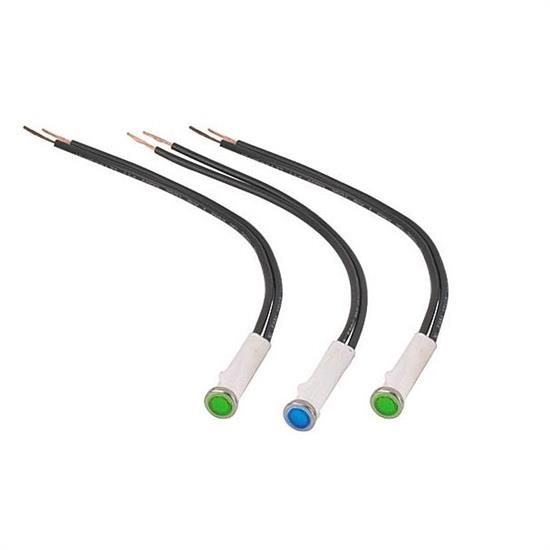
LEDs can vary in brightness depending on the current going through them. Typically an LED is spec'ed to have a given voltage drop (say 1.8V for red) at a given current through the LED (say 70mA). This is a hypothetical red LED (hypthetical but realistic numbers). If the current flow through the LED is higher than 70mA, say 100mA the output will be brighter but the LED life may be significantly shorter. The rated current and voltage is picked because its either the brightest level with reasonable life or the most efficient output level.
If I take my red LED and up the current to say 200mA I will probably burn it out. If I drop the current to say 10mA the output will be dimmer but it may still illuminate. At that current the voltage drop may be 1.5V. My kids have some cheap LED flashlights. These are the ones with a simple current limiting resistor and powered by 2AA batteries. They go from bright to dim rather quickly but it amazes me how long the things can go (literally days) at low output with near dead batteries. So instead of the 3V from new AA cells, the light is running on 1.8V from two very low batteries.
One option the OP could take is to add an additional resistor to further limit the current to the light. It will dim the light when on, and further dim the off state.
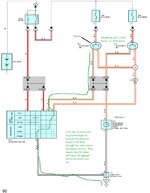
Finally, I wish I had an example but I think it is worth stressing, the circuit might actually be designed to work this way. It's possible this system was designed to send some small amount of current through the intended incandescent lamp at all times. That current would be used to power or sense something in the system. This might be done with a large resistor in line with the lamp. Thus the lamp never gets enough current to visibly light but current still flows. When the high beams are turned on the resistor might be shorted thus full current to the lamp.
Side:
I'm not sure that everyone understand what a current limiting resistor is. Taking my LED example, I need 70mA and 1.8V through my LED. The car is providing 12V. Clearly 12V is too much. However, with the right resistor I can limit the current flow through the resistor to just 70mA. I take 12V - my 1.8V voltage drop across the LED. That gives me 10.2V that I need to drop via the resistor. V=IR, I want I to be 70mA (0.07A), and I want V=10.2. So the resistor that will limit my current to 70mA is 10.2V/0.07A=146ohms.
Here is some more information about current limiting resistors.

www.sparkfun.com