To avoid these ads, REGISTER NOW!

Auto Shops and Compressed Air Systems

vandalthree

Member
Joined
Jul 29, 2016
Messages
23
A friend of mine is a full-time automotive tech and I asked him what line pressure has been used in some of the shops he's worked at. He said 150-175 PSI. I was appalled, I couldn't believe it. Is this common?

I've heard wet air lines are common and shop owners/managers don't know how or don't care to fix it. That alone would piss me off but 150-175 PSI line pressure and I would refuse to use my air tools in that shop.
 
To avoid these ads, REGISTER NOW!

claas880

Well-known member
Joined
Sep 28, 2013
Messages
55
Location
appleton wi
I would rather run all my air tools 150- 175 psi. it really brings them to life. most shops I have seen run higher pressures.
 

Jake C

Well-known member
Joined
Dec 7, 2015
Messages
138
Location
Washington
My shop runs 150-175 also, nothing is regulated, I think I'm gonna throw a air water separator in my bay though, just to protect my air tools and such. I run 100-150 at my shop, all regulated and cleaned.
 

Ruger_556

Well-known member
Joined
Dec 8, 2013
Messages
4,005
Every shop I've worked in has been around 150, you just don't have enough air below that range. I have ours set at 140 psi right now at work.
 
OP
V

vandalthree

Member
Joined
Jul 29, 2016
Messages
23
I guess if it's up to the individual each guy could make his own decision. I wouldn't like being forced; the attitude of "This is how we do it, get on board or leave." Personally, I see using higher pressures as dangerous and damaging. My tools don't disappoint me at lower pressures in a semi-professional setting.

I would rather run all my air tools 150- 175 psi. it really brings them to life. most shops I have seen run higher pressures.
 

Leaflessshadetree

Well-known member
Joined
Aug 1, 2013
Messages
7,146
Location
Don't ask.
I guess if it's up to the individual each guy could make his own decision. I wouldn't like being forced; the attitude of "This is how we do it, get on board or leave." Personally, I see using higher pressures as dangerous and damaging. My tools don't disappoint me at lower pressures in a semi-professional setting.

So the shop pressure is high it isn't a problem.
Point of use regulators allow you to set the pressure lower for the tool/task.
 

MrGiggles

Well-known member
Joined
Dec 11, 2014
Messages
2,524
You have to remember that 150-175 psi at the tank will never be that high at the tool.

By the time you go through the piping, water separator, the hose, and the quick connect, you are much closer to the rated working pressure of the tool.
 

jhelrey

Well-known member
Joined
Sep 15, 2010
Messages
7,240
Location
MN
Shop my buddy owns runs at 165. I run mine all at 155.

The tools work way better!

Just gotta drain the line furthest away from the tank every so often. They like to collect water.
 

md21722

Well-known member
Joined
Nov 30, 2015
Messages
1,840
Location
Mt Juliet, TN
Air tools are usually rated for 90 PSI.

The common mistake people make is to put a regulator at the compressor for 90 PSI. Then you get pressure drop through all the lines and hoses and your tools see far less.

In my opinion, the best way to do it, is run your lines at normal compressor output, then regulate down at point of use.

Put a gauge at the tool and set the regulator at the drop accordingly. Then, everything works as expected.

If you set the regulator with a 25 foot hose, then decide to work in the driveway one day with another 50 feet of hose, the regulator in the shop would need to be adjusted up accordingly.
 

slow_mow

Well-known member
Joined
May 6, 2016
Messages
58
Location
Middletown, CA
My compressor at work is set up at 150PSI unregulated. I can definitely feel the loss of power when using my air tools at home at 120PSI. 150 is the way to go if your compressor will do it.
 

dnschmidt

Well-known member
Joined
Oct 3, 2014
Messages
7,265
Location
Phoenix, AZ
This unfortunately is extremely common. Most air tools can handle this but there are some types that will not tolerate these pressures. I sell impacting ratchets and this particular class of tool will not tolerate these high pressures. It eventually kills them. When I sell these I tell people if you exceed 110 PSIG at the tool I will not guarantee them.
 
To avoid these ads, REGISTER NOW!

Skin

Well-known member
Joined
Feb 24, 2010
Messages
11,713
Location
Boston
Air tool specs given as 90PSI and X CFM are with the valve/trigger open (working pressure) so you don't want a static 90PSI which is why your air tool internals don't explode left right and center despite being hooked up to a tank filled to 150-175PSI. After filters, fittings, and a bunch of air hose you're working pressure could be dropping nearly 25% (or even more especially in a large shop) from the static line pressure. In other words if you regulate down the tank to 90PSI and pull the trigger your pressure (which should be 90) might drop down to about 65 and then you'll go on GJ and complain that X brand has no balls and is junk when in actuality if you set your compressor to fill to 125-130PSI you'd be getting an honest 90PSI at the tool and seeing its real performance.

So yea a lot of shops might be running 150-175PSI but if you take into account its a multi-bay shop with lines running hundreds of feet and all kinds of connectors and fittings, even unregulated, their tools are probably operating far closer to their specified pressures than you think.
 
Last edited:

ItsNemo

Well-known member
Joined
Mar 5, 2016
Messages
4,805
Location
Canada
What I find funny about people saying their tools wake up at 120+ psi is I will run 90-100psi static pressure (usually 80-90ish running pressure at the regular) on my lines and never have an issue with power in any tools.

Just get a whip with an inline regulator if the shop is running higher than you want to use.
 

170-3tree

Well-known member
Joined
Feb 19, 2016
Messages
60
My shop runs 190 at prime time. There is a bit of water suppression, but I still walk around and blow the lines a few times a week. It's not nearly as bad as my last shop though. Those pressures make for easy lug stud destruction in the hands of someone used to 100psi units.
 

KWtech90

Well-known member
Joined
Feb 28, 2016
Messages
149
The air system at work produces more water than it does air. Removing a tire produces approximately 8 ounces of water out of the exhaust port of an air impact. After complaining I finally got fed up and switched to cordless.
 

Finky198

Well-known member
Joined
Feb 25, 2014
Messages
2,120
Location
North East
My lines are 140 to 175 and regulated at 135 which delivers 90 down 50 ft of 3/8 to a 1/2 air gun.

This exactly what I do and ihmo is the best solution :beer:
We use 1/2" line but the same principle...reg set at 130 and I get no more the 110 psi at the tool after the 50' hose reel... The tools perform properly and if there not cutting it it time for a bigger tool... :lol:


if you ran a guage at your tool you would see the pressure drops...
To achieve full power at the tool end you need to maintain the pressue above 90 psi during flow. Doing this requires a slight increase pressure but when it reaches the tool its well within the working limits of 90psi....:thumbup:
 
Last edited:

JKady

Well-known member
Joined
Jan 3, 2012
Messages
349
Location
Spanaway, WA
I've never worked in a shop that didn't run max PSI at the compressor, all my tools have held up fine. As far as water in the lines goes, the vast majority of places I've worked it's been SOP to drain the compressor every night, and we usually had drains at the opposite ends of long runs as well, never had a problem. The shop I'm in currently we run the compressor at about 155, no tool casualties to report.

As far as the "This is how we do it, get onboard or get out", uh... have you ever worked for anyone? That's pretty much universal in any job or industry I've ever been in.
 

lazer50

Well-known member
Joined
Aug 12, 2016
Messages
606
Location
east central indiana
Most employers aren't concerned about air tools.thats usually up to the fella on what quality he buys whether he looks at specs or not and if he regulates what he uses.i worked for a company that had a centrally located industrial compressor piped to 4 different plants over 4 city blocks.not only was it powering tool plumbing but machinery as well.it was regulated between 125-150 but produced high c f m that's where alot of air tool equipment will fail.the only tools that held up without failure where dotco dynadrade and ir industrial.my snap on blue point ingersoll rand and several i thought were professional tools would need rebuilt often especially die grinders cut offs etc.so i regulated my tools at the tool
so from my experience i recommend knowing what your operating specifications are on your tools.knowing what c f m s the compressor puts out @100 psi for example.some tools may seem like they work better at higher psi but they might not be specified to operate under those conditions or be warranties.i know i want my tools to last and am sure you guys do to.
 

Packard V8

Well-known member
Joined
Mar 16, 2009
Messages
7,380
Location
Spokane, WA
so from my experience i recommend knowing what your operating specifications are on your tools.knowing what c f m s the compressor puts out @100 psi

Interesting. I've never thought much about high CFM affecting tool life. Obviously, a high-demand air tool, such as a grinder, will not perform to spec with insufficient CFM, but exactly how does unlimited CFM availability within specified operating PSI harm tools?

jack vines
 

redwrench60

Well-known member
Joined
Sep 10, 2011
Messages
6,062
Location
East Tennessee
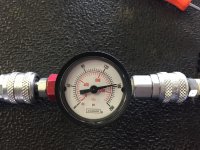
Air tool pressure requirements are often misunderstood. The recomendation of 90 psi Max is a spec meant to be measured under dynamic conditions. Meaning 90 psi measured at the tool under full throttle no load free speed. In other words adjust your tank regulator to whatever it takes to achieve 90 psi at the tool under full no load speed. This has been confirmed here again and again by air tool manufacturers.

Here's the static (at rest) pressure measured at my line drop today at the shop. We hover between 150-170.
 

Attachments

  • image.jpg
    image.jpg
    138.4 KB · Views: 33

redwrench60

Well-known member
Joined
Sep 10, 2011
Messages
6,062
Location
East Tennessee
Here it is with my impact connected and under full throttle free speed. As you can see it doesn't meet max spec. It takes a hell of a supply system to meet demand and most fall short but don't know it. Sorry about the upside down pic.
 

Attachments

  • image.jpg
    image.jpg
    132.7 KB · Views: 37

lazer50

Well-known member
Joined
Aug 12, 2016
Messages
606
Location
east central indiana
I dont know the dynamics of measuring air pressure as redwrench60 stated and sure he's correct.but thru experience regulate my tools@90 at the tool.and yes when i was young i had instances where i thought my impact or any given tool performed better un-regulated.but for longer tool life especially buying a quality air tool i would regulate them its not that expensive.as far as how it damages an air tool running at higher psi.i cant speak from a manufacturers point except that in alot of situations i wasn't able to warranty tools.that's because either that particular truck dealer knew my work conditions or i sent a tool in and it was deemed worn out in an untimely manner or something to that effect.but in those cases my employer would pay for a rebuild or replacement.now what it did to the tools from what i could tell is wear out bearings fast and worm gears on grinders.wear out the hammers on impacts.but on another note in my home shop.i put in a compressor that the manufacturer says puts out 175psi and puts out 29 c f [email protected] runs between 125 and 140 but i still regulate my tools even at home.
 

Farmall450

Well-known member
Joined
Dec 23, 2011
Messages
13,355
Location
Marengo, Illinois
The air system at work produces more water than it does air. Removing a tire produces approximately 8 ounces of water out of the exhaust port of an air impact. After complaining I finally got fed up and switched to cordless.

I hope you're joking :wtf:
And they do have drains, somewhere.
 
To avoid these ads, REGISTER NOW!
Top Bottom