To avoid these ads, REGISTER NOW!

Automotive DMM

SuzukiGS750EZ

Well-known member
Joined
Apr 26, 2012
Messages
3,273
Just bought a fluke 117 and realized it has everything I want, but noticed it was missing mA. How often do you use this in automotive? I usually just use for voltage and continuity or to verify specs, but can't remember using mA?
 
To avoid these ads, REGISTER NOW!

Rabid Badger

Well-known member
Joined
Apr 2, 2018
Messages
1,338
Just bought a fluke 117 and realized it has everything I want, but noticed it was missing mA. How often do you use this in automotive? I usually just use for voltage and continuity or to verify specs, but can't remember using mA?

mA range is useful for finding parasitic loads that drain your battery.

However, for that kind of thing I use a Uni-T UT210e clamp meter. Instead of having to break the circuit you can just clamp it over a conductor and read down to 1mA. You can pick one up for $30-45 depending on where you look and how long you're willing to wait. It's also a pretty well made meter; doesn't feel cheap at all. The next-cheapest clamp meter I know of that can do mA is $90.
 

Bartleby

Well-known member
Joined
Dec 23, 2017
Messages
74
Location
California
Just bought a fluke 117 and realized it has everything I want, but noticed it was missing mA. How often do you use this in automotive? I usually just use for voltage and continuity or to verify specs, but can't remember using mA?

I never use it.

I use a low amp probe or a clamp meter for measuring currents.
 
OP
S

SuzukiGS750EZ

Well-known member
Joined
Apr 26, 2012
Messages
3,273
mA range is useful for finding parasitic loads that drain your battery.


However, for that kind of thing I use a Uni-T UT210e clamp meter. Instead of having to break the circuit you can just clamp it over a conductor and read down to 1mA. You can pick one up for $30-45 depending on where you look and how long you're willing to wait. It's also a pretty well made meter; doesn't feel cheap at all. The next-cheapest clamp meter I know of that can do mA is $90.
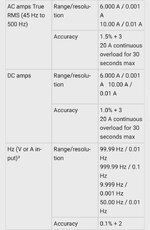
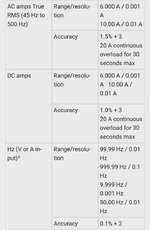
I do parasitic draw tests across the fuses. Though I used to do it that way. Does the amp accuracy specs state that it would go down to ma to see parasitic draw...?06efb7730fec418aab816502e5710d5c.jpg
 

Attachments

  • 06efb7730fec418aab816502e5710d5c.jpg
    06efb7730fec418aab816502e5710d5c.jpg
    58.8 KB · Views: 0

JiminAZ

Well-known member
Joined
Jul 11, 2018
Messages
341
Location
Phoenix, AZ
Looks like from the table in post #4, resolution is 10 ma DC (.01A). I'd imagine that's fine for finding most parasitic draws.

I was poking around on Amazon, looks like the Uni-T UT210e meter is sold under a couple of different brands. Be careful found one exceptionally cheap lookalike but it didn't do DC current with the clamp meter (no Hall effect capability).
 
Last edited:

Rabid Badger

Well-known member
Joined
Apr 2, 2018
Messages
1,338
Yes. mA means milliamp. uA is the shorthand for microamp.

I've never heard of anyone using the microamp range for automotive work.
 
OP
S

SuzukiGS750EZ

Well-known member
Joined
Apr 26, 2012
Messages
3,273
So this meter will be fine for automotive? I mostly use my meter for residential but also continuity, resistance and voltage. 10 milliamps is low enough for testing across the battery? I normally read across the fuses and use a chart to see the values.
 
OP
S

SuzukiGS750EZ

Well-known member
Joined
Apr 26, 2012
Messages
3,273
The meter I have now I've never been happy with. Continuity buzzer is almost non existent. It shuts off randomly. I had it replaced once. The fluke meter my grandfather has, 88v, is a great meter and this one fit my bill. I saw all the specs and upon purchase I realized, no ma... lol
 

MattT

Well-known member
Joined
Feb 20, 2010
Messages
3,201
I do parasitic draw tests across the fuses. Though I used to do it that way. Does the amp accuracy specs state that it would go down to ma to see parasitic draw...?

It states 1mA resolution on the 6A range and 1% accuracy +/- 3 digits. With a 10mA current it'll read somewhere between 7 & 13mA in theory. I wouldn't trust it to actually meet that but it might be close enough for parasitic draw testing.

Also since you're volt dropping fuses check to see what mV accuracy the meter is capable of.
 

2ndGearRubber

Well-known member
Joined
Mar 24, 2014
Messages
14,185
Location
Pittsburgh
I never use it.

I use a low amp probe or a clamp meter for measuring currents.

The meter I have now I've never been happy with. Continuity buzzer is almost non existent. It shuts off randomly. I had it replaced once. The fluke meter my grandfather has, 88v, is a great meter and this one fit my bill. I saw all the specs and upon purchase I realized, no ma... lol


Low amp probe and a lab scope is what you want for low amp situations. I've seen little value in the amp settings on meters. Unless you regularly have parasitic draws, you have no need for any amp readings on a meter. Look at the AESWave U-scope, that's what you want to look at amps.


I don't even bother with meters for draws either, amp probe on the scope, there you go.
 
To avoid these ads, REGISTER NOW!

JiminAZ

Well-known member
Joined
Jul 11, 2018
Messages
341
Location
Phoenix, AZ
For the instrumentation guys in any industrial plant, most control loops run either 4-20 mA or 1-5 volts. For the mA stuff our guys use nice portable Fluke meters IIRC (in circuit not a donut)

But I digress. The meter under discussion does resolve 1 mA when set on the 6A range. My mistake I read the resolution when on the 10A range.
 
Last edited:

Rabid Badger

Well-known member
Joined
Apr 2, 2018
Messages
1,338
It states 1mA resolution on the 6A range and 1% accuracy +/- 3 digits. With a 10mA current it'll read somewhere between 7 & 13mA in theory. I wouldn't trust it to actually meet that but it might be close enough for parasitic draw testing.

Also since you're volt dropping fuses check to see what mV accuracy the meter is capable of.

That's the worst possible accuracy, they're usually better than that. Mine is dead-on with my 87V.

So... it'll be fine for my uses?

Yes.
 

Fluelikesymptoms

Well-known member
Joined
Apr 19, 2019
Messages
289
Location
Midwest snow belt
That's the worst possible accuracy, they're usually better than that. Mine is dead-on with my 87V.


Yes.

Rabid badger wont steer you wrong when it comes to dmm advice.


I think it is common to have the ut210e in alot of guys arsenal. However I wouldn't reach for this if it is your only dmm but you have the 117 so...

I believe there is an abundance of information on this meter. I don't think Uni-T is exactly considered a high quality, golden standard meter, but a good enough for the money meter. I think there are other meters made by them alot of people dont like but that model specifically is considered good.

There is also information on modifying the meter and improving it. You might not want to do this, but 35 dollars isn't a huge risk either.
 
OP
S

SuzukiGS750EZ

Well-known member
Joined
Apr 26, 2012
Messages
3,273
Well that's good to know, at least it wasn't a waste of money! Lots of good info in here. I have checked sensor resistance and such, besides for the occasional parasitic draw test or resistance check that's about as sophisticated as I get on a vehicle.
 

Vvmvbb

Well-known member
Joined
Aug 5, 2011
Messages
743
Location
CT
So this meter will be fine for automotive? I mostly use my meter for residential but also continuity, resistance and voltage. 10 milliamps is low enough for testing across the battery? I normally read across the fuses and use a chart to see the values.
...just in case...I assume you mean in series with the battery not across it (across it will instantly blow the meter’s fuse).
And for each circuit, measure current across the circuits fuse socket with the fuse removed. What did you mean by ‘use a chart’?
 
OP
S

SuzukiGS750EZ

Well-known member
Joined
Apr 26, 2012
Messages
3,273
...just in case...I assume you mean in series with the battery not across it (across it will instantly blow the meter’s fuse).

And for each circuit, measure current across the circuits fuse socket with the fuse removed. What did you mean by ‘use a chart’?
I have a voltage drop chart that converts mv to amp's. And yes, I know across the battery would blow a fuse lol. Ask me how I know!
 

Vvmvbb

Well-known member
Joined
Aug 5, 2011
Messages
743
Location
CT
Well that’s interesting. I never thought of measuring the voltage drop across a fuse’s resistance to determine current.
 
OP
S

SuzukiGS750EZ

Well-known member
Joined
Apr 26, 2012
Messages
3,273
I love my fluke 179, got it at a great price. I messaged TPI to see if they could go over the unit as I was going to have it checked and then throw it in the "tools I can abuse" pile. I was told the first gen dmm like I have had a lower volume buzzer so they're going to replace that and update the firmware. We'll see. I'll probably reach for the fluke most of the time anyways, it's smaller and simpler.
 
To avoid these ads, REGISTER NOW!
Top Bottom