To avoid these ads, REGISTER NOW!

Auxiliary heat air circulation for shop

shamrock12

Well-known member
Joined
Dec 26, 2007
Messages
962
Location
South Dakota
My shop is going to have radiant floor heat installed but once it is in place, it will be used to maintain temperature at around 55-60F. I plan to add a propane heater unit mounted below the ceiling as an auxiliary heat to help bring the shop temperature up quicker as I would be using the shop from time to time, not daily. You know, when I walk in quickly to do a work for a couple hours, etc. So to assist warming up the shop with 14 feet ceiling, will installing the fans with down draft assist with warm air from the heater unit or do I need a reversible fans to create up draft? Thanks!
 
To avoid these ads, REGISTER NOW!

37ford4dr

Well-known member
Joined
Jan 5, 2012
Messages
109
Location
Arlington Va
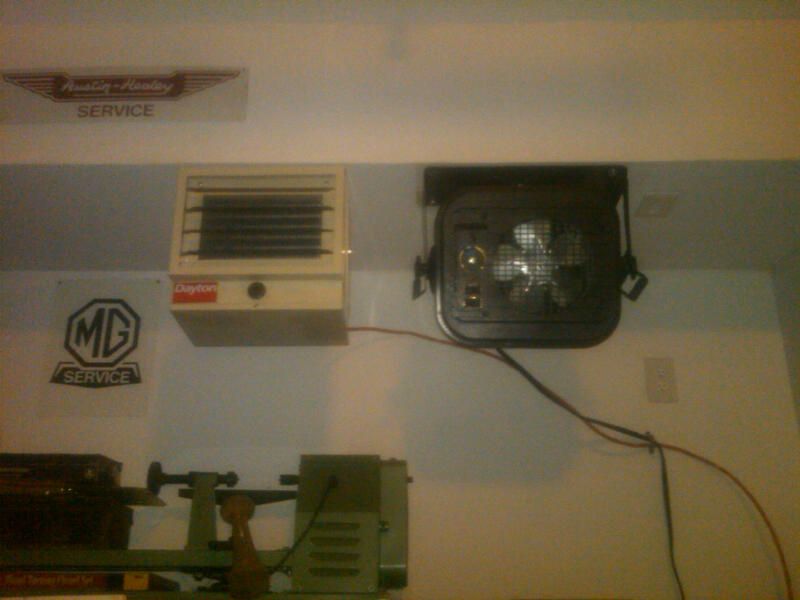
why propane and not electric......i have 14' cielings in a 500 sq ft garage and the floors plumbed for radiant floor heating. during construction we used a propane unit do help us keep warm in FEB when we were building it. the unit put out so much moisture the dry wall mud wouldnt dry so i bought an inexpensive electric unit from HD. my real one from my previous garage was in storage, the white dayton is my real one and the brwon one was from HD i only have the white one hooked up since it doesnt blow air until the unit is warmed up. the funny thing is that this unit worked so well in heating up the garage i have never hooked up the radiant floor heat ...


i use two fan setups.....a normal reversible house type cieling fan with and a 8" duct pipe going straight up to the ridge with a switched fan in the duct work to bring the hot air down to floor level. these two systems keep the air temp inside the same at eye level and at the ridge level.


heaters.jpg
 
Last edited:
OP
S

shamrock12

Well-known member
Joined
Dec 26, 2007
Messages
962
Location
South Dakota
Propane is our primary heating source here in South Dakota; however, that can get expensive to maintain heat all winter long. This is why we are having radiant floor heat for better efficiency to keep the shop fairly warm during brutal cold & windy winters, but when someone want to work in there for just a few hours, it would take like forever for the floor to heat up to a comfortable working temperature and then by the time it does, we probably will be finished with what we are doing and leave. This is why we want an auxiliary heater that we can flip on when we walk in the shop to do some work.
 

37ford4dr

Well-known member
Joined
Jan 5, 2012
Messages
109
Location
Arlington Va
is the propane vented outside or an open flame inside? these electric units are "flammable gas safe" as much as any heat source could be...they have no open elements and heat hydraulic oil in tubes. that was a must for my shop
 
OP
S

shamrock12

Well-known member
Joined
Dec 26, 2007
Messages
962
Location
South Dakota
We have not ordered one yet. The barn is being built soon and will have radiant floor tubings installed before the concrete get poured. Please advise what setup I should look into as a supplementary heat source. The shop is going to be 30x48x14. Thanks
 

37ford4dr

Well-known member
Joined
Jan 5, 2012
Messages
109
Location
Arlington Va
thats a big shop to heat up quickly, maybe it needs to be set up with some internal walls either temporary ones or permanent ones so you bring the area to be heated down to a reasonable size. my guess is with the radiant floor heating you will need 14 hours advance planning to bring it up to the temperature you want. sounds like a nice shop. put in some south facing windows to take advantage of natural heating by the sun.
 
OP
S

shamrock12

Well-known member
Joined
Dec 26, 2007
Messages
962
Location
South Dakota
Yes, I guess what I 'm trying to ask here is if using a pair of ceiling fan creating down draft is the proper direction to help warm up the work space along with the auxiliary heater unit. My thinking is saying yes BUT I have heard from someone who has a wood pellet stove and was told to run the ceiling fan in reverse to create updraft, so I'm not sure which concept I should be applying toward this setup I am planning.
 

37ford4dr

Well-known member
Joined
Jan 5, 2012
Messages
109
Location
Arlington Va
i supervised guys in a shop in Cleveland for a while with really high cielings....thats where i got the idea of the round ducting with the fans in them to pull the hot air from the ridge down to the floor....if i could only have one of my two set ups either the big house fan or the round ducting i would have only the round ducting going to the ridge and pulling the air down and forcing it out the bottom at ground level. hope that helps.


dont sweat the direction of the cieling fan just buy one that is reversible.....when its cold it outside and you have heat on it will be obvious to you to which way to turn the fan. one way makes you cold the other you dont notice.....the one that you dont notice is the right way.
 

pseudorealityx

Well-known member
Joined
Nov 10, 2009
Messages
999
Location
USA
You want to blow the hot air down in the winter, so it doesn't stratify up against the ceiling/roof.

In summer, reverse it.
 
To avoid these ads, REGISTER NOW!

Jackfre

Well-known member
Joined
Dec 26, 2010
Messages
4,411
Location
N CA
I'd suggest that you look over your lay-out and pick the area that you will be doing most of your short term work in and put a nice infra-red tube heater over that location. They are the balls for nice area heating. I like the Detroit Radiant brand, but others are good also.
 

Sureshot

ALLIANCE MEMBER
Joined
Jan 3, 2011
Messages
3,134
Location
Bridge Creek, OK
I have floor heat and I think you should wait and try it first. 55 or 60 feels very warm once you are acclimatized and somewhat dressed for the season. I have ceiling fans and found the direction not such a big deal as the speed. Slow for winter so you don't get the draft feeling and sped up overnight if trying to dry out or warm some equipment. Faster in summer for the cooling effect. My ceilings are 16'.
 

Shop Specialties

Well-known member
Joined
Mar 16, 2012
Messages
530
Location
Grass Range, MT
If it is designed and installed properly it does not take forever to bring the temp up a couple of degrees. The forced air unit would be a waste of money. With infloor heat the air is going to be cool at the ceiling, since the heat starts to dissipate at about 8 foot.
 

HeloMech

Active member
Joined
Jul 21, 2012
Messages
39
Location
Huntsville, AL
I'm going to go with a radiant tube heating system that uses propane. My shop is 24x36' uninsulated w/ 14' ceiling. Friend of mine uses one in his metal building with no insulation, has a thermostat, keeps his building @ 70 when it's in the teens outside. He only uses it for a few hours a day and full days on the weekend. Uses almost a tank of gas a year. Has a big outside tank.
 
Last edited:

Highbeam

Well-known member
Joined
Feb 15, 2011
Messages
2,292
Location
Mt Rainier foothills, WA
It does not matter which direction the fan turns. The end result is that the room air is mixed and the thermal stratification is minimized. Seriously, whether you blow up or down, the air is stirred. In the summer I like the fan blowing down because that maximizes the air velocity felt on my skin which is how humans cool themselves, the comfort goes up though the temperature of the room air is the same.

In my home I burn wood for heat and the stove room has a ceiling fan blowing towards the ceiling to stir the room air without creating wind that can be felt by the occupants.

For your forced air furnace, you can use whatever fuel you want just be sure to vent the combustion gasses outside.
 

Charles (in GA)

Well-known member
Joined
Jan 11, 2006
Messages
12,489
Location
50 mi south of Atlanta
Yes, I guess what I 'm trying to ask here is if using a pair of ceiling fan creating down draft is the proper direction to help warm up the work space along with the auxiliary heater unit. My thinking is saying yes BUT I have heard from someone who has a wood pellet stove and was told to run the ceiling fan in reverse to create updraft, so I'm not sure which concept I should be applying toward this setup I am planning.

I never saw this thread the first time around, and I know its a month later, but your question never really was answered.

In an area 14 ft tall, I certainly would just let the fans run blowing down all the time. I cannot see how blowing up is effective, except in the case of a low ceiling room, such as a house, with flat ceiling and walls, and not much to block airflow.

In large buildings and warehouses and such, I doubt you will ever find a fan blowing up, just doesn't make any sense. If the fan is mounted high (mine are 15 ft off the floor) and blowing up, it would merely push hot air up higher, and then the air would stay up there, forming a circulation around the fan and probably never come back to the floor. A down blowing fan insures that heat reaches the floor.

I have The Home Depot 60 inch fans discussed in this thread, and they work well for my purposes.

Charles
 

Shop Specialties

Well-known member
Joined
Mar 16, 2012
Messages
530
Location
Grass Range, MT
You do not want ceiling fans with in-floor heat. The air is going to be cooler at the ceiling than the floor. A customer of mine with 16' walls was complaining of oil consumption and a cool draft. We turned off the fans the temp went up and oil consumption was decreased by at least 25%. He now only uses the fans in the Summer.
 
OP
S

shamrock12

Well-known member
Joined
Dec 26, 2007
Messages
962
Location
South Dakota
That's ok, the fans would be used primarily for cooling in the summer. I just wanted to check before I ordered the fans. Would surely hate to buy them and then realize I should have gotten a different model. Thanks for all the help! :)
 
To avoid these ads, REGISTER NOW!
Top Bottom