Stubby1743
Well-known member
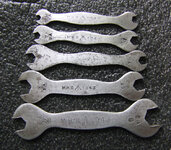
This set was part of my fathers tool kit in the Royal Navy. Does anyone have any idea who the maker M.B.H. was?


They might be Hammond Turner & Sons. From this linkMore from my fathers tool kit. Again, has anyone any info on the makers H.T.&S.
 hammond-turner.com
H.T. & S are Herbert Terry and Sons.
More from my fathers tool kit. Again, has anyone any info on the makers H.T.&S. and Rowan?
Oh dear!Love to see all those British M.O.D. broadarrows and 1943 stamps, Stubby! Lock and key glass display case worthy spanner set!
Figure of speech to express my esteem for them, Dave.Oh dear!
I have some as old as the Civil War, but I'm of the mind they've earned their retirement in a high and dry place of honor, I wouldn't dream of using any of them, and certainly not my father's, a WWII vet, when newer tools will get the same job done. I respect other approaches, and expect the same in return. There is no objective right or wrong on this matter.That's about a third of my regular use tools stuck behind glass then!
I have tools in use dating back to the First World War!

Anachronistic force of habit from my own service, a good span of which was spent across the pond at Menwith Hill, Dave. Stubby already identified the use case as Navy. Thanks for the reminder.The Ministry of Defence wasn’t formed till 1964,
Thanks for that. I am very familiar with Terry products and have got, or have had, quite a lot of their stamped spanners. I hadn't realised that they had also used the longer form of their name.H.T. & S are Herbert Terry and Sons.
You are correct of course and I do know that. For example, tools used by the GPO (General Post Office who were responsible for the UK telephone system) had their tolls marked with the broad arrow. Thinking that all tools marked with the broad arrow were for military use is an easy trap to fall into and I am certainly guilty of doing so. I think it is fair to say however that the majority of tools with the broad arrow were procured for military use in one of the three armed forces.As a matter of interest, the “Broadarrow” (or “Pheon”) to give it’s correct name) doesn’t denote military property, but rather government property. It’s a big distinction, often overlooked.
I've got a box of my dads small BA spanners from when he was in the Merchant Navy.
This set was part of my fathers tool kit in the Royal Navy. Does anyone have any idea who the maker M.B.H. was?
I thought as much!Figure of speech to express my esteem for them, Dave.
I have some as old as the Civil War, but I'm of the mind they've earned their retirement in a high and dry place of honor, I wouldn't dream of using any of them, and certainly not my father's, a WWII vet, when newer tools will get the same job done. I respect other approaches, and expect the same in return. There is no objective right or wrong on this matter.
Have you never "visited" the Lugzsonian?! See the link in my signature.
Yes, same forging, but I assume different broaching.
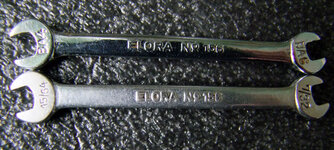
These two are interesting. Clearly the same base forging but correctly sized ends.


That's a 'Superslim' made by T Wiliams, Tilton Road, Birmingham.
This one is a bit odd. Only 82mm long and very over-built for the fasteners it would be used on. The ends are 5mm thick.
It's marked with the sizes on both sides.
Any idea of the maker Dave?
 www.garagejournal.com
I don't know about "fair," but it's certainly what the lads - my colleague WWII collectors in England - say, especially with particular types of tools, like stamped spanners.I think it is fair to say however that the majority of tools with the broad arrow were procured for military use in one of the three armed forces.
Not that different here, Dave. Alot of the Boy Scout equipment of my youth would be considered museum quality stuff now!Tools and equipment were made in such huge quantities during the war, that it continued to be sold off as “surplus” for decades afterwards, and didn’t really have a great value.
That is a bit of a laugh, when museum exhibits are from one's own lifetime! My kids always joke I should be in the museum too..It’s only really in the last few years that I’m seeing things that I own turning up in museum displays, which all feels a bit strange!
Yes, although bear in mind that in the past, there were a lot more government establishments than now.Thanks for that. I am very familiar with Terry products and have got, or have had, quite a lot of their stamped spanners. I hadn't realised that they had also used the longer form of their name.
You are correct of course and I do know that. For example, tools used by the GPO (General Post Office who were responsible for the UK telephone system) had their tolls marked with the broad arrow. Thinking that all tools marked with the broad arrow were for military use is an easy trap to fall into and I am certainly guilty of doing so. I think it is fair to say however that the majority of tools with the broad arrow were procured for military use in one of the three armed forces.
Collectors always want to attribute the greatest importance / value to the things they have.I don't know about "fair," but it's certainly what the lads - my colleague WWII collectors in England - say, especially with particular types of tools, like stamped spanners.
Not that different here, Dave. Alot of the Boy Scout equipment of my youth would be considered museum quality stuff now!
Yes, totally agreed!That is a bit of a laugh, when museum exhibits are from one's own lifetime! My kids always joke I should be in the museum too..
My Grandmother often made similar observations, as she lived to be almost 100 and her lifetime spanned from bicycles to the internet. From the use of horses, steam engines and telegram messages, she witnessed the first motor cars, the first aeroplanes, then Concorde supersonic flight and being able to look things up on computer. She did 100mph in the Rover SD1 car on her 80th birthday! We always thought she had witnessed the greatest changes.
Well, some, especially in Europe, were not sold as surplus, but lost and found or pilfered. A little closer to the action, per se....only surplus tools!
Indeed. I don't know if we'll see that kind of leap in the next 100, and, as we continue to become more virtual, I don't know if hand tools will have the same resonance....from bicycles to the internet.
Perhaps “only” was the wrong word! Although it has a place when considering value, as I can remember so much of this stuff being sold so cheaply.Well, some, especially in Europe, were not sold as surplus, but lost and found or pilfered. A little closer to the action, per se.
But it's probably the "only" qualifier we will have to agree to disagree about.
These were the tools, whether issued or not, that were produced to maintain the equipment that won WWII, the most significant war of the century we were born in, the deadliest anthropogenic disaster in human history, the tools of the greatest generation. Of course, people whose parents fought in or lived through the Punic Wars or the Napoleonic Wars or the 100 Years war etc etc may disagree, but, collecting, as a hobby, wasn't really a "thing". While archeology shows that the Kalahari people collected crystals 100,000 years ago, it wasn't until the 19th century that collecting artifacts for aesthetic purposes (i.e., for display) arose.
Indeed. I don't know if we'll see that kind of leap in the next 100, and, as we continue to become more virtual, I don't know if hand tools will have the same resonance.
I can't believe that I didn't recognise it as such as I have a lot of them that I gathered up 20 or so years ago. I think that what threw me off was the lack of the name in full, the fact that it is BA and it's small size.That's a 'Superslim' made by T Wiliams, Tilton Road, Birmingham.
Farman Experimental, there's one flying in NZ.Yes, totally agreed!
Sounds like your Gran had quite a life, but then that generation did.
A Great Uncle was born into a world of horse drawn transport, indeed that was the family business. He saw the invention of the car, motorbike, and aeroplane, and learnt to fly on aeroplanes a couple of years old that were already considered outdated.
When, in the 1970’s, he flew a turboprop airliner (on an empty sector, with my Dad in the other seat) the cabin crew asked if he’d flown in the war, and what aircraft. When he replied that he had, and listed types including the “FE2B” and the “Pup” nobody knew what they were, or even realised he had flown in the FIRST World War.
So rapid had been the advancement, that it was scarcely believable it had all taken place in one lifetime.
I have a Spitfire mainwheel. I know it's the genuine part as I was the one who removed it from the rest of the aircraft.. which is now sitting in the museum at Wright Patt on a pair of spiffy new wheelsCollectors always want to attribute the greatest importance / value to the things they have.
You always see things like “Spitfire” instruments for sale, despite the fact that they were standardised parts, fitted to dozens of different types, and interchanged between them.
Been around since 1760.This set is probably a bit too young for inclusion in a vintage tools thread, but people may be interested.
The sizes go from 0-6BA. Strangely, the two largest spanners are 0BA/2BA and 0BA/1/8Whitworth.