To avoid these ads, REGISTER NOW!

Back drafting issue - Gas water heater and boiler

chinboys

Well-known member
Joined
Jun 20, 2011
Messages
434
I would conduct a whole house pressure check with all of the exhaust and make-up air appliances (dryer, kitchen exhaust, dhw maker, boiler, fireplace, etc)running relative to the flue opening at the top of the stack as well as where the two exhaust for the water heater and boiler meet (the connection wye according to code should be 1.5 times bigger the largest opening for gravity-based vents.

You can have your HVAC company perform manometer pressure readings relative to the main stack's reading.
Any exhaust appliances' pressure reading has to be greater than that of the main stack's otherwise you will have backdraft problems.
An after-market power ventilator presents complexity during its commissioning.
 
To avoid these ads, REGISTER NOW!
OP
A

AntBru98

Member
Joined
Aug 20, 2024
Messages
15
Location
Long Island
“Involved process?” You need the tank, circ, controls and piping. Piping is pretty straight forward. Not sure what control would look like. As you are finding out, everything is expensive.

Not worried about cost, mainly worried about safety and not having to leave my basement window cracked year round. I'm starting to research combi units as previously suggested. That's beginning to sound like my best option here.

Still open to other opinions 👍
 

danski0224

Well-known member
Joined
Jan 29, 2005
Messages
13,746
Location
Near Naperville, IL
On your CA sizing, note that the book calls for “Free Air”. Your 12.6 sq in 4” pipe may be as little as 8” when you take into consideration the body of the grill.

Pretty sure there's a minimum opening size, 100 square inches. Then it goes up from there.

Free area, not just opening size.
 

Aileron

Well-known member
Joined
Apr 15, 2019
Messages
483
Location
outside
if you put a screen over the free air opening to keep critters out , it derates the size 25%.
 

bazzz

Active member
Joined
Dec 1, 2012
Messages
33
Location
Heathsville Virginia
If you’re not concerned about the cost then my suggestion is to replace both units with high efficiency ones that have their own separate combustion air and flues using PVC pipe installed by a competent contractor. This will eliminate the flue gases being pulled into the living area since each unit will have properly sized ducts as recommended by the manufacturer, make sure to account for elbows as this adds to overall length of ducts. Lochinvar made some commercial units I am familiar with but not sure if they make one that would work in your situation. Rinnai has on demand water heaters for this situation also. I am sure there are other options out there. Good luck with whatever choice you make.
 

lmg

Well-known member
Joined
Mar 17, 2023
Messages
97
I don't post much here, but when I see definite safety issues, I get concerns.

Chinboy is on the right track. You have proved that the existing combustion air intake system is inadequate. The use of exhaust fans in the house and the attic ventilation fan definitely make this worse, as would use of fireplace or wood burning stove.

There is a test procedure to determine if existing venting is adequate: https://www.greenbuildingadvisor.co...fety-and-the-worst-case-depressurization-test

I have worked in the building performance industry, and I have a lot of respect for Martin Holliday and greenbuildingadvisor.com

Found this other quote from Martin: Codes can vary from jurisdiction to jurisdiction, and I am not a code expert on fuel gas codes. That said, here's what I know: "The International Fuel Gas Code requires one of the following options for equipment installed in a mechanical room: either (a) a ceiling duct to provide outside combustion air with a minimum of one square inch of free area for each 4,000 Btu/h input of gas-burning appliances in the room, or (b) a wall duct to provide outside combustion air with a minimum of one square inch of free area for each 2,000 Btu/h input of gas-burning appliances in the room, or (c) a fan that provides 1 cfm of outdoor air for each 2,400 BTU/h of gas-burning appliances in the room." https://www.greenbuildingadvisor.com/question/water-heater-makeup-combustion-air-source

Info linked above describes the worst case depressurization test, but you MUST find a person certified by BPA and or RESNET to do this. It is very unlikely your HVAC contractor will have this certification.

A quick look suggests the Burnham BS25 boiler is rated at AFUE 85, which has been a code minimum boiler in past years, it would not have any power venting.

As someone implied, I am sure that having 2 gas fired appliances connected to the same vent is not code compliant.

You mentioned replacing your existing water heater with what is known as a "sidearm tank" connected. This will certainly help, and also be more energy efficient as you no longer have 50 gallons of hot water in storage at all times. You can also use a heat pump water heater, which is electric, and efficient, and both NY state and federal tax credits are available for this and other possible remedies for your situation. https://www.homeefficiencyexperts.c... maximum,including insulation and air sealing

So as I see it you have a sure fix of properly installed sealed combustion appliances for water heater and boiler, or possibly other alternatives. No need to run the depressurization test.

Spend the money and get this fixed, so you can sleep well knowing that both you and your family will wake up in the morning.
 

danski0224

Well-known member
Joined
Jan 29, 2005
Messages
13,746
Location
Near Naperville, IL
As someone implied, I am sure that having 2 gas fired appliances connected to the same vent is not code compliant.
This is done all of the time, and there can be more than 2 appliances connected to the same vent.

It's even in the tables for Type B vent.

Now, that doesn't mean that the installation will work as described. Unfortunately.
 
To avoid these ads, REGISTER NOW!

lmg

Well-known member
Joined
Mar 17, 2023
Messages
97
This is done all of the time, and there can be more than 2 appliances connected to the same vent.

It's even in the tables for Type B vent.

Now, that doesn't mean that the installation will work as described. Unfortunately.
Thanks for the correction danski.
 

jmiller_2308

Well-known member
Joined
Nov 16, 2013
Messages
575
Location
Shakopee, MN
What is everyone's opinion on eliminating the gas fired water heater and going over to a storage tank for the hot water and setting up my boiler to handle everything. This way ill only have one appliance down there running on gas.

I'm late to the party but came across this thread in dealing with my own backdraft issues. @AntBru98 what was your resolution to this?

First comment: I highly endorse the use of an indirect water heater running off the boiler especially with regard to the amount of hot water it supplies.

I put in a Weil-Mclane 30 gallon indirect water heater connected to my Weil-McLane boiler that has 105,000 Bth/hr input (similar to your situation). I went this way because with conventional water heaters I could never get enough hot water to fill a large spa tub. The results of heating less water with more than 2x the BTU/hr input is dramatic and extremely satisfying. The indirect water heater is better insulated and smaller standing capacity than a conventional water heater so a lot less standby loss. Additionally, heating a smaller amount of water with more BTUs really increases the recovery rate. The recovery is so fast that for all practical purposes I will never run out of hot water.

BTW: my 30 gallon is likely overkill and I probably would have been happy with the 20 gallon indirect water heater.

Backdrafting comments:


Do you have a radon system running in the house? All of my issues with backdrafting were first noticed after having a radon system installed. Like you, I went to great efforts to try to seal everything but the reality is that the radon fans are creating negative pressure in the house which in turn is resulting is backdrafting issues.

Through many helpful comments by some of the same people as above I have ruled out a lot of possible causes and solutions. I am now working on getting a Field Controls CAS-34U "fan in a can" installed to create powered combustion air for when my boiler kicks on.

Venting and air makeup comments above including the quoted requirements should be observed. One thing that wasn't mentioned but that appears to be something added to the code I believe in 2010 is that you actually need 2 openings; one high within 12" of the ceiling and one low withing 12" of the floor. As I interpret it, the addition of the high vent is to encourage heat to exit the room.
 

u3b3rg33k

Well-known member
Joined
Dec 18, 2017
Messages
4,066
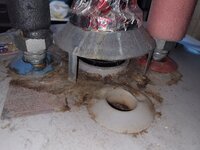
The Red and Blue grommets on top of my water heater... they are both partially melted.

I have no issue leaving the window cracked for the time being... just hoped the 4" fresh air vent I installed would have helped.
as was mentioned in this necro thread a passive inlet has to be LARGER than the combined draft exhaust. there's tables for this.
Not worried about cost, mainly worried about safety and not having to leave my basement window cracked year round. I'm starting to research combi units as previously suggested. That's beginning to sound like my best option here.

Still open to other opinions 👍
I have a rinnai i120CN combi and I LOVE it. switched from a 2 stage 80% furnace and a dying tank to the rinnai with outdoor reset + a hydronic furnace and the comfort levels are WAY up. dedicated 2" venting (supply and exhaust).
 

Bert_

Well-known member
Joined
Dec 24, 2016
Messages
9,859
Location
NW Iowa
20250821_172455.jpg
Note the foil tape used to seal the vent pipe joints... but there's still that big hole under the draft diverter...

😁
Sadly that sort of picture is pretty common.

I've even seen someone vent a natural draft water heater right out the side of a basement wall. Like you would do with a power vent. 🤦
 

danski0224

Well-known member
Joined
Jan 29, 2005
Messages
13,746
Location
Near Naperville, IL
I've even seen someone vent a natural draft water heater right out the side of a basement wall. Like you would do with a power vent.
I recall seeing a model in manufacturer literature that was specifically designed for sidewall venting, but it had a specific piece of vent piping that had to be used.

I find it odd that one is supposed to be a licensed plumber to replace a water heater, yet there is no requirement for someone licensed in venting it to do the venting. At least in my area.
 

Bert_

Well-known member
Joined
Dec 24, 2016
Messages
9,859
Location
NW Iowa
I recall seeing a model in manufacturer literature that was specifically designed for sidewall venting, but it had a specific piece of vent piping that had to be used.

I find it odd that one is supposed to be a licensed plumber to replace a water heater, yet there is no requirement for someone licensed in venting it to do the venting. At least in my area.

Natural draft works because of gravity, hot air is less dense than cold air. You can have some horizontal pipe, best to have some slope, but the majority of the vent has to be vertical. Otherwise gravity isn't going to do the job.

Water heaters are typically natural draft. Other appliances are often draft assisted or forced draft.
 
To avoid these ads, REGISTER NOW!
Top Bottom