Very nice work. BTW, I think the wetstacking problems with the 800 series generators are greatly exaggerated. Most of the ones I have seen had been run A LOT with zero load to get to that point - like running weekly to keep the batteries charged with no load, or powering a tent with 3 60 watt lamps and running nonstop for 2 months. Put a good load on them for an hour and they clear right up. I've spent counteless hours with my head inside of the TQGs 10-60kw) and I wouldn't hesitate for a second to buy one.

You are using an out of date browser. It may not display this or other websites correctly.
You should upgrade or use an alternative browser.
You should upgrade or use an alternative browser.
Back Feeding With A Generator
- Thread starter PapaD
- Start date
So I'm planning on using an interlock kit for my emergency generator. I've been convinced it is a better way to go than backfeeding through my welder plug. I've done some searching and have seen breakers that are red handle. I assume that is an obvious way of marking them as "special purpose." Are they actually different than any other double pole breaker? Where to buy them if they are special?
When power goes out, what is best practice for powering up with the genny? I understand the interlock portion, my question is as far as power use on startup. Say I have a 5,000 watt generator, power goes out. Will the generator start and run enough for me to "lighten the load" or is it best to drop all of the breakers then power up as needed? House is LPG, so no heavy loads other than HVAC which could easily be turned off when in AC mode.
When power goes out, what is best practice for powering up with the genny? I understand the interlock portion, my question is as far as power use on startup. Say I have a 5,000 watt generator, power goes out. Will the generator start and run enough for me to "lighten the load" or is it best to drop all of the breakers then power up as needed? House is LPG, so no heavy loads other than HVAC which could easily be turned off when in AC mode.
Mustang51js
Well-known member
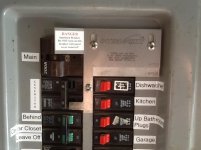
Only red handle breakers I've seen are old Bryant breakers,and it's best to turn all breakers off and then turn them on one at a time
Hpozzuoli
Well-known member
No fancy colors for the breakers. When the power goes start the gen and let it run for a few mins. When warmed up plug into house with all breakers off. Start opening each breaker one at a time till you have everything on that you need.
Do not start the gen and immediately dump the whole house on it.
Do not start the gen and immediately dump the whole house on it.
Attachments
Hpozzuoli
Well-known member
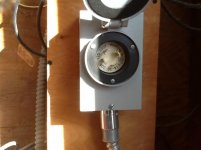
You want a regular gen plug running into your panel. My house is all natural gas. My electrical draw is small compared to what most will need. I have a 10hp diesel that runs 6500/6000. More than enough for what my house requires. I have (2) two ton ad units that I don't even bother to try and run cause I can't.
Attachments
Cool thanks guys. Looks like a normal breaker it is. Makes sense to start the generator first, then go to panel and shut down everything. Then switch from main breaker to generator. Then switch on necessary breakers.
I'll have to do a test run and make notes. Then a sticker with the procedure for my wife.
As a side note. Anyone have experience with the Generlink?
http://generlink.com/about_generlink.cfm
Looks like a good way to go with a bigger generator than mine. Not sure if it is available in my area, and they don't show a price.
I'll have to do a test run and make notes. Then a sticker with the procedure for my wife.
As a side note. Anyone have experience with the Generlink?
http://generlink.com/about_generlink.cfm
Looks like a good way to go with a bigger generator than mine. Not sure if it is available in my area, and they don't show a price.
EOC_Jason
Well-known member
As a side note. Anyone have experience with the Generlink?
http://generlink.com/about_generlink.cfm
Looks like a good way to go with a bigger generator than mine. Not sure if it is available in my area, and they don't show a price.
That looks like a cool concept and easiest for someone that wants to have a backup generator but without doing any rewiring.
Probably best to call your local power company first and ask them about it. Anything involving the meter / meter can they can be touchy about.
What do homeowners, who are feeding the grid with solar power, do when the power goes out? Do they have a switch that disconnects their power source?
If I were a lineman, with the availability of I power sources today (solar, wind, generators, etc), I'd check, double check and then still treat that line like it was live. I'm not justifying back feeding a generator, I just wouldn't trust people these days considering how accessible things are now.
FWIW - I didn't see a response for this, so thought I'd mention it. Typically the inverters used in solar applications have an automatic switch.
The inverters for my solar system (a non battery backup system) need to see the proper frequency of the electricity coming in from the power company before they will switch on and feed power from the solar array. In a power outage they will automatically disconnect.
This was checked by the power company, by pulling our meter ( disconnecting us from the grid) and observing the inverters - before they would certify and allow our unit to be commissioned into service.
Homes built since 1996 have had 4 wire dryer receptacles mandated by the NEC. Therefore they have a neutral included. Some jurisdictions may not have enacted it right then. But it's definitely the rule everywhere by now. 3 wire might still be around in older homes. But any newer dryer than 2000 model, will require a neutral to have 125/250v, for electronics, etc. Hence the 4th wire.
A transfer switch is the best option. An interlock with an inlet and cord would probably be second best.
"Knowing to pull meter or turning off the main to avoid back feeding the utility" is waaaaay down the list of preferred methods.
You have a misunderstanding of dryer/ range receptacles, the 3 wire ones are dual voltage 125/250V NON-grounding devices which means there is a neutral and no grounding conductor, as it was permitted to ground the frame of the appliance to the grounded(neutral) conductor. The 4-wire receptacle means the grounded & grounding conductor are seperate as they should be.
2ManyProjects
Well-known member
- Joined
- Jul 18, 2013
- Messages
- 757
So I'm planning on using an interlock kit for my emergency generator. I've been convinced it is a better way to go than backfeeding through my welder plug.
I see that you are given to understatement.
When power goes out, what is best practice for powering up with the genny?
I covered this in some detail in http://www.garagejournal.com/forum/showpost.php?p=3629069&postcount=7, starting about halfway down the post.
