Deen roto has has 1/4” drive on the handle as well. Its primary drive end is set up like an old push through ratchet however, but rotates only one direction.Love how out-of-the-box this concept is. One of those things that makes a ton of sense to exist once you think about it, and I'm surprised they're not more common. At max torque a top end conventional ratchet is probably stronger - but at the same time, that 90 degree power transfer likely also has stronger teeth than the ratcheting mechanism? And it can even be set up to ggive you a geared advantage on the screw when spinning the handle.
As far as I know, Proxxon is also the only one to have a (albeit one size smaller) square drive on the handle so you can use the ratchet like a 90 degree extension as well, and put a fair bit of torque through it.


You are using an out of date browser. It may not display this or other websites correctly.
You should upgrade or use an alternative browser.
You should upgrade or use an alternative browser.
Backdrag vs. Tooth Count
- Thread starter teagueo
- Start date
richfinn
Well-known member
I have an ancient 3/8" MAC Spinflex that is still my favourite ratchet (I have a dual 80 too) it's coarse tooth but for most jobs it's my first pick.
I don't know if it's a trust thing or down to handle feel or what, I just like how it operates.
I switch to the dual 80 if I'm in a tight spot which not much room to swing.
I don't know if it's a trust thing or down to handle feel or what, I just like how it operates.
I switch to the dual 80 if I'm in a tight spot which not much room to swing.
BarryWells
Well-known member
Get three or four guys to help lift the hood off one of those old tanks and you'll see most bolts can be removed with a 24 inch pipe wrenchOne must ask: "How the hell did mechanics using 24 tooth ratchets in the 1950's possibly repair anything with those primitive high back drag ratchets." Apparently, very well. This is not a problem which will keep me up at nights.
! And you pick up a Plomb, Proto some Walden, Thorsen,Craftsman...not much back drag compared to some later 60-72 clunkers from Toys are us or SH green stamp type stores. Snap ons between models 710 and 936 there was an 832 ? that was rough as a cob. The 9 was no prize either. I switched to Williams round heads 52-3-4 about that time on automotive.
I always found Wrights and SK to be fine on most anything too.
I like fine,no backdrag on bikes and other small engine stuff. I have a zeal thats slick and a Matco 88 and you cant knock Gearwrench either. They all feel good.
Proto pears for tractors and big tools out in the open. Trailers, sawmills,generators and stuff.Armstrong flat handles were pretty decent too.
Warning: Ratchet-***** rant follows
Standard (via Tekton)

Dual 80 (from the SnapOn site)

Staggered Pawl 120XP (from ToolGuyD)
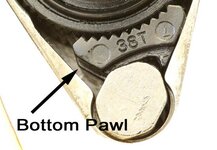
Facom (I believe this is a screenshot from the CatusMaximus vlog)

I'm not even sure what this one is called, but it's generally found in low-tooth-count ratchets, often cheap ones.

There are probably others and/or variations on a theme. But at the end of the day, tooth count is one of the key things that drives backdrag. All that engagement has to "let go" when it's not working and has to feel right/be smooth.
To me it seems like things cap out around 90 physical teeth. Beyond that I'm guessing you're losing strength in ways that are probably difficult and/or expensive to solve. In general, tooth and pawl design - size, finishing, etc. and even factory lubrication have a lot to do with how well the ratchet perform in general, and particularly backdrag. Size matters too - some of the worst backdrag I've seen has been on 1/4" ratchets, especially ones with a high tooth count. I'm not so sure that mass of the head itself doesn't contribute to backdrag reduction. As you increase the number of teeth, dialing backdrag out of the experience gets harder. Some manufacturers are more concerned about winning the marketing war than having a great tool. Some do the work. Price isn't the best indicator, but in general pro-targeted tools unsurprisingly tend to be the best.
Personally, I don't like the 120XP mechanism at all - it feels..."thin" to me and sometimes has crazy backdrag and sometimes not depending on what ratchet you pick up. I'm guessing that has something to do with factory lubrication and possibly the interaction of th two stacked pawls, but whatever - not a fan and any that I've ever held/tried. I haven't had a situation where I needed more than the 4° - 5° or so provided by the various ratchets I have, which are all somewhere between 72 and 90 teeth. I've tried out a couple 100-tooth ratchets and found them riddled with back-drag and they were returned. If there's a 'good' one out there at 100 teeth, I haven't held it. For me, Snap On's (via Bahco apparently) Dual-80 does have the best feel, but my Icon 90-tooth ratchets that have a very standard design are pretty close behind. My Matco Eighty8 and SK LP90 are a step or so away fighting for third (originally I didn't like the LP90 very much at all, but it has seemed to 'break-in' and is pretty nice. Sample variation plays here too - I think it's at least partially a lubrication thing, but there's even some between my SnapOn ratchets.
But I'm pretty sure tooth-count is the primary factor in back-drag. It's just that most of the ways to address it are in most modern designs.
This isn't true. There's a high correlation between backdrag and high tooth count. If you actually look into it you'll find it can be overcome with good design of the mechanism. It's why you see so many iterations from the mainstream pawl design like Bahco/Snap On's Dual 80 and the staggered dual-pawl design of the 120XP that are trying to increase the effective engagement of teeth via pawl design vs. strictly running more teeth. Then there's Facom's design (I call it a 'wheel-pawl', but that's literally just me). Here's what I've seen over the years:backdrag has no apparent relationship with tooth count.
Standard (via Tekton)
Dual 80 (from the SnapOn site)
Staggered Pawl 120XP (from ToolGuyD)
Facom (I believe this is a screenshot from the CatusMaximus vlog)
I'm not even sure what this one is called, but it's generally found in low-tooth-count ratchets, often cheap ones.
There are probably others and/or variations on a theme. But at the end of the day, tooth count is one of the key things that drives backdrag. All that engagement has to "let go" when it's not working and has to feel right/be smooth.
To me it seems like things cap out around 90 physical teeth. Beyond that I'm guessing you're losing strength in ways that are probably difficult and/or expensive to solve. In general, tooth and pawl design - size, finishing, etc. and even factory lubrication have a lot to do with how well the ratchet perform in general, and particularly backdrag. Size matters too - some of the worst backdrag I've seen has been on 1/4" ratchets, especially ones with a high tooth count. I'm not so sure that mass of the head itself doesn't contribute to backdrag reduction. As you increase the number of teeth, dialing backdrag out of the experience gets harder. Some manufacturers are more concerned about winning the marketing war than having a great tool. Some do the work. Price isn't the best indicator, but in general pro-targeted tools unsurprisingly tend to be the best.
Personally, I don't like the 120XP mechanism at all - it feels..."thin" to me and sometimes has crazy backdrag and sometimes not depending on what ratchet you pick up. I'm guessing that has something to do with factory lubrication and possibly the interaction of th two stacked pawls, but whatever - not a fan and any that I've ever held/tried. I haven't had a situation where I needed more than the 4° - 5° or so provided by the various ratchets I have, which are all somewhere between 72 and 90 teeth. I've tried out a couple 100-tooth ratchets and found them riddled with back-drag and they were returned. If there's a 'good' one out there at 100 teeth, I haven't held it. For me, Snap On's (via Bahco apparently) Dual-80 does have the best feel, but my Icon 90-tooth ratchets that have a very standard design are pretty close behind. My Matco Eighty8 and SK LP90 are a step or so away fighting for third (originally I didn't like the LP90 very much at all, but it has seemed to 'break-in' and is pretty nice. Sample variation plays here too - I think it's at least partially a lubrication thing, but there's even some between my SnapOn ratchets.
But I'm pretty sure tooth-count is the primary factor in back-drag. It's just that most of the ways to address it are in most modern designs.
Madjik Man
Well-known member
- Joined
- Dec 3, 2015
- Messages
- 1,540
One must ask: "How the hell did mechanics using 24 tooth ratchets in the 1950's possibly repair anything with those primitive high back drag ratchets." Apparently, very well. This is not a problem which will keep me up at nights.
I’d help work on my buddy’s ‘71 K5 Blazer. The two of us were able to sit on the sides of the engine bay near the wheel wells.
If a 70s being bay can fit two 200 lbers in there, I’m pretty sure 1950s mechanics didn’t have much issues with fastener access.
Mike S.
Well-known member
I still have this ratchet of a somewhat similar design I bought late 80s or early 90s. No idea the brand (iirc 'sidewinder'?) but pretty sure I bought it at a Pep Boys. It sure aint much today but man did it ever work miracles for me back then at helping get at those top bellhousing bolts when there was no room to get a swivel in there and there wasn't a such thing as a wobble end. I could get a normal ratchet ext and socket on them from underneath but there was no room to turn it. Before I stumbled onto this ratchet I couldn't count how many times I'd laid face down across the top of an engine with a stubby wrench snaked down behind the heads completely blind to what I was doing trying to flip the open end over for the tiniest of turns for 10 minutes or more for each bolt, cussing the whole time, all so we could avoid having to put a jack under the pan and remove one or both motor mounts so I could lower it to give me enough needed room, because that would have been even more work.
(GJ wouldn't let me attach files, so using an image host. Fingers crossed it works here)
With this ratchet laid over top of the ****** so it had a straight shot at those bolts with a combination of extensions sometimes a couple ft long I would have all of them out in a minute or two. I'll never forget us laughing the first couple times at how good it worked and how much time it saved. Of course this ratchet has by now been made completely obsolete in my tool arsenal thanks to wobble end extensions and cordless ratchets and such, and hasn't seen any use in a couple decades now, but I've still kept it. It earned it's spot in my box.
My dad had one of these ratchets. I remember using it a lot in the late 90's and early 2000's when I was living at home and working on my first cars. If I'm not mistaken, it came in a kit with shallow and deep 3/8" sockets, a couple of extensions and a universal joint. I used that kit almost exclusively to do my first motor swap. Oh the memories...
I disagree. I've got two ratchets with that last mechanism. I think Proto originally used it. That type is far and away the lowest back drive torque of any on my ratchets minus the one with a Sprague clutch. Anyway, based on what I've seen the primary factor is mechanism design. The secondary factor might be tooth count with higher being better. Consider the Husky version of the typical Gearwrench ratchets. The lower tooth count single pawl is lower drag vs the double pawl higher tooth count version.Warning: Ratchet-***** rant follows
This isn't true. There's a high correlation between backdrag and high tooth count. If you actually look into it you'll find it can be overcome with good design of the mechanism. It's why you see so many iterations from the mainstream pawl design like Bahco/Snap On's Dual 80 and the staggered dual-pawl design of the 120XP that are trying to increase the effective engagement of teeth via pawl design vs. strictly running more teeth. Then there's Facom's design (I call it a 'wheel-pawl', but that's literally just me). Here's what I've seen over the years:
Standard (via Tekton)
Dual 80 (from the SnapOn site)
Staggered Pawl 120XP (from ToolGuyD)
Facom (I believe this is a screenshot from the CatusMaximus vlog)
I'm not even sure what this one is called, but it's generally found in low-tooth-count ratchets, often cheap ones.
There are probably others and/or variations on a theme. But at the end of the day, tooth count is one of the key things that drives backdrag. All that engagement has to "let go" when it's not working and has to feel right/be smooth.
To me it seems like things cap out around 90 physical teeth. Beyond that I'm guessing you're losing strength in ways that are probably difficult and/or expensive to solve. In general, tooth and pawl design - size, finishing, etc. and even factory lubrication have a lot to do with how well the ratchet perform in general, and particularly backdrag. Size matters too - some of the worst backdrag I've seen has been on 1/4" ratchets, especially ones with a high tooth count. I'm not so sure that mass of the head itself doesn't contribute to backdrag reduction. As you increase the number of teeth, dialing backdrag out of the experience gets harder. Some manufacturers are more concerned about winning the marketing war than having a great tool. Some do the work. Price isn't the best indicator, but in general pro-targeted tools unsurprisingly tend to be the best.
Personally, I don't like the 120XP mechanism at all - it feels..."thin" to me and sometimes has crazy backdrag and sometimes not depending on what ratchet you pick up. I'm guessing that has something to do with factory lubrication and possibly the interaction of th two stacked pawls, but whatever - not a fan and any that I've ever held/tried. I haven't had a situation where I needed more than the 4° - 5° or so provided by the various ratchets I have, which are all somewhere between 72 and 90 teeth. I've tried out a couple 100-tooth ratchets and found them riddled with back-drag and they were returned. If there's a 'good' one out there at 100 teeth, I haven't held it. For me, Snap On's (via Bahco apparently) Dual-80 does have the best feel, but my Icon 90-tooth ratchets that have a very standard design are pretty close behind. My Matco Eighty8 and SK LP90 are a step or so away fighting for third (originally I didn't like the LP90 very much at all, but it has seemed to 'break-in' and is pretty nice. Sample variation plays here too - I think it's at least partially a lubrication thing, but there's even some between my SnapOn ratchets.
But I'm pretty sure tooth-count is the primary factor in back-drag. It's just that most of the ways to address it are in most modern designs.
I didn't say the last mechanism was high in backdrag. What is the tooth-count on your Protos? My guess is it's going to be low, especially if it's older. Here's another screen-shot from Catus Maximus of an older Proto:I disagree. I've got two ratchets with that last mechanism. I think Proto originally used it. That type is far and away the lowest back drive torque of any on my ratchets minus the one with a Sprague clutch. Anyway, based on what I've seen the primary factor is mechanism design. The secondary factor might be tooth count with higher being better. Consider the Husky version of the typical Gearwrench ratchets. The lower tooth count single pawl is lower drag vs the double pawl higher tooth count version.
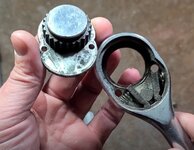
I hadn't seen this one before, but in the caption of the video indicates he agrees with me - lol:
Catus Maximus Video said:"This is a review of the proto standard pear head ratchets, proto either invented or was one of the earliest manufacturers to widely market the swing pawl ratchet. This mechanism is the basis of almost all cheap pear head ratchets today."
I'm sure Proto did a good job, and I'm not surprised to hear it has low backdrag given (A) there's not that many teeth and (B) the pawl has a limited (but very strong) engagement, so there's not a lot of drag to achieve.
I don't have a Proto, just saying this was the design they used. The generic ones seem to have very low back drag.I didn't say the last mechanism was high in backdrag. What is the tooth-count on your Protos? My guess is it's going to be low, especially if it's older. Here's another screen-shot from Catus Maximus of an older Proto:
I hadn't seen this one before, but in the caption of the video indicates he agrees with me - lol:
I'm sure Proto did a good job, and I'm not surprised to hear it has low backdrag given (A) there's not that many teeth and (B) the pawl has a limited (but very strong) engagement, so there's not a lot of drag to achieve.
I think that mechanism is probably good for low back drag, but not optimal for higher tooth-counts.I don't have a Proto, just saying this was the design they used. The generic ones seem to have very low back drag.
dnschmidt
Well-known member
I've said it before, I will say it again and I'll say it until I die. The Williams B-52 and B-54 were and are the best ratchets I've ever used. Miles ahead of anything available at the time and still as good as anything available today. And, ABSOLUTELY BULLETPROOF.
The two ratchets I have with that mechanism are 72 and 90 tooth. No idea if it's a strong mechanism.I think that mechanism is probably good for low back drag, but not optimal for higher tooth-counts.
seber
Well-known member
Actually the formula for friction is coefficient of friction of the mating materials times the force. Area is irrelevant. Therefore, number of teeth is truly unrelated to back drag. This is one of the most misunderstood standards of engineering.Warning: Ratchet-***** rant follows
This isn't true. There's a high correlation between backdrag and high tooth count. If you actually look into it you'll find it can be overcome with good design of the mechanism. It's why you see so many iterations from the mainstream pawl design like Bahco/Snap On's Dual 80 and the staggered dual-pawl design of the 120XP that are trying to increase the effective engagement of teeth via pawl design vs. strictly running more teeth. Then there's Facom's design (I call it a 'wheel-pawl', but that's literally just me). Here's what I've seen over the years:
Standard (via Tekton)
Dual 80 (from the SnapOn site)
Staggered Pawl 120XP (from ToolGuyD)
Facom (I believe this is a screenshot from the CatusMaximus vlog)
I'm not even sure what this one is called, but it's generally found in low-tooth-count ratchets, often cheap ones.
There are probably others and/or variations on a theme. But at the end of the day, tooth count is one of the key things that drives backdrag. All that engagement has to "let go" when it's not working and has to feel right/be smooth.
To me it seems like things cap out around 90 physical teeth. Beyond that I'm guessing you're losing strength in ways that are probably difficult and/or expensive to solve. In general, tooth and pawl design - size, finishing, etc. and even factory lubrication have a lot to do with how well the ratchet perform in general, and particularly backdrag. Size matters too - some of the worst backdrag I've seen has been on 1/4" ratchets, especially ones with a high tooth count. I'm not so sure that mass of the head itself doesn't contribute to backdrag reduction. As you increase the number of teeth, dialing backdrag out of the experience gets harder. Some manufacturers are more concerned about winning the marketing war than having a great tool. Some do the work. Price isn't the best indicator, but in general pro-targeted tools unsurprisingly tend to be the best.
Personally, I don't like the 120XP mechanism at all - it feels..."thin" to me and sometimes has crazy backdrag and sometimes not depending on what ratchet you pick up. I'm guessing that has something to do with factory lubrication and possibly the interaction of th two stacked pawls, but whatever - not a fan and any that I've ever held/tried. I haven't had a situation where I needed more than the 4° - 5° or so provided by the various ratchets I have, which are all somewhere between 72 and 90 teeth. I've tried out a couple 100-tooth ratchets and found them riddled with back-drag and they were returned. If there's a 'good' one out there at 100 teeth, I haven't held it. For me, Snap On's (via Bahco apparently) Dual-80 does have the best feel, but my Icon 90-tooth ratchets that have a very standard design are pretty close behind. My Matco Eighty8 and SK LP90 are a step or so away fighting for third (originally I didn't like the LP90 very much at all, but it has seemed to 'break-in' and is pretty nice. Sample variation plays here too - I think it's at least partially a lubrication thing, but there's even some between my SnapOn ratchets.
But I'm pretty sure tooth-count is the primary factor in back-drag. It's just that most of the ways to address it are in most modern designs.
toddmorr
Well-known member
That's interesting, but if the number of teeth were low for example, wouldn't the angle of the gears have something to do with backdrag?
That's true in ideal conditions. But there can be sticky grease in a ratchet, and that can make a notable difference. Sticky grease bonds like glue would, and the larger the surface the stronger the bond.Actually the formula for friction is coefficient of friction of the mating materials times the force. Area is irrelevant. Therefore, number of teeth is truly unrelated to back drag. This is one of the most misunderstood standards of engineering.
It's similar with car tires. Theoretically it shouldn't matter if you have fat or narrow tires. But in practice, friction is not the only force between the tarmac and the rubber. Basically, especially with hot rubber, there are actual chemical bonds formed between the asphalt and the rubber (it gets glued to the asphalt), and those actually do depend on the surface area.
Ideal friction is better observed on e.g. a brake disc (uniform rigid surfaces...).
I didn't use the word friction, and wasn't really trying to imply it (e.g. my thought that smaller 1/4" ratchets seem to struggle more with it in my limited experience). What I'm trying to say is that high tooth-count seems to complicate the user experience generated by the mechanism. One of those complications appears to be backdrag. Finishing and factory lubrication also seem to contribute.Actually the formula for friction is coefficient of friction of the mating materials times the force. Area is irrelevant. Therefore, number of teeth is truly unrelated to back drag. This is one of the most misunderstood standards of engineering.
I'm not an engineer, so I won't try to argue the standards with you. I'd only say that I don't think it's a simple discussion of the relevancy or contribution of friction.
I'd love to ask the team at Snap On why their 1/4" Dual-80 mechanism has 72 teeth vs. 80 on the 3/8" and 1/2" mechanisms. There's a decent chance that what I'm talking about is reflected in their answer...
In addition to the above, the pawls much be displaced when the thing reverses. As you move the pawl further the return spring compresses more than the force applied by the spring goes up.That's true in ideal conditions. But there can be sticky grease in a ratchet, and that can make a notable difference. Sticky grease bonds like glue would, and the larger the surface the stronger the bond.
It's similar with car tires. Theoretically it shouldn't matter if you have fat or narrow tires. But in practice, friction is not the only force between the tarmac and the rubber. Basically, especially with hot rubber, there are actual chemical bonds formed between the asphalt and the rubber (it gets glued to the asphalt), and those actually do depend on the surface area.
Ideal friction is better observed on e.g. a brake disc (uniform rigid surfaces...).
However, I think the bigger differences come from the fundamental design type rather than number of teeth. Within a single design type I would expect more teeth to have less drag if everything else was equal. I wouldn't apply that across designs.
I doubt backdrag played into it. Instead it was probably a concern over mfg tolerances and minimum tooth depth of engagement. Consider that if I have a pair of gears and my mfg process results in a 0.010" +- tolerance between the centers of those gears. That means the gears might be as much as 0.01" closer or further apart than my design intent. If my gears are 4" in diameter maybe that isn't a big deal. If I reduce the gears to 1", that may be a big deal. Snapon may be hitting a mfg tolerance limit where the teeth on the pawl and anvil can reliably work with 80T on a part sized for a 3/8" ratchet but not when the parts are scaled down to 1/4". Conversely, the design might support more than 80T on the 1/2 ratchet but, perhaps for marketing reasons or just to keep things consistent, they stuck with 80 on the larger sized ratchets.I didn't use the word friction, and wasn't really trying to imply it (e.g. my thought that smaller 1/4" ratchets seem to struggle more with it in my limited experience). What I'm trying to say is that high tooth-count seems to complicate the user experience generated by the mechanism. One of those complications appears to be backdrag. Finishing and factory lubrication also seem to contribute.
I'm not an engineer, so I won't try to argue the standards with you. I'd only say that I don't think it's a simple discussion of the relevancy or contribution of friction.
I'd love to ask the team at Snap On why their 1/4" Dual-80 mechanism has 72 teeth vs. 80 on the 3/8" and 1/2" mechanisms. There's a decent chance that what I'm talking about is reflected in their answer...
Retired dozer fixer
Well-known member
You younger guys are spoiled with this 80-90-100+ tooth ratchets. I only got to buy into the game last 7-8 years I worked. Bought a couple SO 1/2” ratchets. While they were nice I didn’t really trust them in high torque applications. Just used to the old school low tooth count standard SO I used for so many years. What I always wished for was a flex head long handle 3/4” ratchet any tooth count
Madjik Man
Well-known member
- Joined
- Dec 3, 2015
- Messages
- 1,540
I really don’t have any answers or much input to this discussion. I will say this though: I have a couple of Koken 36 tooth ratchets that have (just the “feel” test) lower back drag than the Tekton 90 tooth ratchets I have.
Last edited:
Ole Slewfoot
Well-known member
I'd you have a very small gear with lots of teeth it becomes grit intolerant.
But if you make it a sealed head design, the o-rings add drag regardless of tooth count.
But if you make it a sealed head design, the o-rings add drag regardless of tooth count.
Great discussion on ratchet designs, guys! And M635 - your thoughts and internal pictures are awesome!
I have a pair of old (1930's) Herbrand pearhead ratchets that are extremely low backdrag - yet are very coarse toothed. Can't figure it out. And I've had modern ratchets like the above pictured standard Tekton that seem rough even with alot of teeth - and like to break the pawl at the thin midsection. Can't nail that down, either.
I think that ratchet designers lose sleep and pull their hair out wrestling with demands from the workplace. Low backdrag - but not too low. Lots of teeth for tight areas, but with sufficient strength to get the job done. Thin ratchet heads but able to take a 3 foot cheater bar. Durable enough for long life but not indestructible - gotta have them repeat sales. And affordable for the average Joe to buy - but keep that profit up!
I'm just glad I get to use the tools and not have to make them.
I have a pair of old (1930's) Herbrand pearhead ratchets that are extremely low backdrag - yet are very coarse toothed. Can't figure it out. And I've had modern ratchets like the above pictured standard Tekton that seem rough even with alot of teeth - and like to break the pawl at the thin midsection. Can't nail that down, either.
I think that ratchet designers lose sleep and pull their hair out wrestling with demands from the workplace. Low backdrag - but not too low. Lots of teeth for tight areas, but with sufficient strength to get the job done. Thin ratchet heads but able to take a 3 foot cheater bar. Durable enough for long life but not indestructible - gotta have them repeat sales. And affordable for the average Joe to buy - but keep that profit up!
I'm just glad I get to use the tools and not have to make them.
Attachments

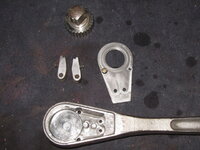
That mechanism looks similar to the swing pawl Proto (and now generic) design. The switch operates differently and it appears to result in a "forward" vs "reversed" switch direction.Great discussion on ratchet designs, guys! And M635 - your thoughts and internal pictures are awesome!
I have a pair of old (1930's) Herbrand pearhead ratchets that are extremely low backdrag - yet are very coarse toothed. Can't figure it out. And I've had modern ratchets like the above pictured standard Tekton that seem rough even with alot of teeth - and like to break the pawl at the thin midsection. Can't nail that down, either.
I think that ratchet designers lose sleep and pull their hair out wrestling with demands from the workplace. Low backdrag - but not too low. Lots of teeth for tight areas, but with sufficient strength to get the job done. Thin ratchet heads but able to take a 3 foot cheater bar. Durable enough for long life but not indestructible - gotta have them repeat sales. And affordable for the average Joe to buy - but keep that profit up!
I'm just glad I get to use the tools and not have to make them.
Wouldn't be surprised the design Snap On uses for the dual-80 just gets too tiny for the 1/4" ratchet. Sure a wrist watch has tiny tiny teeth, but makes no sense to make them as small on a ratchet. At some point it gets way more expensive.
I don't know, others may pull it off in 1/4" size with an entirely different design, but snap on probably wants to keep the design consistent across the lineup...
I don't know, others may pull it off in 1/4" size with an entirely different design, but snap on probably wants to keep the design consistent across the lineup...
Yes, the usual formula for friction is F = μN.Actually the formula for friction is coefficient of friction of the mating materials times the force. Area is irrelevant. Therefore, number of teeth is truly unrelated to back drag. This is one of the most misunderstood standards of engineering.
AKA Amontons' Second Law: The force of friction is independent of the apparent area of contact.
They really shouldn't call this a law, it's really more of a "model".
In this study they show surface area does affect friction:
"The experiment results suggest that the friction force is roughly proportional to both the normal load and the real contact area during loading. Such linearity still holds between friction force and normal load during unloading, while fails for the relation between friction force and real contact area. These results illuminate that the linear assumption of friction force on contact area does not always hold."

An experimental study on the relation between friction force and real contact area - Scientific Reports
Classical laws of friction suggest that friction force is proportional to the normal load and independent of the nominal contact area. As a great improvement in this subject, it is now widely accepted that friction force is proportional to the real contact area, and much work has been conducted...
 www.nature.com
In my experience designing my own ratchet, there are tons of variables, but it does seem that the tooth area in contact with the pawl is a factor. Explains why all my sub-3.0 in-oz ratchets are the tiny 3/8" drive in a 1/4" body ones. All the surface areas in contact with each other are smaller.
I was able to get 0.5-0.7 in-oz of backdrag - video in post #21.
Imagine a toothless gear - a helluva lot less friction lol. It's kind of common sense if you think about it.
Last edited:
The slightly newer Herbrand's have the distinctive "button" selector. These earlier ones had the bigger lever-type switch. Which I prefer when I have greasy hands.That mechanism looks similar to the swing pawl Proto (and now generic) design. The switch operates differently and it appears to result in a "forward" vs "reversed" switch direction.
YoshiMoshi3
Well-known member
- Joined
- Nov 2, 2022
- Messages
- 509
How you modify internal to get lower backdragIt can be very hard to swing a long handled coarse toothed ratchet enough to engage the next ratchet tooth when working inside something like a modern engine compartment, however a coarse toothed stubby ratchet will usually work well everywhere. The longer a ratchet handle is, the more important it is for it to be fine toothed.
Low backdrag is what's most important to me when it comes to 1/4" drive ratchets or 3/8" drive ratchets that will be used on small fasteners or in tight areas. They need to have low backdrag because I often can't fit my other hand in there to help the ratchet along if the backdrag is too high.
Almost all of my 1/4" and 3/8" drive ratchets have been modified internally for lower than stock levels of backdrag. My 1/4" drive custom modified ratchets all sit between 2-2.5 inch ounces of backdrag. As long as 1/4" drive backdrag is 3.5 inch ounces or less, I'm happy.
My 3/8" drive custom modified ratchets all have 3.0-4.5 inch ounces of backdrag. As long as 3/8" drive backdrag is 6 inch ounces or less I'm happy.
For reference purposes-
A stock Snap-on ratchet screwdriver with no modifications has 1.5 inch ounces of backdrag. A stock Snap-on 3/8" drive dual 80 ratchet has about 8 inch ounces of backdrag when new and about 6 inch ounces once it's fully broken in.