To avoid these ads, REGISTER NOW!

Bad result of code violations?.....with pictures.

wyliesdiesels

Well-known member
Joined
Aug 14, 2012
Messages
20,031
Location
Modesto, CA
Your opinion please !

Did the undersized j box cause the problem or the undersized wire or the combination of the two ?
dont think the wire is undersized. looks like copper, which is good for 85a in #4....

What caused this was an improperly torqued connection (the polaris connector).... the small box could contribute some heating issues but wouldnt solely be the cause of the mess were seeing.
 
To avoid these ads, REGISTER NOW!

Half-fast eddie

Well-known member
Joined
Jul 10, 2021
Messages
1,479
Location
Virginia
That doesn't mean they will pay for it.
Actually … in the insurance world you are allowed to … really expected to … take minimum reasonable steps to keep the damage from getting worse. If the shingles blow off the roof, you should stretch a blue tarp across the opening.
 

mike93lx

ALLIANCE MEMBER
Joined
Dec 9, 2013
Messages
37,688
Location
Richmond, VA
Actually … in the insurance world you are allowed to … really expected to … take minimum reasonable steps to keep the damage from getting worse. If the shingles blow off the roof, you should stretch a blue tarp across the opening.
I know, it's mitigating risks. That has nothing to do with getting the negligent party to pay
 

Half-fast eddie

Well-known member
Joined
Jul 10, 2021
Messages
1,479
Location
Virginia
I know, it's mitigating risks. That has nothing to do with getting the negligent party to pay
Maybe i misunderstood. I thought he was concerned about not getting paid back for correcting the “bad wiring” if he had an electrician correct it. My comment was that correction wouldn't affect the claim, he would either collect or not regardless. Have i obfuscated that clearly? 😜
 

mike93lx

ALLIANCE MEMBER
Joined
Dec 9, 2013
Messages
37,688
Location
Richmond, VA
Maybe i misunderstood. I thought he was concerned about not getting paid back for correcting the “bad wiring” if he had an electrician correct it. My comment was that correction wouldn't affect the claim, he would either collect or not regardless. Have i obfuscated that clearly? 😜
Clear as mud. ;)

I generally agree, although the builder will almost certainly argue that they could have done it cheaper and will refuse to pay the full amount. That difference would be the premium paid by the OP to have it done timely.

Ultimately, the courts may have to decide this one
 
OP
J

jtbinvalrico

Well-known member
Joined
Jan 2, 2010
Messages
1,375
Location
Tampa FL
I generally agree, although the builder will almost certainly argue that they could have done it cheaper and will refuse to pay the full amount. That difference would be the premium paid by the OP to have it done timely.

Ultimately, the courts may have to decide this one
Yes....I acknowledge that the wire was sized correctly. I acknowledge that, according to the calculators I found, the 4-4-6-8 they used is proper inside that 1" conduit drop from the soffitt. I further acknowledge that they likely would have come in and done what I thought about doing: Cut the wire further up the wall, install a correct box, and make the correct connection to the pool subpanel.

The problem with that is a lack of confidence in the remaining run of wire 100' back to the main panel. The next problem with that is it's a hack fix and was a hack install to begin with. It may have met code up until it entered the little plastic box, but it introduced 8 potential failure points for no reason other than convenience to the contractor. It's obvious: They should have placed their pool subpanel right where the little plastic box is. That would have prevented all of this. All the other panels on the wall could have been placed accordingly thereafter.

But....if they had simply done their BS hack splice in a properly sized box, and if they had properly torqued those connectors, we wouldn't have had a smoldering mess on the side of the house. And that's where my focus will be. Box fill. If the best I can get is what they would have billed to do another hack splice job, then that will be it. We all know that's maybe a couple hundred bucks. They can keep that. I'd feel like **** if I took a few bills from them and then proceeded to air this out to every entity that will hear it - regulatory and otherwise. If the folks in charge at these companies can't see how their actions set the stage for all this, then so be it. This money won't hurt me.....Agreed, a big part of the bill here is the premium to have it done not only in a timely manner, but in a manner that doesn't just barely skirt the minimum to get it done.
 

mike93lx

ALLIANCE MEMBER
Joined
Dec 9, 2013
Messages
37,688
Location
Richmond, VA
Yes....I acknowledge that the wire was sized correctly. I acknowledge that, according to the calculators I found, the 4-4-6-8 they used is proper inside that 1" conduit drop from the soffitt. I further acknowledge that they likely would have come in and done what I thought about doing: Cut the wire further up the wall, install a correct box, and make the correct connection to the pool subpanel.

The problem with that is a lack of confidence in the remaining run of wire 100' back to the main panel. The next problem with that is it's a hack fix and was a hack install to begin with. It may have met code up until it entered the little plastic box, but it introduced 8 potential failure points for no reason other than convenience to the contractor. It's obvious: They should have placed their pool subpanel right where the little plastic box is. That would have prevented all of this. All the other panels on the wall could have been placed accordingly thereafter.

But....if they had simply done their BS hack splice in a properly sized box, and if they had properly torqued those connectors, we wouldn't have had a smoldering mess on the side of the house. And that's where my focus will be. Box fill. If the best I can get is what they would have billed to do another hack splice job, then that will be it. We all know that's maybe a couple hundred bucks. They can keep that. I'd feel like **** if I took a few bills from them and then proceeded to air this out to every entity that will hear it - regulatory and otherwise. If the folks in charge at these companies can't see how their actions set the stage for all this, then so be it. This money won't hurt me.....Agreed, a big part of the bill here is the premium to have it done not only in a timely manner, but in a manner that doesn't just barely skirt the minimum to get it done.
I am not critiquing your approach at all. I would redo it too.

Just highlighting that, in my opinion, you are fighting an uphill battle on reimbursement. It is worth a try and may even be worth a letter from a lawyer.

Good luck, you'll end up with a good setup either way that won't make you wonder at night if it will fail
 
OP
J

jtbinvalrico

Well-known member
Joined
Jan 2, 2010
Messages
1,375
Location
Tampa FL
Wouldn't this this code requirement apply for your 4 AWG wire junctions?
- Boxes and conduit bodies enclosing conductors 4 AWG or larger (under 600V) must be installed in accordance with the requirements in 314.28.
- For straight pulls, 314.28(A)(1) requires that the length of the box be at least eight times the trade size of the largest raceway.

Since that appears to be 1" conduit and a straight pull, it seems like you would need a minimum of an 8" x8" box for the junction. Or am I missing something?
I think this is where I end up. The box. It measures 2" x 4.5" x 4.5" = 40.5 cu in. Far from familiar with the finer details of the code, I found several online box fill calculators, all of which stop at 6 AWG. So I'm to understand that the 4-4-6-8 they put into this box, along with 4 of the Polaris connectors, is above the maximum AWG these calculators will work with, which means that the above-referenced rule applies. The conduit indeed measures at 1". So the math indicates an 8" x 8" box......that's 128 cu in. The box they used is 40.5 cu in. (I may well have these cu in sizes off and will defer to the appropriate trade sizes).

To me it's simple. The builder terminated those wires in too small of a box. Then the pool contractor stuck their 4 AWG in the box and spliced them. Both parties violated that code. I like a simple, concise argument I can present.
 

rancherbill

Well-known member
Joined
Oct 18, 2007
Messages
5,335
Location
Foothills County, Alberta, Canada
Just **** it up. Give the original contractor and electrician one week to say they will fix it. I doubt they will. Go with the 4600 guy and document document document. Then turn it over to an ambulance chaser and get on with your life. As you see here there are diverging opinions on the problem.

If there is a valid claim the lawyer will get you a judgment.
 

mike93lx

ALLIANCE MEMBER
Joined
Dec 9, 2013
Messages
37,688
Location
Richmond, VA
I think this is where I end up. The box. It measures 2" x 4.5" x 4.5" = 40.5 cu in. Far from familiar with the finer details of the code, I found several online box fill calculators, all of which stop at 6 AWG. So I'm to understand that the 4-4-6-8 they put into this box, along with 4 of the Polaris connectors, is above the maximum AWG these calculators will work with, which means that the above-referenced rule applies. The conduit indeed measures at 1". So the math indicates an 8" x 8" box......that's 128 cu in. The box they used is 40.5 cu in. (I may well have these cu in sizes off and will defer to the appropriate trade sizes).

To me it's simple. The builder terminated those wires in too small of a box. Then the pool contractor stuck their 4 AWG in the box and spliced them. Both parties violated that code. I like a simple, concise argument I can present.
Box fill and pull box sizing are different.

When you have a box that is in a conduit run that is straight through, it requires a box that is 8x the dimension of the conduit which is where the 8" size that was mentioned comes from. This is independent of a volume dimension.

If I have it right, a 90 degree conduit connection requires a box 6x the conduit size.

Ultimately, it would be a lot cleaner if the conduit entered the sub directly, but you also have to be careful of water intrusion with the top entry. It requires some type of sealing hub/connector
 
OP
J

jtbinvalrico

Well-known member
Joined
Jan 2, 2010
Messages
1,375
Location
Tampa FL
Box fill and pull box sizing are different.

When you have a box that is in a conduit run that is straight through, it requires a box that is 8x the dimension of the conduit which is where the 8" size that was mentioned comes from. This is independent of a volume dimension.

If I have it right, a 90 degree conduit connection requires a box 6x the conduit size.
So they have this 4.5" x 4.5" box serving multiple functions here, one as a pull box or junction box, but in the interim a box to terminate and hold wires in for a future job? I get the feeling that the idea was to have the wire protected in this box until someone else came along to connect it to equipment. In the interim, the stucco guys worked it in, then the paint guys made it look nice and neat.

If I'm understanding this a bit better, the pool contractor would have had to, at the minimum, yank the 4.5" x 4.5" box out of the stucco, cut the conduit up to the proper height, chisel out an area at the end to work with, then connect the now fully exposed conduit to the top of a subpanel with a bit of bent conduit?.....If they had done that, there would be no "pull box" issue and some different math would apply?......Is burying conduit in stucco legal?

I appreciate the help. Forgive my ignorance of certain terms and conventions.....I'm trying to hone this down to a few specific points to avoid any style vs substance arguments. I understand that there's "what they should have done", but I also need to correctly identify "what they did" and how each company's role was a departure from code. There shouldn't be any box fill calculations needed here because they never should have treated that as a box, but they did. And all the box fill calculators I can find stop at 6 AWG.....suggesting it's not supposed to be done.....Yes, lol - mud.
 

mike93lx

ALLIANCE MEMBER
Joined
Dec 9, 2013
Messages
37,688
Location
Richmond, VA
So they have this 4.5" x 4.5" box serving multiple functions here, one as a pull box or junction box, but in the interim a box to terminate and hold wires in for a future job? I get the feeling that the idea was to have the wire protected in this box until someone else came along to connect it to equipment. In the interim, the stucco guys worked it in, then the paint guys made it look nice and neat.

If I'm understanding this a bit better, the pool contractor would have had to, at the minimum, yank the 4.5" x 4.5" box out of the stucco, cut the conduit up to the proper height, chisel out an area at the end to work with, then connect the now fully exposed conduit to the top of a subpanel with a bit of bent conduit?.....If they had done that, there would be no "pull box" issue and some different math would apply?......Is burying conduit in stucco legal?

I appreciate the help. Forgive my ignorance of certain terms and conventions.....I'm trying to hone this down to a few specific points to avoid any style vs substance arguments. I understand that there's "what they should have done", but I also need to correctly identify "what they did" and how each company's role was a departure from code. There shouldn't be any box fill calculations needed here because they never should have treated that as a box, but they did. And all the box fill calculators I can find stop at 6 AWG.....suggesting it's not supposed to be done.....Yes, lol - mud.
The pool contractor wouldn't have been doing any of that work. All of the electrical, end to end, should have been done by an electrician, subcontracted by the pool contractor.

Yes,the conduit can be hidden/buried. It is done all the time. But the way they did it looks hack to me and feels like the GC did a crappy job of managing and scheduling crews.

Imo, the stucco should have been done, then the conduit run with the sub being mounted at the same time as the conduit.
 

Git

Well-known member
Joined
May 18, 2008
Messages
6,894
Location
S Cal
We have a 10 year builder's warranty. In my mind, this is the fault of the pool contractor.

Does your 10 year warranty actually cover things like this or is it more along the lines of 'major structural defects' which is pretty common/mandated in some areas?

Doesn't the contractor get a chance to 'make it right' or at least get a chance to look at the problem before you hire someone else to make repairs? I am in the camp that the connection was a slightly loose and enough heat cycles made it worse - but how long do you really expect something like that to be warrantied for?
 
OP
J

jtbinvalrico

Well-known member
Joined
Jan 2, 2010
Messages
1,375
Location
Tampa FL
Does your 10 year warranty actually cover things like this or is it more along the lines of 'major structural defects' which is pretty common/mandated in some areas?

Doesn't the contractor get a chance to 'make it right' or at least get a chance to look at the problem before you hire someone else to make repairs? I am in the camp that the connection was a slightly loose and enough heat cycles made it worse - but how long do you really expect something like that to be warrantied for?
I highly doubt that the warranty covers this.....I believe the builders warranty covers major structural: foundation, integrity of load-bearing walls, etc. I also believe that the short term component of the builders warranty covers certain things within the first year or two - things that are expected to last more than a year. Those items would include a vent fan in a bathroom, the garbage disposal, a window lock, etc. What's generally not covered? Things like settling resulting in minor exterior cracks in the stucco.

There's a difference between something failing and something being done improperly. In this case, the component parts failed because they were installed incorrectly. Each part has a proper use somewhere, but not in this combination. Furthermore, there's no user interaction with a 4.5" x 4.5" box that would cue anyone to its deficiency until it catastrophically fails.

Had the connections been secure, it's possible that this improperly done work would never have been discovered. I agree with that.....Let's say you're not mechanically inclined, and I build and sell you a car. When building this car I make the brake lines out of aluminum and use single flares throughout. Let's say that it somehow holds together. Six years down the road, out of warranty and having otherwise functioned without failing, one of those lines lets go. Am I not liable? Particularly if it can be easily demonstrated that I knew or should have known better?

I don't expect them to warrant or cover a light switch or breaker - something that a reasonable person can be expected to interact with. They hid this behind a cover that Joe Homeowner would never have any reason to open up. And it "functioned" up until the deficiencies - a loose connection and no room in the box - combined to cause this. Even though we recognize that this 4.5" x 4.5" box was acting as a "pull box" and perhaps was intended as a holding point for work to be done the next week, it nonetheless ended up being used as a box, and as a box the fill requirements weren't met. What is the point of the fill requirements? When I google the basic question of why we have box fill limits, I get answers such as this: "....a box that is overfilled can cause a fault, arcing, or even a fire." Of course the companies that did this work would point out that this admonishment cautions against a possibility, and that the actual causation was just the arcing, since we can't prove the box was smoldering for all of the previous 6 years.

These kinds of questions are answered by fire investigators and forensics, none of which will be utilized here because its just not worth it. In this case, Joe Homeowner stood out there, looked at the equipment pad and the wall and thought, "No way. There's no way someone would do that." Four screws later he found that they did.....There's no way in hell these ***-clowns get a second shot. I'll eat every penny and move on before that happens. You don't get a chance to right an intentional wrong; you get a chance to right a mistake. Big difference here.

I'm a reasonable person. My assumption is that someone at these companies will be very disappointed to see that one of their guys did this. My assumption is that they'll want to make it right. My assumptions are sometimes wrong....
 
  • Like
Reactions: RPH

theoldwizard1

Well-known member
Joined
Feb 22, 2011
Messages
43,216
Location
SE MI
dont think the wire is undersized. looks like copper, which is good for 85a in #4....

What caused this was an improperly torqued connection (the polaris connector).... the small box could contribute some heating issues but wouldnt solely be the cause of the mess were seeing.
Interesting !
 

RPH

Well-known member
Joined
Dec 17, 2006
Messages
4,190
Location
Michigan Thumb
32AF7591-B493-444C-84C0-11F88D7C7D63.jpeg
Loose connections can go bad quickly once arcing has commenced. Every arc can diminish the conductors surface area to carry the load. Essentially making the wire smaller leading to failure.
 

wyliesdiesels

Well-known member
Joined
Aug 14, 2012
Messages
20,031
Location
Modesto, CA
So they have this 4.5" x 4.5" box serving multiple functions here, one as a pull box or junction box, but in the interim a box to terminate and hold wires in for a future job? I get the feeling that the idea was to have the wire protected in this box until someone else came along to connect it to equipment. In the interim, the stucco guys worked it in, then the paint guys made it look nice and neat.

If I'm understanding this a bit better, the pool contractor would have had to, at the minimum, yank the 4.5" x 4.5" box out of the stucco, cut the conduit up to the proper height, chisel out an area at the end to work with, then connect the now fully exposed conduit to the top of a subpanel with a bit of bent conduit?.....If they had done that, there would be no "pull box" issue and some different math would apply?......Is burying conduit in stucco legal?

I appreciate the help. Forgive my ignorance of certain terms and conventions.....I'm trying to hone this down to a few specific points to avoid any style vs substance arguments. I understand that there's "what they should have done", but I also need to correctly identify "what they did" and how each company's role was a departure from code. There shouldn't be any box fill calculations needed here because they never should have treated that as a box, but they did. And all the box fill calculators I can find stop at 6 AWG.....suggesting it's not supposed to be done.....Yes, lol - mud.
Thats the thing though, code requires the conduit to be complete end to end before wire is pulled into it.

So some screwed up from the getgo....

They couldve stubbed the conduit there and waited til it could be completed to the panel, then pull the wire

Someone messed up on the order of operations...
 
To avoid these ads, REGISTER NOW!
OP
J

jtbinvalrico

Well-known member
Joined
Jan 2, 2010
Messages
1,375
Location
Tampa FL
Thats the thing though, code requires the conduit to be complete end to end before wire is pulled into it.

So some screwed up from the getgo....

They couldve stubbed the conduit there and waited til it could be completed to the panel, then pull the wire

Someone messed up on the order of operations...
The house build, the pool build, and sale were all under the GC home builder. During the build we were directed to the pool builder as the selected pool contractor for this GC home builder.....There's no scenario where we could have had our own pool builder come in before the house was completed and the Certificate of Occupancy was issued. We received the keys to the whole thing, house and pool completed.

So, it sounds like even through the completion of the pool, the GC home builder had overall site responsibility. That would make the pool contractor their sub.

I'm beginning the process. I'll start with initial complaints to the customer service channels of both. After a couple weeks or being blown off altogether, I'll send letters and photos to the local/regional managers and give that a couple of weeks. If no progress, I'll fire off the same correspondence to the entire chain of command at each company. If no progress, I'll begin formal complaints against the contractor licenses of the local/regional principal players for each company......I've identified those individuals and I have license numbers for everybody - county business licenses, State of Florida business occupational, etc......And we'll go from there.
 

wyliesdiesels

Well-known member
Joined
Aug 14, 2012
Messages
20,031
Location
Modesto, CA
The house build, the pool build, and sale were all under the GC home builder. During the build we were directed to the pool builder as the selected pool contractor for this GC home builder.....There's no scenario where we could have had our own pool builder come in before the house was completed and the Certificate of Occupancy was issued. We received the keys to the whole thing, house and pool completed.

So, it sounds like even through the completion of the pool, the GC home builder had overall site responsibility. That would make the pool contractor their sub.

I'm beginning the process. I'll start with initial complaints to the customer service channels of both. After a couple weeks or being blown off altogether, I'll send letters and photos to the local/regional managers and give that a couple of weeks. If no progress, I'll fire off the same correspondence to the entire chain of command at each company. If no progress, I'll begin formal complaints against the contractor licenses of the local/regional principal players for each company......I've identified those individuals and I have license numbers for everybody - county business licenses, State of Florida business occupational, etc......And we'll go from there.
Yes if theres a GC, theyre ultimately responsible for the work their subs do...
 

Sumboodie

Well-known member
Joined
Mar 20, 2021
Messages
10,700
Location
AK
Too many wires in a small box, questionable screw-clamp splices, a bit of salt air causing some corrosion, not to mention probably some chlorine thrown in, then add some heat. Ding!! fries are done.
It's really no mystery to me why there's problems. The only thing that could have been worse would have been a few wire nuts thrown in the mix.
The connection types are fine. Same style used by PoCo here.
Not like you can wire nut #4 awg!
 
OP
J

jtbinvalrico

Well-known member
Joined
Jan 2, 2010
Messages
1,375
Location
Tampa FL
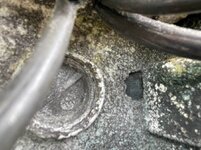
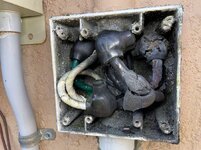
We're back in town.....I was able to look further into this. It just gets worse. The box isn't plastic. It's metal. The grounding screw in the box was unused. Perhaps that's what allowed this arcing clump of 4 AWG wires to burn a hole through the back of the box and scorch the wall behind it......pictures to follow.

I want to be able to say I followed the "process", so I submitted the obligatory complaint through the customer service portals of both the GC home builder and the pool contractor. The GC home builder of course blew it off. But the pool contractor had their electric subcontractor respond on their behalf. The pool contractor's electric sub refers me to the "2013 NEC code requirements as those were the ones that were in effect in 2016 when it was inspected." ......I'm still looking for those 2013 NEC codes. Ya......That person then goes on to point fingers back at the GC. Problem is, I've got photos showing the order in which these steps were done. More on that later.

Yup. The box and the cover are metal. So that means that each time I reached over, by, or around this box to access the Pentair control panel, I risked touching that box with my right hand while grounding myself to the control panel box with my left hand....I think I'm up to five or six NEC violations here:

- Box size rules (6x conduit size=6") for the 4" box and for the 5" pull box after the 90 under it.....314.28(A)(2)
- Failure to ground the metal box containing these splices (see the unused ground screw lower left corner of the metal box)
- Distance from where conductors enter the box to the removable cover can't be less than the bending distance of 4 AWG (2" ?) Theirs is 1"
- Insulating bushings req'd for 4 AWG and greater entering the box.....Can't tell just yet......300.4(G)
- Wet location listing for the 4" box?
- Splicing in conduit bodies with sufficient volume per marking.....No markings here / Is the 4" box a conduit body here? 314.16(C)(2)
- Maximum setback in non-combustible wall is 1/4"....This one is set back 1/2" to 3/4" in the stucco......312.3

Next I'm going to remove the whole assembly from the soffit down and through the 2nd pull box so I can inspect the wall behind and document the burning behind the stucco. My electrician cut the wires top and bottom for me but left the rest at my request.

2.jpg
1.jpg
6.jpg
3.jpg
4.jpg
 

mike93lx

ALLIANCE MEMBER
Joined
Dec 9, 2013
Messages
37,688
Location
Richmond, VA
I think trying to go at them with code violations probably won't be fruitful, but the documentation will be good. Document your attempts to get them to make it right, but I predict that this may need to go to small claims court, depending on your states limits.

IANAL, but I would probably have a consult with one if they already blew you off.

Good luck
 

Half-fast eddie

Well-known member
Joined
Jul 10, 2021
Messages
1,479
Location
Virginia
- Maximum setback in non-combustible wall is 1/4"....This one is set back 1/2" to 3/4" in the stucco......312.3
Are you interpreting that correctly? I think it means for a box completely recessed in the wall, the front of the box can’t be more than 1/4” recessed from the face of the wall. Looks like your box is effectively surface mounted, sunk into the wall about 1/2”.
 

sparky 1971

Well-known member
Joined
Oct 9, 2018
Messages
7,975
Location
Central Iowa
Leave the absence of bushings out of the letter, there is no way to use them on a Bell box since they go on the end of the pipe or connector. And that box is listed for a wet location.
 

wyliesdiesels

Well-known member
Joined
Aug 14, 2012
Messages
20,031
Location
Modesto, CA
We're back in town.....I was able to look further into this. It just gets worse. The box isn't plastic. It's metal. The grounding screw in the box was unused. Perhaps that's what allowed this arcing clump of 4 AWG wires to burn a hole through the back of the box and scorch the wall behind it......pictures to follow.

I want to be able to say I followed the "process", so I submitted the obligatory complaint through the customer service portals of both the GC home builder and the pool contractor. The GC home builder of course blew it off. But the pool contractor had their electric subcontractor respond on their behalf. The pool contractor's electric sub refers me to the "2013 NEC code requirements as those were the ones that were in effect in 2016 when it was inspected." ......I'm still looking for those 2013 NEC codes. Ya......That person then goes on to point fingers back at the GC. Problem is, I've got photos showing the order in which these steps were done. More on that later.
umm what? there is no 2013 codes... 2011, 2014, 2017.... does that guy even know what he's talking about? did you mention to him that there is no 2013 code? did you ask him for a code reference?
 
OP
J

jtbinvalrico

Well-known member
Joined
Jan 2, 2010
Messages
1,375
Location
Tampa FL
umm what? there is no 2013 codes... 2011, 2014, 2017.... does that guy even know what he's talking about? did you mention to him that there is no 2013 code? did you ask him for a code reference?

The incorrect code year wasn't the only thing I noted in their response. Here's an excerpt from the letter they sent - they're all over the place:

"......The home builders electrician provided the homerun feed from the main panel to the pool equipment pad. We are not responsible for the homeruns on any of these jobs. If in fact a homerun was spliced and put into a junction box, it was done by the house electrician not XXXX Electric. Tapping into circuits is not illegal within the national electric code. However, XXXX Electric does not tap into circuits. When we are contracted to do a homerun, we run a continuous feed from the main panel to a subpanel at the pool equipment location without any junctions.

As stated, XXXX Electric nor XXXX Pools had any dealings with the homerun to the pool equipment. This project passed all inspections in 2016. Having a junction is not illegal or against code. Having this size circuit with taps in a 4x4 box is also not against the NEC or box fill regulations. You would also have to refer to the 2013 NEC code requirements as they were the ones that were in effect in 2016 when it was inspected."


So they're saying: We didn't....but if we did....but someone else did.....and if they did....but whoever did it did it right pursuant to the "2013" code. Here's the part where the two electricians will point fingers at who did what. Problem is, neither of them can completely wash their hands of involvement and connecting conductors to and through this mess. You guys tell me: Can an electrician simply shrug their shoulders and say, "This is what the other guy left me, so I'll just hook it up." I doubt it.

There's enough here now to involve not only the GC and the pool contractor, but both of their electric subs......The State of Florida (BPR: Department of Business and Professional Regulation) has a rather detailed 9 page complaint form that I'm working on. I'll file that complaint and others with the County if I do not get a satisfactory response. The State BPR process is noteworthy because once it's sent, I can't pull it back; they retain the ability to pursue it no matter what. Also, the State BPR process appears concerned primarily over whether or not a violation occurred, not whether or not damage resulted from it - although the photos of the smoldering mess and the hole blown through the back of the metal box may be compelling.

Focusing on the actual violation(s) as opposed to what caused the arcing is the easier route. The State BPR seems more concerned with the former - and that makes sense from a regulatory viewpoint. Had our house burned down, or had I been killed touching that ungrounded metal box with a hot 4 AWG conductor contacting it, arson and insurance investigators would no doubt narrow it down to how and why. These companies can decide if they want to be associated with that hazard to life and property, those pictures, and those clear NEC violations. I'm not at all surprised by such a goofy and nonsensical initial response, but I am polite enough to give a decision-maker a clear shot at this.
 

justsam

Well-known member
Joined
Aug 20, 2010
Messages
1,267
Location
Penngrove, California
This seems like more a workmanship issue that should be owned by the team that connected into the junction box. If the box was not the proper size than they should have gone to the home builder to ask for it to be changed. Heat is caused by resistance so again the connectors were not tightened properly, and of course the metal box should have been grounded. Any chance that you can get the original drawings and/or materials list for the work?
 
OP
J

jtbinvalrico

Well-known member
Joined
Jan 2, 2010
Messages
1,375
Location
Tampa FL
Good point…..I in fact have a huge pile of original drawings that were left behind. I’ll look through them and report back….That’s a great idea and is one reason I’m sorting it here with you guys before I tee it up.
 
To avoid these ads, REGISTER NOW!
Top Bottom