To avoid these ads, REGISTER NOW!

Bad thread machining results. What am I doing wrong?

air8

Well-known member
Joined
Apr 3, 2013
Messages
75
I consistently get results like the attached picture. Seems I am only cutting one side of the thread. I have tried threading towards the head stock and away from it. I am using a fishtail gauge. I have tried feeding the compound at 29½ deg. and 30 deg. and tried Zero degree infeed with the cross slide. I have several types of inserts and tried all of the above with the different inserts. Also have tried many, many sizes of threads. I have machined aluminum down to practice on but still get results similar to the attached picture.

Just can't seem to get them to cut properly. I have nearly memorized a webpage on Smithy that has amazing, detailed information about machining threads. I'm either not getting it....or the lathe is totally screwed up. LOL.
 

Attachments

  • 20190327_205958.jpg
    20190327_205958.jpg
    75.5 KB · Views: 356
To avoid these ads, REGISTER NOW!

waynem

Member
Joined
Apr 3, 2006
Messages
15
What type of lathe? Sure looks like the tool is not being returned into the thread in the correct place each pass. Have you tried threading without disconnecting the half nut? Some lathes you have to Change a gear to thread metric. Could you be trying standard threads with the metric gear in place? Don't know if it would cause this.
 

no704

Well-known member
Joined
Apr 27, 2016
Messages
5,207
+2 for leaving the half nut engauged. Reverse the machine out for the next pass
 

larry_g

Well-known member
Joined
Apr 28, 2007
Messages
16,872
Location
oregon
I consistently get results like the attached picture. Seems I am only cutting one side of the thread. I have tried threading towards the head stock and away from it. I am using a fishtail gauge. I have tried feeding the compound at 29½ deg. and 30 deg. and tried Zero degree infeed with the cross slide. I have several types of inserts and tried all of the above with the different inserts. Also have tried many, many sizes of threads. I have machined aluminum down to practice on but still get results similar to the attached picture.

Just can't seem to get them to cut properly. I have nearly memorized a webpage on Smithy that has amazing, detailed information about machining threads. I'm either not getting it....or the lathe is totally screwed up. LOL.

I'm looking at the cutter bit and see no relief on the leading edge? (assuming your cutting right to left toward the headstock.) Are you using a threading insert of a cutting insert. I would suggest that you get a HSS bit and grind your own cutter. Keep at it till you get ALL the angles ground correctly and it cuts a proper thread. Then you will know what a proper bit looks like, and cuts like. From there go back to store bought tools.

lg
no neat sig line
 
Last edited:
OP
A

air8

Well-known member
Joined
Apr 3, 2013
Messages
75
In this picture I had just attempted feeding left to right with the insert upside down and lathe running reverse.

I have attempted leaving the half nut engaged with similar poor results.

The lathe is a Jet GH1660-ZX and all other operations seem to be precise and consistent.

I'll look for some HSS blanks and try grinding my own insert. I have been using the threading inserts from Kennametal. At least that is what Kennametal's website lists them as. However I have also tried some insert that habe no markings on them. But they fit perfectly in the fishtail gauge.

I have tried infeeding with the compound at Zero infeed angle...straight in. Have tried that a lot actually.

Also I have run the lathe slow and fast. Slow as in 25, 65, 120, 185 RPM, and up to 315 RPM.

I'm definately not giving up. I have some tools I want to make for work, to speed up repairs and touch-ups for parts that wear or break.
 

davewo

Well-known member
Joined
Oct 12, 2011
Messages
823
Location
USA
Your compound is 30 degrees from parallel to the spindle instead of 30 degrees perpendicular to the spindle. I can tell because the trailing edge of threads look like 60 degrees.
 
Last edited:

kazlx

Well-known member
Joined
Oct 30, 2012
Messages
2,851
Location
Tustin, CA
Your compound is 30 degrees from parallel to the spindle instead of 30 degrees perpendicular to the spindle. I can tell because the trailing edge of threads look like 60 degrees.

That’s what it looks like to me. He’s got the wrong 30*. If your compound is marked, you might have to use 120 or whatever else. Look at where the comopound mark is when the compound is at 90* to the spindle axis. Then move 30 off of that. Your problem is probably that you are reading the 30 and setting it there and it’s not the correct angle, hence the saw teeth. That’s pretty much the dead giveaway is the cut isn’t even. No matter what the tpi is set at, speed, etc. If you feed with the cross slide and get threads like that, your angle is wrong.
 
Last edited:
OP
A

air8

Well-known member
Joined
Apr 3, 2013
Messages
75
Ohhhhh ****. I bet you guys are right. I'm setting the compound by the 30-deg. mark which is relating to the longitude of the machine. That makes perfect sense.

Gonna go try that as soon as I get a chance. I will post my results. Daaaaaannnng it. I feel humbled and dumb now. LoL
 

bullnerd

Well-known member
Joined
Sep 17, 2012
Messages
5,690
Location
Jersey
Your compound is 30 degrees from parallel to the spindle instead of 30 degrees perpendicular to the spindle. I can tell because the trailing edge of threads look like 60 degrees.

Bingo.

That's why I asked for pic of the compound.

You'll get it now.

Have fun, chasing threads is a blast.
 
OP
A

air8

Well-known member
Joined
Apr 3, 2013
Messages
75
Bingo.

That's why I asked for pic of the compound.

You'll get it now.

Have fun, chasing threads is a blast.

I was planning to take that picture today when I get over to the lathe. Good call on that one.
 
OP
A

air8

Well-known member
Joined
Apr 3, 2013
Messages
75
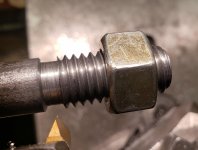
Ok quick attempt and quick pictures after I was finished. One heckuva better looking thread. I didn't have a chance to mic them with the wires yet but they sure are much better.

Thanx guys for helping me see the error.
 

Attachments

  • 20190328_160106.jpg
    20190328_160106.jpg
    92.7 KB · Views: 225
  • 20190328_160059.jpg
    20190328_160059.jpg
    101.7 KB · Views: 208
  • 20190328_160125.jpg
    20190328_160125.jpg
    150.8 KB · Views: 193

kazlx

Well-known member
Joined
Oct 30, 2012
Messages
2,851
Location
Tustin, CA
That looks better :D. Eh, wires are fine, but unless it's for something super specific, just thread a nut on there for a cheap and easy go/no go gauge.
 

bullnerd

Well-known member
Joined
Sep 17, 2012
Messages
5,690
Location
Jersey
Boom!

Also, don't run your fingers over the threads while the lathe is running! See a lot of people do this and it will shred your finger tips.

Try 59 and a half too, just for fun so you can see the difference.
 
OP
A

air8

Well-known member
Joined
Apr 3, 2013
Messages
75
Right on. I will give that a try tomorrow morning.
I am still kind of in shock I didn't realize I was setting the compound at 60-deg. instead of 30. LoL.
 
To avoid these ads, REGISTER NOW!

2oolhound

Well-known member
Joined
Dec 18, 2010
Messages
5,918
Location
BC Canada
Thanks for posting, I still haven't tried to cut threads on my lathe but this will help overcome the fear and uncertainty.
 

ndnchf

Well-known member
Joined
Jan 9, 2012
Messages
1,556
Location
Fredericksburg, Virginia
I'm sure you're not the first person do make this mistake, and you won't be the last. By sharing your experience, you are helping other aspiring home machinists. Good on ya.
 
OP
A

air8

Well-known member
Joined
Apr 3, 2013
Messages
75
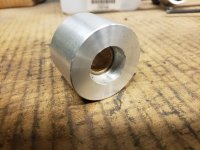
So here is another practice run on 1/2" cold roll. I am super pleased. I am confident now to make a mandrel for some small belt rollers so they can be turned back to level.
 

Attachments

  • 20190329_130602.jpg
    20190329_130602.jpg
    131.3 KB · Views: 103
  • 20190329_131325.jpg
    20190329_131325.jpg
    147.2 KB · Views: 77

Bigblue&Goldie

Well-known member
Joined
Mar 12, 2009
Messages
10,670
Location
AZ
So here is another practice run on 1/2" cold roll. I am super pleased. I am confident now to make a mandrel for some small belt rollers so they can be turned back to level.

Out of curiosity, what size/pitch is this?
 

matt_i

Well-known member
Joined
Mar 14, 2008
Messages
10,725
Location
SE Michigan
I did this once machining a part that had stripped external threads, it was an M24 x (??) or something like this, was welded up first, but first time using a lathe I was unfamiliar with and the half nuts could not be opened due to inch-measure leadscrew. Luckily I saw the non-symmetric thread form early on and corrected the compound in time to recover.

It appears some lathes have the -0- degree mark parallel to the cross-slide's axis and other lathes have the -0- degree mark parallel to the main bedway's long axis.
 

OccupantRJ

Well-known member
Joined
May 15, 2009
Messages
10,975
Location
Eastern North Carolina
Since you got the threading dialed in, another way to make a mandrel is to turn a shoulder on a piece of stock that will closely fit the bore of the part. Drill and tap the turned area for a taper pipe thread to accept a pipe plug. Split the turned area with a saw. Slide part onto arbor, tighten plug. You can machine a face and OD with this type arbor.
 
OP
A

air8

Well-known member
Joined
Apr 3, 2013
Messages
75
Since you got the threading dialed in, another way to make a mandrel is to turn a shoulder on a piece of stock that will closely fit the bore of the part. Drill and tap the turned area for a taper pipe thread to accept a pipe plug. Split the turned area with a saw. Slide part onto arbor, tighten plug. You can machine a face and OD with this type arbor.

That's a great tip. I like it.

Now that I think about it, there are two mandrel type parts at the shop that are very similar to what you described. They have a large o.d. though. Something like 2" and 3 or 4 inch.
 
Last edited:

ilovevocs

Well-known member
Joined
Jun 26, 2009
Messages
1,966
Location
Toledo, Ohio
Just throwing out my .02 even though you sorted your initial issue.

As a hobby machinists with hobby quality tools when I want a real nice thread I will cut it on the lathe and leave just a little material to make a final pass with a die.

Leave your part in the chuck and get a holder for the tail stock. Keeps things in alignment.
 
Last edited:

lilscorpion

Well-known member
Joined
Mar 15, 2010
Messages
3,599
Location
Colorado
Nice job, those look great!!

For those of you who want to thread but aren't into single point, check out a Tailstock Die Holder. I enjoy single point but find the die holder approach to be a really fast way to cut a really nice thread on occasion.
 
OP
A

air8

Well-known member
Joined
Apr 3, 2013
Messages
75
Yea using a die in the tailstock would be easier.

There are some bolts I need to replace which are custom cut. They have threads that are machined up to a shoulder. Maybe .050" short of the shoulder.

My first attempt with a die to fab new ones, resulted in the threads not going far enough for a nut to hold the parts. I will take a picture to show them. I also purchased some bolts to replace the broken ones but they didn't work for the application either. Those bolts are a very rare case of needing to be custom machined.
 

OccupantRJ

Well-known member
Joined
May 15, 2009
Messages
10,975
Location
Eastern North Carolina
A standard threading die can be ground on the leading face to produce a die that will thread right to a shoulder. At work, I kept two of each die to allow me to thread to the limit of the standard die, then switch to the ground die to get that last thread up to a face. I had 3phase power, so just used plug reverse at the right time to reverse right before the shoulder. Alternately, the lathe could be stopped, placed out of gear, and the chuck rotated by hand to achieve the same.
 
OP
A

air8

Well-known member
Joined
Apr 3, 2013
Messages
75
Oh nice!
I never would have thought of grinding a die down. I do have a surface grinder.
 

OccupantRJ

Well-known member
Joined
May 15, 2009
Messages
10,975
Location
Eastern North Carolina
On dies that had removable thread inserts, we also sharpened them on a surface grinder to renew the cutting edge face. That can be done up to a certain point before geometry changes occur.
 
To avoid these ads, REGISTER NOW!
Top Bottom