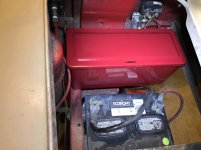
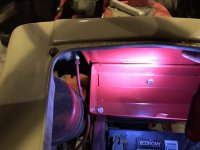
While I would consider the deck installation pretty successful, installing a trolling motor was a bit more precarious. I was lucky enough to find a suitable trolling motor at Cabelas for about 1/3 off. But that's about where the luck ended.
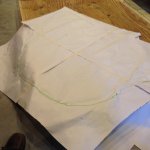
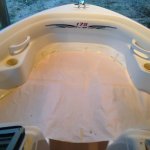
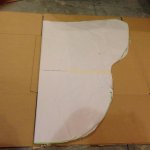
Obviously, the bow of the boat was not necessarily designed to accept a trolling motor although 20 years ago when the boat was new, an option was a fish and ski installation that included a trolling motor. But, how do you get under the mounting area. You cut through the interior hull, of course. My first thought was about 3" would allow me to get my arm in, and I wanted to back the fiberglass with a 16 gauge piece of steel (probably should have been stainless, but I didn't have that handy) so about 6" long. Then I found a hole in a piece of cardboard only about 2 1/4" high that I could actually put my arm through, so I remeasured and cut out about 2 1/2" X 6" -- notice all of the lines!

Yep, that works, sort of.
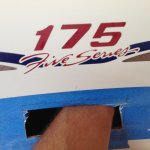
It didn't occur to me that to, say, place a nut on the bolt from the inside I would need to grasp the bolt in my hand thereby increasing the "thickness" of my hand. AND, whenever I moved my hand or fingers the muscles in my skinny arm would contract and bear against the hole I cut. Nevertheless, progress was made.
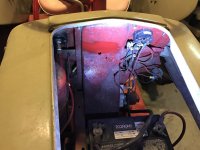
It seemed the best place to put the mounting bracket (which was an extra cost accessory that would allow me to remove the motor for other boat use) was where the front cleat was. So, the first order of business was to remove the cleat. I warned myself that it would be important to hold onto the wrench and the nuts as I loosened them or they may fall into the black hole of the boat interior. Good luck with the nuts; not so much with the wrench. Frankly, of the two choices, the wrench was the lesser of two evils since the nuts were stainless and not magnetic!?! But, when the wrench fell into the boat interior, I had no idea where it was exactly. Fortunately, by removing the running light I was able to see into the interior, find the wrench at the bottom, and position a magnetic retriever to pull the wrench out. Only lost the wrench two other times and one additional washer. Considering that the nuts were nylock and were not easy to thread very far up the bolt, that was not a bad record.
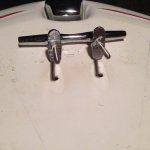
I was pleased to find re-enforcements under the cleat that appeared to be about 3/4" wood encapsulated in fiberglass. But it was difficult to determine the size and position of the re-enforcements. So, The Wife's make-up mirror came into use along with a rule taped to the re-enforcement. By reading the mirror image and transferring the rough measurements to the top of the boat, I found about where to put the motor mounting bracket.


The steel backing was drilled to match the mounting bracket then cut to fit the best position. Still, a couple of pieces of 3/4" plywood were needed to support two of the four mounting bolts. Silicone caulking was applied to all holes and the bracket was attached with much contortion and frustration.


Holes for the re-positioned cleat were drilled, and the cleat attached.
What to do with the 2 1/2" X 6" hole in my boat is still up in the air. I had hoped to put the battery in one of the holds under a front seat and install a quick disconnect in a plate of some sort. But, the battery turned out to be too tall. I do have a teak deck step that I got from West Marine that I could cut down a bit, varnish, and install. But, that's for another day -- we needed to go fishing.


 In fact, SWMBO is out, so I might go do a load now.















 Ahhhh, the things we do for our kids/gkids.