To avoid these ads, REGISTER NOW!

Bar Top Grain - Straight or 90?

Which Direction of the Grain

  • Grain the same Direction?

    Votes: 4 13.8%
  • Cut at a 45 so the side goes 90 deg?

    Votes: 25 86.2%

  • Total voters
    29

ddawg16

Well-known member
Joined
Jul 11, 2008
Messages
21,005
Location
S. California
I just picked up the wood for the bar top in my pub.

The bar top is going to be an L-shape.

So....do I cut it so the wood grain make a 90 at the turn?

Or, join the pieces so the grain goes the same dir?

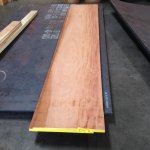
Here is a pic of the raw wood...solid Mahogany...1 1/2" thick.
 

Attachments

  • BarTop Raw.jpg
    BarTop Raw.jpg
    129.9 KB · Views: 111
To avoid these ads, REGISTER NOW!

d.mcfarland

Well-known member
Joined
Jun 18, 2012
Messages
6,584
Location
Western PA
Most I've seen has been cut at a 45 degree angle.

Is there going to be an outer edge that covers the end grain? If so then you have to decide if you want the top to be one or the other.
 

chruler

Well-known member
Joined
Oct 31, 2014
Messages
1,508
Location
Vermont
I would cut the two pieces 45 degree angles to make the 90 degree corner.

It might look cool if you made a flat sawn 1/4" wide strip to run between the two pieces at the joint.
It would look nice and might make a better glue joint instead of trying to glue end grain together.

Bottoms up!
 

rlitman

Well-known member
Joined
Oct 18, 2010
Messages
24,681
Location
Long Island
You'll want a miter in there. The top grain direction needs to match that of the edge, or expansion and contraction will split it.

I don't think there's an advantage of gluing end grain to a flat sawn piece, vs endgrain to endgrain. The better way to do it is to use that flat piece as a spline.
 
OP
D

ddawg16

Well-known member
Joined
Jul 11, 2008
Messages
21,005
Location
S. California
I'm leaning towards the 45 cut....as noted, the edges will look better.

I'm not going to add any molding to the edges....route only.

I have a line on a guy who has a drum sander 55" wide

I'll join them using biscuits and glue....

I'm also thinking of routing some grooves in the underside and installing bars to help hold them flat and prevent any warping.

These pieces have been at the lumber yard for awhile and I'm impressed with how well they are holding their flatness. One piece is 22" wide....the other 24"
 
Last edited:

rlitman

Well-known member
Joined
Oct 18, 2010
Messages
24,681
Location
Long Island
Biscuits are close enough to a spline. But I'd be more comfortable sanding the joint, only after the glue has dried, in case there was any offset (biscuits are good at keeping things aligned, but getting perfect alignment isn't always possible).

If you really want to go all-out, put a couple of dutchmen in the joint.
 

Cyberbear

Well-known member
Joined
Nov 23, 2013
Messages
1,524
Location
California
There are several ways to get the joint done, all have advantages and disadvantages. From my experience genuine mahogany is usually a stable species of wood, especially around boats and wet bars. A spline joint is good but works best when the spline grain runs the same direction as the bar top grain, otherwise the usual very thin spline can often crack or split losing it's ability to hold the joint true. In any case, support the joint well without preventing any necessary expansion if it needs to. I used to build bars for a living.
 

Netman

Member
Joined
Dec 31, 2015
Messages
22
Mahogany is typically pretty stable, just be sure to finish the underside to stop absorption of moisture. Most people overlook this and that is usually the cause of warped and twisted tops.
 
OP
D

ddawg16

Well-known member
Joined
Jul 11, 2008
Messages
21,005
Location
S. California
There are several ways to get the joint done, all have advantages and disadvantages. From my experience genuine mahogany is usually a stable species of wood, especially around boats and wet bars. A spline joint is good but works best when the spline grain runs the same direction as the bar top grain, otherwise the usual very thin spline can often crack or split losing it's ability to hold the joint true. In any case, support the joint well without preventing any necessary expansion if it needs to. I used to build bars for a living.

Mahogany is typically pretty stable, just be sure to finish the underside to stop absorption of moisture. Most people overlook this and that is usually the cause of warped and twisted tops.

Found a guy who has a 55" drum sander.

And, yes, I'll seal both sides. I'll use an oil stain.....and I'm tempted to use an oil finish.....
 

maxpower_hd

Well-known member
Joined
Apr 17, 2015
Messages
2,230
Location
Massachusetts
O vote for the 45 cut and making the grain go 90 as well. I just think it would look better that way regardless of anything else.
 

rlitman

Well-known member
Joined
Oct 18, 2010
Messages
24,681
Location
Long Island
...A spline joint is good but works best when the spline grain runs the same direction as the bar top grain...

Exactly correct. If the spline long grain runs along the joint, it will split along the joint itself, AND may cause the slab to split where the long grain is glued to the end-grain.

This is one reason why biscuits are amazingly useful.
 

pmiranda

Well-known member
Joined
Jul 15, 2008
Messages
1,504
Location
Austin, TX
+1 for the 45 join. It will look nice... even nicer would be to book-match the sides of the L but that's probably only practical when using veneer.
 
To avoid these ads, REGISTER NOW!

kbs2244

Well-known member
Joined
Nov 11, 2006
Messages
14,065
45 degree miters will look the best.
The problem is getting a repeating, matching, seam across the whole surface.
The only way to get it perfect is to install one side "raw," install the other leg "loose", pray, push the two together enough so you can cut the whole panel in one swipe, then push them together.
I saved my son, a 12 year, Chicago Gold Coast, custom hardwood floor installer, a lot of sweat when I told him I was OK with "stair stepping" the corners on a room install.
That makes easier to cut and install tight 90 degree corners.
And it looks just fine.
 

mtnwalton

Well-known member
Joined
Apr 25, 2010
Messages
210
45 degrees and use hardware underneath to draw the joint tight. Not sure of the name, but it's a turnbuckle system that works well. Otherwise, hard to get the two surfaces flush.
 

Shiftless

Well-known member
Joined
Mar 9, 2014
Messages
14,600
Location
East Bay SFO
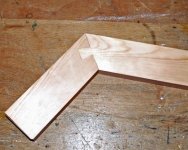
How about just a hint of a dovetail, combined with a hint of a Dutchman, and a bit of mortise and tenon...

like this! (but 90 degrees of course)
 

Attachments

  • image.jpg
    image.jpg
    52.1 KB · Views: 47

The Cobbler

Super Moderator
Staff member
Joined
Oct 24, 2013
Messages
25,999
Location
Niagara Region, Ontario, Canada
I would myself do a 45 if the grains on each pc were similar . try to cover each end with something to mask what would be cut off so you can visualize the joint on each end to best match. See if you can get a countertop place to cut the 45 & cut install cut outs for the bolts they use underneath a miter. Mind is blank now on what they're called.

edit, they are called miter bolts
 

myredracer

Well-known member
Joined
Nov 1, 2015
Messages
557
Location
Langley, BC
My internet 2 cents:

Definitely 45. Won't look right aesthetically and could have excessive shrinkage/expansion across the grain for that kind of distance. I would use the type of fastener like below. They go by different names like tite-joint fastener and flip-bolt. Typically used for laminate counters.

I don't think this is the right situation for biscuit joinery.

If the wood is not properly dried and acclimatized to where it will end up, I would consider not even gluing for say the first year - just don't cinch up the fasteners too tight. If you glue the joint (white/carpenters glue) and there is shrinkage, the wood will split somewhere. A properly glued joint is stronger than the surrounding wood. Then a year later go ahead and fully glue the joint.

I installed kiln dried fir T&G panelling in our house made from trees of our property. Despite being KD'd, some of it still shrank across the width. Should have should have stacked and stickered it for a while first. Never thought KD wood could shrink so much afterwards.

6a00d8358081ff69e201b7c6d109da970b-800wi
 
Last edited:

Muttly

Well-known member
Joined
Dec 11, 2007
Messages
216
Location
Mid-MI
How about just a hint of a dovetail, combined with a hint of a Dutchman, and a bit of mortise and tenon...

like this! (but 90 degrees of course)

Ebony butterflies would look better

butterflykey_lead.jpg


If you own a biscuit jointer it will help with alignment, I like pocket screws to actually hold stuff like this together when you have a bottom side that is unseen.

The countertop turnbuckles work well, but real wood will hold screws well, unlike chipboard.
 

CJ7VFR

Well-known member
Joined
Jan 13, 2015
Messages
2,941
Location
Central New Jersey
Just to throw a bit of a curve at the 90 degree side, here is an old school way of making bar tops. This is what I see in my mind when someone says they went to a real "Pub", and it makes the bar top look like it has been there for decades.

I know it is not to everyone's liking, but I figured I would show a picture of something other than a traditional mitered top.

mad-momos-bar-reclaimed-wood.jpg


Jim
 

kbs2244

Well-known member
Joined
Nov 11, 2006
Messages
14,065
CJ7VFR has shown what I called "stair stepping."
Not only is it way easier to do but it will hide any expansion/contraction problems and makes it unnessary to match the grain.
All the miter experience is with slab style tops.
They are a much more stable surface and do not have grain matching or expansion/contraction problems.
 

NUTTSGT

Super Moderator
Staff member
Joined
Sep 14, 2009
Messages
51,161
Location
Northern Central Ohio
How about just a hint of a dovetail, combined with a hint of a Dutchman, and a bit of mortise and tenon...

like this! (but 90 degrees of course)
Somebody else gets it. :beer:

Ebony butterflies would look better

butterflykey_lead.jpg


If you own a biscuit jointer it will help with alignment, I like pocket screws to actually hold stuff like this together when you have a bottom side that is unseen.

The countertop turnbuckles work well, but real wood will hold screws well, unlike chipboard.


Those look good too.
 
To avoid these ads, REGISTER NOW!
Top Bottom