To avoid these ads, REGISTER NOW!

Basement Cement Block Wall Surface Repair?

offaxis

Well-known member
Joined
Jun 5, 2014
Messages
46
Hi,

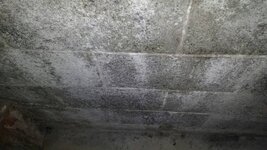
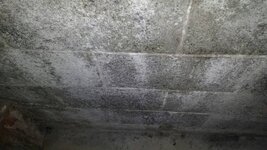
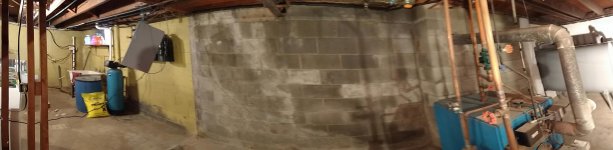
The basement walls of my ranch home need some attention and I need some advice. The home was built in 1955 on a rock knob, I believe they had to blast rock to make room for the basement. Water never comes through the walls in rain storms but the basement is always humid in the summer time and the dehumidifier runs constantly (~1400sf. basement). The surface of the walls is very crumbly at some spots. What do you guys recommend? I have fixed some downspout issues, but the basement still stays very humid in the summer.

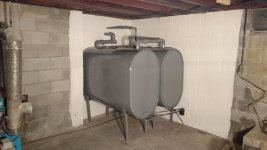
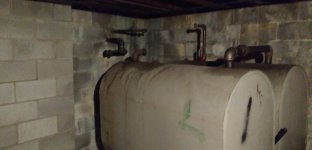
Now that my oil tanks were basically empty, I was able to move them out of the corner. I'd like to fix the area around them before I have to get them filled, then continue on finishing the rest of the walls.

I was thinking of parging the walls with cement then painting with Dryloc. I'd like to make it a finished basement at some point.

Thoughts?

In the attached pictures you can see the build up of dust on the floor from over the many years.
 

Attachments

  • IMG_20170726_205252075.jpg
    IMG_20170726_205252075.jpg
    147.5 KB · Views: 132
  • IMG_20170726_205249344.jpg
    IMG_20170726_205249344.jpg
    146.5 KB · Views: 119
To avoid these ads, REGISTER NOW!

Revtor

Member
Joined
Jun 21, 2014
Messages
22
Location
Northern NJ
Is the dampness caused by condensation? In other words, is warm, moist air getting in and condensing on the floor etc?

I've got a similar situation and I am going to start by trying to seal, as best as I can, all air leaks around the old storm door, old windows, foundation sill etc etc. Solving the problem rather than trying to mask the issue (painting the walls)

For sealing, I'd clean well, (wet scrub brush, concrete cleaner) let dry for a good week or two, then drylock, 2 good coats -no skimping. I'd say, parge the worst areas, but no need to do the whole thing.


~Steve
 
Last edited:
OP
O

offaxis

Well-known member
Joined
Jun 5, 2014
Messages
46
Warm moist air is most definitely getting in due to having my single car garage in the basement. I have a drive way that cuts in below grade and there is a garage door in the gable end of the house. The garage door is opened at least twice daily for me to get to work. The garage is original to the house.

I have not noticed any condensation on the floor.
 
Last edited:

The Cobbler

Super Moderator
Staff member
Joined
Oct 24, 2013
Messages
25,806
Location
Niagara Region, Ontario, Canada
my basement had major leaks but even in a dry spell the basement was humid, damp .
after doing the waterproofing I wrapped the block foundation with Delta Wrap and it's no longer that damp humid.
my theory is the wrap is acting as a moisture barrier and keeping the basement less humid
unfortunately you have to dig up outside to do this
 
OP
O

offaxis

Well-known member
Joined
Jun 5, 2014
Messages
46
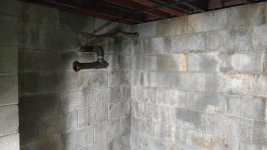
Some more pictures of the block.c9848954a0f0662a1ec8953d79202c86.jpge56d468de4e670cbacb7149eee0606bd.jpg43d1a54d78e375678e07d34d7d1d1310.jpg84b600226d5b107d793fdbedbd5c98d5.jpg

Sent from my MotoG3 using Tapatalk
 

Attachments

  • e56d468de4e670cbacb7149eee0606bd.jpg
    e56d468de4e670cbacb7149eee0606bd.jpg
    120 KB · Views: 0
  • 84b600226d5b107d793fdbedbd5c98d5.jpg
    84b600226d5b107d793fdbedbd5c98d5.jpg
    102.9 KB · Views: 0
  • c9848954a0f0662a1ec8953d79202c86.jpg
    c9848954a0f0662a1ec8953d79202c86.jpg
    90 KB · Views: 0
  • 43d1a54d78e375678e07d34d7d1d1310.jpg
    43d1a54d78e375678e07d34d7d1d1310.jpg
    113.5 KB · Views: 1

jetnow1

Well-known member
Joined
Jun 27, 2016
Messages
511
Location
CT.
Tape some plastic to the wall, wait 48 hours. If there is moisture under the plastic the water is coming from the outside and drylock type paint will not help, indeed will just
be pushed off over time. Do this on the floor also.
 
To avoid these ads, REGISTER NOW!

yeldogt

Well-known member
Joined
Jan 2, 2012
Messages
18,184
In 1955 they were placing tar on the outside of the foundations -- if you dig down (outside) do you see it? They normally did not place a VB under the slab.

Using a large plastic square is a good way to see where moisture is coming from -- do you have any HVAC going into that area?

What type of dehumidifier ? The small home units with the included tank - are not up to the task. I have a Santa FE in one of my basements -- not cheap .. but will dry out a space and keep it dry for much less in operating costs. The small ones just run and run.

Products are available to slow the water transfer through the block -- anything you place on the block like paint will flake off .. even dry lock has a limit.

Your walls don't look bad at all -- the early block was not full cement.
 
OP
O

offaxis

Well-known member
Joined
Jun 5, 2014
Messages
46
I have a typical homeowner 70pint/day unit. I know it's small for the space but the humidity % readout stays below 60%. I also run a box fan on low sometimes to help circulate air.

Plastic squares are on the walls and floor in a few spots. I'll keep you posted.

Sent from my MotoG3 using Tapatalk
 
OP
O

offaxis

Well-known member
Joined
Jun 5, 2014
Messages
46
After removing the plastic squares from the walls and floor, I did not notice any moisture on the block or floor. I believe this concludes that the moisture is coming from opening the garage door and not from water coming through the walls.

We got two inches of rain over night last week and I had a bit of water come in at the corner were I have poor drainage. It use to be a lot worse so I'm making progress fixing the problem.
 
OP
O

offaxis

Well-known member
Joined
Jun 5, 2014
Messages
46
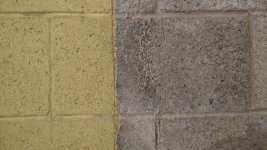
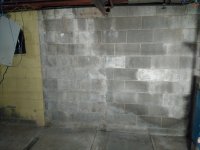
Here is the end result for now. Before and after.

I used an angle grinder with a wire wheel on it to prepare the walls and remove all the loose material, swept up all the dust, then painted two heavy coats of Drylok. The oil tanks also go two coats of Rustoleum oil based enamel paint.

I hope it holds up for a good long while.
 

Attachments

  • IMG_20170824_232315843.jpg
    IMG_20170824_232315843.jpg
    142.9 KB · Views: 59
  • IMG_20170825_062358_01.jpg
    IMG_20170825_062358_01.jpg
    134.9 KB · Views: 24
Last edited:

joes169

Well-known member
Joined
Sep 19, 2011
Messages
663
Location
WI
Any chance there's pavement outside of the wall in the second set of pictures? The crumbling face is pretty consistent with chlorides eating away at the surfaces. occasionally, we see similar degradation from acid soils, as well.

I know it's too late, but I wouldn't advise on using anymore Drylock, until you give this area a few years (at least) to see how it does. Typically, all the drylock does is delay the inevitable, and come off in large chunks with the block when it fails.
 
OP
O

offaxis

Well-known member
Joined
Jun 5, 2014
Messages
46
There is an asphalt walkway and driveways ~6ft off of the corner of that portion of the house. But the condition of the block is not only localized to that corner. The soil around the foundation is mostly clay.

I agree that chlorides are probably eating at the surface. Isn't that called efflorescence? If water doesn't have a chance to pull the minerals to the surface and evaporate, wouldn't it slow down or eliminate efflorescence?

This house is not my forever home, so I don't exactly have a few years to watch a science experiment. I'm ok if Drylok only is delaying the inevitable, and here is why.

The house is 62 years old. For being that old, the walls are in good shape. There is only one corner of the foundation that water runs in and its because of a drainage problem. And now that I think about it, the water probably enters the foundation where the sump pump discharge pipe exits the wall, fills the block cores and then seeps in along the bottom of the wall. The rest of the walls never run water, they only show signs of dampness. See the darker unpainted spots in the above picture. It has been a super wet summer here in PA and if I was going to have worse water issues they would have made themselves more evident. On a side note: The local farmer said that this is only the second summer that he didn't have to get out the irrigation equipment for his crops since 1992. He lives 20mins north of me in the shale ground. My grass is growing like it is spring time.

Also there is a portion of the foundation that was painted a long long time ago. I would guess sometime in the 70's due to the color choice and the style of cabinets and doors that I ripped out. There are some spots that have flaked off and other that are just fine. See attached pictures. I don't know how long it took for the paint to flake, but I would hope that the Drylock of today is better suited for this specific purpose verses whatever was used decades ago on that wall. If in fact that the Drylock can't handle the levels of moisture in the wall, i think the bubbling will be limited to the trouble spots and not the entire wall. I also want to try and reduce the level of humidity in my basement and believe that sealing the walls with something will help. It also makes the basement look a whole lot nicer looking.

I believe that using and angle grinder with wire wheels will provide the best surface for the Drylok to bond to. It makes an absolute mess but its the only way to get he crumbly surface off. I also may spray it with Drylok liquid etch to clean it even more before painting.

Thoughts?
 

Attachments

  • IMG_20170826_141559322.jpg
    IMG_20170826_141559322.jpg
    151.2 KB · Views: 24
  • IMG_20170826_141616523.jpg
    IMG_20170826_141616523.jpg
    152.2 KB · Views: 24
  • IMG_20170826_150732998.jpg
    IMG_20170826_150732998.jpg
    146.9 KB · Views: 18
  • IMG_20170826_150631790.jpg
    IMG_20170826_150631790.jpg
    165.4 KB · Views: 17
Last edited:
To avoid these ads, REGISTER NOW!
Top Bottom