To avoid these ads, REGISTER NOW!

Basement waterproofing

58Yeoman

Well-known member
Joined
Oct 1, 2010
Messages
8,999
Location
Central IL
A few years ago, we had over 7" of rain overnight, and since then, we've had water coming into the basement, sometimes with as little as 1 or 2 inches of rain. I'd already installed a french drain between the house and the hill behind the house; 4" perf pipe and gravel. The ground still slopes toward the house a little, but the way the house is, we can't really raise the level of the yard to slope towards the drain.

We've called a basement waterproofing company to come and assess the leak. I think the wall may have cracked behind the finished wall in the basement. They said to remove the finished wall before they get here, which will be next month on the 13th. I'll probably have to remove part of the suspended ceiling also, plus the paneling, drywall and (I believe) foam insulation for about 10 feet.

What I'm asking is: What should I be looking for when he comes? Questions to ask? In my last house which was built in 1936 (this one in '79), I had a company come in and they dug a trench, put in a sump pump, then put a rubber sheet against the wall to be sure the water ran into the trench. That house had a crumbly concrete wall, and the basement was nice, but not finished. I don't want that on this house.

Any thoughts or ideas?

 
To avoid these ads, REGISTER NOW!

readhead

Well-known member
Joined
Dec 8, 2012
Messages
6,175
Location
Durango, Co.
There are two ways to do it and if you don't want to do it inside then your only option is to dig down around the house, waterproof and install a drain.
 

ChaseDE

Well-known member
Joined
Aug 25, 2016
Messages
2,178
Location
Delaware
pictures and a more clear description would help. you have a hill behind the house that water runs down and toward your basement. you installed a french drain in the yard behind the house to help alleviate that, how far from the house (up the hill) is the drain installed?

if you dont have a sump pump now they will probably try to sell you one, possibly two. for the wall crack they have some stuff now that can be used to patch the inside like carbon fiber sheets and such, they work pretty well. the right way would be to excavate the outside and patch there though.....i think

i had a website client that was a basement waterproofing contractor and hung out and shot the **** with him a lot in his shop, skimmed some knowledge here and there....that why i said "I think" haha
 
OP
5

58Yeoman

Well-known member
Joined
Oct 1, 2010
Messages
8,999
Location
Central IL
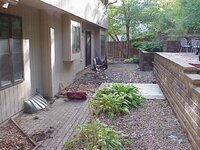
Okay, give me 10 lashes with a used air hose...I should've posted pix. The first one is looking out the back door of the garage towards the stairs going up the hill. The deck is 12 out from the house, so maybe another 5/6 feet to the wall. The leak is right about where the cat scratcher is by the grill in the last pic.
 

Attachments

  • P1000492.jpg
    P1000492.jpg
    116.9 KB · Views: 130
  • P1000493.jpg
    P1000493.jpg
    146.1 KB · Views: 130
  • P1000494.jpg
    P1000494.jpg
    137.6 KB · Views: 141

Jeffksf

Well-known member
Joined
Jul 24, 2007
Messages
381
Location
Cleveland Ohio
The only way to keep water out of your basement is to keep it outside, therefore the best way is to dig up the outside down to the footer, replace the footer tile with new (make sure they inspect existing tile is able to flow water) repair any cracks in the wall, coat wall with waterproofing membrane (tar) the company I worked for installed 1" foam board, then backfill with gravel. I recommend backfilling with gravel all the way to the top of the trench. ASk for refernces, how long they have been in business, how they plan to keep the site clean and minimal damage to any exisitng landscape.
 

ChaseDE

Well-known member
Joined
Aug 25, 2016
Messages
2,178
Location
Delaware
gotcha, i see now, pretty flat to the house from the drain so that bulk of your runoff is taken care of it looks like, hopefully.

for a finished basement it is always a good idea to have a french drain & sump pump or 2. my dad has one and it works fine but i have seen contractors install 2 if its a large or irregular basement.

that crack sealer on amazon has great reviews, i agree with bochnak on that one.
 

kd3pc

Well-known member
Joined
Aug 10, 2013
Messages
3,630
Location
Northern Neck
anything applied to the inside is a band aid at best...the concrete? may have shifted allowing water to run to the foundation instead of away from it.

Will be digging down on the outside to mitigate
 

SALIV8

Well-known member
Joined
Dec 11, 2008
Messages
2,114
Location
chicago and s/w michigan
I had U.S. waterproofing epoxy inject some foundation cracks I had. I believe it was $300 per crack, and they gave me a lifetime warranty. One or two leaked again, and they came out and fixed those for free without hesitation.

And this was done on the inside.
 

machsnell

Well-known member
Joined
Jun 12, 2010
Messages
942
Location
Northern Virginia
I had U.S. waterproofing epoxy inject some foundation cracks I had. I believe it was $300 per crack, and they gave me a lifetime warranty. One or two leaked again, and they came out and fixed those for free without hesitation.

And this was done on the inside.
If it's concrete wall then epoxy fix is good. If block then more difficult. I have done the epoxy injection on poured walls with good results.

Mine was leaking slightly and was block. The blocks were not filled with concrete.

I excavated on the outside did drain tile at bottom of footer and tar and drain board and then filled up with stone within a foot from the top.

Since wall was bowing in slightly I had my guys cut open block at the top and middle of wall and insert rebar and fill with concrete. One cell of each block in the bad areas and every other to third block in the hairline Crack areas. Dilefinitely the hard way to fill cells of block.

It was a pain but it hasn't leaked a drop since I did that.

If you want to cover up the wall again and have peace of mind that there isn't a mold farm behind it you need to check outside and possibly do it the hard but right way.

If only a small area you might be able to control it with minor work.

Positive fall away from house (6 percent good)
Clay on top not a pervious well draining soil
Catch water that can seep in towards foundation
Pipe downspouts to daylight away from the house

Blah blah blah the usual type of things

Sent from my SM-G900V using Tapatalk
 
OP
5

58Yeoman

Well-known member
Joined
Oct 1, 2010
Messages
8,999
Location
Central IL
It's a poured foundation. We have clay soil here. Being that the back yard is almost flat and no room to grade a slope, would removing the clay topsoil and replacing with something else help? Thanks for all the help so far.
 

tjpavlov

Well-known member
Joined
May 18, 2012
Messages
1,276
Location
Providence, RI
Where do the gutters drain?

Does the French drain lead to a dry well?

Can the water be coming in from where that conduit enters the basement?

Can you look under the deck or is it sealed up? Perhaps the ground shifted under the deck.
 
Last edited:
To avoid these ads, REGISTER NOW!
OP
5

58Yeoman

Well-known member
Joined
Oct 1, 2010
Messages
8,999
Location
Central IL
All four gutters drain through underground pipes to sunlight. The french drain drains to sunlight over 50' away. The deck sits on the ground; may have to be taken up for repairs to the wall. I never thought about the conduit. The breaker box is about 15' away from that wall...I never gave that a thought. Will have to check that out. Thank you.
 

bochnak

Well-known member
Joined
Apr 9, 2007
Messages
1,230
Location
Mt. Prospect, IL
I used the polyurethane foam injection kit as opposed to the epoxy. Reason being is that the foam can expand/contract a bit.

The injection kit seals the entire depth/width of wall, as well as the height. From the outside, I see foam 6" above grade on the exterior.

Not a drop of water since I did mine 5yrs ago on 3 cracks.

US waterproofing quoted me 1k for all the cracks. He told me a single is 500 and he was going to give me a deal at 3 for 1k. I found the kits for 80ea online.

Here is a pic:

https://goo.gl/photos/DQMwjvShADfFAZ3d6
 

theoldwizard1

Well-known member
Joined
Feb 22, 2011
Messages
43,073
Location
SE MI
The only way to keep water out of your basement is to keep it outside, therefore the best way is to dig up the outside down to the footer, replace the footer tile with new (make sure they inspect existing tile is able to flow water) repair any cracks in the wall, coat wall with waterproofing membrane (tar) the company I worked for installed 1" foam board, then backfill with gravel.

Most places use dimpled drain board instead of the foam board, but it is a similar concept.

The goal is to get the water to drain down to the footer (weeping) tile as quick as possible (that is why you back fill with gravel) and then to a sump pit and pump. If water is coming through cracks in the wall, it is not being carried away fast enough.

The trench should be lined with commercial grade landscape cloth on the bottom and the side AWAY from the house. If not, over time, dirt/silt will fill the spaces between the gravel and slow down the water flow. I am not a fan of the corrugated drain pipe but it is easy to install especially at the bottom of a deep trench. What ever you use, put a sock on it.
 
Last edited:

tjpavlov

Well-known member
Joined
May 18, 2012
Messages
1,276
Location
Providence, RI
All four gutters drain through underground pipes to sunlight. The french drain drains to sunlight over 50' away. The deck sits on the ground; may have to be taken up for repairs to the wall. I never thought about the conduit. The breaker box is about 15' away from that wall...I never gave that a thought. Will have to check that out. Thank you.

Have you tested all of the drain lines from the gutters? Maybe you have something simple like a clog and everything is backing up on you. Or maybe the grading under the deck is pushing water back towards the house.
 

Tim Kennedy

Well-known member
Joined
Oct 16, 2011
Messages
368
theoldwizard1: filling with gravel instead of fill dirt, helps structurally also --- unlike fill dirt --- gravel doesn't get heavier when it gets wet --- I have seen a lot of basement walls pushed in because only fill dirt was used --- just my opinion.
 

lamywaby

Member
Joined
Feb 7, 2023
Messages
22
A few years ago, we had over 7" of rain overnight, and since then, we've had water coming into the basement, sometimes with as little as 1 or 2 inches of rain. I'd already installed a french drain between the house and the hill behind the house; 4" perf pipe and gravel. The ground still slopes toward the house a little, but the way the house is, we can't really raise the level of the yard to slope towards the drain.

We've called a basement waterproofing company to come and assess the leak. I think the wall may have cracked behind the finished wall in the basement. They said to remove the finished wall before they get here, which will be next month on the 13th. I'll probably have to remove part of the suspended ceiling also, plus the paneling, drywall and (I believe) foam insulation for about 10 feet.

What I'm asking is: What should I be looking for when he comes? Questions to ask? In my last house which was built in 1936 (this one in '79), I had a company come in and they dug a trench, put in a sump pump, then put a rubber sheet against the wall to be sure the water ran into the trench. That house had a crumbly concrete wall and basement waterproofing, and the basement was nice, but not finished. I don't want that on this house.

Any thoughts or ideas?
It seems like you're dealing with recurring water intrusion issues in your basement, and you're seeking advice on what to look for and what questions to ask when the basement waterproofing company comes to assess the situation. Here are some suggestions to consider:

  1. Inspection of the affected area: Take note of the specific areas where water is entering your basement. This includes any visible cracks, signs of moisture, or areas where water stains are present. Make sure to point out these areas to the waterproofing company during their assessment.
  2. Evaluation of the French drain: Since you've already installed a French drain, inquire about its condition and effectiveness. Ask the waterproofing company to assess whether the drain is properly functioning and if any improvements or modifications are necessary.
  3. Identification of potential wall cracks: Inform the company about your suspicion of a cracked wall behind the finished wall in the basement. Ask them to thoroughly examine the wall for any signs of cracking, deterioration, or structural issues that may be contributing to the water penetration.
  4. Assessment of the existing drainage situation: Discuss with the company the current slope of the ground around your house and its impact on water flow. Inquire if there are alternative drainage solutions or strategies that can help redirect water away from the foundation, even if raising the yard's level is not feasible.
  5. Recommendations for repair options: Ask the waterproofing company about the recommended course of action based on their assessment. Inquire about specific repair techniques or products they propose to address the water intrusion issue. Request an explanation of how these solutions differ from the previous approach used in your previous house, considering your concerns about crumbly concrete walls and preserving the finished basement in your current house.
  6. Cost estimation and timeline: Obtain a detailed cost estimate for the proposed repairs, including any necessary excavation, installation of new drainage systems, crack repairs, and waterproofing measures. Inquire about the expected timeline for the project completion and any potential disruptions during the repair process.
Remember to communicate your concerns and preferences clearly to the waterproofing company, emphasizing your desire to avoid a repeat of the issues experienced in your previous house. It's also advisable to gather multiple opinions and quotes from different waterproofing companies to ensure you make an informed decision.
 

mikedodge

Well-known member
Joined
Jun 27, 2017
Messages
2,749
Edit: Never mind my reply. I didn't see someone brought a dead post back to life after 7 years.
 

jollygreengiant

Well-known member
Joined
Nov 10, 2013
Messages
2,354
Location
Ontario, Canada
Edit: Never mind my reply. I didn't see someone brought a dead post back to life after 7 years.

I don't see why that's a problem? It's a good thread with relevant info for other people with wet basements.

It might even be useful for a follow-up. Some posters above said they used crack repair kits on their basement walls. If any of those posters see this again it would be very appreciated if they could chime in with their results several years later. At least I would appreciate it lol. I've been using those kits in my basement as well.
 

mikedodge

Well-known member
Joined
Jun 27, 2017
Messages
2,749
I don't see why that's a problem? It's a good thread with relevant info for other people with wet basements.

It might even be useful for a follow-up. Some posters above said they used crack repair kits on their basement walls. If any of those posters see this again it would be very appreciated if they could chime in with their results several years later. At least I would appreciate it lol. I've been using those kits in my basement as well.

Because my reply was geared more towards the original poster.

Having a thread with relevant info is one thing. Having a thread brought back from dead that people add another page of replies trying to help someone who had a problem years ago is a waste of everyone's time.

One follow up that would be nice to know is if the original poster ever fixed his problem.
 
Last edited:

Fav Onefour

Well-known member
Joined
Jul 14, 2022
Messages
686
Location
MN cold and hot
I'm curious to see what was leaking and if @58Yeoman , found a working solution. In this case I believe the time passed is relevant.

I have a similar layout and clay soils.
This is a before picture after taking out the lower level deck.
lower back before 2.jpg
The negative slope grade next to the home was a big problem. It was a nice big funnel toward the foundation.
What you can't see is the backyard above the retaining wall. Next to the fence, the retaining wall is about 12' tall. The ground behind the wall used to slope toward the home.
Nice house, bad yard.
I've been in the home since 03 and have done quite a lot of work to manage the water. I'm still figuring out some minor parts of a solution.
 

scramboleer

Active member
Joined
Feb 3, 2013
Messages
37
Location
San Francisco
I appreciate this thread. Thanks to all who posted. We life in a city where buildings (nearly) touch and have uphill water getting into our basement. I was debating adding on here or starting a separate thread (more likely).
 
To avoid these ads, REGISTER NOW!
Top Bottom