I have 2 lifts in my shop. One overhead and the other baseplate. The baseplate is 12k lb and for heavy trucks, but my floor is only about 5 inch. So I have had 0 issues up until today. I've had several cars on the baseplate lift. Today I put a crew cab dually on it. When raising the truck I heard some popping, which was the anchors posing in the concrete. I tightened them back down, but I'm sure they will do the same thing again. I plan to reset them with epoxy. My question is, has anyone added an overhead beam to a baseplate lift? I'm thinking about putting some 1/4" 2x3 tubing across the top to keep the columns from pulling so hard on those back bolts. My overhead lift has had no issues


You are using an out of date browser. It may not display this or other websites correctly.
You should upgrade or use an alternative browser.
You should upgrade or use an alternative browser.
Baseplate lift
- Thread starter Cdmartin
- Start date
lakeroadster
Well-known member
I have 2 lifts in my shop. One overhead and the other baseplate. The baseplate is 12k lb and for heavy trucks, but my floor is only about 5 inch. So I have had 0 issues up until today. I've had several cars on the baseplate lift. Today I put a crew cab dually on it. When raising the truck I heard some popping, which was the anchors posing in the concrete. I tightened them back down, but I'm sure they will do the same thing again. I plan to reset them with epoxy. My question is, has anyone added an overhead beam to a baseplate lift? I'm thinking about putting some 1/4" 2x3 tubing across the top to keep the columns from pulling so hard on those back bolts. My overhead lift has had no issues
Hmm... what floor thickness is specified for your 12k lift?
Do you mean replace the mechanical anchors... and use epoxy type anchors / or threaded rod with epoxy?
Floor thickness specifies 6 inches. I drilled 1 hole and it was every bit of 6 inches. So I installed one post with no issues. Once I n got to the other side, the floor slopes to a drain and the concrete on that side is closer to 5.5" where the outside lift anchors are. That's where they are trying g to pull out. Eventually I'm sure the anchors will no longer tighten down, so I'm planning to use some sort of epoxy method. Whichever is most recommended. I probably won't have any more 1 tons trucks on it just to be safe. But I would still like to tie the columns together. The lift is a Atlas Bp12000
lakeroadster
Well-known member
The lift is a Atlas Bp12000
Since the BP12000 is designed as a baseplate lift the columns are short. This means if you wanted an overhead structural "bridge" you would need to install structural uprights, as well as the cross-over structural component.
What you are proposing is scary... IMO.
It looks like the columns have an option to go taller. There are holes on each column that look like an extention could go there. I'm not talking about building something flimsy. This would basically be a steel truck made from 2x3 .250 tubing. The tubing would be welded to 1/4" or thicker plates that bolt to the columns. Scary to me is having the anchors pulling out. I'm just trying to prevent it again. Do you think the epoxy will be stronger than the regular anchors?
I did contact them. Just waiting to hear back. Thought I would check to see if anyone else had run into this same issue. I much prefer overhead lifts, but this baseplate lift is wide enough for us to drive through and that is the only reason we have it. So I'm just trying to figure out the best approach to keep this thing safe. Like I said, it was perfect until I put the big truck on it, so no more big trucks. I'm sure cars and light trucks would be fine as it sits right now. Just checking
toplessHO
Well-known member
you may not want to hear this but the only real way to fix is to slide the lift over about 5 ft
saw cut the slab and put in a column footer.
saw cut the slab and put in a column footer.
lakeroadster
Well-known member
Check out post #9 here: http://www.garagejournal.com/forum/showthread.php?t=347194&highlight=headers
wssix99
Well-known member
That's pretty much what I had in mind. Except I thought about coming off the post from 2 points to form a triangle on each side, structures love triangles
This type of modification can set you up for an epic fail...
The failure you had gave you some safety margin. You had warning before you got into a really dangerous situation. When you add stiffeners and other structural elements, (not intended by the equipment's engineers) you move peak stresses around the equipment to different parts and can also put the system in to a place where it will fail in a brittle (rapid) manner instead of the subtle/slow manner you just enjoyed.
You have identified the proper issue to fix - the anchors. If you add stiffeners, how will you know if the anchors are properly seated? If your stiffener were to fail or buckle and your new anchors aren't just right, the whole thing could pop right out instead of a gradual slip.
You should be just fine by putting in properly seated anchors that can take the loading the lift was designed for.
Z2V
Well-known member
The right fix sure isn't the easiest answer but sounds like you know what you need to do. It is YOUR SAFETY that is most important.
lakeroadster
Well-known member
What about epoxy anchors. Which type work the best? Even if I do resources the concrete the epoxy seems like a stronger way to anchor the posts
Epoxies come in various strengths and types...
Call the manufacturer of your lift and see what they specify for use.
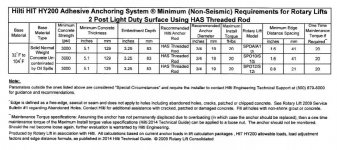
I used Quan. (10) A-193-B7 3/4" Dia x 7" Long fully threaded studs with A-194-2H Nuts and Hilti HY-200 Epoxy... I have a Rotary Lift and that is what they recommended.
Don't use your mechanical wedge type anchors with epoxy..
Attachments
Last edited:
lakeroadster
Well-known member
Check out post #9 here: http://www.garagejournal.com/forum/showthread.php?t=347194&highlight=headers
That's pretty much what I had in mind. Except I thought about coming off the post from 2 points to form a triangle on each side, structures love triangles
This type of modification can set you up for an epic fail...
The failure you had gave you some safety margin. You had warning before you got into a really dangerous situation. When you add stiffeners and other structural elements, (not intended by the equipment's engineers) you move peak stresses around the equipment to different parts and can also put the system in to a place where it will fail in a brittle (rapid) manner instead of the subtle/slow manner you just enjoyed.
It depends on how the modification is implemented. The crossover support could have a slip joint. Thus the columns could act as designed from the manufacturer... unless there was an anchor bolt failure, then the cross over would prevent a catastrophic failure.
Attachments

Last edited:
Forever Fixin
Well-known member
Is there room to expand the baseplate and add more anchors? Greg smith sells a baseplate extension that might work and spreading the weight over more anchors might be preferable.
http://www.gregsmithequipment.com/Atlas-Baseplate-Extension-Kit
The Atlas® Base Plate Extension Kit is designed for those customers who are unsure of the integrity (thickness and PSI) of their concrete floor. These extensions increase the column base surface area that is anchored to the floor.
http://www.gregsmithequipment.com/Atlas-Baseplate-Extension-Kit
The Atlas® Base Plate Extension Kit is designed for those customers who are unsure of the integrity (thickness and PSI) of their concrete floor. These extensions increase the column base surface area that is anchored to the floor.
Last edited:
It actually already has those same baseplate extensions. I bought them with the lift because I knew the concrete was at the minimum standard. They sold them to me cheap since I was buying the lift at the same time. The seem to work well, 13 bolts in each side. Those are the few anchors that came loose. Where can these epoxy items be purchased? All I'm finding at lowes is a quickrete product and another called Sika.
Marcm157
Well-known member
I used Hilti expansion anchors instead of the ones I got with my Atlas lift. The anchors that came with my lift appeared cheap and I wasn't comfortable with them. There are certain things in life I will only buy name brand stuff on and something that affects my life / safety is one of them.
I purchased them at Home Depot. They carry the epoxy ones as well but I was hesitant because you had to drill the hole to a larger diameter than the anchor to leave room for the epoxy and I wasn't sure it would be strong enough.
I installed my lift in a new construction garage and added 10 inches of concrete under where my lift posts would be placed, in addition to my 5 inch floor.
I purchased them at Home Depot. They carry the epoxy ones as well but I was hesitant because you had to drill the hole to a larger diameter than the anchor to leave room for the epoxy and I wasn't sure it would be strong enough.
I installed my lift in a new construction garage and added 10 inches of concrete under where my lift posts would be placed, in addition to my 5 inch floor.
wssix99
Well-known member
Epoxies come in various strengths and types...
Call the manufacturer of your lift and see what they specify for use.
+1
Don't use your mechanical wedge type anchors with epoxy..
+2
Where can these epoxy items be purchased? All I'm finding at lowes is a quickrete product and another called Sika.
I haven't researched all of the big box options, but I recall seeing that Home Depot had some good Hilti ones. No ordinary epoxy anchor will do, as not all are rated for sustained tension loads. (The anchors rated for overhead use are best for this sort of thing.)
You may need to think beyond Orange, Blue, and Green stores and look to a place like Grainger to get something fitting in your area.
Now, the big question - Can you even get the old anchors out???
I think I can get the old ones out, if I keep tightening them they either have to pull themselves out, or start spinning free. If they spin free I'll yank them out with a big slide hammer. I'm hoping they just pull themselves out the rest of the way by tightening the but down. I will order the hilti200 stuff of home depot doesn't have it. We have a fastenal local too, they will be open tomorrow I will check with them. As for the overhead beam, I did find d a post on a Chevelle forum where a guy had the same issue. He claimed that Greg Smith said some people do bridge the columns. But I will wait to hear that from them in person. I feel like it was the cheaper anchors that is the major issue. Yanking them out of the ground will leave the hike oversized anyway, so epoxy is really the only option at that point anyway.
Aahz
Well-known member
CDMartin....IMO, pouring a new concrete pad is really your only option. Something that I haven't seen discussed at all in this thread is whether or not you shimmed the column that's on the thin concrete.
I believe most OEM's would agree that 5.5" of concrete would be acceptable for a 12K lift, even with a lesser number of anchors, provided the anchors are sized properly for the loads. It surprises me that Atlas is requiring 6", but if that's what they call for, it is what it is.
Hilti epoxy anchors may be a good choice, we use them all the time in professional lift installations. If the lift isn't installed completely level, though, you WILL have issues. I bring that up due to your mentioning the slope of the floor and no mention of shims. If the lift is installed on an angle, the base WILL try and pull out of the floor, as you've created a lever.
Installing an overhead support structure really doesn't make sense. Believe it or not, the crossmember on an overhead style lift really doesn't so much besides insure that the hoses and cables have a place to sit and insure correct spacing between the columns. Most of them are designed of relatively thin sheet metal as they don't provide any structural support at all. Adding a structure like that to your existing setup, if the lift isn't shimmed correctly, will simply transfer the force to the TOP of the opposite column, creating an even LARGER lever against the anchors on the column that's not having a problem.
I'm doing a lot of speculating here, based on the shimming issue. Other issues could be concrete that's just not up to snuff (ie. 2500 psi concrete instead of 3500 psi, etc.)
All in all, your best bet is cut the floor and pour a new base pad that's level with the good column. Make sure you use the recommended psi concrete the lift calls for, tie the patched area into the existing concrete with rebar, add some wire mesh and re-install the column.
I believe most OEM's would agree that 5.5" of concrete would be acceptable for a 12K lift, even with a lesser number of anchors, provided the anchors are sized properly for the loads. It surprises me that Atlas is requiring 6", but if that's what they call for, it is what it is.
Hilti epoxy anchors may be a good choice, we use them all the time in professional lift installations. If the lift isn't installed completely level, though, you WILL have issues. I bring that up due to your mentioning the slope of the floor and no mention of shims. If the lift is installed on an angle, the base WILL try and pull out of the floor, as you've created a lever.
Installing an overhead support structure really doesn't make sense. Believe it or not, the crossmember on an overhead style lift really doesn't so much besides insure that the hoses and cables have a place to sit and insure correct spacing between the columns. Most of them are designed of relatively thin sheet metal as they don't provide any structural support at all. Adding a structure like that to your existing setup, if the lift isn't shimmed correctly, will simply transfer the force to the TOP of the opposite column, creating an even LARGER lever against the anchors on the column that's not having a problem.
I'm doing a lot of speculating here, based on the shimming issue. Other issues could be concrete that's just not up to snuff (ie. 2500 psi concrete instead of 3500 psi, etc.)
All in all, your best bet is cut the floor and pour a new base pad that's level with the good column. Make sure you use the recommended psi concrete the lift calls for, tie the patched area into the existing concrete with rebar, add some wire mesh and re-install the column.
lakeroadster
Well-known member
.. Today I put a crew cab dually on it. When raising the truck I heard some popping, which was the anchors posing in the concrete. I tightened them back down, but I'm sure they will do the same thing again....
CDMartin....IMO, pouring a new concrete pad is really your only option.
All in all, your best bet is cut the floor and pour a new base pad that's level with the good column. Make sure you use the recommended psi concrete the lift calls for, tie the patched area into the existing concrete with rebar, add some wire mesh and re-install the column.
That seems to be throwing the baby out with the bath water.
His anchors aren't holding. Could be bad anchors, could be the holes in the concrete are the wrong size.
How do we go from issues with anchors (not concrete issues) to tearing out concrete?
Hilti epoxy anchors may be a good choice, we use them all the time in professional lift installations. If the lift isn't installed completely level, though, you WILL have issues. I bring that up due to your mentioning the slope of the floor and no mention of shims. If the lift is installed on an angle, the base WILL try and pull out of the floor, as you've created a lever.
"The base will try and pull out of the floor"

Please provide further information... 'cause this isn't making sense. The epoxy is gripping the wall of the concrete hole and the shim is between the concrete and the base plate of the lift.
Aahz
Well-known member
John...sorry if I wasn't clear. If the anchors are popping, it can be from a few different issues. 1.) the anchors are pulling out 2.) the concrete isn't strong enough to hold them in or 3.) the lift is not level (he said he has a sloped floor) or shimmed properly
Using epoxy anchors isn't going to solve the problem, in and off itself, if A.) the concrete isn't strong enough or B.) The anchors are pulling out but he can't get them out completely. Pounding the existing anchors through the floor is usually a bad idea as well. That can or will cause a blowout on the underside of the concrete and he's borderline already if the mfg is calling for 6" and he only has 5.5".
To use epoxy anchors, he will need to core out the existing anchor holes to a larger diameter. The epoxy needs approximately 1/8" minimum around the new anchor in order to get a good grip. If he's going to core out all the anchors (or drill them out), it would probably be easier to cut the floor and pour a new pad. At least he could pour it level with the other column and the amount of work is going to be about the same!
If the concrete is the problem (soft & silty, poor psi strength, etc.), the epoxy won't make it any better. The anchors will stay glued to the concrete, but the concrete may still crumble and come up around the epoxy.
If it's only 1 or 2 anchors coming loose, I could see drilling them out (or coring them out) and replacing with epoxy, but he really didn't say if they were ALL coming loose or just a few of them.
"The base will try and pull out of the floor" should have been "the base will try and pull the anchors out of the floor". My bad on that...If the base is not level and you are lifting a vehicle on the lift, the base acts as a lever (fulcrum), pulling the anchors out.
Using epoxy anchors isn't going to solve the problem, in and off itself, if A.) the concrete isn't strong enough or B.) The anchors are pulling out but he can't get them out completely. Pounding the existing anchors through the floor is usually a bad idea as well. That can or will cause a blowout on the underside of the concrete and he's borderline already if the mfg is calling for 6" and he only has 5.5".
To use epoxy anchors, he will need to core out the existing anchor holes to a larger diameter. The epoxy needs approximately 1/8" minimum around the new anchor in order to get a good grip. If he's going to core out all the anchors (or drill them out), it would probably be easier to cut the floor and pour a new pad. At least he could pour it level with the other column and the amount of work is going to be about the same!
If the concrete is the problem (soft & silty, poor psi strength, etc.), the epoxy won't make it any better. The anchors will stay glued to the concrete, but the concrete may still crumble and come up around the epoxy.
If it's only 1 or 2 anchors coming loose, I could see drilling them out (or coring them out) and replacing with epoxy, but he really didn't say if they were ALL coming loose or just a few of them.
"The base will try and pull out of the floor" should have been "the base will try and pull the anchors out of the floor". My bad on that...If the base is not level and you are lifting a vehicle on the lift, the base acts as a lever (fulcrum), pulling the anchors out.
lakeroadster
Well-known member
Lakeroadster comments in Blue
John...sorry if I wasn't clear. If the anchors are popping, it can be from a few different issues. 1.) the anchors are pulling out 2.) the concrete isn't strong enough to hold them in or 3.) the lift is not level (he said he has a sloped floor) or shimmed properly
1a) The anchors weren't torqued correctly
1b) The anchors are poor quality
2a) This would be evident by spalling / damaged concrete
3a) Level is insignificant, within reason, in regard to anchor loading,
3b) Shimmiing is insignificant in regard to anchor loading. It can be significant in regard to concrete compressive stresses though.
Using epoxy anchors isn't going to solve the problem, in and off itself, if A.) the concrete isn't strong enough or B.) The anchors are pulling out but he can't get them out completely. Pounding the existing anchors through the floor is usually a bad idea as well. That can or will cause a blowout on the underside of the concrete and he's borderline already if the mfg is calling for 6" and he only has 5.5".
Epoxy anchors can indeed fix the problem. Their mode of attachment provides less stress on the concrete and they therefore have superior performance. They don't "add" to the stress on the concrete the way mechanical anchors do.
To use epoxy anchors, he will need to core out the existing anchor holes to a larger diameter. The epoxy needs approximately 1/8" minimum around the new anchor in order to get a good grip. If he's going to core out all the anchors (or drill them out), it would probably be easier to cut the floor and pour a new pad. At least he could pour it level without the other column and the amount of work is going to be about the same!
Cutting concrete out and replacing it is easier than drilling out a few holes?He can drill out the holes without even moving the lift.
If the concrete is the problem (soft & silty, poor psi strength, etc.), the epoxy won't make it any better. The anchors will stay glued to the concrete, but the concrete may still crumble and come up around the epoxy.
Agreed
If it's only 1 or 2 anchors coming loose, I could see drilling them out (or coring them out) and replacing with epoxy, but he really didn't say if they were ALL coming loose or just a few of them.
Cdmartin stated:
"The base will try and pull out of the floor" should have been "the base will try and pull the anchors out of the floor". My bad on that...If the base is not level and you are lifting a vehicle on the lift, the base acts as a lever (fulcrum), pulling the anchors out.Floor thickness specifies 6 inches. I drilled 1 hole and it was every bit of 6 inches. So I installed one post with no issues. Once I n got to the other side, the floor slopes to a drain and the concrete on that side is closer to 5.5" where the outside lift anchors are. That's where they are trying to pull out. ...
The base always acts as a lever, the lift being out of level will make a negligible difference, if any.