To avoid these ads, REGISTER NOW!

Basic AC toolkit

Zebu Fellenz

Well-known member
Joined
Aug 3, 2010
Messages
1,687
Location
Phelps, NY
Hey,

I'll start by saying I know next to nothing about air conditioning systems but I'm a quick study!

Considering getting setup to do my own AC work and wondering what's in the basic toolkit. I'm assuming a set of gauges, refrigerant, vacuum pump, and a way to recover refrigerant.

Looking to get setup to do it myself as I have some heavy equipment to work on in addition to cars/trucks and the big equipment isn't something my local mechanic is really interested in messing with.
 
To avoid these ads, REGISTER NOW!

sberry

Banned
Joined
Jun 18, 2005
Messages
35,747
Location
Brethren, Michigan
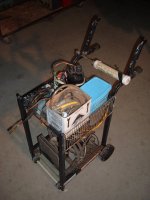
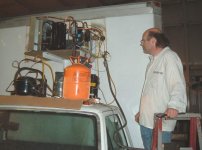
My helper does mine. I don't know squat, I built the cart,,, ha
 

Attachments

  • refer work.JPG
    refer work.JPG
    36 KB · Views: 116
  • refrig cart.jpg
    refrig cart.jpg
    79.5 KB · Views: 104
Last edited:

RedneckWelder

Well-known member
Joined
Nov 12, 2013
Messages
5,703
Location
The Ghetto Kingdom of Methlandia
Vacuum pump, manifold gauges, recovery machine and tank (not cheap) to do it legally, scale if using 30lb bottles. Leak detection I end up using nitrogen charge kit, dye injector and UV light, and an electronic leak detector. Thermometer for the vent. Flush bottle for cleaning out a failed system.

I consider A/C work to be a pain in the *** but we have to do it
 

JiminAZ

Well-known member
Joined
Jul 11, 2018
Messages
341
Location
Phoenix, AZ
Also at least for automotive, you will find yourself breaking tubing connections in goofy places that can be a bit hard to get to. I've had to chase threads on connectors a time or two also in order to save a condenser.
 

Modern Garage

Well-known member
Joined
Mar 26, 2015
Messages
583
Location
Southern Minnesota
I'm assuming R-134a although if you have old heavy equipment you may run into some R-12. I still convert one or two cars a year from R-12 to R-134a. You can find a used charging station which will have recovery, vac pump, charging scale all together but that might be useless on something like ag or construction vehicles which would require a more portable gauge/hose set and separate vac and scale. If you're working on your own equipment the scale could be optional on old stuff where you have no capacity spec and no need to bill out supplies for a customer. On-road HD trucks are designed to be shop serviced so a rolling charge station would be OK.
I have a "sniffer" electronic leak detector for 134 and a UV light and dye, and use them both, but I find a few very slow leaks just by looking for the slightly oily spot on a hose or connection. The refrigerant oils I use have UV dye in them so everything I touch has leak-detect dye in it. Which reminds me, if you don't use a charging station you'll need an oil injector of some kind.

And a strong understanding of basic physics. A large portion of ac diagnosis is done with my bare hands feeling hose temps and knowing what should feel hot and cold.
Joe
 

DGersic

Well-known member
Joined
Mar 12, 2017
Messages
6,304
Location
DeKalb, IL
For car A/C I’ve never needed a recovery. The system is leaking and generally pretty much empty by the time I get to it.

Nitrogen bottle for testing your work is good.

One or more schraeder valve tools. Damn things seem to be single use. They leak on second use.

A set of the spring release tools. You’ll need those for tubing connections.


Sent from my iPad using The Garage Journal mobile app
 

Modern Garage

Well-known member
Joined
Mar 26, 2015
Messages
583
Location
Southern Minnesota
"For car A/C I’ve never needed a recovery. The system is leaking and generally pretty much empty by the time I get to it."

Agreed they're usually empty (or almost) but I usually like to add some refrigerant for testing - which leads to:

"Nitrogen bottle for testing your work is good."

I've seen reference to this before. I have a friend who flushes with nitrogen instead of a vac pump for removing moisture ( not advocating or deriding - just reporting) but how do you use nitrogen for testing? I'm always open to new ways to get my work done.

"A set of the spring release tools. You’ll need those for tubing connections."

Good idea! I forgot those.


Joe
 
To avoid these ads, REGISTER NOW!

theoldwizard1

Well-known member
Joined
Feb 22, 2011
Messages
43,147
Location
SE MI
Recovery machines are expensive, especially the automotive one that "do it all". A couple of used tanks that you have pulled a vacuum on will do almost as good.

For DIYers, it is hard to justify good manifold/gauges. Which means the cheap ones will fail just when you go to use them the third or fourth time. Same with cheap versus expensive vacuum pumps.

I never see the auto guys use a micron gauge, but maybe it is because it is built into the machine. You need one for non-automotive work. If you want to speed up the evacuating process on large systems, they make larger ID hoses and a special tool that removes/installs the Schrader valve while the manifold set is connected (less restriction without the Schrader valve in place).

Some manifolds do NOT come with hoses so you can select the length you want. Some come with hoses that are really too short. Sometime you need angle adapters.

Modern auto systems typically have one or more "safety" switches that prevent the compressor from coming on. Common failure. You will need a DMM. The Fluke 116 has Low Input Impedance (when in Auto Volt mode) so less likely to pick up "ghost voltage". It also measures capacitance and has temperature input. Get a second "amp clamp" style meter just for measuring currents (make sure it can do both AC and DC).


Last summer, the AC in my car started to "act up". Between the "flat hour" labor charges and the ridiculous charge for refrigerant some sops are making a KILLING ! Of course everyone wants it fixed TODAY, so the parts stores charge a premium for having items on hand. Buy your refrigerant at Walmart and your A/C parts from Rock Auto. I saved about $400 installing my own compressor.
 
Last edited:

metaldad

Well-known member
Joined
Aug 2, 2011
Messages
7,753
Location
nw indiana
in regards to the nitrogen question. an a/c system, will always have trace amounts of refrigerant in it, even it flat. bump it up with nitro, leak check with a quality electronic leak detector.
nitrogen is dry. sweeping a mt system, before and during evacuation, the nitro will 'absorb' moisture.
 

DGersic

Well-known member
Joined
Mar 12, 2017
Messages
6,304
Location
DeKalb, IL
"For car A/C I’ve never needed a recovery. The system is leaking and generally pretty much empty by the time I get to it."


Agreed they're usually empty (or almost) but I usually like to add some refrigerant for testing - which leads to:


"Nitrogen bottle for testing your work is good."


I've seen reference to this before. I have a friend who flushes with nitrogen instead of a vac pump for removing moisture ( not advocating or deriding - just reporting) but how do you use nitrogen for testing? I'm always open to new ways to get my work done.


"A set of the spring release tools. You’ll need those for tubing connections."


Good idea! I forgot those.


Joe


You can’t flush an a/c system. You vacuum it. That removes any moisture. Then you fill it with N2 to test it. If it leaks, air is mostly N2 anyway, so no harm done. If it holds pressure ok, you vacuum pump it down again, then fill with refrigerant.


Sent from my iPad using The Garage Journal mobile app
 

DGersic

Well-known member
Joined
Mar 12, 2017
Messages
6,304
Location
DeKalb, IL
Recovery machines are expensive, especially the automotive one that "do it all". A couple of used tanks that you have pulled a vacuum on will do almost as good.

For DIYers, it is hard to justify good manifold/gauges. Which means the cheap ones will fail just when you go to use them the third or fourth time. Same with cheap versus expensive vacuum pumps.

I never see the auto guys use a micron gauge, but maybe it is because it is built into the machine. You need one for non-automotive work. If you want to speed up the evacuating process on large systems, they make larger ID hoses and a special tool that removes/installs the Schrader valve while the manifold set is connected (less restriction without the Schrader valve in place).

Some manifolds do NOT come with hoses so you can select the length you want. Some come with hoses that are really too short. Sometime you need angle adapters.

Modern auto systems typically have one or more "safety" switches that prevent the compressor from coming on. Common failure. You will need a DMM. The Fluke 116 has Low Input Impedance (when in Auto Volt mode) so less likely to pick up "ghost voltage". It also measures capacitance and has temperature input. Get a second "amp clamp" style meter just for measuring currents (make sure it can do both AC and DC).


Last summer, the AC in my car started to "act up". Between the "flat hour" labor charges and the ridiculous charge for refrigerant some sops are making a KILLING ! Of course everyone wants it fixed TODAY, so the parts stores charge a premium for having items on hand. Buy your refrigerant at Walmart and your A/C parts from Rock Auto. I saved about $400 installing my own compressor.


Best price I’ve found locally for R134a cans is at Menards.


Sent from my iPad using The Garage Journal mobile app
 

theoldwizard1

Well-known member
Joined
Feb 22, 2011
Messages
43,147
Location
SE MI
Best price I’ve found locally for R134a cans is at Menards.
Under $5/lb is a good price !

I would feel a lot better if a repair shop charged me a "reasonable" price (<$10/lb) for the refrigerant and 1 hour of labor for installing it !
 
To avoid these ads, REGISTER NOW!
Top Bottom