To avoid these ads, REGISTER NOW!

Basic Generator fuel consumption questions

Razorhunter

Well-known member
Joined
Apr 25, 2013
Messages
393
Trying to decide on gasoline vs diesel vs propane/gas generator to primarily provide power for heat pump and A/C unit in a small 1500 sq ft house in a power outtage. I think the A/C is 3.5 ton maybe? It pulls only 8amps after startup and I do have a Micro Air Easystart box if needed to help with the inrush current on startup.
SO, I know something like your typical Honda 6500 or 7500 (I've even used a 5kw Honda for this A/C unit) generator will work, but I'm also considering larger generators like 10kw or so.
Regardless, I want to know about fuel. I know the gasoline Hondas use a lot of fuel, in my opinion anyway. I think it was 6-7gal or more per night when I used to run them. I don't know how much better diesel generators are with fuel consumption to be honest, but what about propane/LP? I'm trying to determine how drastic of a difference there is between these three fuels as far as consumption goes.
Basically wondering if I buy a 250gal tank for diesel, or gas, or LP propane, which is going to last the longest, roughly speaking and all electrical loads being equal?
I fully understand the generator itself and the loads it sees will affect this, but typically speaking, is LP/Propane far more efficient?
Just looking for someone to give me some basic insight on fuel consumption here.
As I said, I am primarily looking to be able to run my heat pump and maybe the fridge on a budget. If I had the resources at the moment I'd buy a huge 20kw and hook it up to natural gas or propane, but at this time I'm just looking for a small generator maybe 10kw at most.
 
To avoid these ads, REGISTER NOW!

Davefr

Well-known member
Joined
Jan 7, 2010
Messages
11,815
Location
OR
Propane will be the best for storage but it has the least energy (ie BTU content) than gas/diesel and most dual fuel generators have separate specs when using gas vs propane. Does your heat pump have secondary backup/emergency heat? Those supplemental heating elements consume a huge amount of amps when energized.

Is the heat pump the only thing you'll run? If you're running appliances, well pump, hot water heater etc you'll need to be concerned about the startup surge which can be a lot higher than running amps. You might need to manually flip/sequence breakers so all these things don't start/run at the same time.

Your other factor is how long do you anticipate being without power? I find it easy to store around 15 gallons of gas which will power my generator for a couple days (daytime only) + the already full tank. (power is usually back on by then or roads are passable). I don't run my heat pump during an outage. Wood heat is just fine and we usually don't drop below the teens.
 

GCS

Well-known member
Joined
Dec 12, 2014
Messages
311
Location
Oklahoma
This was from a few years ago…. 2K sq/ft house
$169.37 total fuel bill


Generac Guardian portable Generator

22,500 peak/15K constant

4 1/2 days
(Soft start not installed)
Could not run A/C 5 ton unit

Neighbor’s 22K Generac Standby whole house NG generator
4 1/2 days

$200 total fuel cost
$45/day w A/C 5 ton
 

Firebrick43

Well-known member
Joined
May 12, 2015
Messages
13,974
Location
West central Indiana
250 gallons of diesel has more btus per gallon (138000~) than 250 gallons of gasoline (120,000~)

250 gals of gasoline has more btus than 250 gallons of propane (91,500)

So if your mentally stuck on only 250 gallons of each the diesel wins.

However diesel has water issues in storage which in itself can destroy injectors and high pressure pumps. Also water and tanks that don’t get used are breeding ground for algae that loves to grow in diesel tanks that are turned over often plugging fuel filters.

Gasoline is still a vented tank in that size and is going to have moisture issues, especially if it’s has ethanol in it. This usually won’t destroy things out right but still causes issues or stoppages. Gas will also varnish up carburetors as well causing issues

Propane stores indefinitely which is why 95 percent of standby stationary residential generators are propane.

Also diesel fuel is usually the most expensive per 100,000 btu delivered, over a dollar a gallon more than gasoline

Propane is usually the cheapest per 100,000 btus, usually a dollar cheaper than gasoline but is very dependent on your area and the propane companies there.

Also diesel generators will have the highest purchase cost and the highest maintenance cost typically in standby usage.

Propane portables will be slightly higher than gasoline counterparts in purchase but because the fuel burns so clean it will require less maintenance and last longer, although the difference will be much smaller.

Gasoline stationary generators are not really a product offered any more.
 
Last edited:
OP
R

Razorhunter

Well-known member
Joined
Apr 25, 2013
Messages
393
Great info above guys. Thanks. That just gives me an idea.
As for diesel and gasoline storage though... The moisture and algae growth issue has always intrigued me.
I've worried about this issue for years, with old diesel trucks sitting for long periods of time and I have never once experienced an issue, and I'm talking one truck sat for 5yrs which may not be an eternity, but I figure if it'll go 5yrs then I can always store diesel in a tank, and progressively use it in my vehicles and cylce it at will.
I actually just tore a 5.9 Cummins 35gal tank out to replace the fuel sending unit, and after sitting for 5yrs with about 1/4 tank of diesel in it, I was surprised to see there was not a single sign of anything negative. No algae, no water, no trash or debris. Nothing except the tiniest little dime-sized piece of plastic which had torn off from the baffle inside the tank.
This is a 2004 Cummins so it has sat for many long periods of time with the previous owner, whom I knew. Now granted, the injectors took a hit and tiny amounts of water eventually did kill the orifices and the ball seat inside and created high return rates, but no issues with the diesel in the tank. Located in the southeast U.S.
I would be interested to hear from anyone here who has experienced the diesel fuel algae issue via long term storage. I know it's a real possibility, I'm just saying I've never experienced it. Maybe it takes more years than I've let one sit?
 

Steve W.

Well-known member
Joined
Mar 27, 2019
Messages
1,240
Location
Southwest oHIo
As others have mentioned, there are definitely some differences. One more to consider (that @Firebrick43 mentioned) is fuel storage. One fuel that you barely mentioned is natural gas. If that is available, I would go with that. There is no storage problem, it will always be fresh. I have no idea about the cost/100,000 BTU, but the abundance of fresh fuel might offset that.

.
 

Firebrick43

Well-known member
Joined
May 12, 2015
Messages
13,974
Location
West central Indiana
Great info above guys. Thanks. That just gives me an idea.
As for diesel and gasoline storage though... The moisture and algae growth issue has always intrigued me.
I've worried about this issue for years, with old diesel trucks sitting for long periods of time and I have never once experienced an issue, and I'm talking one truck sat for 5yrs which may not be an eternity, but I figure if it'll go 5yrs then I can always store diesel in a tank, and progressively use it in my vehicles and cylce it at will.
I actually just tore a 5.9 Cummins 35gal tank out to replace the fuel sending unit, and after sitting for 5yrs with about 1/4 tank of diesel in it, I was surprised to see there was not a single sign of anything negative. No algae, no water, no trash or debris. Nothing except the tiniest little dime-sized piece of plastic which had torn off from the baffle inside the tank.
This is a 2004 Cummins so it has sat for many long periods of time with the previous owner, whom I knew. Now granted, the injectors took a hit and tiny amounts of water eventually did kill the orifices and the ball seat inside and created high return rates, but no issues with the diesel in the tank. Located in the southeast U.S.
The water came from the tank that took out the injectors.
I would be interested to hear from anyone here who has experienced the diesel fuel algae issue via long term storage. I know it's a real possibility, I'm just saying I've never experienced it. Maybe it takes more years than I've let one sit?
A fuel tank up under a truck that isn’t exposed to the sun and temp swings that the sun causes. A large 250 gal tank is a different beast because the daily temps might be 40 degrees different than the one under the truck.

Our company is one of the largest on farm fuel providers in the state. Every year maybe 8 to 10 IBC totes are filled with contaminated fuel from diesel tanks that set too much The customers paid for that fuel plus some to flush the tank clean. And that is one branch.
 
Last edited:

Davefr

Well-known member
Joined
Jan 7, 2010
Messages
11,815
Location
OR
I would be interested to hear from anyone here who has experienced the diesel fuel algae issue via long term storage. I know it's a real possibility, I'm just saying I've never experienced it. Maybe it takes more years than I've let one sit?
It's my experience that diesel storage is a PIA just like gasoline. I have a JD 1070 diesel that isn't used much and untreated diesel will form a slime that clogs fuel filters. It's gotten better since I started using biocides but you really need to keep it fresh.

PI_Asset_1206270.jpg
 

RTM

Well-known member
Joined
May 13, 2019
Messages
13,061
Location
SF Bay Area
250 gallons of diesel has more btus per gallon (138000~) than 250 gallons of gasoline (120,000~)

250 gals of gasoline has more btus than 250 gallons of propane (91,500)
One fuel that you barely mentioned is natural gas. If that is available, I would go with that. There is no storage problem, it will always be fresh. I have no idea about the cost/100,000 BTU
I bought a tri fuel generator, and the specs for natural gas are lower than propane. My manual rates them in max kW, but I'm sure that is directly tied to the BTUs per gallon.

I plan on adding a natural gas connection to the house soon, as in any normal power outage we get here, caused by wind and or rain, the natural gas will still be present. I've never priced natural gas per gallon, but I suspect it's cheaper than propane. I am much more comfortable storing 20+ gallons of propane than the same amount of gas. My longest outage to date has been three days.

I don't know the run time per gallon, but I think my manual lists run rate (gallons per hour) for each fuel at the same load. Yours should too.

And the joy of starting a battery starter on propane vs gasoline after sitting, no comparison.
 

Firebrick43

Well-known member
Joined
May 12, 2015
Messages
13,974
Location
West central Indiana
I bought a tri fuel generator, and the specs for natural gas are lower than propane. My manual rates them in max kW, but I'm sure that is directly tied to the BTUs per gallon.
NG is sold by the Therm, which is 100 cubic feet and close to 100000 Btu.

It’s not liquified typically like propane as the tanks would be insanely thick walls to hold the pressures that liquids NG produces.

Propane has about 2.5 times the energy per cubic foot after it expanded to 11" wc or 1/2 psi.

But yes, NG is usually significantly cheaper than propane, many times half of that of propane. Although there are monthly service fees have gone up significantly even if you dont use any that month.
 
OP
R

Razorhunter

Well-known member
Joined
Apr 25, 2013
Messages
393
On a similar note, I recently bought an older but very low hr Honda EM5000s and I’ve been wanting to ask you guys who is a good parts source for these Hondas? It would be nice to find a parts source with a good knowledge base on these Hondas as well.
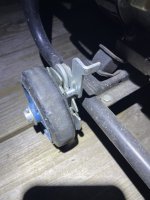
For instance, at the moment I’m trying to decide if the off road wheels will mount right on to this EM5000s or do I have to throw new longer axles on etc etc? You see very few of them with these “on road” wheels, but I have seen a few with these same blue little wheels. Makes me think maybe they did come as OEM at one point. I need flat-free off road wheels though. Not sure if this axle is long enough however.
Anyone got a basic list of most common parts failures on these Hondas? Aside from air filter and basic carb parts, what else goes wrong? What spare parts for Honda should be kept? I can’t say I’ve ever had one break down, aside from a pull starter rope issue. I’ve honestly never pushed them hard though.
 

Attachments

  • IMG_0394.png
    IMG_0394.png
    2.5 MB · Views: 14
  • IMG_0392.jpeg
    IMG_0392.jpeg
    575.7 KB · Views: 14
  • IMG_0391.jpeg
    IMG_0391.jpeg
    499.4 KB · Views: 13

NWOhioChevyGuy

Well-known member
Joined
Feb 20, 2007
Messages
1,918
Location
Buckeye Hill (Morenci, MI)
I purchased a 17.5K Generac "portable" and use it in outages to power our home.

On gas it will run our whole home, we don't have central air, and it is a thirsty beast when cold.
I had the numbers but can't locate them from our last long outage. Outage was 10 days if I recall correctly, mid winter ice storm.
But I can say I borrowed every gas can I could to keep her running.

Since then I have purchased a propane conversion kit and plan to install a 500 gallon LP tank for easier/long term storage.
Its on the list of projects ;)
 

Retired dozer fixer

Well-known member
Joined
Aug 6, 2022
Messages
327
Location
Leesburg Indiana
I run a 10K John Deere portable generator for camping and house backup. Can run anything in my house just not all at same time. Must be selective with the heavier loads. Will burn 7 gallons in 12 hours of use. Storms took out our power last year for about 5 days. Used around 70 gallons of gas running 23-7. Stopping 30 minutes each 12 hours to refill. Was over $200 bucks just for gas. In a situation like that cost is irrelevant compared to losses to food and lodging
 

Rinspeed

Well-known member
Joined
Apr 26, 2020
Messages
1,816
Location
NY
I have a gas Predator 9500 and it's been great but if I was ever going to upgrade propane certainly would be convenient especially seeing the tank is only 10 feet away from where I run the gen.
 
OP
R

Razorhunter

Well-known member
Joined
Apr 25, 2013
Messages
393
Anyone care to tell me the premier Honda generator parts and info source online? Preferably a company with a good knowledge base on Honda generator parts etc? There’s gotta be someone who is Tier1, no? Parts is my main goal here. I don’t care about who sells the most generators. Anyone can do that.
 

theoldwizard1

Well-known member
Joined
Feb 22, 2011
Messages
43,076
Location
SE MI
Basically wondering if I buy a 250gal tank for diesel, or gas, or LP propane, which is going to last the longest, roughly speaking and all electrical loads being equal?
An important question is how well do those fuels handle long term storage ?
  • Gasoline ? Terrible
  • Diesel ? Much better, but not perfect. (Depending on where you live, you might be able to buy diesel without road tax.)
  • Propane ? Best
But as pointed out, propane does have less energy.

If I had the resources at the moment I'd buy a huge 20kw and hook it up to natural gas or propane, but at this time I'm just looking for a small generator maybe 10kw at most.
10KW is NOT small ! If you had a secondary heat source, with a little care, you can run a house on <3,500W, including a window A/C.

Buy a small (3 kW) portable and save up for a natural gas whole home system !
 
Last edited:

ebj

Active member
Joined
Nov 17, 2020
Messages
38
Location
Texas
Anyone care to tell me the premier Honda generator parts and info source online? Preferably a company with a good knowledge base on Honda generator parts etc? There’s gotta be someone who is Tier1, no? Parts is my main goal here. I don’t care about who sells the most generators. Anyone can do that.
Honda provides owner manuals and parts lists online.

Owners Manuals https://powerequipment.honda.com/support/owners-manuals/generators

Parts diagrams https://peparts.honda.com/powerequipment/generators/eb/models

I've had great service ordering parts from Partspak and Honda of South Georgia. Parts that are shown as no longer available can sometimes be found on ebay as used or new old stock.
 
To avoid these ads, REGISTER NOW!
OP
R

Razorhunter

Well-known member
Joined
Apr 25, 2013
Messages
393
An important question is how well do those fuels handle long term storage ?
  • Gasoline ? Terrible
  • Diesel ? Much better, but not perfect. (Depending on where you live, you might be able to buy diesel without road tax.)
  • Propane ? Best
But as pointed out, propane does have less energy.


10KW is NOT small ! If you had a secondary heat source, with a little care, you can run a house on <3,500W, including a window A/C.

Buy a small (3 kW) portable and save up for a natural gas whole home system !
Yes Sir, exactly what I’m doing. I really prefer propane because apparently natural gas comes from the county only around here and I prefer to have my own fuel on site in my own tank. Does anyone have natural gas delivered to a privately owned tank or is that only propane?
 

The Metric System

Well-known member
Joined
Apr 28, 2025
Messages
268
Diesel is gross, gasoline is unstable, propane lasts forever and keeps the carb and engine internals clean. IMO it's an easy decision.

My generator is a dual-fuel gas/propane to maximize our options during an extended outage, but we regard propane as the primary and it's the only fuel we've ever run it with. As a side benefit, the propane exhaust has less of a reek to it than gas/diesel does.

My experience living through the aftermath of Hurricane Helene was that gasoline and diesel were not available at any price but propane was readily available.
 

honcho

Well-known member
Joined
Feb 2, 2011
Messages
2,288
Location
Near Sodom & Gommorah (aka Wash. DC)
Natural gas is stored under EXTREMELY high pressures making the tanks UN-AFFORDABLE !

This why you DO see propane used on some vehicle, but almost NO VEHICLES run on CNG !
Actually, there are more than a few vehicles running on CNG. Transit buses are very common on CNG and some of the trash haulers around me are CNG. In California, UPS and other companies use LNG (liquified natural gas) tractors for depot to depot operations. LNG is actually not high pressure, it's very cold and pressure builds will build as liquid evaporates The tanks are insulated and they are fueled such that planned used is within the evaporation rates of the NG load. Hybrids and electric vehicles pretty much killed the market for CNG light vehicles. CNG is a good alternative for vehicles that return to a central depot where they have a refueling point.

Back to generators. A dual (gasoline/propane) or tri-fuel (gasoline/propane/natural gas) spark ignition (aka: gas engine) generator provides the most flexibility. Total power output and fuel consumption rate will vary depending on which fuel is used. Most of the small portable generators will be air cooled and noisy. Inverter generators from Honda are typically among the quietest air cooled models, but may not be big enough for your planned loads. Outside of high demand appliances like central ac/heat pumps, electric dryers, electric stoves, the base load of most normal size homes can be surprisingly small. If you're willing to go into survival mode, you can probably get by with a small generator to power fridge, freezer and lights and space heater. It takes some forethought and understanding what sacrifices you and your family are willing to make when the power goes out. Good luck
 

rust in the eye

Well-known member
Joined
Oct 2, 2017
Messages
2,739
Location
Chicagoland
This discussion interests me because yesterday I ordered a tri-fuel carburetor* for my portable 6.5 kw generator.
Mainly interested in the other fuels because of the gasoline storage issue. Outages of any significance are rare where I'm at (Chicago burbs) so storing a bunch of fuel isn't something I care to do.
Last significant outage was for 3 days in the summertime. Re-fueling a different 5kw portable was a PITA.
My hopes are that in the event of another outage I'll have been successful in hooking up to NG so I can start the thing and forget it. LP or gasoline could still be used if for some reason NG fails.
If this works out for me the next experiment will be a hush kit.
Anyone that has done this conversion and connected to NG please chime in with your experience.
*https://www.ebay.com/itm/284666393749
 

theoldwizard1

Well-known member
Joined
Feb 22, 2011
Messages
43,076
Location
SE MI
Actually, there are more than a few vehicles running on CNG.
I worked in the "conversion" industry. The tanks are EXTREMELY expensive and typically take up over 50% of the trunk space in a sedan. Probably over 25% of the bed of a 1/2 ton pickup.

LNG is actually not high pressure, it's very cold and pressure builds will build as liquid evaporates
To liquify NG at 1 atmosphere (about 15 PSI), you have to hold it at -260°F. Tanks used for LNG transportation usually hold it at about 300 psi so the temperature does not have to be so cold.

CNG is a good alternative for vehicles that return to a central depot where they have a refueling point.
The only place in the US where it is truly cost effective even for large, high mileage fleets is parts of OK and TX (with one exception below) !

There are still a few "conversion" companies out there. Several big companies lost hundreds of millions betting CNG/LNG would be the "answer" in medium/heavy duty trucks about 15 years ago. It was not !

Segue 1

The only company I ever heard of successfully using LNG was UPS. The "story" I heard was, somewhere "out west", there is a "depot" in the middle of nowhere. It is there because truck drivers can not legally drive farther (on road time limit). Because it was in the middle of nowhere, diesel had to be hauled in. Very expensive ! Turns out, there was a natural gas pipeline "a few miles down the road". UPS paid to tap the pipeline and run a pipe to their depot. They installed their own liquification plant (millions $ !)

So UPS ground shipments that went from Point A to Point C had to stop at Point B. UPS owns a small fleet (less than 100?) of LNG trucks that go from A -> B and B -> C and back again.


Segue 2

Propane (LP) is a different story. For reasonably large fleets (>100?) where the trucks come back to the "barn" every night and there is space for huge LP tanks, it can be cost effective. The "on vehicle" tanks are reasonably priced. The fuel priced is negotiated during the "off season" (likely with the caveat that they will receive no LP during the peak season). There is still an additional cost of installing multiple refill station so that the fleet will be ready to roll the next day. (All Frito-Lay deliver trucks in SE MI run on LP.)
 

ericm

Well-known member
Joined
Apr 17, 2016
Messages
1,963
Location
Southern Oregon
On a similar note, I recently bought an older but very low hr Honda EM5000s and I’ve been wanting to ask you guys who is a good parts source for these Hondas? It would be nice to find a parts source with a good knowledge base on these Hondas as well.
For instance, at the moment I’m trying to decide if the off road wheels will mount right on to this EM5000s or do I have to throw new longer axles on etc etc? You see very few of them with these “on road” wheels, but I have seen a few with these same blue little wheels. Makes me think maybe they did come as OEM at one point. I need flat-free off road wheels though. Not sure if this axle is long enough however.
Anyone got a basic list of most common parts failures on these Hondas? Aside from air filter and basic carb parts, what else goes wrong? What spare parts for Honda should be kept? I can’t say I’ve ever had one break down, aside from a pull starter rope issue. I’ve honestly never pushed them hard though.

Those are the wheels that came on mine. I used it as a backup generator for 26 years. We had a lot of outages at that house, lasting up to a week at at time. Running the generator roughly half or 2/3 of the day would use about 5 gallons of gas. I changed the oil yearly or more often in a bad outage year and adjusted the valves once.

I never let it run over night and would turn it off for a few hours here and there during the day. We found out by accident that it would run the 3 ton A/C when I forgot to turn the A/C off. Normally we would not run the A/C or oven on the generator. Just lights computers fridge and chest freezer.

It's a loud unit. We replaced it with a ES7000i which is much much quieter.
 

Mike007

Well-known member
Joined
Dec 4, 2010
Messages
2,590
I run a 10K John Deere portable generator for camping and house backup. Can run anything in my house just not all at same time. Must be selective with the heavier loads. Will burn 7 gallons in 12 hours of use. Storms took out our power last year for about 5 days. Used around 70 gallons of gas running 23-7. Stopping 30 minutes each 12 hours to refill. Was over $200 bucks just for gas. In a situation like that cost is irrelevant compared to losses to food and lodging
I'm curious as to how big your home is and what loads were maxing out a 10K generator? Electric water heater? Heat pump or AC? I ask because I ran my home and 2 neighbors homes for a week after hurricane Sandy on a 4500 watt portable Generac. It was cold out. It was carrying 3 refrigerators, heating systems and a few lights. I assume never all at once.
 

Rinspeed

Well-known member
Joined
Apr 26, 2020
Messages
1,816
Location
NY
I'm curious as to how big your home is and what loads were maxing out a 10K generator? Electric water heater? Heat pump or AC? I ask because I ran my home and 2 neighbors homes for a week after hurricane Sandy on a 4500 watt portable Generac. It was cold out. It was carrying 3 refrigerators, heating systems and a few lights. I assume never all at once.


When I tested my Predator 9500 the first time I turned the well pump on, furnace blower on, all the lights in the house on and one window AC unit on. It only tripped the breaker when I turned on the microwave. Hot Water, dryer and stove are all propane. One unknown, and why I should get a meter, is when one of the fridges or the freezer cycles on.
 

finn

Well-known member
Joined
Mar 27, 2005
Messages
16,180
Location
The UP, God's country
I worked in the "conversion" industry. The tanks are EXTREMELY expensive and typically take up over 50% of the trunk space in a sedan. Probably over 25% of the bed of a 1/2 ton pickup.


To liquify NG at 1 atmosphere (about 15 PSI), you have to hold it at -260°F. Tanks used for LNG transportation usually hold it at about 300 psi so the temperature does not have to be so cold.


The only place in the US where it is truly cost effective even for large, high mileage fleets is parts of OK and TX (with one exception below) !

There are still a few "conversion" companies out there. Several big companies lost hundreds of millions betting CNG/LNG would be the "answer" in medium/heavy duty trucks about 15 years ago. It was not !

Segue 1

The only company I ever heard of successfully using LNG was UPS. The "story" I heard was, somewhere "out west", there is a "depot" in the middle of nowhere. It is there because truck drivers can not legally drive farther (on road time limit). Because it was in the middle of nowhere, diesel had to be hauled in. Very expensive ! Turns out, there was a natural gas pipeline "a few miles down the road". UPS paid to tap the pipeline and run a pipe to their depot. They installed their own liquification plant (millions $ !)

So UPS ground shipments that went from Point A to Point C had to stop at Point B. UPS owns a small fleet (less than 100?) of LNG trucks that go from A -> B and B -> C and back again.


Segue 2

Propane (LP) is a different story. For reasonably large fleets (>100?) where the trucks come back to the "barn" every night and there is space for huge LP tanks, it can be cost effective. The "on vehicle" tanks are reasonably priced. The fuel priced is negotiated during the "off season" (likely with the caveat that they will receive no LP during the peak season). There is still an additional cost of installing multiple refill station so that the fleet will be ready to roll the next day. (All Frito-Lay deliver trucks in SE MI run on LP.)
It’s not uncommon to see CNG tractors run by UPS and other companies running between Phoenix and LA. Saw one Thursday night driving through LA.

Some of our Garbage trucks in Tucson, and other cities are CNG units, and quite a few transit busses run on CNG. They’re easily identified because the roofs are unusually bulbous.

These alternate fuel powertrains pop up every few years when oil prices spike, then fade when oil prices collapse. Oil is at $58-60 now, so they’re out of favor. Problem is, low prices make drilling unprofitable, so the price eventually cycles upward, which will rekindle interest in CNG. It’s a yo-yo..
 

Retired dozer fixer

Well-known member
Joined
Aug 6, 2022
Messages
327
Location
Leesburg Indiana
I'm curious as to how big your home is and what loads were maxing out a 10K generator? Electric water heater? Heat pump or AC? I ask because I ran my home and 2 neighbors homes for a week after hurricane Sandy on a 4500 watt portable Generac. It was cold out. It was carrying 3 refrigerators, heating systems and a few lights. I assume never all at once.
Live in the country. It’s the starting loads have to selectively run. Electric water heater,A/C,well,stove running in summer. Just not all the same time
 

theoldwizard1

Well-known member
Joined
Feb 22, 2011
Messages
43,076
Location
SE MI
To avoid these ads, REGISTER NOW!
Top Bottom