To avoid these ads, REGISTER NOW!

Basic questions for adding a large subpanel

Doug427

Well-known member
Joined
Jan 24, 2015
Messages
60
Location
Houston
So.......I bought a house that has what is essentially my dream garage. It's a 4 bay detached garage, and even better it's wide open, just studs and a concrete floor. The proverbial blank canvas, so to speak. The main panel for the house is right here in the garage. It's 150 amp service, which is fine. The problem is the breaker box is out of space, so I need to add a sub-panel for all the things I want to wire in the garage. I don't do all sorts of heavy machinery work, so there's no need to all sorts of heavy duty electric, three phase, or anything like that. I will have lots of lights and outlets, a 220v 5HP compressor, and perhaps a 220v outlet for just in case type of use.

All that being said, I will be adding a sub panel right next to the maxed out main panel. My thought is to use another main panel type box with a main breaker in it, as I can then just shut the main breaker for when I want to do electrical work on the garage without powering down the whole house as well. My question is, I remember reading somewhere that something needs to be done to a main panel to be used as a sub-panel, but I can't for the life of me remember what that is. Something to do with a bonding or grounding bar if I remember correctly.

If anyone can chime in on anything at all to do with this question, or the project in general I'd appreciate it. I'm planning on using a main panel as my sub-panel with the most possible spaces in it, as wall space is not an issue at all and I don't see a downside to that, better too much space then not enough. That'll give me the opportunity to split up lots of outlets to different breakers to prevent overload, etc.

If anyone has any recommendations on what panel to use, I'd appreciate it.

Also for the compressor, it'll be approx a 40 foot run from the panel to the compressor, I am planning on using 8ga wire and a 40 amp breaker. Same for the 220v outlet. The wall outlets will all be 12 ga on 20 amp breakers, with 14ga and 15 amp breakers for the lighting.

Any comments are greatly appreciated, especially on the sub-panel choice and modification issues.

Thanks!
 
Last edited:
To avoid these ads, REGISTER NOW!

wyliesdiesels

Well-known member
Joined
Aug 14, 2012
Messages
19,991
Location
Modesto, CA
Something doesnt make sense here...

Where does the main service come in at? The garage?

If theres no electrical in the garage how is the panel out of space?

Detached structures can only have 1 feed....

How big(breaker spaces) is this panel?

Can u post some pics?

The bonding issue applies to sub panels not main service panels...
 
Last edited:

pattenp

Well-known member
Joined
Jun 4, 2008
Messages
10,175
Location
Virginia - USA
I believe you'll find that a 20 space main breaker panel will make an adequate sub-panel. The only thing you need to do at the sub-panel is isolate the neutrals from the ground. That is usually done by adding a ground bar kit for all the grounds. The existing bars in the panel are used just for the neutrals so you need to make sure the bonding strap is removed from the neutral bar to the case to isolate the neutral bar(s) from ground.
 
OP
D

Doug427

Well-known member
Joined
Jan 24, 2015
Messages
60
Location
Houston
Something doesnt make sense here...

Where does the main service come in at? The garage?

The main service enters the garage. The panel for the house is right there in the garage where the service enters.

If theres no electrical in the garage how is the panel out of space?

The main panel is in the garage. It's the panel for the house and one or two circuits for the current electrical in the garage, which is just a few lights and outlets. That takes up all the space in the current panel.

Detached structures can oy have 1 feed....

I don't understand what this means. The main panel for the house is in the garage at the point the main feed from the street enters.

How big(breaker spaces) is this panel?

I believe it's about 30. I'm not at home now so I can't count, but it's a full size panel, and it already has lots of double breakers in it as well.

Can u post some pics?

The bonding issue applies to sub panels not main service panels...
This will be set up as a subpanel. I want t use a full size main panel as a subpanel as well. That's the issue.
 

miner

Well-known member
Joined
Oct 3, 2012
Messages
96
The main panel for the house is in a detached garage? That doesn't make any sense to me. How do all the circuits get to the house? Surely you must have a panel in the house somewhere too.
 
OP
D

Doug427

Well-known member
Joined
Jan 24, 2015
Messages
60
Location
Houston
The main panel for the house is in a detached garage? That doesn't make any sense to me. How do all the circuits get to the house? Surely you must have a panel in the house somewhere too.

No panel in the house, the garage is detached but is "connected" to the house by a covered walkway. All the power lines for the house go through the "attic" type area of covered walkway over a distance of about 20 feet from the house to the garage.
 
OP
D

Doug427

Well-known member
Joined
Jan 24, 2015
Messages
60
Location
Houston
I'm thinking about something like this:

http://www.homedepot.com/p/Square-D...th-Cover-Value-Pack-HOM3060M200PCVP/204836369

I realize that it has a 200 amp main breaker in it and my main service is only 150 amp, but I really have no use for a main breaker in the sub panel other than to power down the whole garage while I work on the garage wiring, keeping the main panel and therefore the house powered up the whole time. I'm essentially looking to use the main 200 amp breaker in the new subpanel not as a protective breaker but rather as a panel disconnect switch, if that explanation makes any sense.

Pattenb, written above, recommends that I do this:

"The only thing you need to do at the sub-panel is isolate the neutrals from the ground. That is usually done by adding a ground bar kit for all the grounds. The existing bars in the panel are used just for the neutrals so you need to make sure the bonding strap is removed from the neutral bar to the case to isolate the neutral bar(s) from ground. "

Assuming I do that, which of course I will, does anyone see an issue with using this box as a subpanel?

Anyone else have any other ideas, suggestions, etc about the subpanel or the garage wiring in general?
 
Last edited:

wyliesdiesels

Well-known member
Joined
Aug 14, 2012
Messages
19,991
Location
Modesto, CA
I don't understand what this means. The main panel for the house is in the garage at the point the main feed from the street enters.

You said the garage is detached.

Since all the branch circuits originate in a panel in the garage, this means u have multiple feeds/cables going to a detached structure, in this case your house. This is a BIG no-no.

No panel in the house, the garage is detached but is "connected" to the house by a covered walkway. All the power lines for the house go through the "attic" type area of covered walkway over a distance of about 20 feet from the house to the garage.

O ok.

That is technically NOT detached then.

This is what was throwing everyone off.
 
Last edited:

justsam

Well-known member
Joined
Aug 20, 2010
Messages
1,267
Location
Penngrove, California
Certainly subject to local jurisdiction, but I believe the covered breezeway makes it NOT a detached structure, so the multiple feed is OK.

Install a similar panel to what you currently have, so you can use common breaker types.
 
OP
D

Doug427

Well-known member
Joined
Jan 24, 2015
Messages
60
Location
Houston
I believe you'll find that a 20 space main breaker panel will make an adequate sub-panel. The only thing you need to do at the sub-panel is isolate the neutrals from the ground. That is usually done by adding a ground bar kit for all the grounds. The existing bars in the panel are used just for the neutrals so you need to make sure the bonding strap is removed from the neutral bar to the case to isolate the neutral bar(s) from ground.

Do most of the boxes designed for main panels come with the additional ground bar? If so is it installed? Is it usually just a case of removing the green screw to make it all work correctly?
 

pattenp

Well-known member
Joined
Jun 4, 2008
Messages
10,175
Location
Virginia - USA
Main breaker boxes are not set up with an isolated neutral you need to buy a ground bar kit and remove the neutral bar green bonding screw.
 

FullRaceMerc

Well-known member
Joined
Jan 9, 2015
Messages
3,836
Location
SoCal (SGV)
Won't you be using 2 pole breaker in the main panel to feed the sub? Wouldn't you be able to turn off the sub right there anyway? It doesn't seem like the sub needs a main breaker inside of it with the sub breaker in the main panel nearby. With a breaker for the sub in the main panel the entire sub panel will be off, instead of having it hot before the main breaker in the sub panel.
 
Last edited:
To avoid these ads, REGISTER NOW!

wyliesdiesels

Well-known member
Joined
Aug 14, 2012
Messages
19,991
Location
Modesto, CA
Do most of the boxes designed for main panels come with the additional ground bar? If so is it installed? Is it usually just a case of removing the green screw to make it all work correctly?

Nope because main panels have their neutral bar bonded...

Ground bar kits are sold in baggies hanging from hooks at home depot.
 

Redwolf947

Well-known member
Joined
Feb 13, 2015
Messages
613
Location
South East WI
Does your existing box have feed thru lugs? If not you'll need to move 2 circuits (sense your main is full) to the new sub and put in a double pole breaker where those 2 circuits were. then you only need a main lug panel without the main breaker in it. tho you can still use a main breaker style panel if you chose. I'd defiantly go with the same type panel as your current one.. Make sure to size the wires correctly and use the correct breaker in your existing panel..

Pictures are worth a thousand words...
 
Last edited:

mburrus

Well-known member
Joined
Nov 15, 2014
Messages
235
Location
Miami, Fl
i think you may be over thinking this... what brand/type is the existing panel?

are the existing breakers full size? if so, replace them with wafer breakers or piggy back breakers to add some circuit space in that panel.

if it was me, i would just replace the existing panel with a larger one, that way you dont have to mess with subfeeding another panel or anything. i am assuming your panel is exposed (not walled in) and that its wired in romex... may not be too hard to do if piped and all pipes enter the top or one side only...
 
OP
D

Doug427

Well-known member
Joined
Jan 24, 2015
Messages
60
Location
Houston
The old panel is labelled "Challenger" brand. Never heard of it, but I'm not totally up on all the different brands anyway. If anyone is familiar with what brand these breakers in the Challenger panel may fit, that would help.

The old breaker panel is totally full. Over the years, the previous owner(s) of the house have apparently added multiple circuits by adding dual breakers in many of the single breaker slots.

Now, this may get complicated to describe in writing, but I'll give it a whirl. There is already a subpanel on the main panel, in the garage right under the main panel. It's a very small one, only 6 or 8 slots in it. Here's why I insist on taking it out and doing it right.

First, of course, it's WAY too small and it's also full. However, what someone in the past did was to wire the subpanel into the main panel correctly, but then they did this: The used one of the breaker slots for a breaker on which there is only one outlet connected. That outlet would be used (NEVER by me) to connect a power generator to. You can all see where this debacle is going....

The rest of the circuits in the small subpanel are some main floor lighting and the refrigerator circuit. Instructions scribbled in the inside of the subpanel cover say to hook the generator into the "supply" outlet, and turn off the breaker feeding the subpanel from the main breaker box, allegedly isolating the subpanel from the rest of the house and again allegedly from the power grid outside. Then the rest of the breakers in the subpanel would be powered for use in an extended power outage.

THIS scares the hack out of me. I will leave the main panel as it is, remove ALL traces of that subpanel, and put in a properly installed subpanel to power the few home circuits in the existing subpanel as well as additional circuits for the garage.

That ridiculous subpanel arrangement has to go. And again, no worries, I have ZERO intention of ever using it with a generator. I'm sure some power line workers could easily get zapped by that arrangement.
 

miner

Well-known member
Joined
Oct 3, 2012
Messages
96
That kind of generator subpanel is perfectly fine provided there is an interlock device that prevents both "generator supply" and "main" from being on at the same time. These devices are usually simple mechanical brackets supplied with the generator subpanel, but may also be available separately if yours is missing/never was.

Depending on the reliability of your electric in storms and such it might be very nice to have backup power.
 
OP
D

Doug427

Well-known member
Joined
Jan 24, 2015
Messages
60
Location
Houston
Nothing of the sort you describe is on here, and it's not even a purpose built generator subpanel. It's a half baked, home brewed solution using a small basic 8 bay Home Depot subpanel, some breakers and an outlet. Bad news waiting to happen for some poor lineman somewhere.
 

Norcal

Well-known member
Joined
Mar 16, 2008
Messages
13,752
Challenger is defunct formerly known as Zinsco/ Sylvania, Eaton sells breakers that are UL classified to be used in Challenger panels, OEM breakers are UL listed, some makes are UL classified to be used in competitors panels, there are a lot of breakers that "fit" a Challenger panel, only a few that can be used in compliance with the UL listing.
 

wyliesdiesels

Well-known member
Joined
Aug 14, 2012
Messages
19,991
Location
Modesto, CA
Challenger panels are garbage.

Theres 2 types of challenger panels- the ones with the typical shaped retangular breakers that are about 3/4"-1 wide and 2" long and then theres the Zinsco style that are about 1/2" wide and 4" long. The Zinsco style ones have lots of issues.

The first type can have issues too. A few months back i had to replace a 100a main breaker in a Challenger(GTE/Sylvania panel that was melting at the bus bars(back fed main)...

I would replace anything challenger...
 
Last edited:
OP
D

Doug427

Well-known member
Joined
Jan 24, 2015
Messages
60
Location
Houston
Challenger panels are garbage.

Theres 2 types of challenger panels- the typical shaped retangular ones that are about 3/4"-1 wide and 2" long and then theres the Zinsco style. The Zinsco style ones can have lots of issues.

The first type can have issues too. A few months back i had to replace a 100a main breaker in a Challenger panel that was melting at the bus bars(back fed main)...

I would replace anything challenger...

What part of the panel are you referring to that is 3/4" to 1" wide and 2" long? Darn, if I have to replace the main panel too, this is going to turn into a pricey proposition.

So far its been trouble free, but of course that can change in a moment.
 

Norcal

Well-known member
Joined
Mar 16, 2008
Messages
13,752
The Challenger twin breakers are a POS, really versatile from a installation standpoint, but the connection to the bus stab is weak, and they were made up to 50A, a case of trying to put 10 pounds of **** in a 5 pound bag. Crouse-Hinds had a very similar design that was discontinued when that div. was sold to Siemens, & they reverted to their original name, Murray.


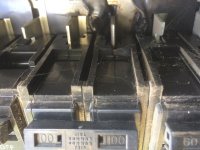
These are from a Challenger panel I took out a while ago, the distasteful thing is I ended up using a Eaton BR panel which I despise/hate/loath, but was a close fit to the existing panel and with the exception of one supply house, that is all they carry, the exception handles SQ D, which if it would have been easy to swap to do, I'd would have gladly used a QO.
 

wyliesdiesels

Well-known member
Joined
Aug 14, 2012
Messages
19,991
Location
Modesto, CA
What part of the panel are you referring to that is 3/4" to 1" wide and 2" long? Darn, if I have to replace the main panel too, this is going to turn into a pricey proposition.

So far its been trouble free, but of course that can change in a moment.

Whoops! I forgot the word breaker. I edited my post.

The Challenger twin breakers are a POS, really versatile from a installation standpoint, but the connection to the bus stab is weak, and they were made up to 50A, a case of trying to put 10 pounds of **** in a 5 pound bag. Crouse-Hinds had a very similar design that was discontinued when that div. was sold to Siemens, & they reverted to their original name, Murray.


These are from a Challenger panel I took out a while ago, the distasteful thing is I ended up using a Eaton BR panel which I despise/hate/loath, but was a close fit to the existing panel and with the exception of one supply house, that is all they carry, the exception handles SQ D, which if it would have been easy to swap to do, I'd would have gladly used a QO.

Those are cruse hinds breakers with the stabs on the side IIRCC....

Heres a GTE/Sylvania main that was out of a challenger panel. It was backfed and burnt up at the bus stabs...
 

Attachments

  • image.jpg
    image.jpg
    138.7 KB · Views: 16
Last edited:
To avoid these ads, REGISTER NOW!
Top Bottom