To avoid these ads, REGISTER NOW!

Battery rebuild

specklehunter

New member
Joined
Nov 16, 2014
Messages
4
I'm not sure if this is the right place to post this but............I have a pile of power tool batteries that are bad and am trying to save a few bucks and rebuild them myself. I bought some 2800 mah sub c nicad batteries to rebuild a pack that was originally rated at 2400(which I assume is fine to do). I organized the batteries like the old ones and soldered them in place. When I put them on charge, they charged for about five minutes and the charger cut off saying fully charged. I attached it to my drill and it had very little power. It turned the drill but I could stop it by hand, which I shouldn't be able to do. I then tried a different charger and the same thing happened. So now I am puzzled. Are the batteries bad? Well.....it is an 18 volt pack so I used 15 1.2 volt batteries and they are checking at 21 volts. I'm not sure why its too high but I assume that's okay. Could the chargers be bad? Could the thermistor in the pack be bad? I'm at a loss as to what to do next..........Any advice would be greatly appreciated!
 
To avoid these ads, REGISTER NOW!

wild cowboy

Banned
Joined
Mar 11, 2014
Messages
1,650
Location
Birmingham
because of weird hidden protection circuitry on some battery packs, I have had the best luck just duplicating the exact batteries that the pack came with, and soldering them in one for one replacing the originals
 

devoncoolman

Well-known member
Joined
Mar 17, 2013
Messages
2,096
Location
quakertown pa
because of weird hidden protection circuitry on some battery packs, I have had the best luck just duplicating the exact batteries that the pack came with, and soldering them in one for one replacing the originals

What he said. The charger might not be designed to charge the higher capacity cells that you used. Not sure.
 
To avoid these ads, REGISTER NOW!

uart

Well-known member
Joined
Nov 17, 2011
Messages
1,226
Location
Australia
When I put them on charge, they charged for about five minutes and the charger cut off saying fully charged. I attached it to my drill and it had very little power. It turned the drill but I could stop it by hand, which I shouldn't be able to do. I then tried a different charger and the same thing happened. So now I am puzzled. Are the batteries bad? Well.....it is an 18 volt pack so I used 15 1.2 volt batteries and they are checking at 21 volts. I'm not sure why its too high but I assume that's okay. Could the chargers be bad? Could the thermistor in the pack be bad?

- First let me say that the 2800 mAH capacity is NOT the problem here. It's close enough to the original capacity to not be an issue with the charger. Even if the capacity was very much larger than the charger was expecting it wouldn't cause the issues you're getting. (Not to mention that if those 2800 mAH _batteries came from Hong Kong via ebay they're probably no more than 1700 mAH actual capacity anyway).

- Assuming that the 21 volts you're measuring is correct then that corresponds to about 1.4 volts per cell and a very healthy state of charge. If there are no faulty cells then this should power the drill just fine. Just to test this a little further, can you try charging it again and then just it sit idle for a few hours (or overnight) and measure again. Is it still about 21 volts?

- I think your most likely problem is either a faulty cell or a high resistance joint. Did you use "solder tab" cells so as to avoid putting too much heat into them while soldering? The batteries can be damaged if you put too much heat into them. If they're all soldered correctly then you may have one faulty cell that is high resistance, or one of the cells came with a solder tab that wasn't properly spot welded.

- If possible try measuring the individual voltage of each cell. They should each be close to the total voltage divide 15 (1.4 volts for example). If one cell is very much lower than the others then it may either be that it's a faulty cell or that it was initially much flatter than the other cells when the pack was assembled. Personally I measure all my cells before I assemble a pack and try have them as well balanced as possible. I find the easiest way to do this is to either full charge or to fully discharge them individually before assembly.

- Finally, are you certain that you have the thermistor connected correctly. Can you measure the thermistor resistance (typically between the negative and auxiliary terminals) and compare it with a working pack?
 
Last edited:

ddawg16

Well-known member
Joined
Jul 11, 2008
Messages
21,005
Location
S. California
Uart covered it well.

If it was me, I'd be taking the drill partially apart so I could get a voltmeter into the guts and pull the trigger on the drill and measure the voltage. If it drops drastically, then it's as Uart posted.

If the voltage stays near 18v....then the drill is bad.

Side note....I've done what you have. In most cases, new NiCad's are not fully charged....so I'm inclined to lean towards Uart's comments.
 

wild cowboy

Banned
Joined
Mar 11, 2014
Messages
1,650
Location
Birmingham
I have a related question - I sometimes encounter laptop batteries that use coin type batteries, and the full part with connectors is no longer manufactured, and I need to replace the battery, and the actual battery portion is an easily available type. So I want to reuse the original connector and wires, or else use a well made battery holder.

So if I was going to reuse the original connector and wires, what is the trick to soldering wires to a coin type battery, without damaging the battery and also getting a strong physical connection so that the wires will not fall off of the coin battery?

or perhaps a well made battery holder is a better option? (not sure if well made and coin battery holder belong in the same sentence!)

here is a photo of a battery I need to replace, for clarity:

Ba0wA2X.jpg
 

uart

Well-known member
Joined
Nov 17, 2011
Messages
1,226
Location
Australia
I have a related question - I sometimes encounter laptop batteries that use coin type batteries
Yeah I often have problems with those on laptops too. They only hold the cmos and RTC settings when the main battery is flat or removed, but they are a nuisance when they go flat.

Once or twice I've thought about trying to solder onto them but always decided it was too risky, especially for Lithium. The metal case being such a large proportion of the entire battery means it's almost certain to overheat the active material before you could get any solder to flow.

I've also thought about trying to make a battery holder, but mostly those batteries have to slip into a fairly small recess somewhere in the guts of the laptop. Any battery holder would have to be very slim or otherwise you'd probably end up unable to fit everything back together again.

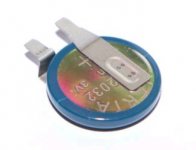
The best option is probably just to buy them with solder tabs already in place. They're about 5 times the price of a plain old CR2032 without the tabs, but they are available.
http://www.ebay.com.au/itm/CR2032-V...27?pt=LH_DefaultDomain_77&hash=item338aebc38f
 

Attachments

  • cr3032 - solder tab.jpg
    cr3032 - solder tab.jpg
    9.5 KB · Views: 3
To avoid these ads, REGISTER NOW!
Top Bottom