To avoid these ads, REGISTER NOW!

Battery Straps

PMAC

Well-known member
Joined
Jan 29, 2020
Messages
53
Location
attached to house in MN
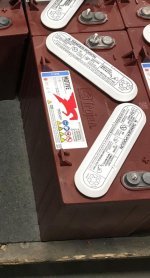
We have some heavy batteries that we lift into a material mover unit we are manufacturing. The battery straps do not work well on this particular battery. We do not have a strap available for the jib. (do they exist for safe battery lifting?) A team lift is awkward.

We are currently lifting them from a warehouse pallet (with 1 strap) to a roller cart pushed to the unit and then lifting (with 1 strap) into the battery box. Occasionally the strap slips.

I was thinking of a strap handle that has 2 straps weaved thru it (4 hooks) to give more stability and balance. Does anyone use something like this? Can this be purchased? I have such a problem with creating our own for safety and OSHA reasons.

I would be open to other suggestions.
 

Attachments

  • Trojan battery.jpg
    Trojan battery.jpg
    81.6 KB · Views: 167
To avoid these ads, REGISTER NOW!

rlitman

Well-known member
Joined
Oct 18, 2010
Messages
24,705
Location
Long Island
That's not a particularly heavy battery. If you want a battery with straps, just buy one that has them integral with the case. Do NOT ever use straps that lift from the terminals. That will destroy your post seals.

Your particular battery looks to be designed to use rope straps with S hooks.
 

ttpete

Well-known member
Joined
Mar 8, 2011
Messages
6,737
Location
Dearborn, MI
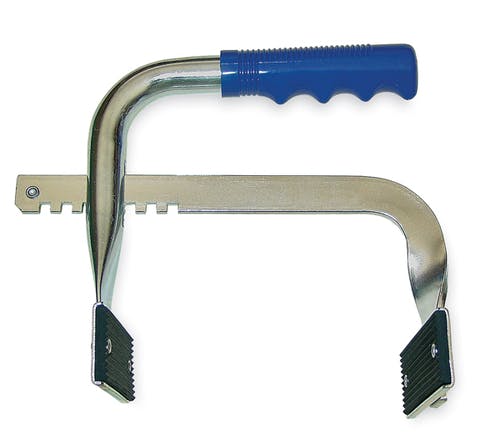
I have a K-D #140 clamp tool that was sold as a welding clamp. I use mine for lifting batteries by clamping on the top edge of the case and using it as a handle. I've been using it for years, and it works very well.
 

richfinn

Well-known member
Joined
Jan 29, 2011
Messages
4,821
Location
Leeds, Yorkshire, England
I install hundreds of batteries in cars every year and I doubt any Automotive tool is going to cut it!!

I think you need to be looking at designing a solution

I think a webbing strap arrangement that remain with the battery when its installed would be what I would explore
Maybe with a non conductive lifting eye or handle??

Is it possible to get your battery manufacturer to incorporate something so you dont have the H&S paperwork to deal with
 
Last edited:
To avoid these ads, REGISTER NOW!

matt_i

Well-known member
Joined
Mar 14, 2008
Messages
10,761
Location
SE Michigan
A few things I can add.

I have designed and built several custom end effectors for lifting parts (in-house in a manufacturing plant). What I do is weigh the part with our scale, document this, and then proof test the end effector usually at 200% of rated-part-weight, document this with pictures, etc. I feel like that covers my work at the start of the program. Information regarding the basic static analysis, strap angles and load vectors could also be included.

OSHA compliance needs many inspections. In basic form, there should be a daily visual inspection by an operator with a written record. There should be a deeper-dive monthly inspection of hoist systems in any case, and this end effector can be a specific part, for wear, again with a written record. Our company hires an outside inspector Annually who will duplicate our work and can also do magnetic particle inspections for cracks especially in welded joints. It could also be proof-tested annually. The outside inspector works off an inventory list we manage and maintain. There are some rules slackening the frequency of inspections for hoist systems which are "idled" but I choose to ignore those and go a more conservative route of treating every hoist system as if its in regular use.

If you in-house sew any rigging (web straps, etc) I would do some investigation into the strength of the thread and the number of stitches, make sure a rounded point needle is used that "slips past" the load carrying fibers rather than shearing them, and document that in your notes.

Automotive manufacturing can drive higher-end solutions, like all-pneumatic clamping and load-sensing safeties (so that the gripper can't open after its raised and holding a part). But the higher volume drives higher investment for reduced cycle times. The double-check of the mechanical "air" logic safety is done by the operator as part of their standardized start-of-shift checks above....they grip a part and lift it free by 1/2" over a solid surface (where the part starts or finishes) and purposefully attempt to unclamp it. This way if the system fails nothing is damaged and repair work can start immediately. All-mechanical safeties can also involve detents and latches that have to be purposefully shifted to release the part. It doesn't have to be as complex as I describe.
 
Last edited:

rlitman

Well-known member
Joined
Oct 18, 2010
Messages
24,705
Location
Long Island
...If you in-house sew any rigging (web straps, etc) I would do some investigation into the strength of the thread and the number of stitches, make sure a rounded point needle is used that "slips past" the load carrying fibers rather than shearing them, and document that in your notes...

The carrier for this doesn't require sewing. Two pieces of rope slipped through a PVC pipe handle. Tie a slip knot loop on the end of each rope, and insert an S hook in each of the 4 loops. Use S hooks and rope with a SWL higher than the battery weight. Add lashing on the rope to prevent the handle from shifting off the center.
 

RTM

Well-known member
Joined
May 13, 2019
Messages
13,296
Location
SF Bay Area
I would look into what large distribution warehouses do for their forklift batteries. We had ~30 lifts, and ran 24/7, so had 3x per forklift, and 1st thing every day you installed a new battery. Had a gantry crane over the charging bay (and lots of ventilation), but I can't recall what the business end looked like, been 22 years since I was there.
 

jgromada

Well-known member
Joined
Oct 13, 2011
Messages
1,017
Location
Maryland (between DC & Balt)
I always wondered that about straps that connected to the terminals. Thought that might be putting forces on a battery that were not intended.

I used to have a battery carrier that clamped onto a battery and once it was lifted it would clamp even more. I had it stolen from my yard along with some spare batteries i had sitting around
 

homebuilt burner

Well-known member
Joined
Dec 8, 2014
Messages
1,763
Location
central Wisconsin
We used to replace those batteries in solar powered message boards. I always used two bungee cords with the hooks slipped into the molded things on top. Unhook the bungee straps when it was located and move onto the next battery.
 

Woody1320

Well-known member
Joined
Sep 27, 2017
Messages
164
Location
Southeast Michigan

SeisMec

Well-known member
Joined
Aug 24, 2018
Messages
406
Location
Beryl, Utah
What I was thinking was to figure out a way to put two of this style together. This is the type I use and it feels a little iffy picking up a group 65.

I suspect they're not all created equal - which is why I linked to the Blue Point one. The pads on the one the shop had 40 years ago were actual rubber and group 65 batteries always seemed secure. Thinking back though, I don't think they're idiot proof - which is probably what's wanted if OSHA is involved.

Picture for reference.
BL1B.jpg
 
To avoid these ads, REGISTER NOW!
Top Bottom