To avoid these ads, REGISTER NOW!

Before I hone that cylinder.....

John Timmins

Well-known member
Joined
Sep 1, 2008
Messages
862
Location
Flagler Beach, FL
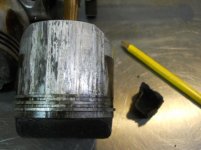
I am restoring a power head for a 1962 2 cylinder 25 HP Mercury outboard motor. I have started this motor briefly but the water pump wasn't working. I think there is evidence of prior overheating with possible microsiezures to the piston skirt, scored ring lands, and dead rings. I have decided to replace the piston.

Somebody had been in this power head before because the lead sead for the power head bolt was missing plus the casing had permatex on the joint. I opened it up , and sure enough, a critical o-ring was missing. So I desided to renew the crankcase seals and install new rings while it was apart.

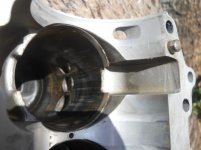
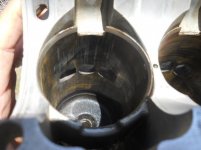
the cylinder that had the cooked piston looks like it has some grooves in it on the exhaust port side. This means that it LOOKS like there's wear but you cna't really feel it with your fingernail.

Question : somebody wrote on a blog that I need to use a Q-Tip or something and wipe the cylinders with muratic acid to get the oil out of the cast iron ( or steel ? ) cylinder wall before I hone it.

I have not done much honing. should I get a 3 stone hone? Is Harbor Freight good enough or should I gt a machine shop to do it right ?

I have read 2 things.....the stones will smooth out the flaws and show the low spots, whereas, the dingle berry brush style home is more friendly to the ports but will not show the low spots.

OK then...why don't I just put a .015 over piston and rings in this ? Because they are extremely scarce and EXPEN$IVE if you can get somebody to part witih a piston. I'm told that Wiseco onve made a run of 100 oversize pistons but there're being hoarded up. In a perfect world, I'd ship the block to a specialty outboard machine shop, get the exhaust ports raised and squared up, put 2 oversize pistons, and gain another 5-6 HP. Parts aren' there to buy !

So:

do I muratic acid the cylinder ? If I want to remove the oil, why don't i just use electric contact cleaner?

don't you just put oil back on it to hone anyway ?

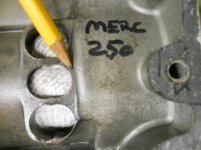
The pistures show both piston skirts on the intake side of the piston = nice looking. the other 2 pictures show the upper piston skirt on the exhaust side. Only that side of the cylinder looks like it might have some very SLIGHT marks.

Confused
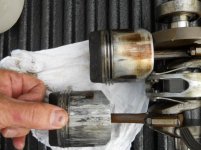
 

Attachments

  • scored piston Jan 8, 2013 002.jpg
    scored piston Jan 8, 2013 002.jpg
    45.5 KB · Views: 172
  • scored piston Jan 8, 2013 004.jpg
    scored piston Jan 8, 2013 004.jpg
    37.1 KB · Views: 181
  • scored piston Jan 8, 2013 003.jpg
    scored piston Jan 8, 2013 003.jpg
    47.3 KB · Views: 159
To avoid these ads, REGISTER NOW!

mayday0017

Well-known member
Joined
Oct 20, 2010
Messages
1,715
Location
Houston Texas
John, I am going to assume you have an aluminum block, sleves in it, and that the pistons are aluminum... Is this correct?

On Kawasaki motors I have worked on in the past the sleves had a VERY VERY hard coating that was almost impossible to scratch. Because of this you did not hone the cylinder or you would cause more harm then good. For this Muratic Acid was used to remove any aluminum particals that had become embedded in the coating, so you would have the nice factory cross hatch in the cylinder again. You could tell when you had done a good enough job too, because instead of looking perfect and slick it would look like a brand new case that just left the factory. If you want to clean the cylinders when you are done there are better things out there then muratic acid. Also if you are going to hone I can't think of any reason you would want to use muratic acid before, but I would recommend cleaning the cylinders so nothing extra is there to scratch things.

Now if you think it is possible that your cylinder might have this same coating (the motors I am thinking of were 2 stroke). Maybe the other person knows that and they are trying to tell you to wipe it down with muratic and call it a day.

Also just because you can "see" a problem in a cylinder doesn't mean it is always worth being concerned with... Do you have any pictures of the cylinder itself? Typically for motors that won't see 100's of hours of use, I make sure everything feels smooth and mic it to make sure it's not way out of round and call it a day. But that's just me...
 

theoldwizard1

Well-known member
Joined
Feb 22, 2011
Messages
43,581
Location
SE MI
... On Kawasaki motors I have worked on in the past the sleves had a VERY VERY hard coating that was almost impossible to scratch. ...

OP stated this was a 1962 motor. That is long before any of the "exotic" cylinder lining processes/material (Nikasil, etc.) were invented.
 

38Chevy454

Well-known member
Joined
Dec 26, 2006
Messages
4,038
Location
Cincinnati, OH
Acid does not remove oil. Solvent will remove the oil. Acid will remove any oxide (aka rust). Acids are water based, and you know water is not so good at removing oil.
 

AMCguy

Well-known member
Joined
Dec 23, 2009
Messages
2,022
Location
Sunshine Coast, BC Canada
Do not use a flex (dingle berry) hone. It is less port friendly. It will round the port edges. A three stone hone is required to bridge the gap over the port opening.

Neither is really a hone. They are actually only glaze breakers, and cant really remove much metal. They will do little to fix a cylinder. A proper hone usually has four stones and is adjusted to fit the finished bore size.

I use a glaze breaker with a trickle of solvent. That will get rid of any oil on the walls.
 

theoldwizard1

Well-known member
Joined
Feb 22, 2011
Messages
43,581
Location
SE MI
I am restoring a power head for a 1962 2 cylinder 25 HP Mercury outboard motor. I have started this motor briefly but the water pump wasn't working. I think there is evidence of prior overheating with possible microsiezures to the piston skirt, scored ring lands, and dead rings. I have decided to replace the piston.

Hold your horses !

Beg or borrow a set of inside micrometers and find out what you have FIRST ! Measure across the bore at several different places and at several different depths. Record all of your readings. You may not want to buy new pistons, but you may have to !

Question : somebody wrote on a blog that I need to use a Q-Tip or something and wipe the cylinders with muratic acid to get the oil out of the cast iron ( or steel ? ) cylinder wall before I hone it.
I can't say I have heard that. Just clean it good. You can use soap and hot water as long as you blow all of the water out of all of the holes. Baking in the sun or a 100F oven isn't a bad idea either.

I have not done much honing. should I get a 3 stone hone? Is Harbor Freight good enough or should I gt a machine shop to do it right ?

I have read 2 things.....the stones will smooth out the flaws and show the low spots, whereas, the dingle berry brush style home is more friendly to the ports but will not show the low spots.
Watch this video from about 2:30-5:00. If you are doing an aluminum block it will cut much faster, so BE CAREFUL. If I could find a reputable shop, that would agree with doing measurements before and after honing for about $100, I would do that.

Before assembling, check the ring end gap (install just the ring in the bore and use a feeler gauge to check the gap). If it is out of spec on the low side (not likely it you are using standard sized rings) you can file the ends. If it is out of spec high, well you really wanted those new pistons anyway !
 

1953mercury

Well-known member
Joined
Nov 25, 2012
Messages
701
Location
Steamboat Springs CO
Inside mic might work, but a bore gauge is much faster and more accurate for this procedure. Unless it's pretty straight (no taper) I would take it to a good machine shop. Shouldn't cost much, and it will be right. Even if you have the proper hone, it takes some experience to get it right. Mike
 

Kev442

Well-known member
Joined
Jan 15, 2009
Messages
5,386
Location
Wi
Do not use a flex (dingle berry) hone. It is less port friendly. It will round the port edges. A three stone hone is required to bridge the gap over the port opening.

Neither is really a hone. They are actually only glaze breakers, and cant really remove much metal. They will do little to fix a cylinder. A proper hone usually has four stones and is adjusted to fit the finished bore size.

I use a glaze breaker with a trickle of solvent. That will get rid of any oil on the walls.

+1
A four stone allowed me to put a .010 piston into my Skidoo jug easily. It helped that there was quite a lot of wear, which is why the original piston exploded in the bore in the first place. I was a happy camper to repair my sled for the cost of a new piston and access to a friend with a four stone and a micrometer.
 

PWC Repair

Well-known member
Joined
Dec 27, 2012
Messages
3,217
Location
Arkansas
I see this stuff all the time on jet ski motors. Looks like there was some overheating possibly due to a bad exhaust gasket. 2 strokes don't like that, it leans them out. Not only do you have a badly scuffed piston but I'm pretty sure you have some aluminum melted and pushed up into a ringland. Being that old I'm sure you don't have chromed or Nik-a-sil cylinders. Probably just a standard boreable sleeve. Use some solvent on a paper towel and wipe the bores down. Take a good look at the port edges they need about a 1mm chamfer for long ring life. If they are sharp now would be a good time to do it. I use a dremel with a small round stone. After that you are ready to hone. Spray the cylinders with a liberal amount of lube and hone with a medium grit 3 stone hone. Be careful how far up and down you travel, you don't want the stones hanging in the ports. I generally use my cordless drill and some speed to "clean up" the cylinder, then wipe it down again. Then lube and slow your speed down to put a nice looking crosshatch nside, slow drill speed and even up and down movement. When your all done wash thoroughly and blow dry with compressed air. Take a paper towel and put a little 2 stroke oil on it and rub the cylinders down. Do it twice. Done. Now on to the piston.
Carefully remove those rings. Take some 220 grit wet sandpaper and smooth out the side of that piston by sanding across the scratches. Fold your sandpaper and run it through the ring grooves too. Take a ring and roll it around the outside of the piston inside the grooves. If it sticks or feels tight anywhere work that spot over a little more. When that's all done wash the piston and blow dry with air. Now use a wire brush to clean deposits off the old rings then take some 220 grit to the ring sealing edges. Just kind of go over the edges to knock the shine off. They are hard and will eat up the sandpaper quickly. You will be able to feel the paper working as you rub and tell when it's worn. If you hold the ring edge to the light you will see you freshly "scuffed" surface. This will help the old used rings seat back up like new. I do it all the time. Now clean the rings and wipe them down with some 2 stroke oil and you'll be ready to re-assemble.
 

BillK

Well-known member
Joined
Aug 24, 2006
Messages
9,429
Location
Beautiful Southern Maryland
John,
1. By the looks of that piston, the cylinder will need to be bored oversize to do a proper repair. Of course I dont have it here to look at or measure so I could be wrong.
2. If you have never honed a 2 stroke cylinder, dont waste your money on a typical parts store 3 or 4 stone hone. They will not work. The proper hone has two stones and two guide shoes. Believe me, even after 25 years of the machine shop business, I HATE 2 strokes :(

So basically, before you waste a bunch of money and get even more frustrated, take the thing to a local machine shop that does that type of work and at least get their opinion.

Thats my 25 cents worth :)
 

SGKent

Banned
Joined
Feb 12, 2010
Messages
1,959
Location
Citrus Heights CA
I used to work in a machine shop that built some very high end engines for well known racers. I was the guy who did all the block machine work while a couple of other fellows did all the head work. I have also rebuilt quite a few merc outboards in my life.

First - a two cycle engine is different than most other engines. The blocks on something like you have are lighter and have less webbing built in to support the sidewalls on the bores. This means that as the stones cut they push out on the walls unevenly so you have uneven wear as you hone them. To do it successfully one needs something better than a harbor freight hone. You need to be able to read the surface pressure between the stone and the face to keep it light and even. Second, in many merc outboards the pistons are inserted into the block from the bottom. The cylinder dome is cast into the cylinder. This presents a challenge not to bottom the stone on the dome.

Were it me I would step back a second on this rebuild. First answer what you expect out of it. Are you looking for a really nice motor or an Ok motor. If you want a really nice motor get on the phone to some old Merc dealers and fish around to see if anyone has an old new stock block they want to sell cheap. The last merc motor I did, the dealer near me had a new old stock block he had ordered for someone who never picked it up. He basically gave it to me along with some new old stock carbs the guy ordered too for the price of the pistons. He was tired of looking at the space it took. Many merc engines use the same block over many years so this isn't as far fetched as it seems.

You will also need all new needle bearings and reeds. Price them. They can be outrageously priced on some models. If your crank is like new and you can get needles cheaply as well as reeds, then it is worth rebuilding nice. If you can't price out these things, glass bead the pistons at a high pressure. Use a flat file to smooth out any raised areas on the piston skirts. Wrap some 2000 grit sandpaper around a 3 or 4 stone hone and make 3 passes in each bore. Clean it out with hot water and lots of soap. Put in new rings (check the end gap and land clearance with the old ones before you spend any money). Then put it together with old parts and consider it an Ok motor but nothing special. I would replace the reeds regardless. Be aware that those blocks can warp with heat so it may never run like a new motor when you are done.

Keep track of how many needles go in each spot. If it is a motor with domes cast in the cylinders you will need special tools to stuff the pistons from the crank side without damaging the rings. The dealer may lend them to you or agree to stuff the pistons for you at a minimal price.
 
To avoid these ads, REGISTER NOW!

Tig Master

Well-known member
Joined
Sep 9, 2012
Messages
106
Location
Where it snows
You are getting some very poor info on the flex hone "aka" dingle berry.Some of the posts are obviously from some that wouldn't know a flex hone if it jumped up and bit them in the *** never mind saying what the outcome would be.I am in the engine rebuilding industry and you should do some "google" searches yourself to set yourself straight and get the info from the horses mouth and not the other end of the horse!!Or someone who sits at a keyboard and drivels about something they know nothing about.Feel free to ask any questions.The flex hone is designed for glaze breaking and not material removal for piston fit.

http://www.brushresearch.com/pdf/GB.pdf

This will get you started and then you can search yourself.

T
 
OP
J

John Timmins

Well-known member
Joined
Sep 1, 2008
Messages
862
Location
Flagler Beach, FL
First of all I want to thank everybody for your comments. I live near Daytona Beach, and you'd think we'd have some of the best machine shops around...maybe when Smokey Yunick was still with us. A local BIG TIME now retired machinist that did a LOT for Mercury outboards at Lake X etc., told my Snap On friend that there was no machine shop except Tallahassee that HE would use.

One guy I've used has a Sunen claims that NASCAR teams have come to his shop to use his stuff...if I want to believe that BS. They bring spare engines or will fly something down in 3 hours that they need.

Anyway, the subject of cylinder sleeves, honing, ring seal is very complicated and has led people to write entire Doctoral thesis on this topic.

I will post some pictures of the project motor block tomorrow.

I am really interested in this Mercury 1962 Merc 250 outboard. It was made only 1 year. They pretty much took half of a 50 HP Merc and put it on a fishing motor. Compared to the earlier 22 HP Super Hurricane, the 25 has a special reed block, aggressive exhaust porting, unique carb for that motor and so on. I have never seen another one running in the state of Florida. I have seen a lot with a missing power head; they were highly desired by the racing guys. Supposedly they did their magic and got 32-33 HP.

From a letter I have from Charlie Strang, the former chief engineer of Kiekhaefer Mercury, inventor of the modern inboard -outboard stern drive, head engineer of Evinrude etc., the 1952 Mercury Super 10 Hurricane was sold as a 10 HP but in fact put out 18-22. My point is Mercury knew how to squeeze HP out of a block !

I got this advise from a friend who worted 42 years at Mercury, and his 38th year got their Tech of the Year award:

I have never used muratic acid - don't think its a good idea on aluminum anyway, is it? Some carb cleaner in the bore and some rags - clean enough, like you said you are going to use oil anyway.
I've honed alot of cylinders with my spring loaded three bar hone - this rebuild is just a runner right, you're not going racing. Light hone job, emery paper on the ports, good soap and hot water bath, reoil and slam it home.
 

PWC Repair

Well-known member
Joined
Dec 27, 2012
Messages
3,217
Location
Arkansas
I got this advise from a friend who worted 42 years at Mercury, and his 38th year got their Tech of the Year award:

I have never used muratic acid - don't think its a good idea on aluminum anyway, is it? Some carb cleaner in the bore and some rags - clean enough, like you said you are going to use oil anyway.
I've honed alot of cylinders with my spring loaded three bar hone - this rebuild is just a runner right, you're not going racing. Light hone job, emery paper on the ports, good soap and hot water bath, reoil and slam it home.

Listen to your friend. I can't tell you how many jet ski engines I've put back together with used parts (they are expensive toys to own). Well inspected and cleaned parts, close enough tolerances, RUN IT. My twin cylinder ski engines make 80-120 hp at 7200 RPM for hours on end, and get abused regularly. Your outboard will be fine.;)
 
OP
J

John Timmins

Well-known member
Joined
Sep 1, 2008
Messages
862
Location
Flagler Beach, FL
Before I post an update to this project, I want the say a ver big THANK YOU to everybody that has written.

I am not unfamiliar with engine overhauls but my experience is on a much bigger scale. The engines I worked with for almost 30 years were mostly slow speed 2 stroke cycle diesels in the neighborhood of 4000 HP per cylinder.

This outboard was made only 1 year. The porting was aggressive and that block was highly desired by the racing community. No new blocks are around .

I am very active in the Antique Outboard Club. A meet next weekend will have some outboard machinist - racers there and I will get my questions answered about the condition of my cylinder walls.

I have found 2 new pistons of standard diameter - no oversize available. I have a friend that bought 1500# of Mercury parts on eBay plus his brother was a Mercury dealer. I have access to OLD NOS piston rings & needle bearings. I have received an offer from a machinst in Altanta who said he will do my cylinders. Currently he is making custom pistons.

the porting edges closest to the piston skirt and rings is a subject of may writings. The port edges are reileved to protect the rings from damage.

this outboard is special to me and I plan on doing it right. My hobbly is restoring 2 cylinder Mercury outboards to museum quality wotk...and then I run them, fresh water only with 25:1oil-no ethanol gas premix.

Other outboards with this 22 cu. inch block can have their ports raised to match the Merc 250s without too much work - just set it up in the jig and do it. An excellent book has been written that goes into great detail about do's and don'ts when raising ports, awareness of water passages, and a lot more.

the Outboards I work on are exclusively those with the auotmatic transmission made for 1957-1962. due to the special tools needed and the apporx. 6 hour billing job to change out a water pump impeller, many were overheated and not repaired and thus have real low hours. Personally I am a glut for punishment tackling the 52 parts of the transmission assembly and linkage.

I can find new reeds if needed althought I believe the reed block, reed stops, maybe the reed openings are unique to this model. The carbureator is. I will follow up on this project.

the wear marks are more visable below the ports. I believe the machinist "experts" I will see new week will tell me to simply hone it and button it up with a good used piston I have and save the 2 NEW pistons for another project.
 

Attachments

  • 250-#2 cylinder wear, Jan 10, 2013 001.jpg
    250-#2 cylinder wear, Jan 10, 2013 001.jpg
    34.9 KB · Views: 46
  • 250-#2 cylinder wear, Jan 10, 2013 002.jpg
    250-#2 cylinder wear, Jan 10, 2013 002.jpg
    31.4 KB · Views: 41
OP
J

John Timmins

Well-known member
Joined
Sep 1, 2008
Messages
862
Location
Flagler Beach, FL
So here's the difference in the porting between the 1959 Mercury Mark 15A - 15 HP and the Merc 250 which is 25 HP.

the 25 HP has a little wider diameter piston and the 5/8 inch milling tool punched the cylinder 2 times in each port, the upper right up to the water jacket.

Racers had the ports "squared off "at the tops using a 1/4 inch cutting tool which left a 1/8 inch radius. The purpose was to suddenly dump MORE exhaust at the initial port opening to change the pressure wave.

The bottom of the port is left alone because you're playing with uncovering the part the piston skirt blocks or messing with the reed block sealing surface.

This starts to get into the area of racer's secrets with exhaust megaphones, spraying cooling water on the open exhaust to change the exhaust tone and power band...all kinds of non stock stuff !
 

Attachments

  • Ports 2, Dec. 31, 2012 002.jpg
    Ports 2, Dec. 31, 2012 002.jpg
    42.3 KB · Views: 14
  • Ports 2, Dec. 31, 2012 003.jpg
    Ports 2, Dec. 31, 2012 003.jpg
    31.1 KB · Views: 13

PWC Repair

Well-known member
Joined
Dec 27, 2012
Messages
3,217
Location
Arkansas
Those cylinders don't look bad at all. Can you actually hang a fingernail in any of those marks? If not a good honing will clean it right up.
 

bigbubba

Well-known member
Joined
Jul 12, 2010
Messages
2,884
Location
Poplar Bluff Mo
I don't know anything about the Mercury's,But when i ran a Johnson outboard where i used to live we had a strict 25 HP limit on the O/B.Meaning it had to start out as a 25 title had to say 25.We rebuilt my old Johnson "Commercial" O/B with 400 polaris pistons,Carb was off a much larger outboard (I want to say a 200HP with twin carbs) It ran a jetpump and when finished at the jet it was pushing 43 HP!! I don't know if you can do something like that with yours but it's something to think about.
 
OP
J

John Timmins

Well-known member
Joined
Sep 1, 2008
Messages
862
Location
Flagler Beach, FL
I cannot feel anything that "catches" a fingernail. After I soaked this in degreaser , rinsed, and wiped it out, the cylinder that had the bad piston is not really bad looking. It is now oiled and waiting to be shown at my next outboard meet soon.

Some of these outboard swith the transmisson show up on eBay. The first thing I look for is the very discolored power head from overheating. this block did not have that severe overheated color; it was still the original white...which is a good sign. I believe this block is saveable with little work.

Most outboards simply need the lower unit pulled off to renew the water pump impeller. On these the power head must be removed, the lower unit removed, The entire drive shaft - transmission assembly pushed out the bottom. After all that is done, the water pump maintenance can be addressed which is inside the drive shaft housing about 18 inches above the propeller. Yep...working on these things is like no other outboard !

The red cowling is a 1958 Mark 10 "Troll-Twin" 18 cu. inch Rocket and the other is a 22 cubic inch Super Hurricane 1962 Merc 250 - the first and last models with the automatic transmission. There is no reverse gear on the propeller shaft. Reverse propeller happens using a transmission with planetary gears.
 

Attachments

  • Nov 11,2010 Outboard Super Meet in Winter Haven 021.jpg
    Nov 11,2010 Outboard Super Meet in Winter Haven 021.jpg
    66.9 KB · Views: 18
  • Nov 11,2010 Outboard Super Meet in Winter Haven 019.jpg
    Nov 11,2010 Outboard Super Meet in Winter Haven 019.jpg
    54.2 KB · Views: 20

Tig Master

Well-known member
Joined
Sep 9, 2012
Messages
106
Location
Where it snows
Now is when you swab the bore with muriatic acid it will remove the smeared aluminum and doesn't hurt the bore at all.Google it for yourself.Then you are in to the deg-laze stage.

T
 

AMCguy

Well-known member
Joined
Dec 23, 2009
Messages
2,022
Location
Sunshine Coast, BC Canada
Wow! that is really cool that there are actually shows to go to if you are into these babies.

I used to have a Mk20 on a hydroplane I built from Popular Mechanics plans. It was supposed to be eight feet long but I stretched it to ten. I was a kid on a paper boy's budget so I cheeped out on materials. The engine had a racing bottom end with direct drive and a trick prop.

It's all at the bottom of lake St. Louis near Montreal. The boat came apart at speed and the rest is only a foggy memory. That was 1975.
 
To avoid these ads, REGISTER NOW!
Top Bottom