To avoid these ads, REGISTER NOW!

Beginner welder...hobart 135?

a***nc83

Well-known member
Joined
Jan 10, 2010
Messages
252
Location
Toronto, ON
Hey guys, so as the title said, i finally decided to try my hand at welding. I am not massively mechanically inclined, i recently finished med school, and started practicing. So i thought i would finally try welding.

I intend to give it a proper go, so i expect to be relatively proficient, so i am hoping to get a machine that grows with me...however i don't need a top of the line machine. This has brought me to the Hobart 135, a friend of mine recommended Hobart, something about it being made with Lincoln parts, but being branded differently.

So i am getting an almost brand new Hobart 135, for $250 canadian.

Thoughts? Opinions? Suggestions?

Thx:beer:
 
To avoid these ads, REGISTER NOW!

sberry

Banned
Joined
Jun 18, 2005
Messages
35,747
Location
Brethren, Michigan
An almost brand new 135 is worth 250 especially if it comes with any goodies. BTW, I know 2 doctor welders. The Hobart is good, a 210 Hobart is twice as good but they are not made from Lincoln parts. They do share some pieces from the Miller shelf though.
 
OP
A

a***nc83

Well-known member
Joined
Jan 10, 2010
Messages
252
Location
Toronto, ON
An almost brand new 135 is worth 250 especially if it comes with any goodies. BTW, I know 2 doctor welders. The Hobart is good, a 210 Hobart is twice as good but they are not made from Lincoln parts. They do share some pieces from the Miller shelf though.


Thanks sberry, for some reasons the Hobart 135 seem to sell around $400+ here...and those are used...was just checking... kijiji
 

zkling

Well-known member
Joined
Jan 23, 2007
Messages
16,939
Hobart makes a good solid machine. The little 135 handlers are great machines as long as you realize their capabilities. I'm a bit concerned with the " i am hoping to get a machine that grows with me". IMHO there really isn't much of any growth room for the HH135. It is pretty limited in material thickness and aluminum is really out as it just doesn't have the amps to properly run the wire.

Just depends on what your welding goals and expectations are. :beer:

O and Hobart is a division of Miller, not Lincoln.
 

#1SomeGuy

Banned
Joined
Dec 4, 2012
Messages
511
Location
Canada
If you want to grow with it, get a 240v class machine...the Hobart 210 is a great choice but costs a fair bit more. Hobart and Miller share parts, not Lincoln.
 

srmofo

Well-known member
Joined
Oct 15, 2009
Messages
6,161
Location
SW ohio
You are not going to get hurt with that Hobart at that price, however if you want it to last for a while you will need a 240 machine unless you are only doing small light work
 

matthew

Well-known member
Joined
Dec 4, 2009
Messages
1,347
Would the Matco wfw12179 or the miller 130 be more suitable then, if not the Hobart 135?

The Miller 130 and the Hobart 135 are both roughly the same size. For $250 you should be able to learn a lot on the 135, handle steel up to about 1/8" thick, and turn around and sell it for what you paid. That's not a bad thing, just limited to thinner steel / sheet metal work.

FWIW, I have a Hobart 210MVP, I quite like it. A Hobart 190 or Miller 180 or similar sized machine would probably handle anything you'd be interested in as a recreational welder. You do probably want something that runs on 230V.

Personally, strictly for a hobby I really liked oxy-acetylene welding - and if you're not production welding it's okay that it's slow.
 

donthelegend

Well-known member
Joined
Nov 7, 2011
Messages
203
Location
St. Louis, MO
If you go with Hobart, Miller, or Lincoln, you will not be disappointed. All will serve you well and all have welders that compete with each other at different power levels.

But as several people have said, a 120 volt machine simply won't leave you any room for bigger things. You need a 240 volt welder for that, which jumps the price but no one has ever said "You know what, I wish my welder had less power". If you have any plans of regularly working with anything thicker than 3/16" thick, you should really just go with the 240 volt to start.

You can make the 120 welder work on thicker material, but you'll hit the limits of the welder's duty cycle much more frequently and have to make multiple passes.
 

nine4gmc

Well-known member
Joined
Mar 24, 2012
Messages
14,357
Location
Dallas
I have a Hobart 140 and love it, only machine I would rather have is a Miller 210 or 211?
 
OP
A

a***nc83

Well-known member
Joined
Jan 10, 2010
Messages
252
Location
Toronto, ON
Thanks for the input guys...i guess i will go for 240v machine...so it seems the Hobart 210..or Miller 180 is the way to go...what do you guys think of ESAB and Linde welders?
 

alwaysFlOoReD

Well-known member
Joined
Sep 24, 2013
Messages
2,403
Location
Airdrie, Alberta, Canada
I'm a serious hobbiest. I have been using a lincoln 100 weldpac for over 10 years. I have just finally gone to a bigger machine, a thermal-arc 211i. It is a three in one machine, mig, tig, and stick. With a gas bottle and big spool of .025 I paid ~C$1600.00. I like it but it is a bigger learning curve for setting it up.
If I was you I'd buy the hobart. It's portable and with extra passes and heat will weld 1/4" no problem. The only problem is flux core is dirty welding, a lot of clean up is needed after a pass. The lincoln I have is capable of gas welding if an extra kit is bought. I use the lincoln still, especially on exhaust and dirty metal, the fluxcore will burn through light dirt and give a better weld. It is also better in windy conditions.
For learning purposes I would suggest an oxy/acet unit, it will give you a much better idea of how metal joins together and it will come in handy for lots of other uses in the future.
Good luck,

Richard
 

zkling

Well-known member
Joined
Jan 23, 2007
Messages
16,939
Thanks for the input guys...i guess i will go for 240v machine...so it seems the Hobart 210..or Miller 180 is the way to go...what do you guys think of ESAB and Linde welders?

Esab and Linde (old) make good machines. They typically make larger machines. I'm not sure what the support is like up in Canada, but down here it can be kinda of a regoinal thing. My preference for mig machines is Miller, Hobart, Lincoln, Esab. For tig/stick Miller, Lincoln, TA, Esab, others.

I'd definitaly take the HH210 over the MM180. The HH210 is a more capable machine plus it can run 120/240v input where as the 180 is 240v only. The miller equivalent to the HH210 is the MM211.
 

gsport

Well-known member
Joined
Mar 1, 2008
Messages
2,176
Location
Salem Oregon
I've got a millermatic 211.. If you can swing it, go for it. It's a dual voltage machine, meaning you can use it on either 110 or 220 volts. And with the auto-set feature, all you have to do is set the metal thickness and wire size you're using, and the machine will do the rest. I'm a fairly new weldor and this machine sure makes it a lot easier to lay down some good welds... Then practice, practice, practice
 
OP
A

a***nc83

Well-known member
Joined
Jan 10, 2010
Messages
252
Location
Toronto, ON
Ok, well i have 220 in my garage, so if there is a definite advantage to 220 i think i will go with that. May need to run a separate line as my compressor runs off that 220 as well.

So as luck would have it, i treated an elderly gentleman this morning whom was a welder...and he is selling as his gear, and said he thinks his Miller 175, runs off 220...would be perfect for me.
 

scaron

Well-known member
Joined
Aug 6, 2013
Messages
407
Location
ypsilanti, michigan
i've been following this thread with some interest; i'd like to get into welding someday myself. nothing too elaborate, maybe like exhaust work on my car or fabricating some bicycle frames out of tube would be the extent of it. there are all these processes out there, MIG, TIG, "stick", ... i see the hobart 135 and the millermatic 211 being discussed are both MIG welders... is this a good process for the sort of work i mention above? easy for a beginner to pick up? could i do these kinds of jobs just with "stick" welding? this seems like the cheapest process to start up with in terms of equipment cost and not needing to keep gas bottles around.
 
OP
A

a***nc83

Well-known member
Joined
Jan 10, 2010
Messages
252
Location
Toronto, ON
i've been following this thread with some interest; i'd like to get into welding someday myself. nothing too elaborate, maybe like exhaust work on my car or fabricating some bicycle frames out of tube would be the extent of it. there are all these processes out there, MIG, TIG, "stick", ... i see the hobart 135 and the millermatic 211 being discussed are both MIG welders... is this a good process for the sort of work i mention above? easy for a beginner to pick up? could i do these kinds of jobs just with "stick" welding? this seems like the cheapest process to start up with in terms of equipment cost and not needing to keep gas bottles around.

Well truth be told me being in your position, I have little to add, hopefully one of the many more experienced and knowledgeable guys answers those questions for you. As for me, i did some stick welding...with an old italian welder, that a friend of mine lent me to satisfy my curiosity...lolol i remember starting friday evening after dinner around 8...by the time i realised it was 3am..my wife was at the garage door asking me what is wrong with me, as i had taken apart one the bed frames so that i can continue practicing .... i didn't have much metal to practice on..lolol...and i was told that Mig is a pretty good starting ground...and with the exception of certain specific materials...its a pretty good process with a broad spectrum of applications...

And yes i do believe stick is the cheapest one to get going with...in Toronto here you can get a lincoln stick or miller thunderbolt for $150...even $100 sometimes...safety equipment is the same however...i doubt anyone would want to skimp on that...you are playing with a lot of energy...

Anyone please feel free to correct anything that i said...
 
Last edited:

sberry

Banned
Joined
Jun 18, 2005
Messages
35,747
Location
Brethren, Michigan
The Miller 175 is a bit fussy with the adjustments but it works. My neighbor has one, I really like the 210 tap better but its not a deal breaker.
Ok, well i have 220 in my garage, so if there is a definite advantage to 220 i think i will go with that. May need to run a separate line as my compressor runs off that 220 as well.
You are starting off closer to the end where you want to be, yes the 230 machine is twice as good as the 120 units.

The Doctor I talked to said he started with a 135 and now has a 255.
 
Last edited:

zkling

Well-known member
Joined
Jan 23, 2007
Messages
16,939
nothing too elaborate, maybe like exhaust work on my car or fabricating some bicycle frames out of tube would be the extent of it. there are all these processes out there, MIG, TIG, "stick", ... i see the hobart 135 and the millermatic 211 being discussed are both MIG welders... is this a good process for the sort of work i mention above? easy for a beginner to pick up? could i do these kinds of jobs just with "stick" welding? this seems like the cheapest process to start up with in terms of equipment cost and not needing to keep gas bottles around.

No, Yes, No, yes it is the cheapest to get into but not well suited to your applications.
 
To avoid these ads, REGISTER NOW!

Jack Olsen

Super Moderator
Staff member
Joined
Mar 22, 2009
Messages
6,678
Location
Los Angeles
Everyone who welds (and who's posted in this thread) knows this already. But just to clarify, the difference between a 120V and a 240V machine is simply the power. It doesn't correspond to skill level in any way. It corresponds to the thickness of the metal you are able to weld with it. If all you're ever going to do is sheet metal, then there is nothing you're going to 'run out of' with a 120V machine. The advantage of the 240V machine is that you can weld thicker steel with it. If all you're ever going to weld is 1/4" stock, then you don't want to use a 120V machine ever, no matter if you're a beginner or not. The advantage of a 120V machine is not that it's easier to weld with it -- the advantage is that it's smaller, lighter, and can be carried to workplaces where 240V is not available.


There's no such thing as a beginner MIG machine or an expert's MIG machine. They all do pretty much the same thing, and you want to choose the right one for the thickness of metal you're welding.
 
Last edited:

sberry

Banned
Joined
Jun 18, 2005
Messages
35,747
Location
Brethren, Michigan
The 175-210 class run 030 really well, this allows for twice the wattage shoved thru as 023 and gives them a little punch for light fab, even on thinner materials it is substantially faster. A 250 with 035 is twice as much again. Allows for lots more speed and deposit with same gas use and bigger cheaper rolls of wire.

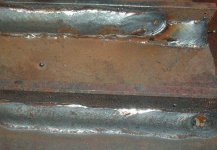
First one is HH210, the second a little Lincoln. A 120 couldn't make enough power to melt this well on this thick.
 

Attachments

  • Hob set test.JPG
    Hob set test.JPG
    79.7 KB · Views: 42
  • DSCF1855.jpg
    DSCF1855.jpg
    143.8 KB · Views: 44
Last edited:

taumac

Well-known member
Joined
Aug 30, 2011
Messages
8,104
Location
Brooksville, Fl
Im in market too for a welder and im going for the Hobart 210 myself. The Hobart 140 and 190 where in running but the 210 gives me best of both. Although I am losing the Spool gun by going with 210 but being able to run on 110 or 220 is worth it. My old welder is 220 only.
 

bcradio

Well-known member
Joined
Jan 30, 2012
Messages
6,017
Location
New Mexico
Everyone who welds (and who's posted in this thread) knows this already. But just to clarify, the difference between a 120V and a 240V machine is simply the power. It doesn't correspond to skill level in any way. It corresponds to the thickness of the metal you are able to weld with it. If all you're ever going to do is sheet metal, then there is nothing you're going to 'run out of' with a 120V machine. The advantage of the 240V machine is that you can weld thicker steel with it. If all you're ever going to weld is 1/4" stock, then you don't want to use a 120V machine ever, no matter if you're a beginner or not. The advantage of a 120V machine is not that it's easier to weld with it -- the advantage is that it's smaller, lighter, and can be carried to workplaces where 240V is not available.


There's no such thing as a beginner MIG machine or an expert's MIG machine. They all do pretty much the same thing, and you want to choose the right one for the thickness of metal you're welding.

To add to this, a 120v machine has the advantage that it seems to weld thinner materials better than a 240v machine. This is why I personally recommend dual voltage machines myself.
 

Zeke

Well-known member
Joined
Aug 13, 2009
Messages
17,176
Location
Long Beach CA, the sewer by the sea.
Everyone who welds (and who's posted in this thread) knows this already. But just to clarify, the difference between a 120V and a 240V machine is simply the power. It doesn't correspond to skill level in any way. It corresponds to the thickness of the metal you are able to weld with it. If all you're ever going to do is sheet metal, then there is nothing you're going to 'run out of' with a 120V machine. The advantage of the 240V machine is that you can weld thicker steel with it. If all you're ever going to weld is 1/4" stock, then you don't want to use a 120V machine ever, no matter if you're a beginner or not. The advantage of a 120V machine is not that it's easier to weld with it -- the advantage is that it's smaller, lighter, and can be carried to workplaces where 240V is not available.


There's no such thing as a beginner MIG machine or an expert's MIG machine. They all do pretty much the same thing, and you want to choose the right one for the thickness of metal you're welding.
I have to disagree with this. While much of it is true, the better machines do weld better. When I was in welding school I mentioned that I had a Lincoln 100 SP at home. They had one in the tool room and we got it out. I couldn't weld for **** with it. It could have had some problems like a worn tip. School units tend to be used and abuse.

Nevertheless, I couldn't wait to get back in my booth with the big transformer machine. Smooth as butter. I can weld beautifully with some practice to shake off the rust if given a great machine. I still have the 100 and someday I'm going to covert it to use with silicone bronze wire. That's when I get a decent MIG welder to use as a GMAW unit. I'll be looking at an inverter unit with pulse.

A little off the thread topic, but the ancient transformer stick machine way down in the last booth was a joy to use. I can see why those pipeline guys love their old SA 200's. Nothing like a perfect DC current coming off a generator. That's some rock steady welding.
 

Jack Olsen

Super Moderator
Staff member
Joined
Mar 22, 2009
Messages
6,678
Location
Los Angeles
I agree that a little bit of overkill on the machine side can make things easier. (Or at least seem easier; I'm not really clear on why it would be easier, technically speaking.) But that makes it even more clear that there's nothing 'beginner' about a 120V machine. If anything, the 240V is going to be easier for a novice to use.
 

Zeke

Well-known member
Joined
Aug 13, 2009
Messages
17,176
Location
Long Beach CA, the sewer by the sea.
I agree that a little bit of overkill on the machine side can make things easier. (Or at least seem easier; I'm not really clear on why it would be easier, technically speaking.) But that makes it even more clear that there's nothing 'beginner' about a 120V machine. If anything, the 240V is going to be easier for a novice to use.

MIG machines are very sensitive to voltage variations. I'm going to assume that the 240v sine wave is easier for the electronics to understand over the "push-pull" of 120v. That doesn't address the efficiency sberry mentions. Efficiency is good in more than one way, again assuming.

All I know is some arcs are smoother bacon frying or whatever. If I'm doing 18ga. (Porsche sheet metal back in the day), I can get the 120v machine tuned when the gas flow is right and I hold a tight stick out. That seems to calm the arc. OTOH, when I get a hold of a better machine, that arc control seems easier to achieve.

What do I know? A few semesters in Saturday classes does a welder not make.

Back to the OP, I would not recommend a strictly 120v machine. Also, look at the Thermodyne Fabricator series.
 
Last edited:

matthew

Well-known member
Joined
Dec 4, 2009
Messages
1,347
A couple of further points:

1) learning to set the machine is the most important part - practice, practice, practice

2) I say this as a learner - oxy-acetylene is a great way to learn, an a lot of fun. Tig is a rather similar motion. I bought a MIG because the price was right, and it gives me the capabilities I was looking for, but given a choice I'd probably prefer an oxytorch or TIG machine (or best of all, MIG/TIG/stick multiprocess machine). Yes, oxy or TIG is slow, but if you're welding recreationally that's perfect, and finish is nice.

3) don't forget that there are plenty of expenses other than the machine. Lease and fill on a bottle of gas, a helmet, some gloves, filler metal, a cart, pliers, extra consumables, etc. I've probably spent $300 or so on that stuff, and still have a list of stuff I want to buy.

4) regarding the comment on the stick machine - most of the cheap ones I see around are AC only, and if you're getting a stick welder you really want an AC/DC machine. At least around here that's quite a bit more. If you want a stick machine, might as well buy a TIG and get both processes in one.

5) to the OP, again, consider taking a course, trying it all and seeing what process you like before buying. You might find yourself wishing you had gone TIG instead of MIG. And ask yourself what you want to build. If it's automotive, chances are you just need light sheet metal capabilities, 120V MIG is probably well suited to your work. If it's not clean surfaces, flux core wire weld. If it's thicker a 220V machine, or possibly a stick welder. For stainless probably TIG, and for aluminum a spoolgun for a 220V MIG, or possibly a TIG.
 
Last edited:
OP
A

a***nc83

Well-known member
Joined
Jan 10, 2010
Messages
252
Location
Toronto, ON
Whoa, thanks for all the great input and pointers (i'm kind floored that Jack Olson replied to my thread)....lol i feel somewhat confused now... so it seems i should figure out what exactly i want to weld ...and that would help with what i need to buy...unfortunately i don't really know what i want to do...i am working on my 300zx project car...but no much welding if anything there..maybe some exhaust work...some anti-roll or stiffening work on the chasis...i will always find stuff to build to push my learning curve...i could see myself welding together the metal panels for my fence...rather than paying $20,000+ next time...i also would want to weld a solid sturdy workbench together, like i see some of you guys doing...if i ever get good enough i won't mind trying my hand at a small tool box even....

So the dual voltage would be good...and as powerful as possible?
 

Zeke

Well-known member
Joined
Aug 13, 2009
Messages
17,176
Location
Long Beach CA, the sewer by the sea.
Whoa, thanks for all the great input and pointers (i'm kind floored that Jack Olson replied to my thread)....lol i feel somewhat confused now... so it seems i should figure out what exactly i want to weld ...and that would help with what i need to buy...unfortunately i don't really know what i want to do...i am working on my 300zx project car...but no much welding if anything there..maybe some exhaust work...some anti-roll or stiffening work on the chasis...i will always find stuff to build to push my learning curve...i could see myself welding together the metal panels for my fence...rather than paying $20,000+ next time...i also would want to weld a solid sturdy workbench together, like i see some of you guys doing...if i ever get good enough i won't mind trying my hand at a small tool box even....

So the dual voltage would be good...and as powerful as possible?
Most machines have some limitations. The lower the price, the more limitations. That doesn't mean a low priced unit won't weld, it will. When you combine things, you get more limitations. You can't have it all in one box unless you want to buy something like a Miller Trailblazer for 9000 bucks and then you don't get AC TIG. It just doesn't all come in one handy unit.

Let's summarize: Basic MIG but as much as you can see paying and and matched to your power sources available would be a first choice. That's MIG with the gas. Dual voltage perhaps, but once you're on 240v, you'll be looking for 240 volts to plug into.

Stick/TIG: It's easy to combine these welders in one box because they put out the same kind of current for each process. You just change the polarity. DC capability is standard with these units so you can do more stick (SMAW) types depending on what you are welding. Great for outdoors and not so clean material. I have used some small 1/16th rods doing stick and have made that work well on 1/8th sheet (11 ga.). This was on some old truck tool boxes where prep was not easy.

AC TIG is necessary if you are getting into aluminum. You'll want all the features of a better machine. But you can do fundamental AL welding with a MIG and optional spool gun. SG because the AL wire does not like the feed cable.

If you go to the site weldingtipsandtricks.com, Jody goes through all the machines at one time or another. He shows welding techniques, but he critiques welders as well. He will show welding with a Lincoln "tombstone" A/C welder and make it work nicely. NO reason not to have one of these if you can pick it up cheap. I wouldn't buy one at retail new. The next model up with D/C is preferred.

Jody uses a Chinese multi process welder and explains the features in comparison to an equivalent Miller. They all weld. Some are just better in the hands of a trained welder. He gets into all of that as he seems to want to try different settings even of the same job even while he's doing just fine.

For me. Jody has made me way more comfortable with my A/C tombstone. I'm limited but comfortable with my Lincoln SP 100, a definite starter unit that I bought off a guy moving up. I got it cheap and it's lasted 7 years and 4 cars plus lots of odds and ends. It has power limitations. I also have a Thermodyne TIG/stick unit with pulse, downslope, spot and remote control capability (think foot pedal). I got that cheap too. Needed a little work.

It's a big subject so take your time. You will be rewarded.
 

zkling

Well-known member
Joined
Jan 23, 2007
Messages
16,939
Most machines have some limitations. The lower the price, the more limitations. That doesn't mean a low priced unit won't weld, it will. When you combine things, you get more limitations. You can't have it all in one box unless you want to buy something like a Miller Trailblazer for 9000 bucks and then you don't get AC TIG. It just doesn't all come in one handy unit.

If only more people understood this.

So the dual voltage would be good...and as powerful as possible?

There is a saying "you can't use amps you didn't purchase". A 120/240v ~200amp compact mig machine will do ~90% of what most hobbyist will ever run into. Outside of that they really need to look into a tig machine for thinner stuff, and metals besides steel.
 
Last edited:

PoorOwner

Well-known member
Joined
Feb 10, 2007
Messages
5,032
Location
CA
I am self taught hobbyist. I use 120V MIG and it penetrates 1/8" steel properly and I sometimes warp it. I would be comfortable to even do 3/16s if it wasn't something terribly critical (not making trailer hitches soon) Maybe I preheat it with a Mapp torch and camfered edges to help!

I never found the need to fabricate anything that thick, mostly little brackets mostly using 1/8" stock. You don't even need full power of 120V MIG making an exhaust, it would blow a hole in it. One day my shop called and said the catback broke, I asked what happened? they said it broke at the muffler and not one of the joints I made.
 

Zeke

Well-known member
Joined
Aug 13, 2009
Messages
17,176
Location
Long Beach CA, the sewer by the sea.
They weld the same on 120 as 240. The reason its easier on 240 is likely you are using a bigger wire, more power. .

In theory. I mentioned power variation. It is my belief that you will find more voltage drop on the average 120v circuit used for welding. A typical 240v circuit for welding is 30 A or more. Many times a 50A circuit is provided as many machines need the power. As such, the wires are bigger and carry more current at distance. We've all run into this, welding on an ample extension cord plugged into a branch that is already a 100 feet from the panel. Given the efficiency that you pointed out earlier, 240v is the way to go. MIG units don't like voltage drop from my experience.

Under typical conditions found around the hobby shop and home, the 240v unit will perform better, IMHO. My MIG is a 120v only and it is plugged into a 30A receptacle wired with 10ga. Not typical. It gets all the power it needs.
 
OP
A

a***nc83

Well-known member
Joined
Jan 10, 2010
Messages
252
Location
Toronto, ON
So, once again thanks for all the great input. I have been looking and came across a hardly used Lincoln 180 mig, for $350...pretty much settled on it...just thought i would run it by you guys and get your opinions...
 

Attachments

  • 00F0F_22a4wpUahJ8_600x450.jpg
    00F0F_22a4wpUahJ8_600x450.jpg
    51.8 KB · Views: 16
  • 00808_gK4bmUEXRg_600x450.jpg
    00808_gK4bmUEXRg_600x450.jpg
    48.2 KB · Views: 13

zkling

Well-known member
Joined
Jan 23, 2007
Messages
16,939
I'm personally not a fan of the DIY store machines from Lincolns line. AKA the Pak's, Handi's and so on and so forth. With that said, that is ~1/2 of what it would run new down here. Not sure what retail is up there. :dunno: I would consider that a pretty good deal. Mig units tend to hold their value pretty well. Would be nice if it had a gas bottle with it. Has it been used much?
 

alwaysFlOoReD

Well-known member
Joined
Sep 24, 2013
Messages
2,403
Location
Airdrie, Alberta, Canada
That will do just fine to start. If you find you need to go bigger you can recoup most if not all of your money. I would also suggest an auto-darkening helmet. I've bought cheap $50.00 ones and have learned to look for at least four sensors. That's so you don't get welding flash when all the sensors are blocked by interfering metal...like when welding in awkward positions on a roll cage.
Good luck and have fun,

Richard
 
OP
A

a***nc83

Well-known member
Joined
Jan 10, 2010
Messages
252
Location
Toronto, ON
I'm personally not a fan of the DIY store machines from Lincolns line. AKA the Pak's, Handi's and so on and so forth. With that said, that is ~1/2 of what it would run new down here. Not sure what retail is up there. :dunno: I would consider that a pretty good deal. Mig units tend to hold their value pretty well. Would be nice if it had a gas bottle with it. Has it been used much?

Brand new they would cost around $800, the guy claims to have used it once to mend a plough, said it worked just fine, owned for 2 months. He says he was able to weld 1/2 with it.

So it with it being capable of welding to that thickness, and being 240, and a lincoln...thought i would be a good starting point.

And yup... an 3M auto darkening helmet, and one of the harbor freights, and welding aprons, and sleeves and gloves...:thumbup:
 

zkling

Well-known member
Joined
Jan 23, 2007
Messages
16,939
Yea, you could do much worse. If you take care of it, you could probably sell it a few years down the road for the same or just slightly less what you have into it. Compact migs tend to hold their value and used value pretty well.

He says he was able to weld 1/2 with it.

OK :rolleyes:
 
To avoid these ads, REGISTER NOW!
Top Bottom