To avoid these ads, REGISTER NOW!

bench top mill vs. lathe attachment

tlevan03

Well-known member
Joined
Oct 24, 2011
Messages
264
Location
Chesapeake, VA
Looking for a little advice for milling. I have an old craftsman/atlas lathe and can get a milling attachment for about $500 on the ebay. That would be nice since its not adding another machine to my small garage, I can easily replace my drill press with a small mill. but is really worth it? I feel using the lathe for milling is more limited than a small benchtop lathe. I dont need anything fancy im just trying to weigh out the pros/cons of each. I feel that a benchtop would give more options like adding a rotary table. Thanks!
 
To avoid these ads, REGISTER NOW!

marinusdees

Well-known member
Joined
Oct 30, 2012
Messages
1,325
Location
Edgewood, Washington
Looking for a little advice for milling. I have an old craftsman/atlas lathe and can get a milling attachment for about $500 on the ebay. That would be nice since its not adding another machine to my small garage, I can easily replace my drill press with a small mill. but is really worth it? I feel using the lathe for milling is more limited than a small benchtop lathe. I dont need anything fancy im just trying to weigh out the pros/cons of each. I feel that a benchtop would give more options like adding a rotary table. Thanks!
I faced this dilemma several years ago. The South Bend 9A I bought came with a South Bend milling attachment. I sold the milling attachment and bought a small round column mill (Harbor Freight) for roughly twice what I sold the milling attachment for. It will do much more than the lathe, I haven't looked back. If nothing else, it makes a better drill press than a drill press. Just my 2 cents worth.
 
OP
T

tlevan03

Well-known member
Joined
Oct 24, 2011
Messages
264
Location
Chesapeake, VA
I faced this dilemma several years ago. The South Bend 9A I bought came with a South Bend milling attachment. I sold the milling attachment and bought a small round column mill (Harbor Freight) for roughly twice what I sold the milling attachment for. It will do much more than the lathe, I haven't looked back. If nothing else, it makes a better drill press than a drill press. Just my 2 cents worth.
Thanks. That was pretty much the way i was leaning and needed to hear it from someone.
 

WisJim

Well-known member
Joined
Dec 20, 2010
Messages
2,270
Location
Menomonie, WI
A milling machine of almost any sort will be more versatile than a milling attachment on a lathe. $500 would go a long ways towards a small round column mill/drill. My Grizzly round column mill drill was $650 with a stand, vise, and a chest full of tooling. I was lucky and noticed the Craigslist listing minutes after it appeared and I called and committed myself right away. Luck pays off sometimes. Of course a lot depends on what kind of things you plan to be machining.
 

Aaron_W

Well-known member
Joined
Feb 6, 2018
Messages
2,894
Location
Northern California
With the price those milling attachments go for I agree, not really worthwhile. One came with my 6" Atlas / Craftsman and it isn't useless, but very limited compared to an actual mill.

If you could get one for around $200 I could see going that route if you don't have a lot of milling needs, but for $500 I'd rather spend a bit more and get a small mill. I think even a little Sieg X1 mill would probably be more useful and those don't cost much more than $500 new.

A round column Rong-Fu or clone would be far more capable than a milling attachment, and I see them fairly often in the $800-1200 range. They are not a perfect mill, but can be nice bargain mills.
 

Richard D

Well-known member
Joined
Jan 19, 2007
Messages
1,922
Location
Texas City, between Houston and Galveston
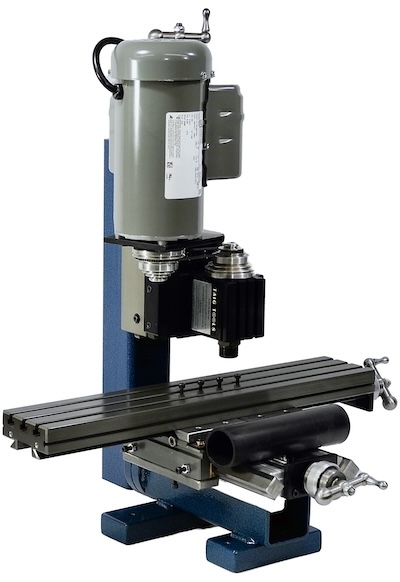
Taig(American company) makes a nice small mill in that price range. I had one years ago, quality U.S.A. made product. Solid enough to do accurate work, but somewhat light (80 lbs) so it can be stored away when not needed.
 

HoosierBuddy

Well-known member
Joined
May 9, 2006
Messages
2,918
Location
Southern Indiana
When faced with the same choice, after getting my South Bend Heavy 10 up and running, I decided to go to a small knee mill. Found an old U.S. Burke Millrite knee mill. I barely had room for that in my garage (about 2/3 the size of a bridgeport). But man am I glad I bought it.

I agree with the above...any mill is going to be better than a milling attachment on a lathe.
 

gorilla

Well-known member
Joined
Dec 13, 2007
Messages
1,651
IMHO spending $500.00 for a milling attachment for that Atlas lathe would be really foolish. Atlas lathes are not sturdy machines so you would be limited to really light cuts and would likely feel a lot of chatter. The other limiting factor is the amount of travel you would have. One other factor is that lathe chucks don't do a good job of holding end mills.
 

RoninB4

Well-known member
Joined
Jul 22, 2020
Messages
3,504
Location
Under My House
Not a fan of round column mills either. Odd thing about machining is the more things you make the bigger and more ambitious your projects will become. I understand the limitations of available space, I deal with it too.

Milling attachments for lathes will disappoint for anything larger than watch components. The tiny micro mills may be well made but are still too small to fit a vise, rotary table, index head, or any hand sized work on. Yes there is small tooling available for these machines but you'll need to buy items that are only available new and miss out on the bargains of great tooling for larger machines that's used but still in good condition. The used market can be a big help to your spending budget.

One more thing, be wary of machines with plastic gears and electric motors straight from China. Some machine importers specify better components than the failure prone ones on stock Horrible Freight/Northern Tool machines. Less expensive can quickly become more expensive when critical components have to be replaced. Sometimes more than once.
 

csp

Well-known member
Joined
Mar 23, 2010
Messages
5,719
Location
Franktown, CO
One other factor is that lathe chucks don't do a good job of holding end mills.
Not trying to defend the milling attachments, but these utilize a tapered drawbar in the spindle to hold the milling tools. At least they do on the Atlas/Craftsman lathes.
 
To avoid these ads, REGISTER NOW!

Bobnoxious32

Well-known member
Joined
Feb 21, 2016
Messages
54
Location
Ireland
I have the milling attachment for my myford ML7 1971 year mini lathe. It's a pain in the *** to setup because the workpiece is loaded from the side. I've only used it 1 time. My advise, buy a separate milling machine.
 

Richard D

Well-known member
Joined
Jan 19, 2007
Messages
1,922
Location
Texas City, between Houston and Galveston
When faced with the same choice, after getting my South Bend Heavy 10 up and running, I decided to go to a small knee mill. Found an old U.S. Burke Millrite knee mill. I barely had room for that in my garage (about 2/3 the size of a bridgeport). But man am I glad I bought it.

I agree with the above...any mill is going to be better than a milling attachment on a lathe.
I have a Millrite as well, nice machines for a garage shop.
 

liliysdad

Well-known member
Joined
Jul 18, 2008
Messages
5,382
I had a milling attachment for my Atlas. I used it once, and ended up selling it for about $500 on eBay. I found a Clausing 8530 for a really great deal locally and its a lot more useful than that milling attachement.
 

cannuck

Well-known member
Joined
Nov 30, 2021
Messages
4,607
Location
Rural SK
If you just want the challenge, and only do it once a year or so, you MIGHT be able to get by with a lathe mounted attachment, but if you have to buy it, don't. Spend your money on a little mill. I made do with a tiny Chinese one (and matching VFD lathe) for a few years before I found a decent dovetail column vertical mill. Some of the tooling crosses over from the little mill, but obviously the larger stuff goes on the big mill and needs larger tooling. The mini lathe only gets used when I have to do something too small to chuck up in my 13" machine, but my Son-in-law makes a lot of pen parts with it. Will serve as learning tool for grandkids because it will stall before breaking stuff.
 

dutchgray

Well-known member
Joined
Sep 28, 2014
Messages
6,465
Location
Dorset. England.
Those lathe milling attachments only existed because prior to the 80's when manual machines started getting dumped out of machine shops for relatively little money to make room for CNC's a home user really couldn't afford a decent mill and in most cases lathes that were intended for home use rather than industry.
So they made affordable milling attachments to fit on the affordable home use lathes but none of it is very good.
 

Great white

Well-known member
Joined
Nov 6, 2009
Messages
175
I have the original Atlas milling attachment for my Atlas TH42. I wouldn’t call it worthless, but its very, very, VERY limited. Its also very fiddley and a PITA to install and use.

About all its really good for is maybe cutting a slot in something and even then, don’t expect any real degree of accuracy.

I paid very little for the attachment (under 100 bucks), so I made it work for a while. It was always frustrating to use.

They are grossly overpriced these days. All I can figure is its the collector market driving them up. These days, I could probably sell the atlas milling attachment for more than I paid for the entire lathe and tooling. Gotta be the collector market driving the prices up because they are just not worth the prices being asked.

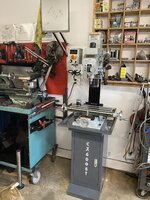
It sits on the rack now that I’ve bought a benchtop mill:

IMG_8662.jpeg

No comparison between the two. Benchtop wins every time. The two aren’t even in the same universe as far as capability and ease of use.

Go for a dovetail column if you can, but even a round column is still a huge step up from a lathe milling attachment. Next step up is the big boys like a Bridgeport, but you're either getting into serious money or rebuilding a worn out unit at that point. Dovetail column is a nice "in between" level between a round column and the "big boys".

The only complaint I have about mine is it uses a couple nylon gears in the gear head drivetrain. They are intended as a sort of "fuse" to protect the rest of the gears, but in practice they just strip out over time. My first one lasted about a year in regular use. Honestly, I think using a nylon hi/lo gear is as more about manufacturing cost as it is geartrain protection. Steel you have to machine, nylon you can just inject into a mold.

Major PITA when the nylon hi/lo gear goes because you almost have to take the gear box apart to get to it.

The first one that stripped on me was my last one as I sourced a steel replacement gear for the nylon "hi/lo" gear. I wasn't too impressed with an 80 dollar replacement nylon gear, plus shipping (and taxes) and a 3-6 month wait for it to be "in stock". Hasn't given me a lick of trouble since installing the steel gear. Kicker was it was even less expensive to buy than the nylon gear.

There's still a nylon gear under the motor, so I still have a "fuse" in the drivetrain should I crash a cutter. But the under motor gear is easier to get to by just pulling the motor off. I just printed off a couple spare nylon gears on my 3d printer and hasn't had to use one yet.
 
Last edited:

WillyBoy

Well-known member
Joined
Nov 10, 2021
Messages
636
Location
Genesee valley area of New York state
I've had experience with both. In 2007 I purchased a Craftsman/Atlas model 101.07301 as my first metal lathe.
I quickly found that it's good for brass and not really rigid enough for fine work on steel. They can be good machines if their limitations are respected. A few years later the original owner offered me the matching milling attachment for it. Again, maybe good for brass but not steel. There's just not enough stiffness, said a different way, it defects too much to have any kind of accuracy.

Forward to 2019, I found a Clausing 8520 mill at a good price. I had let one slip through my too-slow-to-dial-the-number fingers the year before. While still not what some would call a heavy duty machine, it's a world of difference. Again, there are limitations, mine has a #2 morse taper spindle with a maximum collet diameter of 1/2 inch.

At one end of the spectrum there are micrometer machinists and at the other end there are wooden yardstick machinists. I'm somewhere in the middle.
 

Aaron_W

Well-known member
Joined
Feb 6, 2018
Messages
2,894
Location
Northern California
Those lathe milling attachments only existed because prior to the 80's when manual machines started getting dumped out of machine shops for relatively little money to make room for CNC's a home user really couldn't afford a decent mill and in most cases lathes that were intended for home use rather than industry.
So they made affordable milling attachments to fit on the affordable home use lathes but none of it is very good.

This is a good point. To highlight this I like to look at the historical prices of Atlas / Craftsman machines.
Atlas kind of filled the niche of the current Chinese machines, basically targeting the light industrial and hobbyist market. Sears sold Atlas machines rebadged as Craftsman from the 1930s into the 80s.

In 1960 Sears offered four machine tools made by Atlas, a 6x18" lathe, a 12" lathe with 24" or 36" between centers, a 7" shaper and a small (4.5x18" table) horizontal mill.

The 6x18" lathe cost $175.50
The 12" change gear lathe cost $348 (24") or $389 (36"), a cabinet added $125, and a quick change gear box was an $86 option.
The 7" shaper cost $550
The Horizontal mill cost $495

These prices were without a motor. A good 1/2 hp motor suitable for the above cost $46.95
They also sold the milling attachment for 6" cost $43.20 (includes milling arbor), and the 12" cost $51.75 (includes milling arbor).

So if you bought the top of the line 12x36" Craftsman lathe, with cabinet, QCGB and best quality (for Sears) 1/2hp motor you had spent $646.95 + tax (about $6700 in 2023).

The mill with motor would cost $541.95 ($5620) so almost 85% the cost of that lathe, and you still need a lot more tooling to really use the mill. or you can spend about 1/10 the cost to get a milling attachment.

The Atlas / Craftsman mill, is honestly quite small and really more suitable for somebody that would be happy with the 6x18" lathe which makes the cost an even bigger hurdle being nearly 3x the cost of that lathe.


Benchmaster is another small mill of the period, offered in both horizontal and 2 in 1 horizontal / vertical mills. They were priced about the same as the Atlas / Craftsman mill. In 1960 these cost $475-510 depending on model.

Now you could get a Clausing 8520 vertical mill, for a mere $905 (1958 price, or $9600 in 2023).

(Edit just for fun I looked up the cost of a Bridgeport mill)
In 1964, a Bridgeport J head mill cost $1530 (about $15,000 in 2023 dollars), so probably just out of reach for most hobbyists.


The vintage milling attachments are more sophisticated then the import milling attachments, again likely due to the appearance of relatively inexpensive milling machines. Hard to sell a modern milling attachment for $500 when you can get a small mill for about the same price.
 
Last edited:

dutchgray

Well-known member
Joined
Sep 28, 2014
Messages
6,465
Location
Dorset. England.
This is a good point. To highlight this I like to look at the historical prices of Atlas / Craftsman machines.
Atlas kind of filled the niche of the current Chinese machines, basically targeting the light industrial and hobbyist market. Sears sold Atlas machines rebadged as Craftsman from the 1930s into the 80s.

In 1960 Sears offered four machine tools made by Atlas, a 6x18" lathe, a 12" lathe with 24" or 36" between centers, a 7" shaper and a small (4.5x18" table) horizontal mill.

The 6x18" lathe cost $175.50
The 12" change gear lathe cost $348 (24") or $389 (36"), a cabinet added $125, and a quick change gear box was an $86 option.
The 7" shaper cost $550
The Horizontal mill cost $495

These prices were without a motor. A good 1/2 hp motor suitable for the above cost $46.95
They also sold the milling attachment for 6" cost $43.20 (includes milling arbor), and the 12" cost $51.75 (includes milling arbor).

So if you bought the top of the line 12x36" Craftsman lathe, with cabinet, QCGB and best quality (for Sears) 1/2hp motor you had spent $646.95 + tax (about $6700 in 2023).

The mill with motor would cost $541.95 ($5620) so almost 85% the cost of that lathe, and you still need a lot more tooling to really use the mill. or you can spend about 1/10 the cost to get a milling attachment.

The Atlas / Craftsman mill, is honestly quite small and really more suitable for somebody that would be happy with the 6x18" lathe which makes the cost an even bigger hurdle being nearly 3x the cost of that lathe.


Benchmaster is another small mill of the period, offered in both horizontal and 2 in 1 horizontal / vertical mills. They were priced about the same as the Atlas / Craftsman mill. In 1960 these cost $475-510 depending on model.

Now you could get a Clausing 8520 vertical mill, for a mere $905 (1958 price, or $9600 in 2023).

(Edit just for fun I looked up the cost of a Bridgeport mill)
In 1964, a Bridgeport J head mill cost $1530 (about $15,000 in 2023 dollars), so probably just out of reach for most hobbyists.


The vintage milling attachments are more sophisticated then the import milling attachments, again likely due to the appearance of relatively inexpensive milling machines. Hard to sell a modern milling attachment for $500 when you can get a small mill for about the same price.
Plus you have to add in the fact that mills like the Bridgport were often in such demand that there were long waiting lists to get one if ordered and nearly new used machines were selling for more than a brand new one.
Tooling also cost much more, being that there was no good enough cheap import tooling available, hence why hobby machinists often made so much themselves.

The last few decades have really been a golden age for the hobby machinist, between relatively affordable Asian made machinery and high quality industrial manual machines being all but obsolete in industry and thus often incredibly cheap, especially if they are just a bit bigger than the average home user can deal with.
 
To avoid these ads, REGISTER NOW!
Top Bottom