To avoid these ads, REGISTER NOW!

Bend pak HD 9 slack safety help please

wareaglescott

Member
Joined
Feb 4, 2017
Messages
15
I am instilling a HD 9 four post lift.
The directions indicate "It is important that the slack safety lock is cleared. The slack safety lock must never rest on the safety ladder".

The illustration in the manual leaves something to be desired. Best I can tell all my safety locks are sitting on the ladders.

Im having a hard time understanding how they work and how to release them with no cables or air lines hooked up yet. I don't want to proceed with the install until I get this sorted out and of course they are closed for the weekend.

Any insight to these slack safety locks would be appreciated.

Thanks
 
To avoid these ads, REGISTER NOW!

Z2V

Well-known member
Joined
Jul 19, 2016
Messages
418
Location
Cedar Park (Austin) Texas
The primary safety is operated by the pneumatic cylinder at each corner. The slack safety is operated by the roller that is operated by the lifting cable at each corner. Look on pg 18 figure 8.3. With the cross beams sitting on the primary lock the slack safety should still be retracted. You can go to each corner and lift up on the cross beam slightly while pushing the roller shown in fig 8.3 out to make sure the safety is retracted. The slack safety will only operate if the lifting cable at any corner breaks or becomes slack enough to allow that roller in 8.3 to release.
Hope this helps
 

Clik

Well-known member
Joined
Jan 1, 2011
Messages
430
Location
Highest Mountain in Western, MD
I have always raised my vehicles to just above the desired level and then brought it down with no air pressure applied to allow it to rest on the ladders. That way I know it isn't going to creep.
 
OP
W

wareaglescott

Member
Joined
Feb 4, 2017
Messages
15
The primary safety is operated by the pneumatic cylinder at each corner. The slack safety is operated by the roller that is operated by the lifting cable at each corner. Look on pg 18 figure 8.3. With the cross beams sitting on the primary lock the slack safety should still be retracted. You can go to each corner and lift up on the cross beam slightly while pushing the roller shown in fig 8.3 out to make sure the safety is retracted. The slack safety will only operate if the lifting cable at any corner breaks or becomes slack enough to allow that roller in 8.3 to release.
Hope this helps

Thanks for the explanation.
I have not installed any pneumatic lines or cables yet. With nothing hooked up is it abnormal that both safeties are engaged?
Is it ok to proceed? Once I start moving the lift under power will this issue resolve itself?
 

DerStig

Well-known member
Joined
Jun 15, 2015
Messages
441
I was installing my hd9 today and literally had the same exact confusion. The user manual is very poorly written.

I realized by the time my lift was already 24" high with both runways attached that I should have disengaged the slack safety locks by getting the springs to retract. Well too late because they were already engaged. So I had to manually remove them while they were engaged and use my cherry picker on each corner to lift each side so the secondary lock clears.

This is not something I recommend you do as it was very dangerous and nerve recking but I couldnt think of anything else.

I think they should redo the manual. The part about hoses is also very poorly done. No idea which is a hydraulic fitting which is air fitting and where they plug in on the power unit because they have so many different models.

Also with the air line and the way it attaches, the white plastic piece is crucial its not somethint you should throw out.
 

Z2V

Well-known member
Joined
Jul 19, 2016
Messages
418
Location
Cedar Park (Austin) Texas
Thanks for the explanation.
I have not installed any pneumatic lines or cables yet. With nothing hooked up is it abnormal that both safeties are engaged?
Is it ok to proceed? Once I start moving the lift under power will this issue resolve itself?

I would go to each corner and raise it slightly while pushing on the roller arm that releases the slack safety. You will want all four corners released before you attach the cables as it is the cable tension that keeps these safeties released. You will probably have to lift each corner a couple inches to get the slack safety to release. After you set it back down only on the primary safety the slack safety will stay released until you route the cables and get tension on them. Once you get all cables and hoses hooked up and the lift operational the slack safety will be fine, you won't have to worry with it. It's a backup safety that will operate if a cable breaks or becomes slack while lowering the lift.
 

Z2V

Well-known member
Joined
Jul 19, 2016
Messages
418
Location
Cedar Park (Austin) Texas
((I think they should redo the manual. The part about hoses is also very poorly done. No idea which is a hydraulic fitting which is air fitting and where they plug in on the power unit because they have so many different models.))

The hydraulic hose attaches to port labeled "P1" on the right side and the air return goes to port labeled "T" on the left side of the power unit as in figure 10.1 on pg 19. On the cylinder end the length of the hydraulic hose is a dead giveaway as to where it goes. On the end where the piston is in fig 8.1
 
To avoid these ads, REGISTER NOW!
OP
W

wareaglescott

Member
Joined
Feb 4, 2017
Messages
15
Thanks for the responses. The instructions are ****!

I tried manually raising the cross tubes some to get the slack safety to disengage prior to my initial post. The thing is to heavy so I used a floor jack. I guess I went to far because they all ended up engaged again just on the next higher ladder step.

Is it going to require me to go all the way up to the next ladder position or when I raise it just a bit should I be able to manually disengage the slack safety and then lower it back to where I started?

Also I found some other threads concerning the springs on that safety and the possibility I might need to take one off. They were older threads though. Anyone have input on that?
 

Z2V

Well-known member
Joined
Jul 19, 2016
Messages
418
Location
Cedar Park (Austin) Texas
IMG_0635.jpg

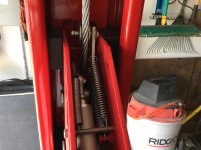
You just need to raise it an inch or so to take the tension off of the safety lock so it can retract. In the photo the slack safety is operated by the roller behind the cable. I guess that you could temporarily remove the two springs attached to it to keep it released. This did not present a problem to me when I assembled mine. Be certain that all corners are resting on the same level before attaching the cables.
 
OP
W

wareaglescott

Member
Joined
Feb 4, 2017
Messages
15
IMG_0635.jpg

You just need to raise it an inch or so to take the tension off of the safety lock so it can retract. In the photo the slack safety is operated by the roller behind the cable. I guess that you could temporarily remove the two springs attached to it to keep it released. This did not present a problem to me when I assembled mine. Be certain that all corners are resting on the same level before attaching the cables.

Very helpful information. Thank you. I have never seen one of these lifts in person and the illustrations in the manual leave something to be desired. I was having a hard time understanding how it all worked. Plus when I am manually lifting the cross tubes I am hearing the clicking but not really seeing what is happening when I go up the ladders.

So if the cable is not in position yet and the springs are still attached how can it possibly stay retracted? It seems like whenever it passes the ladder opening it goes right back into sitting on the ladder by itself. Of course I have not tried manually retracting it. If I manually retract will it kind of lock back into position?
 

Z2V

Well-known member
Joined
Jul 19, 2016
Messages
418
Location
Cedar Park (Austin) Texas
Manually retract it while lowering the cross tube down on the primary lock.
Push on the roller when you start to raise the cross tube. You will feel it release, while still pushing out on roller, lower it back down.
 
Last edited:
OP
W

wareaglescott

Member
Joined
Feb 4, 2017
Messages
15
Manually retract it while lowering the cross tube down on the primary lock.
Push on the roller when you start to raise the cross tube. You will feel it release, while still pushing out on roller, lower it back down.

Ok thanks.
Going to work on it today. Will have to rig something up to be able to hold both sides at the same time while lowering it back.
 

DerStig

Well-known member
Joined
Jun 15, 2015
Messages
441
Please be extremely careful with this stuff. Floor jack has a very small surface area and around its maximum height it will move towards you as it raises which might cause the crossmember to slip (i tried that first when i hadthe issue). I ended up using a crane with chains to be safe. You are going to be lifting around 1200 lbs/4= 300 lbs, its not too much but it can cause injury easily. I did the same exact thing and I had a bodybuilder friend with me who is 6'3" (I also workout) and both of us who independently can squat and deadlift very heavy weights could not manage this by hand or by floor jack + hand. We had to use the crane. I recommend you go get one for $179 from HF, you can always return it. You will thank me later.
 
Last edited:
OP
W

wareaglescott

Member
Joined
Feb 4, 2017
Messages
15
Please be extremely careful with this stuff. Floor jack has a very small surface area and around its maximum height it will move towards you as it raises which might cause the crossmember to slip (i tried that first when i hadthe issue). I ended up using a crane with chains to be safe. You are going to be lifting around 1200 lbs/4= 300 lbs, its not too much but it can cause injury easily. I did the same exact thing and I had a bodybuilder friend with me who is 6'3" (I also workout) and both of us who independently can squat and deadlift very heavy weights could not manage this by hand or by floor jack + hand. We had to use the crane. I recommend you go get one for $179 from HF, you can always return it. You will thank me later.


I have a crane. I can use that on the front cross tube. Cant get the crane to the rear one because the back wall of the garage is to close. I put 2x10s on the lift point of my floor jack. Makes a much wider platform for the cross tube to sit on and I have no concerns of it slipping off. Thanks for the words of caution though.
 
OP
W

wareaglescott

Member
Joined
Feb 4, 2017
Messages
15
Success on the safety locks!
Thanks for the advice Z2V.
Raising it up a couple inches then getting the safety in the correct position and lowering worked perfect!
 
To avoid these ads, REGISTER NOW!
Top Bottom