To avoid these ads, REGISTER NOW!

Bending Aluminum

outtaplace

Active member
Joined
Jan 21, 2011
Messages
37
Location
Central NJ
I recently purchased some sway bar arms and I wanted to put to 45 degree bends in the arms. They are 6061 T6 and are 3/4" thick. I know when I heat them up, I will lose the temper and all, but for my application, they will still be plenty strong. The folks I bought the arms from said the heat them up with a torch and after bending, quench them in a bucket of cold water? Would it be best to heat them with an oxy-acetylene torch? I plan on bending them by hand. I've bent steel this way before, but not aluminum and was wondering what would be the best way to get nice bends?

Thanks,

Rob
 
To avoid these ads, REGISTER NOW!

A_Pmech

Well-known member
Joined
May 8, 2007
Messages
8,002
Location
IL
6xxx series alloys are hot short. It will likely crack. Even if you can't see the cracks it doesn't mean they aren't there.

Cold bending with a press brake may work if the geometry is sufficiently forgiving.
 
OP
O

outtaplace

Active member
Joined
Jan 21, 2011
Messages
37
Location
Central NJ
AP Mech,

I just ran my practice arm through the press and it made a smooth 45 deg bend with no cracking that I could see. I will use a nice 3/4" radius on the end of the press piston for the actual arms and I think I'll be all set. I will post pics of the actual arms cause my practice bend looks a little messy...

As always, thanks for the help.
 

Kevin54

MEMBER EMERITUS
Joined
Jan 12, 2005
Messages
29,341
Location
Urbana, Ohio
You can heat up 6061-T6 with a torch. It will anneal it and go back to T6 on it's own after a while. We have to anneal 6061-T6 in a salt bath when we form it at work. There is a four hour time frame before it starts to harden back up.
 

Boiler

Well-known member
Joined
Nov 20, 2009
Messages
1,967
Location
Indiana
At last I get to share my process with the world!

Heating with a torch will take out the temper completely (and the strength!). It's hit or miss. You might not heat it enough or you might melt it away!

6061 aluminum is solution heat treated to a T-4 condition at around 900 degrees iirc. Then it's quenched. Then the T4 is artificially aged at around 300-350 degrees for 1-20 hours to reach a T6. If you perform this treatment too long, it weakens back to properties similar to T4 eventually. T4 is readily bendable at tighter radii than T6 is.

After som testing, we came up with the following process. Bake the part in an oven at 300 degrees for 12 hours. Turn off the oven and allow the temp to drop slowly to room temp (don't open the oven). Once at room temp you should be able to safely bend your sample to an inside radius equal to your thickness. In the case of 3/4 round, use a 3/4 radius.

You may cold bend it, but to avoid tiny cracks I use a bend radius of 4 to 5x the thickness. 3/4 rad on 3/4 D round is too sharp. I'm betting there are fine cracks on the outside

T-0 yeild strength = 8000 psi
T-4 yeild strength = 18000 psi
T-6 yeild strength = 40000 psi
 
Last edited:

mjb

Well-known member
Joined
Jan 9, 2008
Messages
225
Location
San Diego
I'm a little late, but I broke some .25 6061 and just took some pics.

I used a press brake and had to go a little at a time. Tried it on auto and it cracked in half.

You can see all the cracks
alum2.jpg


alum.jpg


alum1.jpg


I used them as brackets to hold an acrylic sneeze guard on a table, so it works fine for that application.
 

Boiler

Well-known member
Joined
Nov 20, 2009
Messages
1,967
Location
Indiana
If you need to form that 1/4 cold you'll need a 1" radius, maybe sneak by with 3/4".

Oh and w/ aluminum you ALWAYS bend perpendicular to the grain.
 

mjb

Well-known member
Joined
Jan 9, 2008
Messages
225
Location
San Diego
Unfortunately, using flat bar doesn't give me much of a choice on the grain nor does a small selection of dies. :lol:
 

Boiler

Well-known member
Joined
Nov 20, 2009
Messages
1,967
Location
Indiana
With bar grain is pretty much always right. Was more just adding a nOte for those doing sheet in the future.

As far as dies go, we always just weld the appropriate round bar to 1/2" flat. Works fine for small aluminum things. May not want to form a whole 3/8 plate with a homemade die though
 
OP
O

outtaplace

Active member
Joined
Jan 21, 2011
Messages
37
Location
Central NJ
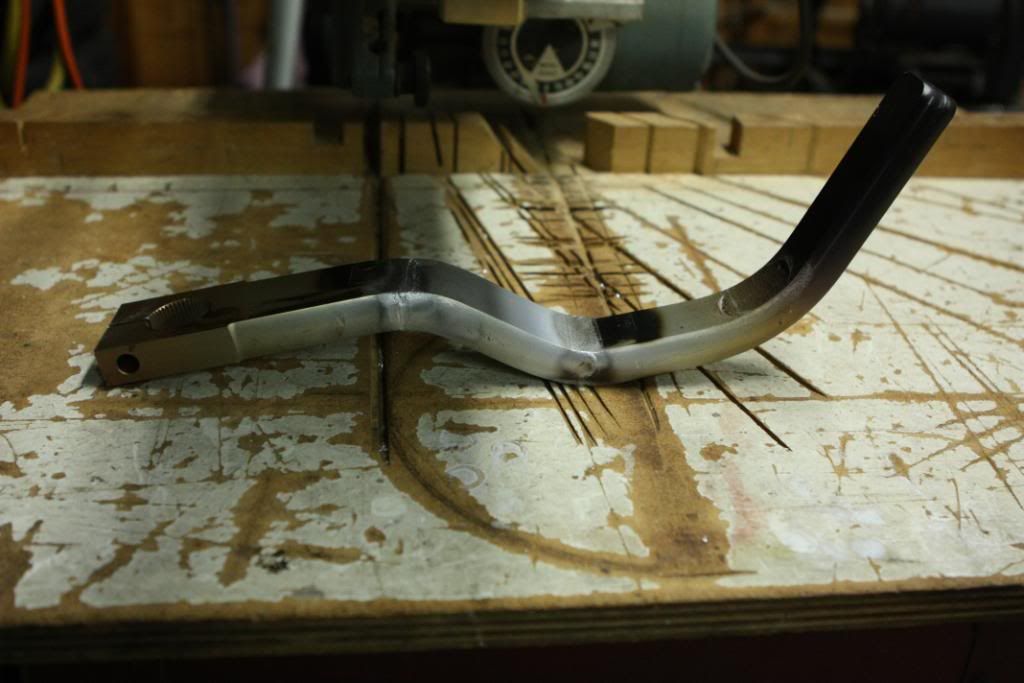
Here are some of the pieces I've 'attempted' to bend. They are 6061 T6. The first one was heated with a torch and just like AP Mech said, it cracked....

IMG_0151.jpg


IMG_0152.jpg


The smooth bend at the section where the bar changes color was done on the press, cold, but after the bar had been heated with the torch for the other bends. It did not crack:
IMG_0154.jpg


I then worked on the second piece on the press with a rounded section of steel rod that I cut off so it was flat on one side:
IMG_0156.jpg


IMG_0158.jpg


The whole time the gauge stayed right at 2000 psi:
IMG_0157.jpg


This bend came out so-so with little to no cracking on the outside:
IMG_0159.jpg


IMG_0160.jpg


IMG_0163.jpg


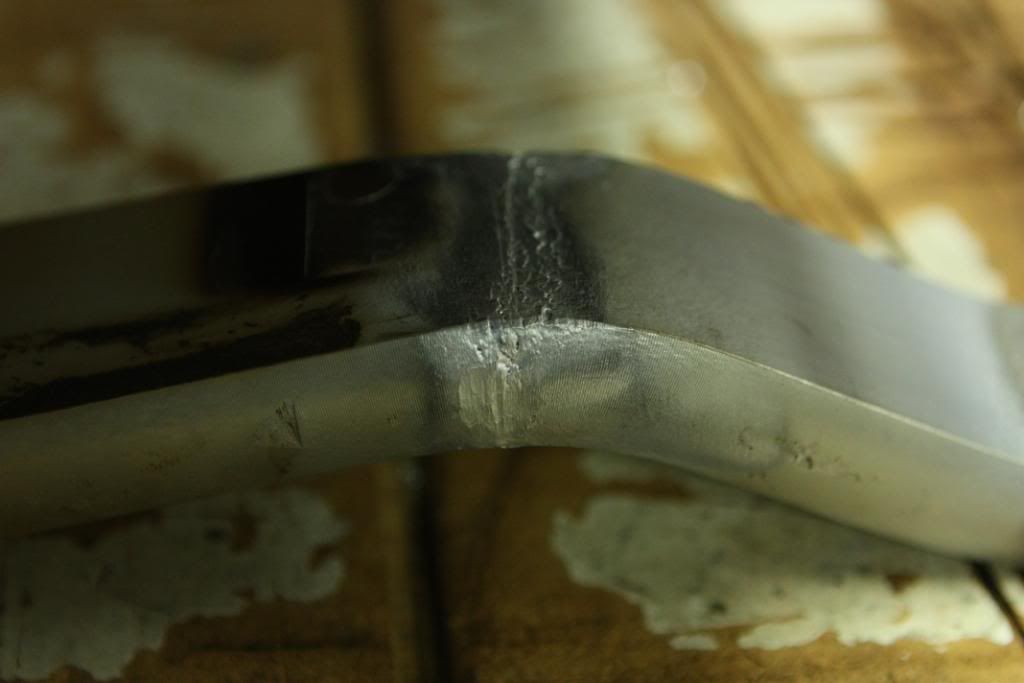
But the second bend that I tried on this piece started to crack on the outside:
IMG_0165.jpg


IMG_0166.jpg


IMG_0168.jpg


IMG_0167.jpg


I was thinking of trying the second one on the car to see if it can hold up. I was also thinking of trying again with a bigger radius, but I don't want to mess anything else up - these aluminum bar arms are $52 each and I've already wrecked one - maybe two, lol.

Any thoughts/suggestions??

Thanks,

-Rob
 
Last edited:

Kevin54

MEMBER EMERITUS
Joined
Jan 12, 2005
Messages
29,341
Location
Urbana, Ohio
If you need to form that 1/4 cold you'll need a 1" radius, maybe sneak by with 3/4".

Oh and w/ aluminum you ALWAYS bend perpendicular to the grain.

Not always. There are many parts we form at work that go with the grain. Some of the parts if they bend past 90 degrees we may go with the grain to avoid stress cracking, Other parts we may go perpendicular to the grain for strength. It all depends on what alloy of Aluminum we are using and to whether or not it gets annealed before bending, or heat treated after bending. Another deciding factor is the radius that the parts are bent to. If we have to have a tighter radius than what the material thickness is, then we might bend it with the grain to get it to form without cracking. But again it depends on the material.

But yes, for the most part, you are correct, bending perpendicular to the grain will give you the best results.
 
To avoid these ads, REGISTER NOW!

kmacht

Well-known member
Joined
Apr 12, 2010
Messages
2,765
Location
Connecticut
I have built an entire airplane out of 6061T6 and was given some good advice from an oldtimer on how to bend non structural parts with compound curves such as fairings made out of this material. It is amazing how workable it is once the temper is gone. Here is how to do it. Take a sharpie and write all over the top side of the area you want to bend. Slowly heat the part up from the bottom side using a propane torch until the sharpie marks burn off. You will still see a shiny spot where there was color but the color will be gone. Let the part air cool. At that point the material will have lost its temper and will be much easier to bend. I'm not sure why but the sharpie burns off at just the right temperature for 6061. The key is not to force it when heating. If you go at it with a oxy-acetylene torch it won't work. If the material starts looking grainy when it cools before bending you have heated it too much and it will most likely crack. Depending on the thickness of the material it may take a while to get it up to temperature. Don't force it. Just keep playing the torch around the bottom side until it heats all the way through and the sharpie is gone. Hope this helps.

Keith
 

MFGENG

Well-known member
Joined
Jul 21, 2011
Messages
79
5052-H32 is much better for forming/bending.

If we have to use 6061-T6 we use a internal radius x2 the thickness. With 5052 you can use the material thickness.
 

retrobuilder

Well-known member
Joined
Oct 18, 2012
Messages
408
Location
Alpharetta GA
Yes to 5052..great for cold bending at tighter radii. 6000 series is not the perfect alloy many folks believe it to be- particularly if T6.

6063 (T5) can be used but much larger radii bends.

Need good forming but not much hardness use 2024
 

garboui

Well-known member
Joined
Jun 30, 2011
Messages
999
Location
Southern Ontario
Does the part have to be aluminum? I can see needing the part for the broached spline but what about cutting it 3" out from the splined hole and attaching some steel that could be easily bent to the radius and shape you need?
 

ddawg16

Well-known member
Joined
Jul 11, 2008
Messages
21,005
Location
S. California
Ok...I can't offer much advice on this thread....

But.....

You have to love some of the good advice.............pmech...boiler....

mjb...good pics and examples of what can go wrong...

out...more good pics....as least your trying to do it right...

So...what is the application? Jeep?
 

Kevin54

MEMBER EMERITUS
Joined
Jan 12, 2005
Messages
29,341
Location
Urbana, Ohio
IMG_0160.jpg


IMG_0168.jpg


For what you are using the brackets for, those stress fractures won't hurt. If you are willing to recoat them (Black anodize) you can file down the stress crack and they won't show. If that was a structural member on a moving part, I would be leery. But to hold the sneeze shield, you'll be fine.


IMG_0156.jpg


When you are bending the parts like that, make sure you don't have anyone standing off to the side. You have 2x's sitting on steel and they could slide out rather quickly under pressure.
 
OP
O

outtaplace

Active member
Joined
Jan 21, 2011
Messages
37
Location
Central NJ
Forgot all about this thread till it popped up this morning. Here is the finished product. I used a radius of about 1.25" on the same hand-pump hydraulic press in my earlier posts. The offset shown was actually more than I needed it to be so in the spring I may make another set but I was able to squeeze these onto the car and the whole sway-bar system worked great.

DSC05642-2.jpg


DSC05643-2.jpg


This is the whole bar assembly. In the picture I hadn't cut the arms to length or drilled the holes as shown in the pics above.

swaybar-2.jpg


Kevin: I was extremely careful when bending and very worried that something would slip but nothing did. The second bend was a little more troublesome to setup but it worked out in the long run.

Thanks to everyone for the help:beer:

Rob
 

BigWheel007

New member
Joined
Jun 9, 2016
Messages
1
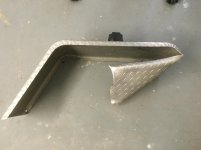
Anybody still out there from these 2012 posts? I need to straighten my aluminum trailer fender that buckled under when I blew a tire. The tread grabbed the trailing edge of the fender and bent it under about 90 degrees (and then ripped the fender completely off! - at 60 mph).

I don't know the grade of aluminum. It is diamond plate, about 10 inches wide, and about 3/32" thick. If I can bend it back I can save a few (hundreds?) bucks. It doesn't have to be pretty; I just want to straighten it and stick it back on the trailer so it can do its job.

Your earlier posts were very informative. Any suggestions for this one?
 

Attachments

  • IMG_1543.jpg
    IMG_1543.jpg
    140.5 KB · Views: 28

EdT

Well-known member
Joined
Sep 21, 2010
Messages
1,104
Location
North Georgia
Since this doesn't have to be pretty, I think I would start by standing on the bent end and pushing the unbent end away from me and see what happens. If you're lucky, it will mostly unbend where it's bent. Then I would get a block of wood and arrange it in a vise so that I could beat the rest of it into shape using a dead blow hammer. It won't be "perfect", but you can probably make it functional again. If it really doesn't want to bend where it needs to, you can anneal that area as described earlier in this thread. It should then bend very easily where it's annealed and will recover some of it's hardness as it's bent back into shape. Remember, this is a trailer fender not a show car.
 

mike13u

Well-known member
Joined
Mar 1, 2008
Messages
616
Location
S.Florida
Anybody still out there from these 2012 posts? I need to straighten my aluminum trailer fender that buckled under when I blew a tire. The tread grabbed the trailing edge of the fender and bent it under about 90 degrees (and then ripped the fender completely off! - at 60 mph).

I don't know the grade of aluminum. It is diamond plate, about 10 inches wide, and about 3/32" thick. If I can bend it back I can save a few (hundreds?) bucks. It doesn't have to be pretty; I just want to straighten it and stick it back on the trailer so it can do its job.

Your earlier posts were very informative. Any suggestions for this one?

If it is bright diamond/tread plate it is likely 3003-H22 which has excellent formability. It looks like it was formed already which is another indication that its likely 3003. You should be good to go if you have the tools and patience to bring that back to life.
6061 tread plate has a mill finish (not flashy) and is usually used in applications where it isnt formed like floor and wall panels or loading ramps.
 
Last edited:
To avoid these ads, REGISTER NOW!
Top Bottom