
To avoid these ads, REGISTER NOW!

Berylco "brass" tools: DANGER

Man of Many Vices

Well-known member
Joined
Aug 23, 2012
Messages
366
I picked up an unusual Berylco hammer a few months ago, and before I did my usual wire wheel clean up, I decided to look it up on the web. Turns out that it is made out of berylium (hence Berylco), a carcinogenic metal.

Berylco tools are extremely expensive. The main use for such tools is that they do not spark when they strike other metallic objects.... Not a bad idea when working inside gas pipelines or missile silos.

The factory strongly advises against any attempts to wire wheel, sharpen, scrape, or otherwise cause fragments or particles to be released into the working environment. The company apparently offers a free lifetime resharpening service for Berylco tools with cutting edges.

I have seen several references to Berylco tools in GJ, including an earlier post in the "Tiny Tools" thread. None made any reference to the hazards. All seemed to describe the tool as being made out of brass.

I decided not to give an adjustable wrench to my nephew because his two young children might have access to it. Please keep this in mind if you come across any Berylco tool or similar non-sparking tool you believe made be made out of brass. Maybe it is, maybe it isn't.

Dan
Indio, CA
 
To avoid these ads, REGISTER NOW!

FMC

Well-known member
Joined
Aug 24, 2012
Messages
259
I believe they are a "copper" based tool, there is a specific disease associated, berylliosis caused from particulate exposure but really its a lot safer than many metals we work with and wood, as to cancer risks, Id be more worried about gas for my truck lol
 

AZ_Catskinner

Well-known member
Joined
Jan 29, 2011
Messages
1,354
Location
Morenci, AZ
They are a Beryllium/Copper alloy (similar composition to some Ping and other putters).

If you want to clean them up, use hot sauce (Tapatio is not only delicious, but cleans copper like nobody's business) or something else mildly acidic. The concentration of beryllium in tools is between .5% and 3%, so toxicity without machining/grinding/welding is virtually non-existent. Until you reduce it to a respirable dust or fumes, it presents virtually no health hazard.
 

Outlawmws

Well-known member
Joined
Aug 9, 2011
Messages
39,148
Location
The Badlands
I can't recall anyone claiming these tools were brass, other than someone that had never seen one, and it is pointed out that it is a Beryllium Copper alloy, not brass. Probably should be better about pointing out not to grind or wire wheel on them though... (I have some pliers, wrenches, and a bung wrench...)
 

sumner52000

Well-known member
Joined
May 13, 2010
Messages
1,025
Location
Roxboro, NC
I've been picking them up at flea markets and yard sales. I have an adjustable wrench, a hammer, chisel, and wrench so far. Don't think i have used any of them yet.

Thanks for the safety update.
 

Mickey O

Well-known member
Joined
Oct 25, 2009
Messages
6,153
Location
Chicago, IL
I picked up an unusual Berylco hammer a few months ago, and before I did my usual wire wheel clean up, I decided to look it up on the web. Turns out that it is made out of berylium (hence Berylco), a carcinogenic metal.

Berylco tools are extremely expensive. The main use for such tools is that they do not spark when they strike other metallic objects.... Not a bad idea when working inside gas pipelines or missile silos.

The factory strongly advises against any attempts to wire wheel, sharpen, scrape, or otherwise cause fragments or particles to be released into the working environment. The company apparently offers a free lifetime resharpening service for Berylco tools with cutting edges.

I have seen several references to Berylco tools in GJ, including an earlier post in the "Tiny Tools" thread. None made any reference to the hazards. All seemed to describe the tool as being made out of brass.

I decided not to give an adjustable wrench to my nephew because his two young children might have access to it. Please keep this in mind if you come across any Berylco tool or similar non-sparking tool you believe made be made out of brass. Maybe it is, maybe it isn't.

Dan
Indio, CA


Where was this post last week when I was wire brushing the hell out my Berylco adjustable wrench*. Everything is hazardous to your health, yeah you shouldn't sand, grind or wire brush the stuff but it ain't gonna kill you. All those types of tools are made of brass/copper, some with beryllium added for strength.


* didn't really wire brush it.
 

kc-steve

Well-known member
Joined
Jun 22, 2010
Messages
4,240
Location
Kansas City
Yeah, a lot of those government "warnings" are blown way out of proportion compared to reality.

Back 40 years ago in the military I was digging gold electron tube grids out of used tubes but I noticed a beryllium oxide ceramic underneath was degrading and I was getting a little dizzy, so I called the medics. They looked it up and pretty much said, don't worry about it but stop it. Forty years later and a smoker, I'm still alive and kicking. :thumbup:

Steve
 
Last edited:

cbracer

Well-known member
Joined
Feb 27, 2012
Messages
637
Location
Costa Mesa, CA
They use beryllium to strengthen metals forming a metal composite. Very high strength metals can be made from it. Many Formula 1 race car teams used beryllium in aluminum alloys for ultra high strength (think brake calipers), but due to their cost and toxicity it has been outlawed by the sanctioning body. Dangerous only when turned into dust and becomes airborne. Some people are hypersensitive to it.

http://www.atsdr.cdc.gov/toxfaqs/TF.asp?id=184&tid=33

Chronic beryllium disease (CBD) occurs when people inhale beryllium dust or fume and can take anywhere from a few months to 30 years to develop. CBD is caused by an immune system reaction to beryllium metal, with symptoms such as persistent coughing, difficulty breathing upon physical exertion, fatigue, chest and joint pain, weight loss, and fevers.

Acute Beryllium Disease (ABD) is caused by breathing in relatively high concentrations of beryllium in dust and metal fumes (>100 µg/m3). High level exposures may lead to death or respiratory illness similar to pneumonia or bronchitis. Symptoms associated with ABD include difficulty breathing, cough, and chest pain. These symptoms occur much more rapidly than those associated with chronic beryllium disease (CBD).
 

AZ_Catskinner

Well-known member
Joined
Jan 29, 2011
Messages
1,354
Location
Morenci, AZ
Had no idea. Learn something new everyday (though I can attest to it being delicious)!

Take the rattiest penny you've got, coat it with Tapatio and wait about 15-20 minutes, rub it with a rag then rinse it off. It'll shine like new.

I recently discovered another metal cleaner extraordinaire when I cleaned a bunch of grease off of my keys with Barnes Citrisolve. I've never seen Master lock keys look so clean and tarnish free.
 

rlitman

Well-known member
Joined
Oct 18, 2010
Messages
24,589
Location
Long Island
Berylco tools are extremely expensive. The main use for such tools is that they do not spark when they strike other metallic objects.... Not a bad idea when working inside gas pipelines or missile silos.

The factory strongly advises against any attempts to wire wheel, sharpen, scrape, or otherwise cause fragments or particles to be released into the working environment. The company apparently offers a free lifetime resharpening service for Berylco tools with cutting edges.

Please keep this in mind if you come across any Berylco tool or similar non-sparking tool you believe made be made out of brass. Maybe it is, maybe it isn't.

It is not brass. Berylco tools ALL use beryllium bronze aka BeCu. That alloy is around 98% copper, and 2% beryllium. Note that the entire tool may not be BeCu. Take for example the pipe wrench. The ones that do indeed have a bronze body are actually made from aluminum bronze, with just the jaws being BeCu.
Ampco is also in the business of making BeCu tools, but unless they are marked BeCu, they are probably aluminum bronze.

Aside from non-sparking, BeCu is also used in corrosive environments, cryogenic environments, and service of equipment sensitive to magnetism (such as an MRI machine).

As a general rule I am all for wire wheel clean up but never on any kind of soft metal or when I have a valuable old tool.

Trust me. BeCu is not soft by any means.

I can't recall anyone claiming these tools were brass, other than someone that had never seen one, and it is pointed out that it is a Beryllium Copper alloy, not brass. Probably should be better about pointing out not to grind or wire wheel on them though... (I have some pliers, wrenches, and a bung wrench...)

Look, is isn't like this guy happened upon a radioactive source, but the advise to not grind it is sound. Since the percentage of beryllium is very low, it is unlikely to be that bad, but yes, breathing grinding dust from BeCu can be more harmful than other grinding dusts. If you have access to wet grinding equipment, that would be fine to use. Otherwise, just let it get to a nice bronze color.

Really, what is up with tool polishers?
 

0.511MeV

Well-known member
Joined
May 25, 2011
Messages
421
I've worked with Be a lot. It is an amazing metal, super light. Used in a lot of x-ray applications because it is pretty much invisible to those low energy photons.

I think something to always keep in mind is that a lot of metals are going to be hazardous if you breathe them (mercury vapor, Be dust, thoriated tig welding electrodes, etc).
 

Outlawmws

Well-known member
Joined
Aug 9, 2011
Messages
39,148
Location
The Badlands
Look, is isn't like this guy happened upon a radioactive source, but the advise to not grind it is sound. Since the percentage of beryllium is very low, it is unlikely to be that bad, but yes, breathing grinding dust from BeCu can be more harmful than other grinding dusts. If you have access to wet grinding equipment, that would be fine to use. Otherwise, just let it get to a nice bronze color.

Really, what is up with tool polishers?

Not sure why you are barking on my comment. :dunno:

As to "tool polishers" I buy a lot of old tools, tools that in many cases the PO abused and have rust and/or a lot of crud on them. It's not tool polishing to return an abused tool to near it's original condition before adding to the box ready for use. If you like using rusty crusty greasy tools fine, but cleaning them after use some messy use isn't what I'd call tool polishing...
 

Outlawmws

Well-known member
Joined
Aug 9, 2011
Messages
39,148
Location
The Badlands
Had no idea. Learn something new everyday (though I can attest to it being delicious)!

Almost any vinegar based sauce will to the same; Catchup, also works, as well as Taco Bell sauce. You want to be a bit careful with brass alloys though, used too long at a time and it can take out the top layers of non copper metals and turn the item a copperish red
 

rlitman

Well-known member
Joined
Oct 18, 2010
Messages
24,589
Location
Long Island
Not sure why you are barking on my comment. :dunno:

As to "tool polishers" I buy a lot of old tools, tools that in many cases the PO abused and have rust and/or a lot of crud on them....

Sorry if you read it that way. That's not at all how it was intended, but after re-reading it, I can see how it can be interpreted that way. I just meant to pick out your comment as something I completely agreed with.

I'm all for wire wheeling crusted up rusty steel tools that I've bought at garage sales. I'm more for keeping tools clean, so they don't get rusty in the first place.

But bronze doesn't get crusted up. It doesn't rust. It just goes from a golden color out of the factory, to a deep brown. Removing this patina is tool polishing. It isn't going to change the function of the tool. It isn't going to make it feel better in the hand. It isn't even making it look better.
It just removes character.

Have you seen the many Antiques Roadshow episodes where people polished the patinas right off their bronze statues, polishing away 90% of the value?

If you need to have a gold colored tool gleaming in the sun, just get the 24 carat plated commemorative tool sets. They'll be much cheaper in the end.
 
To avoid these ads, REGISTER NOW!

vga

Well-known member
Joined
Nov 21, 2011
Messages
302
Nice catch. Thanks for the warning. Those of us that are home audio spkr hounds well know the value of this metal. I have 5 pairs of Yamaha NS model speakers that all use this very material in their tweeters as the domes. ( NS 1000, NS 1000m, Ns 500m, Ns 200m, Ns 200ma) The lines was discontinued for this very reason due to worker safety and the cost involved in working with this metal.
 

AZ_Catskinner

Well-known member
Joined
Jan 29, 2011
Messages
1,354
Location
Morenci, AZ
Sorry if you read it that way. That's not at all how it was intended, but after re-reading it, I can see how it can be interpreted that way. I just meant to pick out your comment as something I completely agreed with.

I'm all for wire wheeling crusted up rusty steel tools that I've bought at garage sales. I'm more for keeping tools clean, so they don't get rusty in the first place.

But bronze doesn't get crusted up. It doesn't rust. It just goes from a golden color out of the factory, to a deep brown. Removing this patina is tool polishing. It isn't going to change the function of the tool. It isn't going to make it feel better in the hand. It isn't even making it look better.
It just removes character.

Have you seen the many Antiques Roadshow episodes where people polished the patinas right off their bronze statues, polishing away 90% of the value?

If you need to have a gold colored tool gleaming in the sun, just get the 24 carat plated commemorative tool sets. They'll be much cheaper in the end.

Actually you don't want ANY oxidation/patina on beryllium/copper tools. In addition to mild toxicity and the ability to stain the hell out of your skin, that cuprous oxide can have nasty reactions with some chemicals. I've never seen it, but they used to tell us that any oxidation on our tools in the oxygen plant was verboten because it can generate sparks and/or flames when in contact with certain chemicals. Not wanting to risk turning the smelter and surrounding areas into a crater, we just quietly cleaned our tools.
 

Outlawmws

Well-known member
Joined
Aug 9, 2011
Messages
39,148
Location
The Badlands
Actually you don't want ANY oxidation/patina on beryllium/copper tools. In addition to mild toxicity and the ability to stain the hell out of your skin, that cuprous oxide can have nasty reactions with some chemicals. I've never seen it, but they used to tell us that any oxidation on our tools in the oxygen plant was verboten because it can generate sparks and/or flames when in contact with certain chemicals. Not wanting to risk turning the smelter and surrounding areas into a crater, we just quietly cleaned our tools.

Interesting. that bit of info was news to me for BeCu tools :thumbup: Thanks.
 

rlitman

Well-known member
Joined
Oct 18, 2010
Messages
24,589
Location
Long Island
Nice catch. Thanks for the warning. Those of us that are home audio spkr hounds well know the value of this metal. I have 5 pairs of Yamaha NS model speakers that all use this very material in their tweeters as the domes. ( NS 1000, NS 1000m, Ns 500m, Ns 200m, Ns 200ma) The lines was discontinued for this very reason due to worker safety and the cost involved in working with this metal.

Actually BeCu is used in a LOT more things than you think.
Just about every computer has it in several places. The gold plated spring wires in your ethernet and modem jacks are BeCu. The nickel plated springy leaf material that keeps the RF shield intact at the case openings.
 

Charles (in GA)

Well-known member
Joined
Jan 11, 2006
Messages
12,489
Location
50 mi south of Atlanta
If you want to clean them up, use hot sauce (Tapatio is not only delicious, but cleans copper like nobody's business) or something else mildly acidic.

Had no idea. Learn something new everyday (though I can attest to it being delicious)!

Would white vinegar not do the same thing? Vinegar is also mildly acidic and I use it to clean the inside of car windshields. Better than anything else I've run across.

Charles
 

Kevin54

MEMBER EMERITUS
Joined
Jan 12, 2005
Messages
29,341
Location
Urbana, Ohio
Quite a few industries are now trying to get away from using Beryllium Copper because of the hazards of it. Our shop is one of them. Some products can be substituted but then others cannot and they have to use the Beryllium.
 

toolmaven

Well-known member
Joined
Feb 28, 2008
Messages
72
Location
New Jersey
Now, this is an old thread, but here is my contribution:

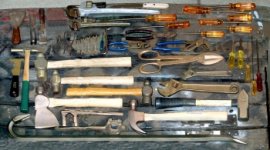
I have quite a set of non sparking tools.
Cu / Be +_ 2% Not Magnetic, copper color, tarnishes browner than pure copper. Made by NGK Berylco & others. Hardest non-ferrous alloy. Best for cutting tools. Safe to work in chip-producing operations, but definitely NOT in dust producing ones. Never grind, buff or wire brush, except in dedicated industrial equipment. It isn't nearly as scary as pure Be or aerospace light alloys, but don't tempt fate. NGK Berylco offers a low cost or free sharpening service, or at least used to. MRI safe.

Aluminum Bronze (Ampco Metal) Cu with Al & Ni, Pinkish bronze when new, tarnishes like an old penny. Naturally by Ampco, but not the old auto electric parts company of the
same name. Can be machined & finished with ordinary precautions for copper based metals. Not quite as hard, fine for wrenches, etc. A few Ampco tools, such as pipe wrenches DO have BeCu jaws or inserts. MRI safe.

Aluminum, just plain alloy aluminum. Often with BeCu jaw inserts in pipe wrenches. MRI safe. Some non-spark tools are made of other (common)brasses and bronzes as well, especially hammers.

Manganese bronze, light greenish gold when new, tarnishes like brass, no longer favored. It is unusual, a copper based alloy that is somewhat magnetic. I have an old Hinsdale wrench in this material and a couple of ball-peen hammers. Working precautions like Ampco metal. NOT MRI safe.
 

Attachments

  • non spark_s.jpg
    non spark_s.jpg
    81.2 KB · Views: 87

toolmaven

Well-known member
Joined
Feb 28, 2008
Messages
72
Location
New Jersey
Thanks! Actually that was several years ago, I've added a big monkey wrench, 18" & 36" line up bars & a 1/4" drive socket set since then. I bought the hatchet, tin snips & hammer direct from Berylco when they moved these item from "stock" to special order only. I wasn't going to get the hatchet, but it was down in normal steel tool price range. If I ever have to use it, it would probably be in an emergency situation involving flammable liquids.
I could see it being used to quickly shape a wooden plug for a leaking drum or tank. I use the tin snips in my science classes. After showing the kids normal steel snips cutting copper, I use the BeCu snips to cut sheet steel. Then I ask them "How is this possible?" In this way I open the discussion about metal elements and alloys.
 

Steinmetz

Well-known member
Joined
Oct 11, 2012
Messages
2,274
Location
Washington State
I picked up an unusual Berylco hammer a few months ago, and before I did my usual wire wheel clean up, I decided to look it up on the web. Turns out that it is made out of berylium (hence Berylco), a carcinogenic metal.

Berylco tools are extremely expensive. The main use for such tools is that they do not spark when they strike other metallic objects.... Not a bad idea when working inside gas pipelines or missile silos.

The factory strongly advises against any attempts to wire wheel, sharpen, scrape, or otherwise cause fragments or particles to be released into the working environment. The company apparently offers a free lifetime resharpening service for Berylco tools with cutting edges.

I have seen several references to Berylco tools in GJ, including an earlier post in the "Tiny Tools" thread. None made any reference to the hazards. All seemed to describe the tool as being made out of brass.

I decided not to give an adjustable wrench to my nephew because his two young children might have access to it. Please keep this in mind if you come across any Berylco tool or similar non-sparking tool you believe made be made out of brass. Maybe it is, maybe it isn't.

Dan
Indio, CA
A beryllium copper alloy. Not beryllium.
 

Exceller8

Well-known member
Joined
Jul 19, 2012
Messages
2,337
Location
Banning, CA
Man, I wish I would have seen this sooner. I cleaned up a couple of those wrenches on a scotchbrite wheel a few months ago. What now?
 

neophyte

Well-known member
Joined
Apr 23, 2012
Messages
9,576
Location
Pennsylvannia
Has anybody ever run across Beryllium Copper drill bits? I read a reference to them once but I haven't seen them offered from any of the specialty companies that specialize in Beryllium Copper and Non-Sparking tools. I've checked Ampco, Berylco, Carltsoe, and Beta Tools.
 
Last edited:

neophyte

Well-known member
Joined
Apr 23, 2012
Messages
9,576
Location
Pennsylvannia
Has anybody ever run across Beryllium Copper drill bits? I read a reference to them once but I haven't seen them offered from any of the specialty companies that specialize in Beryllium Copper and Non-Sparking tools. I've checked Ampco, Berylco, Carltsoe, and Beta Tools.

Nevermind, Ega-Master seems to offer Beryllium Copper drill bits. I'm still wondering if anybody has ever used them though.
 

glenmore

Well-known member
Joined
Nov 18, 2008
Messages
1,351
Location
Los Angeles
For you estate/garage sale guys, PING made a BeCu putter that seems to be quite collectible, over $100 on ebay. When you take a break rooting thru the garage for tools, check out the old golf bag.
 

toolmaven

Well-known member
Joined
Feb 28, 2008
Messages
72
Location
New Jersey
Exceller8,

You'll be dead within . . .Oh, too late! Not really. Now Copper-beryllium is a better description, than the common "BeCu", since the Be is generally less than 2% and is not nearly as likely to cause beryllium diseases as pure or high-percent aerospace alloys.

Not everybody exposed in industry, even before they knew better, progresses to true beryllium disease. Probably some genetic predisposition involved. Other factors, too. Do you mask-up when you buff things? Do you smoke? That harms the lung's self cleaning mechanisms. How is your general garage/shop ventilation?

I'd discuss it with my doctor if I thought I got a big exposure to any nasty chemical. I had my doctor add lead check to my last blood test after stripping some old paint. (No problems found, whew!) If you have any respiratory symptoms that don't go away, I'd mention them at my next check-up or sooner.
 
Last edited:

WWIIjeep

Well-known member
Joined
May 30, 2012
Messages
1,240
Location
Arizona
Now Copper-beryllium is a better description, than the common "BeCu", since the Be is generally less than 2% and is not nearly as likely to cause beryllium diseases as pure or high-percent aerospace alloys.

That may be a better description of the actual content, from most to least, but it's not how most industrial metallurgical alloys are named. The minor alloy element(s) almost always precede the predominant element in the common name.

Examples:

Beryllium copper
Aluminum bronze
Phosphor bronze
Manganese bronze
Silicon bronze
Carbon steel
Nickel steel
Tungsten steel

So, saying "copper beryllium" implies that beryllium is the predominant element, which it's not.
 

Kevin54

MEMBER EMERITUS
Joined
Jan 12, 2005
Messages
29,341
Location
Urbana, Ohio
Has anybody ever run across Beryllium Copper drill bits? I read a reference to them once but I haven't seen them offered from any of the specialty companies that specialize in Beryllium Copper and Non-Sparking tools. I've checked Ampco, Berylco, Carltsoe, and Beta Tools.

Nevermind, Ega-Master seems to offer Beryllium Copper drill bits. I'm still wondering if anybody has ever used them though.

For you estate/garage sale guys, PING made a BeCu putter that seems to be quite collectible, over $100 on ebay. When you take a break rooting thru the garage for tools, check out the old golf bag.

Exceller8,

You'll be dead within . . .Oh, too late! Not really. Now Copper-beryllium is a better description, than the common "BeCu", since the Be is generally less than 2% and is not nearly as likely to cause beryllium diseases as pure or high-percent aerospace alloys.

Not everybody exposed in industry, even before they knew better, progresses to true beryllium disease. Probably some genetic predisposition involved. Other factors, too. Do you mask-up when you buff things? Do you smoke? That harms the lung's self cleaning mechanisms. How is your general garage/shop ventilation?

I'd discuss it with my doctor if I thought I got a big exposure to any nasty chemical. I had my doctor add lead check to my last blood test after stripping some old paint. (No problems found, whew!) If you have any respiratory symptoms that don't go away, I'd mention them at my next check-up or sooner.

The largest hazard with beryllium copper comes from airborne particles (breathing the dust). Where I worked, quite a few of the electrical components had to be sanded to fit. And on top of that, it was in and enclosed room. A few years back when the Safety Nazi's really started to checking into things, they found the hazards associated with BeCu. So the room where the sanding was done had to have and air exchanger that went through a filtration system, plus the guys doing the sanding had to "suit up" with a Tyvek suit and a filtration mask. Was it overkill? Some say it was and that the hazards are blown out of proportion. Myself, I look at it as an inconvenience having to suit up, but definitely not overkill. A lot of the hazardous chemicals can enter your system through pores of your skin just as easily as entering your system through your lungs.

I know that with all of the stuff my dad breathed in and all that he absorbed through his skin didn't do him any good. He made it to the ripe age of 95, but he fought with COPD and emphysema for many years because of smoking for one, but with also breathing paint fumes, messing with lead for years as he was a bodyman, and also with Bondo dust.

So it's better to be safe than having to pay the price later on down the road.
 
To avoid these ads, REGISTER NOW!
Top Bottom