

You are using an out of date browser. It may not display this or other websites correctly.
You should upgrade or use an alternative browser.
You should upgrade or use an alternative browser.
Best Budget Mini-mill?
- Thread starter Gore
- Start date
manwithtools
ALLIANCE MEMBER
Sherline's are cute little machines and have their place, but they are even smaller than the Sieg mills. If the Microlux (Micro Mark) mini-mill your family member has comes with some tooling for $500, it's probably a decent place to get started. Post #27 in this thread is very accurate and describes exactly what I went through with a mini-mill before moving on to round column Rong-Fu and then to a square column CNC machine. It's all a learning process, but you have to start somewhere.
Last edited:
ptschram
Well-known member
Buy the mill from your family member. Keep in mind that part of the reason you're not finding much on the used market for small mills is that EVERYONE wants a small mill and they either go quickly or they are sold before the current owner knows he wants to sell it.
That said, I have a micro-mill as I said and I keep it in my main shop for more precise drillpress duties and the occasional small, light mill job that I don't want to wrestle the knee mill to do.
W/R/T buying used, be careful and read the small print. many auctions require you to use their riggers OR to hire riggers with huge insurance and such. All of a sudden, your inexpensive mill got VERY expensive to move!
Next, with used, you really don't know what you have until it's home and you've had time to tear into it. If you do find a major problem, you typically have no recourse. With a new machine, there is hopefully a vendor that will back up their product, if nothing else, with repair parts-this is also handy for newbies. I know I broke a lot when starting out. In spite of having training and having worked as a machinist, I do things differently at home and have completely different constraints at home-mainly time and these sometimes lead to taking shortcuts or pushing harder than one would in a commercial environment.
Buy the mill from your family member, buy a handfull of mills (carbide only, it took me many years to learn this), a clamp set (I kick myself for buying the vise as I use it so rarely and thought I'd never use the toe-clamps and they get used every day!) and start making chips.
W/R/T AR lowers, I know I catch Hell for this here, but once I realized what they are supposed to look like, I only use the jig as a rough guide for my lay-out and I lay them out using a surface plate, height gauge, a 1/4" drill rod with a point on it and have had much better success than with the jig.
Measure twice, go slow
That said, I have a micro-mill as I said and I keep it in my main shop for more precise drillpress duties and the occasional small, light mill job that I don't want to wrestle the knee mill to do.
W/R/T buying used, be careful and read the small print. many auctions require you to use their riggers OR to hire riggers with huge insurance and such. All of a sudden, your inexpensive mill got VERY expensive to move!
Next, with used, you really don't know what you have until it's home and you've had time to tear into it. If you do find a major problem, you typically have no recourse. With a new machine, there is hopefully a vendor that will back up their product, if nothing else, with repair parts-this is also handy for newbies. I know I broke a lot when starting out. In spite of having training and having worked as a machinist, I do things differently at home and have completely different constraints at home-mainly time and these sometimes lead to taking shortcuts or pushing harder than one would in a commercial environment.
Buy the mill from your family member, buy a handfull of mills (carbide only, it took me many years to learn this), a clamp set (I kick myself for buying the vise as I use it so rarely and thought I'd never use the toe-clamps and they get used every day!) and start making chips.
W/R/T AR lowers, I know I catch Hell for this here, but once I realized what they are supposed to look like, I only use the jig as a rough guide for my lay-out and I lay them out using a surface plate, height gauge, a 1/4" drill rod with a point on it and have had much better success than with the jig.
Measure twice, go slow
Last edited:
JustinS
Well-known member
Following this with interest, let us know what you pick up.
Jawn
Well-known member
buy a handfull of mills (carbide only, it took me many years to learn this)
What's your reasoning for this? I thought conventional wisdom was that HSS was better if you didn't have lots of mass/rigidity/speed with your machine.
What's your reasoning for this? I thought conventional wisdom was that HSS was better if you didn't have lots of mass/rigidity/speed with your machine.
I would go with HSS. Carbide is brittle. Especially for a beginner, it is easy to break. If you damage HSS, you can touch it up with a file.
ptschram
Well-known member
What's your reasoning for this? I thought conventional wisdom was that HSS was better if you didn't have lots of mass/rigidity/speed with your machine.
They all break the same.
Quite frequently encounter harder materials than I expect. Using Carbide, I don't have much problem with these materials.
manwithtools
ALLIANCE MEMBER
What's your reasoning for this? I thought conventional wisdom was that HSS was better if you didn't have lots of mass/rigidity/speed with your machine.
Agreed...rigidity is key when using solid carbide. Speeds and feeds are important as well.
Jawn
Well-known member
They all break the same.
Quite frequently encounter harder materials than I expect. Using Carbide, I don't have much problem with these materials.
Good point on the hardness of work materials. I had tried some 1/8" and 3/16" carbide end mills due to price and availability with some success and some failure, but was not sure if I should consider larger carbide end mills as well. I'm working with one of the HF mill/drills (Jet JMD-18, Rong-Fu RF31 equivalent).
Learning experience... By the numbers, the 1/8" should be run stupid fast... well above the ~2500rpm my machine's capable of. But I tried it, and when I got a bit too heavy on the depth of cut, the end mill suddenly disappeared leaving a broken-off stub in the collet. Made lighter cuts and successfully cut a 1/8" keyway in a 1/2" shaft of 4130.
BajaScout
Well-known member
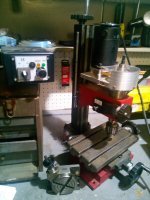
Picked up this mini mill a couple years ago. Got the mill and a Micro Lathe II Model 4500 for $200. Came with a bunch of tooling too. I bought it from a guy I worked with. He was moving to the east coast and did not take it with him. His hobby was model railroading. I could not find a model number on the mill. From internet research I think I have a Sieg X1. My unit also has an external box that controls the voltage and polarity to the DC motor on the mill. That seems to be very unique.
My goal is to learn about using a mill. My dad was a machinist in his early years working for companies such as Chrysler (Detroit), Rocky Flats (Colorado) and General Dynamics (here in San Diego). If he were still here, I would be asking him.
I would appreciate any advice where a newbie should start out learning the basics. Also anything you may note about my mill. Most of the tooling appears to have come from LittleMachineShop.com as it it still in the boxes. If I knew exactly what I had, I would make a list. I honestly know nothing about machining. I have found quite a few videos on the internet, but really want to use a site that has good information and does not teach me bad habits.
These machines have sat on my workbench for 2-3 years, so I need to either use them or get rid of them. Figured I would try to learn a new skill.
My goal is to learn about using a mill. My dad was a machinist in his early years working for companies such as Chrysler (Detroit), Rocky Flats (Colorado) and General Dynamics (here in San Diego). If he were still here, I would be asking him.
I would appreciate any advice where a newbie should start out learning the basics. Also anything you may note about my mill. Most of the tooling appears to have come from LittleMachineShop.com as it it still in the boxes. If I knew exactly what I had, I would make a list. I honestly know nothing about machining. I have found quite a few videos on the internet, but really want to use a site that has good information and does not teach me bad habits.
These machines have sat on my workbench for 2-3 years, so I need to either use them or get rid of them. Figured I would try to learn a new skill.
Attachments

Very nice micro mill. The Hobby-Machinist forum is the place to learn. No intimidation just friendly machinists and beginners helping each other out. Tons of downloadable training material. I'm a premium member there. Great forum for learning.
http://www.hobby-machinist.com/
For parts and tooling The little machine shop has everything from parts to machines to tooling and support and downloads.
http://www.littlemachineshop.com/
Roy
http://www.hobby-machinist.com/
For parts and tooling The little machine shop has everything from parts to machines to tooling and support and downloads.
http://www.littlemachineshop.com/
Roy
BajaScout
Well-known member
Very nice micro mill. The Hobby-Machinist forum is the place to learn. No intimidation just friendly machinists and beginners helping each other out. Tons of downloadable training material. I'm a premium member there. Great forum for learning.
http://www.hobby-machinist.com/
For parts and tooling The little machine shop has everything from parts to machines to tooling and support and downloads.
http://www.littlemachineshop.com/
Roy
Roy, thanks. Submitted my registration for Hobby-Machinist. Same user name BajaScout. Looks like they don't mind if you do not know anything about machining.