

You are using an out of date browser. It may not display this or other websites correctly.
You should upgrade or use an alternative browser.
You should upgrade or use an alternative browser.
Best Casement Windows?
- Thread starter NWOhioChevyGuy
- Start date
OP
NWOhioChevyGuy
Well-known member
What adjustments are you trying to achieve?I'm dealing with Pella Casement window aggrrivation as we speak. Very little adjustment built in. I'd look elsewhere knowing what I know now.
Properly installed I don't understand what would require adjustment.
Triple pane with Slimshades are heavy, add humidity, seasonal movement and wear. These are variables that occur in real life and there should be adjustments built in to compensate for some of these things. There are better options out there in my opinion with smart adjustability built in. Pella spent a long time being the best. While Other companys focused heavily on innovation to put out better products, Pella was busy resting on their laurels and stuck in the past barely improving on the same old designs using the same old materials. As I said I will look elsewhere in the futureWhat adjustments are you trying to achieve?
Properly installed I don't understand what would require adjustment.
OP
NWOhioChevyGuy
Well-known member
Moving closer at doing the Pella Impervia's.
Bonus is I can buy these directly and get contractor pricing from Pella.
Currently waiting on that quote.
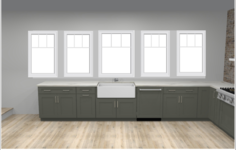
4 Casements (48" x 30") & 1 larger Awning (48" x 36") window in the center.
Bonus is I can buy these directly and get contractor pricing from Pella.
Currently waiting on that quote.
4 Casements (48" x 30") & 1 larger Awning (48" x 36") window in the center.
rerod
Well-known member
I'm also looking for casements or awning windows for my country home, but several years ago I considered replacement inserts for my house in town until I called a dealer. The salesman used aggressive sales tactics, like a price that was only good for 24 hours, endless calls etc.. Not impressed.
Anyway, Ive been reading at replacement windows dot com, which is a great window forum.
Things Ive learned there..
"Most pro’s view pella impervia as being subpar, specifically when it comes to air infiltration ratings."
"Silverline 2000 series by Andersen is junk, so is Pella vinyl and alside"
"Research your own state energy agencies"
Some of the recommended windows there are: Soft-Lite, Sunrise Vanguard, Highmark/Okna 500, Vytex Fortis, Polaris, Marvin, milgard, gorell..
Anyway, Ive been reading at replacement windows dot com, which is a great window forum.
Things Ive learned there..
"Most pro’s view pella impervia as being subpar, specifically when it comes to air infiltration ratings."
"Silverline 2000 series by Andersen is junk, so is Pella vinyl and alside"
"Research your own state energy agencies"
Some of the recommended windows there are: Soft-Lite, Sunrise Vanguard, Highmark/Okna 500, Vytex Fortis, Polaris, Marvin, milgard, gorell..
OP
NWOhioChevyGuy
Well-known member
We have ordered the Pella Impervia's
We were able to order them directly from Pella (as the contractor, since we are doing the work ourselves) which saved us around 45% on MSRP.
Delivered to my doorstep at no extra charge.
I put Marvin vinyl windows in my garage build and was less than impressed.
For our area these were the best value for the $ in a fiberglass window.
We were able to order them directly from Pella (as the contractor, since we are doing the work ourselves) which saved us around 45% on MSRP.
Delivered to my doorstep at no extra charge.
I put Marvin vinyl windows in my garage build and was less than impressed.
For our area these were the best value for the $ in a fiberglass window.
dcg9381
Well-known member
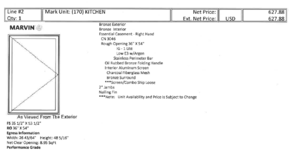
We bought Marvin Essentials (Fiberglass). Neighbor is a builder that does a lot of 1-5M homes. These are the windows in his home also.
This was 2020 pricing though, casement unit.
This was 2020 pricing though, casement unit.
MushCreek
Well-known member
I didn't even know that Marvin made vinyl windows.
OP
NWOhioChevyGuy
Well-known member
I thought they were Marvin's but I maybe mistaken.I didn't even know that Marvin made vinyl windows.
Anyways, I had 4 different Fiberglass companies quote my windows and Pella was the best deal.
We also were able to go to their showroom in Plymouth, MI and put hands on them.
This was not the case with all of the mfg's.
MushCreek
Well-known member
Yeah, part of the reason I went Marvin on our house was due to an excellent dealer close by.
rerod
Well-known member
That's usually the kicker.. Pella and Anderson are strong around Iowa, but the pro's on that forum don't care for them.Yeah, part of the reason I went Marvin on our house was due to an excellent dealer close by.
What Im learning is some companies try to "win the window sticker game" by sending samples to NFRC with for example, 6 coats of low E or something ridiculous to make the sticker numbers look better.. Why even have NFRC stickers if a company can manipulate the results in their favor?
All I can say is what a deceptive industry. One story of windows showing up without NFRC stickers and the owner told they blew off en-route.. Basically buying something, but receiving something else.
Last edited:
I'm also looking for casements or awning windows for my country home, but several years ago I considered replacement inserts for my house in town until I called a dealer. The salesman used aggressive sales tactics, like a price that was only good for 24 hours, endless calls etc.. Not impressed.
Anyway, Ive been reading at replacement windows dot com, which is a great window forum.
Things Ive learned there..
"Most pro’s view pella impervia as being subpar, specifically when it comes to air infiltration ratings."
"Silverline 2000 series by Andersen is junk, so is Pella vinyl and alside"
"Research your own state energy agencies"
Some of the recommended windows there are: Soft-Lite, Sunrise Vanguard, Highmark/Okna 500, Vytex Fortis, Polaris, Marvin, milgard, gorell..
That forum is full of a lot of rather interesting and outdated information
Air infiltration rating of Pella Impervia as "subpar"....ok let's compare it
Air infiltration in the US is tested per ASTM E283, and for residential product with a performance grade of R thru CW is tested at 1.57 psf which is an approx 20 or 25 mph wind equivalent and allowable leakage is up to .3 cfm/sqft. You want the smallest leakage number possible as you're measuring the qty of air getting thru. So if there is a standard, and manufacturers all test to it...should be easy to see how some of the major brands stack up against each other?
Marvin Essential Casement: They're not making a specific air leakage claim here it appears. But their Performance Class of LC means it's less than .30

Andersen 100 Series: Claiming less than .20

Pella Impervia: Claiming .05

Now yes, this is just a spot check of 1 product type (Casement) and 3 total companies, however they are the 3 largest composite(Andersen) or Fiberglass(Marvin and Pella) brands out there available in the US. So a deeper dive may bring up other data points that could support or refute this...but it's not supporting the position above of Impervia leaks more...in fact this shows it has the lowest claimed air leakage.
"Silverline 2000 series by Andersen is junk, so is Pella vinyl and alside"
Silverline was sold by Andersen in 2018...so the statement being 6 years out of date doesn't help it's credibility on the surface...
Somewhere between 60-70% of the window units sold in a given year in the US will be vinyl, so whether one likes it or not, it's the predominant material type by a long ways.
The window market is highly fragmented and very regional...but so is the US climate. What is needed from a performance and aesthetic standpoint in Boston is very different then Atlanta and is vastly different then Phoenix or Portland. Because of these differences, it's challenging for vinyl products to be successful with the same design everywhere. So the market has been "regionalized" with small companies focusing on a particular region/couple of states or larger companies trying to cover more of the country with different offering/designs for different areas. The aesthetics and installation needs of Southern California are different than Wisconsin, but both have vinyl windows commonly used...but not the same design/features/performance.
A window that is "good enough" for a southern market where it doesn't get cold often and energy prices are cheap doesn't do well in the north...and vice versa a triple pane, highly thermally efficient product designed for northern climates will be 3x the price of a basic slider or hung unit in Texas...either way they're both the wrong product for that market. Hence...a fairly fragmented, regionalized approach to design and mfg has come about.
"Research your own state energy agencies"
A valid point, however energy requirements and building codes aren't always a state level thing. In many areas, this can be a city, county or state item that drives thermal performance requirements. Recently enacted Energy Star v7 requirements can also throw a wrench into things as well if the consumer is trying to get certain tax credits, rebates or utility company refunds. But yes, an educated consumer knowing what they're getting and what any applicable building code requirements are is a good thing
Some of the recommended windows there are: Soft-Lite, Sunrise Vanguard, Highmark/Okna 500, Vytex Fortis, Polaris, Marvin, milgard, gorell.
- Soft-Lite: Really only a player in the replacement vinyl space in Ohio and surrounding areas. Was also bought by Harvey Building Products in 2016, and Harvey was just actually purchased by Cornerstone Building Products last month....so unknown how long this name will exist and what the legal standing of the warranty on existing product is
- Sunrise Vanguard: Again, bought by someone else (MI) in 2020, which was then paper "acquired" by Miter Brands which was the parent company they created to hold their planned window/door/other related companies...you'll hear this name again
- Okna: Not very familiar but it means Window in Polish, there are several different companies using various spins of that word in their name. Appears to be a very regional vinyl window company based in PA. Not a lot on their website of the technical details/downloads/cross sections to evaluate
- Vytex-Another regional vinyl window company, this time in Maryland
- Polaris-Slightly larger vinyl window company, broader distribution, similar designs and offering to all the rest of the vinyl window players
- Marvin-The largest of the players in their "recommended" list by a long shot and the only one with a national presence
- Milgard-Used to be the major player in the west, little if any recognition or presence east of the Rockies. Sold off a couple years ago to the previously mentioned Miter Brands as they work to build a collection of brands with relevance/market share in all major areas. Offering is going to be up in flux for awhile as they figure out their new market position
- Gorell-Sold to Soft-lite in 2012 as a causality of the housing crash, Softlite as mentioned above was then sold 2x more after that...
I didn't even know that Marvin made vinyl windows.
They don't. Essential is fiberglass which is a different material type/categorization then vinyl
rerod
Well-known member
That forum is full of a lot of rather interesting and outdated information
The fact they're touting that many brands which have been bought, in several cases multiple times over the past decade...some of which have been dead for that long would make many people question the validity/accuracy of some of the information.
That forum is the only one I could find about windows, and seemed to have a knowledgeable moderator and installers giving advice to consumers.
Id like a little more than just consumer Joe stating he likes his brand X forgetting to mention which series. But when they do, Ive searched brand X, and you might find discussions back to 2004 when it started. No reason to question validity/accuracy, other than being outdated.
Do you have any recommendations for windows that excel at minimizing air leakage in windy Iowa? Or another forum that's more valid and accurate? Thanks loganb..
MushCreek
Well-known member
It would be even more useful to see the performance of a particular window after 5 or ten years.
Do you have any recommendations for windows that excel at minimizing air leakage in windy Iowa?
Great question...and I've got a position that is slightly controversial in some places:
-What product type(hung, casement, slider etc) and how it's installed matters more then what brand you install
First off: What Type
When air leakage/air infiltration is a concern, the general recommendation will be to look for direct set fixed types(as opposed to sash set) and for venting windows use hinging product instead of hung or sliding windows.
The benefit of a "direct set" type window where the glass is glazed directly to the frame vs a "sash set" where it's set in a sash that is then attached to the frame is you have fewer seals/potential leak points. Below is an image of the Pella Impervia Direct Set:

This particular type is also in more demand now due to the aesthetic push for "more glass" as this offers slimmer sightlines since you don't have a sash. Most manufacturers will have a product like this, while also having a "fixed sash" or "sash set" product so that the sightlines line up with venting product that may be close by when that is prioritized over more glass.
For venting windows, again the key part is improving the seal between sash and frame and generally speaking, hinged or projecting windows do that better then product that slides. This is primarily driven by the types of seals used on the 2 products.
For windows sashes that slide, the common design is 1 to several layers of mohair/bristle type strips are generally used as it has to allow the sash to pass by, below is an image from an Andersen 100 Series Single Hung and I circled the mohair strip as an example

Even with some interwoven nylon/plastic layers in that mohair, it's still very challenging to get as good of an air seal on that type of a weatherstrip vs a bulb or leaf gasket, however the sliding nature of the product makes bulb/leaf gaskets harder to use with negatively impacting operational force. Below is a Marvin Essential casement detail showing how it has (2) different bulb gaskets that will compress as the sash pulls in, helping to seal the product.

In short....where possible...use fixed. Where not, use casement/awning over hung/sliders.
Should note, there are some European designs becoming a bit more common in the US, specifically tilt-turns, hoppers, inswing casements. These Euro designs or Euro inspired designs are generally very good at air infiltration, however the challenge is they're generally exceptionally expensive and distribution can be tough when you're looking at residential projects. The northeast area of the US will have more options to get these products in residential projects as the push for higher energy performance houses is strongest there...in Iowa I'm honestly not sure where you may be able to find some of those short of ordering online for delivery and hoping it works out. Some companies, for example Intus windows are doing these with a heavily reinforced vinyl product and getting good published performance and using them in a lot of mid-rise structures (up to say 30 stories) in the northeast. The product is built in Poland or the Czech Republic I believe and shipped over on boat, but when buying hundreds of them they can make the logistics work better. A showroom in the Boston area that has some of this style of product is: https://eas-usa.com/. One of the more popular YouTube builder channels The Build Show recently visited it and walked thru some of the products:
For installation...it gets far less attention then it should on the jobsite. Most "my window *****" complaints/comments/feedback are due to the installation, not the product. Most common sins I see in no particular order (and I am in the window business on the design/mfg side):
- Shims-Omitted or not used properly, they're important and have multiple purposes...especially on venting product they need to be used and used per mfg instructions for that product
- Fastening-wrong fasteners, not enough fasteners, installed improperly(set with nail gun too deep)....the list goes on
- Flashing/sealing: Again...carefully read the mfg instructions on how to properly flash/seal the window to the weather barrier on the wall (assuming new build). The defacto standard residential installation in new construction of Tyvek HouseWrap or similar sheet type weather barrier and a nail fin is done wrong on half the jobsites I see.
- Interior seal: Get rid of the spray foam if you're really wanting low air leakage numbers, the interior seal needs to be properly installed backer rod and caulk. It performs superior to low expansion foam from an air infiltration basis, but is more labor intensive which means more costly so less common. Staying on videos from The Build Show...see an example of this below:
As for sources of information, when looking at better trying to understand and manage air infiltration, it's really getting into the field of Building Science. For lack of a better title, the link below is for who is widely considered the "father" of the current field of building science today, Joe Listburek and Building Science Corporation:
Home Page | buildingscience.com
 buildingscience.com
The amount of info out there is substantial, but most everything out there about modern building science, design etc is directly from or based on the work he and his colleagues have done. Other places or search terms to find more information on some of the application of this....Green Building Advisor, Passive House US (www.phius.org),
jar944
Well-known member
.
Should note, there are some European designs becoming a bit more common in the US, specifically tilt-turns, hoppers, inswing casements. These Euro designs or Euro inspired designs are generally very good at air infiltration, however the challenge is they're generally exceptionally expensive and distribution can be tough when you're looking at residential projects.
I know of a couple shops building tilt and turn, and one offering training on building tilt and turn windows. Rangate (US) sells the tooling required.. So if someone was inclined, motivated and financially irresponsible..
I prefer the look of continental type in swings myself.
I know of a couple shops building tilt and turn, and one offering training on building tilt and turn windows. Rangate (US) sells the tooling required.. So if someone was inclined, motivated and financially irresponsible..
Dang....hadn't ever looked at their site...that's a fun rabbit hole....very sure I won't be dropping $14k on their FlexSet cutters!
jar944
Well-known member
Dang....hadn't ever looked at their site...that's a fun rabbit hole....very sure I won't be dropping $14k on their FlexSet cutters!
Yeah, lots of interesting things there. And here https://www.whitehill-tools.com/window-tooling/
MushCreek
Well-known member
I love our casements, because we are surrounded by woods, so no curtains on the windows. They offer a clear, unrestricted view. If you plan it right, you can open certain ones to catch the breeze. The downsides are that you can't leave them open in the rain, and they are a hazard for people walking near the house when they are open. Our windows are all well off of the ground, so that's not an issue. We have three double-hungs across the front for the old-timey look, but the casements have a much better view.
paredown
Well-known member
The 'newcomer' in our area is Kolbe, offering Euro style windows, but they are pricey. They seem to be de rigeur for the fancy beach houses out in the Hamptons...
I'm not sure if they are in wide distribution or not:

 www.kolbewindows.com
I'm not sure if they are in wide distribution or not:
Kolbe | Luxury Windows & Doors
At Kolbe, our windows and doors are best known for superior quality, custom craftsmanship, attention to detail, as well as innovative and unique designs.
The 'newcomer' in our area is Kolbe, offering Euro style windows, but they are pricey. They seem to be de rigeur for the fancy beach houses out in the Hamptons...
I'm not sure if they are in wide distribution or not:
Kolbe | Luxury Windows & Doors
At Kolbe, our windows and doors are best known for superior quality, custom craftsmanship, attention to detail, as well as innovative and unique designs.
Kolbe is fairly widely distributed, but not as common as their target market is the premium/custom higher end homes so you don't find them at big box stores. Based in Wisconsin and around for 75+ years, they're another of the major, US based window and door companies who started in the upper midwest/great lakes-ish region
That's usually the kicker.. Pella and Anderson are strong around Iowa, but the pro's on that forum don't care for them.
What Im learning is some companies try to "win the window sticker game" by sending samples to NFRC with for example, 6 coats of low E or something ridiculous to make the sticker numbers look better.. Why even have NFRC stickers if a company can manipulate the results in their favor?
All I can say is what a deceptive market. One story of windows showing up without NFRC stickers and the owner told they blew off en-route.. Basically buying something, but receiving something else.
Is there some bait and switch going on with less ethical companies...probably but that's the case with any industry where someone thinks there is money to be made. For the well known brands with long histories....not a ton of gain to attempt to cheat the system for the huge amount of risk
Thermal certification of the products is a bit of a rabbit hole...but at a high level
In the US(and Canada generally follows the same process just with different units of measure), the National Fenestration Rating Council(https://nfrc.org/) is the primary group that administers/manages the thermal performance standards for fenestration elements...aka windows, doors, skylights etc. The standards NFRC 100, 200 and 300 are the primary standards of which applicable products are rated by.
NFRC 100: U-Factor or thermal performance
NFRC 200: Solar Heat Gain Coefficient (SHGC), how much solar energy will pass thru the window
NFRC 300: Visible Light Transmittance (VT or VLT): How much light will pass thru
Generally speaking, the design engineers for the manufacturer will work to figure out what the needed design to hit the target performance values based on the product/marketing specification for the market the product is intended to tackle. Pretty standard process for any company
For thermal performance values, we run the designs thru the software, per all applicable standards to get the resulting values...aka the U-Factor, SHGC, VLT etc based on the design of the product which includes the glass/coating package being used. Quick pause here on this part. The choice of the "glazing package" which includes glass pane thickness, spacer thickness, coating(s) being used, gas fill etc makes up around 60-70 % of the resulting U-Factor of the window for your average residential product. This means that glass/glazing solution is critically important to the resulting performance of the entire unit.
Once a manufacturer has finalized their design and all the associated requirements, they have to submit all the "stuff" to a 3rd party, independently certified validation company who will then basically "redo" all the thermal analysis work for the U/SHGC/VT values to provide checks and balances for the consumer that the values were properly calculated and nobody is cheating. Both parties are using the same software, but based on some assumptions occasionally results may differ in which case you then get to work out which set of assumptions is right. The important thing here is that an independent, 3rd party validation company is the final say on what the performance values are, and it's not just the manufacturer saying "trust me bro" on the performance claims. The values that show up on the labels that get shipped with the window/door can also be independently validated by the consumer on a public website...but that's a bit tangential on an already length comment.
So back to performance of windows:
As performance requirements get stricter, the usage of more "exotic" or higher performance coating packages has become common and in some geographic markets even required. It's important to note it is not the manufacturer's pushing this...it's the end consumer by the way of building code requirements, tax credits, and in some narrow niches the desire for better performance/net zero type goals.
The coatings being used are Low Emissivity or LowE/Low-E for short where it manages the solar/UV rays to get the desired end result. They can be configured to have low Solar Gain(SHGC) which is better for cooling climates in the southern US where goal is generally to reduce cooling load, or it can be done for a "High Solar gain" more common in the north where extra solar heating is often desired due to a heating climate. Again this is a deep rabbit hole....more can be learned at:
Vitro(formerly PPG) who is a major/the major player in commercial glazing/coatings:

How Low-e Glass Works
What is low-e glass? Learn how low-e glass works and much more in the Glass Education Center by Vitro Architectural Glass.
Cardinal Corporation who is the major player in residential coatings/insulated glazings:
As building codes, Energy Star requirements, consumer demand continue to get tighter, the window/door market must respond. Due to the previously mentioned 60-70% of the thermal performance(U-Factor) coming from the glazing package....changes to the glass and or coatings are critical.
For the bulk of the product sold in the US, it's a dual pane insulated glass unit with (1) Low-E coating, generally on Surface 2 but sometimes on 3 as indicated in the image below from the above linked Cardinal Tech Glass Guide:
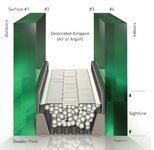
That LowE coating is typically made up of 1, 2 or 3 layers of a silver oxide coating that is "sputtered" onto the underlaying glass. As I'm most familiar with the Cardinal products and they're the bulk of the residential market, their "standard" coatings are below:
Cardinal 180: (1) coating of silver and gives 80% visible light transmittance, this is a high solar gain coating and generally used in heating climates(northern)
Cardinal 272 or 270: (2) coatings of silver and 70 or 72% visible light, this is a mid level coating that is likely the standard for most companies as it provides broad benefits for the bulk of the US
Cardinal 366: (3) coatings of silver and 66% visible light. This is a low solar gain coating, generally used in cooling climates/aka southern US or on southern exposure walls where less solar gain is desired
Additional gory details of these and their other offerings are in the above linked document
To meet the new Energy Star v7 guidelines enacted in Oct '23, many manufacturers gave consumers additional options where a "roomside" or Surface 4 LowE coating was added to improve the U-Factor of the window(making U-Factor lower). These manufacturers likely already offered some options with the Side 4 coating...but most all expanded it to meet the Energy Star v7 requirements and provide additional options.
From a glass only perspective, the U-Factor of a pretty typical Insulated Glass Unit(IGU) for a residential application is approximately 3/4" total thickness, with 1/8" (3mm) thick panes and a 1/2" airspace. Based on the table below, that U-Factor with no LowE is .48, however add basically any coating and it jumps to .30, add argon and it jumps to around .25. So the addition of almost any LowE coating on Surface 2 and argon to a dual pane IG doubles it's thermal performance.

The coatings have become such a common place item that for some companies it's not even a deduct/savings to not get it because that's how rarely it's done. The only time I see units without a LowE coating get ordered are in some extremely particular historic districts or for interior units
Now back to that roomside coating, the addition of that coating (Cardinal name i89) to the interior surface of the IG takes the same IG makeup from a .25 U value to a .20

So just by changing the coatings/gas fill, using the same insulated glass thickness the manufacturer can give the consumer a choice of performance from .48 down to .20 U-Factor without changing the product design/pieces/parts of the window/door itself. This helps to keep costs down for the consumer...so everyone wins there.
The challenge is that for dual pane windows, .20 U-Factor is about as good as it gets. Yes there are some ways to get that number a bit better here or there....but that's the effective functional limit for thermal performance in a dual pane product with current, consumer ready technology. So to get better, the cheapest way to accomplish that today is with triple pane...aka another piece of glass allowing an additional airspace to act as a thermal barrier and another option to add another LowE coating onto. When you do a triple pane with (3) coatings, you can get down to a roughly .11 U-Factor, or 2x'ing the performance value from that dual pane unit:
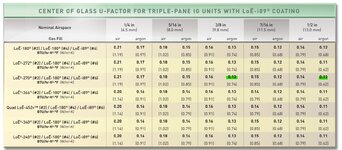
The challenge here is that the .11 U-Factor highlighted is now a very thick insulated glass unit...because you have:
1/8" thick exterior pane
1/2" airspace
1/8" thick middle pane
1/2" airspace
1/8" thick interior pane
For the non-math majors...that's 1-3/8" thick, and we said above a common thickness was 3/4"...yikes! Then as the window gets bigger...those panes have to get thicker. 1/8" thick panes are generally good for glass up to around 18 sq ft...as you get bigger pane thickness jumps up to 4mm, 5mm or 6mm...again making that total IG thicker.
This means that in order to accommodate that, there is probably some significant design changes that would have to occur....which is both costly and expensive. Those costs aren't going to be incurred without the expected positive financial paybacks....so either big sales volume has to happen as a result or price increases for that performance....or more likely a combination of both.
Now there are some products such as the above mentioned "fixed" or "direct set" product that can more easily(and often already does) have that thicker IG units in it for exceptional performance options, but on windows like hungs or sliders with multiple sashes it's challenging to get that thick of an IG into the frame. Your standard vinyl window has a total thickness of the frame from interior to exterior of 3" or 3-1/4"....not easy to get (2) piece of IG at 1-3/8" thick plus all the associated pieces to hold them in place, go up and down etc in that package. Make the frame deeper is an option...that then adds cost and window packages are one of the 1st things to get "Value engineered" in todays building environment...so yeah...what to do. Go back to the coating options and figure out just how much performance we can get out of the existing IG package...which normally means give consumers the options of additional coatings if they want better thermal values. When they want even better than dual pane....jump to triple pane....when want better then that....there are some quad pane and other super exotic stuff out there when budget and payback period aren't really in the priority bucket
It's also important to note that the values in the above charts are "glass only" U-Factors and not complete window/door values. The values you see on the window/door you order or what a manufacturer advertises is the complete "full unit" value and takes into account both the glass as well as the surrounding elements(sash, frame etc). That full unit U-Factor in todays world will be worse than the glass only value, so that .20 U-Factor for glass only could translate to a complete unit U-Factor of .23 to .27 U-Factor depending on what it's going in. That "full unit" U-Factor is what building codes, energy rebates, Energy Star etc is based on
So in summary:
Yes, more LowE coatings are becoming more common as the thermal performance requirements get tighter and require lower U-Factors.
Consumer demand/code requirement are pushing this. A manufacturer can offer something, but if the demand via consumer isn't there...it doesn't get bought (example...Fiat in the US). The demand/requirement here for the full unit window U-Factors less than .25 is largely being driven right now by Energy Star and building codes, "organic" consumer demand is there but very geographically driven
These additional coatings do offer improved performance as readily shown by thermal simulations which are backed up by full scale lab testing to validate the computer sim's match real life....so when you pay for more coatings, you're getting a better thermally performing product.
reader2580
Well-known member
Demand for higher efficiency windows is mostly driven by government regulations and energy tax credits. Some states, like Minnesota, have state energy codes requiring higher efficiency windows.
If consumers truly cared about the energy efficiency of windows they wouldn't be buying cheap sliding vinyl windows. Heck, I think big box stores still sell vinyl sliding single pane windows. I hope nobody is still buying those crappy single pane windows for a house. I bought one of those back in 2013 for a temporary food booth, but energy efficiency was not an issue.
If consumers truly cared about the energy efficiency of windows they wouldn't be buying cheap sliding vinyl windows. Heck, I think big box stores still sell vinyl sliding single pane windows. I hope nobody is still buying those crappy single pane windows for a house. I bought one of those back in 2013 for a temporary food booth, but energy efficiency was not an issue.
rerod
Well-known member
Thanks again loganb.Great question... First off: What Type
The benefit of a "direct set" type window where the glass is glazed directly to the frame vs a "sash set" where it's set in a sash that is then attached to the frame is you have fewer seals/potential leak points. Below is an image of the Pella Impervia Direct Set:
For venting windows, again the key part is improving the seal between sash and frame and generally speaking, hinged or projecting windows do that better then product that slides. This is primarily driven by the types of seals used on the 2 products.
In short....where possible...use fixed. Where not, use casement/awning over hung/sliders.
- Interior seal: Get rid of the spray foam if you're really wanting low air leakage numbers, the interior seal needs to be properly installed backer rod and caulk. It performs superior to low expansion foam from an air infiltration basis, but is more labor intensive which means more costly so less common. Staying on videos from The Build Show...see an example of this below:
As for sources of information, when looking at better trying to understand and manage air infiltration, it's really getting into the field of Building Science. For lack of a better title, the link below is for who is widely considered the "father" of the current field of building science today, Joe Listburek and Building Science Corporation:
Home Page | buildingscience.com
The amount of info out there is substantial, but most everything out there about modern building science, design etc is directly from or based on the work he and his colleagues have done. Other places or search terms to find more information on some of the application of this....Green Building Advisor, Passive House US (www.phius.org),
As far as that quote I posted saying "Most pro’s view pella impervia as being subpar, specifically when it comes to air infiltration ratings.", I found it here.. and he later says "I believe it’s a .2 (AL) and possibly a .22 which is horrible." so masterext must not be talking about the same window you referred to, or he is incorrect, but the other pro's didn't care to challenge .22..
Im sold on casements, but awning windows look better for shedding water and wouldn't catch the wind as much as casements. My local window store carries Kolbe's and I like how the Vistaluxe series combine a direct set pane with a hopper window in one unit, but wish they were awning instead because high winds should seal a awning/casement better than a inward opening hopper window IMO. I also like how the vistaluxe series are thermally broken aluminum windows because Im not sold on plastic.
Joe Listburek is a character.. Ive read allot of his material and watched what video's I could find while I was subscribed to Green Building Advisor years ago.. What I learned at GBA was most of the effort taken to build a super efficient home was all in the name of "comfort". They never claimed any payback or breakeven period, but only that the rich occupant would be comfortable when it was a windy negative 20 outside.
Im a function over form type who doesn't like wasting money on comfort or looks and Im not too proud to tape window shrink film on, but my existing windows are junk and need replaced. Maybe a frame suitable for shrink film tape should be one of my requirements? lol. I also learned at GBA that air sealing was just as important as R value. Maybe more so, is why Im trying to pay attention to the AL ratings. But I was just told that when looking at the NFRC sticker, it would either show nothing, or <0.3 AL, but nothing less than 0.3. They said .3 is like a car manufacturer stating their car gets 10 mpg.. If I really want to know the AL, I have to search the NFRC product identification number in the certified products directory to find all the data.
Again, thanks for such a detailed explanation, but I still haven't absorbed everything you've written, yet.
Last edited:
Dagny
Well-known member
Just wanted to add that if your HVAC guy does his job most windows will be fine. Indoor humidity problems can cause a lot of problems.
My Old Tools
Well-known member
After a lot of reading, I figured there is no payback for replacing functioning single hung windows. Our 20 year old AL windows were still fine, but some were fogging, none were Low-E, and they had the fake dividers that dated the house. We had all of the glass replaced with new Low-E IGU's. About 100 units including transoms for $16 000. The estimate for new windows was over $60,000. This house has 38 large single hung windows with transoms above all of them. Now to replace two French door units and two other glass doors.