Hey all,
Hopefully posting in this section is ok. I've got some questions about the mechanics as well as the tooling used.
I live in a new apartment style lving residence hall on a college campus. The building was completed this summer (summer 2012) but, the structure was up/enclosed by beginning of winter 2011.
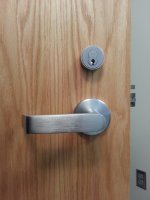
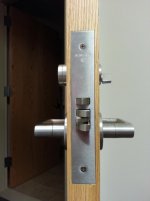
Well, they installed Schlage ff series door knobs that use Best Lock IC cores. Last week I got locked out of my bedroom without locking the door--no, they aren't automatic locking. Locksmith came and used a tool that had a cylinder looking side and a half-cylinder looking side (What is that tool!?). He tried his master key, my key and he said that it was unlocked but, the handle/mechanisms seems to still be locked. After pulling the core and fighting with the mech. with his cylinder tool, he said it's just not doing it. He was hoping to get extra leverage with that tool--didn't seem to work. Finally, he torqued on it and the mechanism broke free. I asked him if he'd ever seen it before and he said it was a first (and grumbled that they should have used deadbolts on the doors. That way you could at least manually retract it) but that he was going to look into it.
Today, however, the same thing happened to my roommates door except that he HAD locked it. He could unlock the core but, the handle still acted like it was locked. I tried and it showed the same problem as my door. It's like the handle is locked but the core isn't. New locksmith comes, does about the same thing, so I ask if HE had seen it and that my door had the same problem a week ago. He said not yet but, "I think we'll have problems with all of them. Usually a little lube frees them up and gets them back but, we'll see." This locksmith was a little rude and short but, the roommates showed him little respect--kept playing their music, hooting and hollering, and overall being college guys.
My question: Why would something like this be happening on locks/mechanisms that are less than a year old, or, installed for less than a year? I could see if it was the building shifting but, they are steel frames with solid wood doors so shifting THAT dramatically (in a commercial structure anyway) seems a bit alarming and unlikely. I am actually quite fascinated by the Best Cores and the whole mechanisms but, don't have a practical reason to really play with them. (I've got a few cores from another project but, don't have a use for them yet or, the tools to play with them)
Hopefully posting in this section is ok. I've got some questions about the mechanics as well as the tooling used.
I live in a new apartment style lving residence hall on a college campus. The building was completed this summer (summer 2012) but, the structure was up/enclosed by beginning of winter 2011.
Well, they installed Schlage ff series door knobs that use Best Lock IC cores. Last week I got locked out of my bedroom without locking the door--no, they aren't automatic locking. Locksmith came and used a tool that had a cylinder looking side and a half-cylinder looking side (What is that tool!?). He tried his master key, my key and he said that it was unlocked but, the handle/mechanisms seems to still be locked. After pulling the core and fighting with the mech. with his cylinder tool, he said it's just not doing it. He was hoping to get extra leverage with that tool--didn't seem to work. Finally, he torqued on it and the mechanism broke free. I asked him if he'd ever seen it before and he said it was a first (and grumbled that they should have used deadbolts on the doors. That way you could at least manually retract it) but that he was going to look into it.
Today, however, the same thing happened to my roommates door except that he HAD locked it. He could unlock the core but, the handle still acted like it was locked. I tried and it showed the same problem as my door. It's like the handle is locked but the core isn't. New locksmith comes, does about the same thing, so I ask if HE had seen it and that my door had the same problem a week ago. He said not yet but, "I think we'll have problems with all of them. Usually a little lube frees them up and gets them back but, we'll see." This locksmith was a little rude and short but, the roommates showed him little respect--kept playing their music, hooting and hollering, and overall being college guys.
My question: Why would something like this be happening on locks/mechanisms that are less than a year old, or, installed for less than a year? I could see if it was the building shifting but, they are steel frames with solid wood doors so shifting THAT dramatically (in a commercial structure anyway) seems a bit alarming and unlikely. I am actually quite fascinated by the Best Cores and the whole mechanisms but, don't have a practical reason to really play with them. (I've got a few cores from another project but, don't have a use for them yet or, the tools to play with them)