To avoid these ads, REGISTER NOW!

Best method to connect #6 copper AWG wires

75gmck25

Well-known member
Joined
Jul 21, 2014
Messages
1,336
Location
Alexandria, VA
I have #6 AWG copper wiring running from a 50 amp breaker to a weatherproof 4x4 junction box on the outside of my house. From there it connects to the wall charger through conduit and the wiring whip provided with my Chargepoint hard-wired EV charger. When I installed this setup I used large wire nuts (in the 4x4 box) that were rated on the package for connecting two #6 gauge wires. I don't remember the color of the wire nuts.

However, in reading some other forums that discussed how to properly make #6 wiring connections (maybe not that great a resource), there were several folks who were adamant about using Polaris connectors or similar for #6 wiring connections. They did not think wire nuts were the right method.

My current vehicle draws only 32 amps, so I'm well within the specs of the 50 amp Chargepoint EV charger. Is there a good reason to replace the wire nuts with a different type of connector, or is it just internet hype about not using wire nuts?
 
To avoid these ads, REGISTER NOW!

Chuckster in NJ

Well-known member
Joined
Jan 26, 2010
Messages
2,362
Location
Hunterdon County NJ
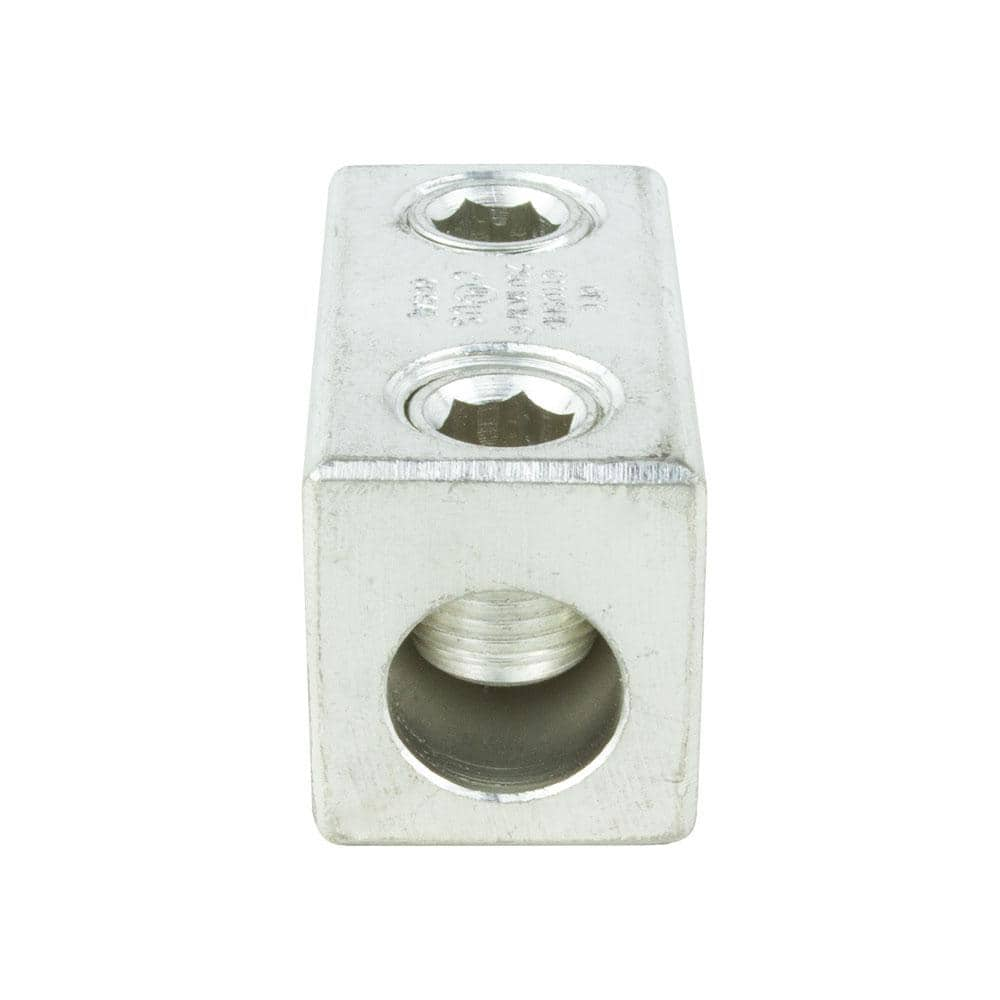
Polaris connectors would be my first choice……. "Bugs" (split bolt connectors) would be my second choice. These two choices do not require any special tools or skills.
I have made hundreds of splices (mostly large motors) with bugs and they are time tested "old school" connectors and once done correctly the connections should last a lifetime. When I did a motor connection I would put a wrap of varnish cambric tape before wrapping the splice with 130c then 33+ tape to make removal at a later date easy.
 
Last edited:

cgrutt

Well-known member
Joined
Mar 4, 2016
Messages
8,445
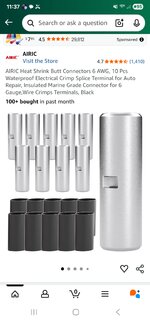
They make #6 **** splices too but pretty sure should only be used if wire is stranded. For example:

Screenshot_20251104_113713_Amazon Shopping.jpg
 

rlitman

Well-known member
Joined
Oct 18, 2010
Messages
24,738
Location
Long Island
... I don't remember the color of the wire nuts...
The color depends on the brand, as there are no color requirements in the code, but I have blue/gray wire nuts at work that are rated to connect two 6AWG wires. I only used them for connecting grounds in some weird use cases, and I can't say I'd be comfortable with them on an EVSE. EVSE are like heaters. They're about as abusive to connectors as uses get. Outdoor weather tight enclosures are another problematic area. They may not get rain, but they certainly get humidity, condensation and corrosion (plus spiders and insects).

Looking up Dryconn connectors, their largest stocked at HD accepts 2#8 (too small), but I'd be happier with a dielectric grease filled connector (as messy as that is) in an outdoor box.

Polaris connectors are the gold standard, and they're priced that way. If you're ok with a single-use product, what I've done instead of a Polaris connector on the cheap is use these:
and sleeve that in (adhesive lined thick wall 105C 600V rated) heat shrink tube.

The combination sold as a direct burial splice kit with two pieces of tubing for a lot more money (more than a Polaris):

But in a weather tight box, you don't need to direct burial levels of protection.
 
OP
7

75gmck25

Well-known member
Joined
Jul 21, 2014
Messages
1,336
Location
Alexandria, VA
It sounds like an upgrade to Polaris connectors is a good idea fore the EV power feed. And you are correct, I don't need them to be weatherproof. I would like to avoid any type of crimp connecter because I'm sure there will be an evolution of EV chargers and that may lead to replacing the charger I have.

I see there are a couple of Polaris connectors that are rated for find strand wire, which seems to be for applications where they use fine strand wire to increase cable flexibility. I assume that standard #6 copper NM-B is not considered to be "fine strand", so the mainstream Polaris connectors are fine.
 

rlitman

Well-known member
Joined
Oct 18, 2010
Messages
24,738
Location
Long Island
...I assume that standard #6 copper NM-B is not considered to be "fine strand", so the mainstream Polaris connectors are fine.
Fine strand would be welding or battery cable. Also used in marine applications and on motor leads. Fine stranding is not something you would encounter in American building wiring.
 

Bert_

Well-known member
Joined
Dec 24, 2016
Messages
9,859
Location
NW Iowa
Wire nuts are ok. Just make sure they are tight. You really have to crank on them
 

nadogail

Well-known member
Joined
Jan 23, 2009
Messages
32,214
Location
Coronado, CA
I would reach for Split Bolt Connectors, Scotch Fill, and Varnished Cambric tape. Then wrap it in 3M 33+. For extra measure you could paint everything inside the box with Scotch Coat.
I know this is old school, but when i started, Knob & Tube was still commonly used.
 

rlitman

Well-known member
Joined
Oct 18, 2010
Messages
24,738
Location
Long Island
In a 4x4 box, I believe split bolts would offer more flexibility and take up less room than Polaris.

**** splice type would be nightmare in a 4x4 box.
So, I had this exact issue., and the **** splices I mentioned fit much better than the split bolts I used before them (the replacement was to add a ground wire feed to an out building), but both worked (barely). Split bolts are the biggest of the options, once you account for the golfball of tape around them. The four **** splices end up pretty thin, so I was able to loop the rings of wire in the box easily. The three split bolts they replaced were TIGHT, and there's no way I could have gotten a fourth in there.

Polaris style generally take up the least room, since the insulation is pre-cast tight to the metal, though you do have the hubs that stick out in places.
 

mm08822

Well-known member
Joined
Jan 13, 2012
Messages
6,229
Location
NJ
So, I had this exact issue., and the **** splices I mentioned fit much better than the split bolts I used before them (the replacement was to add a ground wire feed to an out building), but both worked (barely). Split bolts are the biggest of the options, once you account for the golfball of tape around them. The four **** splices end up pretty thin, so I was able to loop the rings of wire in the box easily. The three split bolts they replaced were TIGHT, and there's no way I could have gotten a fourth in there.

Polaris style generally take up the least room, since the insulation is pre-cast tight to the metal, though you do have the hubs that stick out in places.
I use the style of **** splice you pictured for service temp connections. The smaller versions could still be too big for the 4x4 box the OP has but depends upon conduit/cable entry locations and available conductor length. Would surely work with pre-planning knowing the wires are going to be positioned for their use.

Small split bolts can easily be rubber taped and then vinyl coated without the ubiquitous golf ball glob of black slime used.
 

rlitman

Well-known member
Joined
Oct 18, 2010
Messages
24,738
Location
Long Island
...Small split bolts can easily be rubber taped and then vinyl coated without the ubiquitous golf ball glob of black slime used.
Maybe, but I've never had luck. Cambric on the base layer gives the best protection from sharp corners, but makes for the biggest results. Scotch 88 on the base layer gives me the thinnest corner protection I'm comfortable with, because every time I use the self-fusing rubber directly on the split bolt, I find it starts to slowly tear itself apart around anything remotely sharp inside. And by the time I've got an inside layer, a layer of rubber, and a layer of Scotch 33+ on top (again, because this is thinner than a traditional friction tape cover), I'm back to the same old golf ball. But I'm the first to admit that maybe it's just me. I mostly use split bolts to connect bare grounds, where none of this matters.

Either way, cutting open old self-fusing rubber tape is marginally less frustrating than cutting open adhesive lined heat shrink. And both are even less enjoyable when done in a crawl space, so I'm not hoping to ever touch those splices again.
 
To avoid these ads, REGISTER NOW!

theoldwizard1

Well-known member
Joined
Feb 22, 2011
Messages
43,504
Location
SE MI
"Bugs" (split bolt connectors) would be my second choice. These two choices do not require any special tools or skills.
I have used split bolts (never heard them called "bugs") a couple time. Easy to use. One old sparky told me to use a double wrap of Scotch 3407 friction tape. It stays flexible and sticky forever !
 

cgrutt

Well-known member
Joined
Mar 4, 2016
Messages
8,445
I can not IMAGINE #6 SOLID wire !

The problem with those **** splices is having crimpers big enough to use them.
I wasn't sure if the wire was solid but know enough that those crimp connectors should only be used on stranded. Believe I have seen 6GA solid wire for ground connections though.

I have a Temco hydraulic crimper that can handle 6 GA (and larger) just fine. They are widely available in different brands and styles. Mine looks like this:

TEMCo-Industrial-Hydraulic-Cable-Lug-Crimper-TH0006-V2-0-5-US-TON-12-AWG-to-00-2-0_b1594958-b...jpeg
 

micromind

Well-known member
Joined
Sep 24, 2023
Messages
3,127
Location
Fernley, Nevada, about 30 miles east of Reno.
1 hole crimp lugs bolted together. Very easy to tape up and will easily fit in a box.

Otherwise, split-bolts.

When I tape up any splice that I might need to undo later (big motors, etc), I always wrap the first layer of basic tape sticky side out. Then 130C then 35 or 88. This way when I need to undo the splice, simply slit it and it'll peel open since the first layer doesn't stick to anything.
 

PCustoms

Well-known member
Joined
Jul 23, 2011
Messages
23,684
Location
VT
For two #6's I'm using Ideal blue wing nuts. When it gets hard to turn I'll give it another crank or two with Channelocks.

I'm sure the industry expert that claims wirenuts should be properly torqued would disagree, but I specialize in upsetting certain people.

As long as you pre-twist, that's should work!

😉
 
To avoid these ads, REGISTER NOW!
Top Bottom