Any recommendations? I need to remove some proto-plaster wall board from mid 1950s. It has what appears to be an outer layer of plaster with something similar to Duroc underneath. Razor knife barely scratches the stuff. I see some for O-saw with diamond grit, which seems promising...


You are using an out of date browser. It may not display this or other websites correctly.
You should upgrade or use an alternative browser.
You should upgrade or use an alternative browser.
Best Oscillating saw blade for cutting plaster walls?
- Thread starter MikeC55
- Start date
kj_mustang
Well-known member
Carbide blades last pretty well but I have never tried them on something like that.
DGersic
Well-known member
How nice do you want the cut to be?
It’s rock lath, by the way. Similar to modern sheet rock, topped with a layer of plaster. Then likely many coats of lead paint. Try to contain the dust from cutting this stuff.
Oscillating tool blades don’t last long cutting this. A sawzall will cut it if you need a big ugly cut. Might try a jigsaw, more controllable than the sawzall.
It’s rock lath, by the way. Similar to modern sheet rock, topped with a layer of plaster. Then likely many coats of lead paint. Try to contain the dust from cutting this stuff.
Oscillating tool blades don’t last long cutting this. A sawzall will cut it if you need a big ugly cut. Might try a jigsaw, more controllable than the sawzall.
and asbestosThen likely many coats of lead paint.
I use carbide scoring knife to get thru the top coat then a regular utility knife to cut the gypsum board
Use a carbide-grit demolition blade. it works ok. But really you need a Oscillating Multi-Tool with Carbide or Diamond Grit Blade.
Milwaukee GIDDS2-2488111 9" Tungsten Carbide Sawzall Blades, 3-Pack - Reciprocating Saw Blades - Amazon.com
Milwaukee GIDDS2-2488111 9" Tungsten Carbide Sawzall Blades, 3-Pack - Reciprocating Saw Blades - Amazon.com
www.amazon.com
nadogail
Well-known member
I have found that Bosh makes very good blades for oscillating tools. I use them when I can get them.
A diamond blade on an angle grinder will go through that like butter and make a very clean cut. Have a helper hold the shop vac or you'll need to vacate the premises for a day so the dust can settle. Handheld sawzall or hacksaw blade can finish/square up any ends the angle grinder can't reach.
CraigStu
Well-known member
I'd try w/ different blades on a jigsaw. As DGersic says it's more controllable. Many times you can run the saw w/ one hand and hold the shop vac hose next to the blade w/ the other hand. I'd also use high quality breathing mask w/ replaceable elements.
Leon bee
Well-known member
^^^ You just hold your breath while cutting it. I ain't dead yet.
cmandp
Well-known member
I use all the dull oscillating tool blades from cutting wood and metal for cutting drywall or plaster. The metal cutting ones last a bit better because they are HSS cutting edges.
I also buy the cheap generic ones from Amazon. They last near (60-75%) what the name brand ones do and you get 20 of them for the price of one brand name blade.
I also buy the cheap generic ones from Amazon. They last near (60-75%) what the name brand ones do and you get 20 of them for the price of one brand name blade.
Fav Onefour
Well-known member
I've done quite a few cuts with a small angle grinder and diamond blade. It works fantastic and even goes through mesh if that's in there. The blade doesn't do much if you hit wood lathe or framing. I'd grab a sawzall to finish the job if you have a lot of wood.A diamond blade on an angle grinder will go through that like butter and make a very clean cut. Have a helper hold the shop vac or you'll need to vacate the premises for a day so the dust can settle. Handheld sawzall or hacksaw blade can finish/square up any ends the angle grinder can't reach.
I will say it it a dusty ****** though. If it's a small room, I close up every opening and let er buck. I wear goggles and a mask. It only take a few minutes to fill the room with dust. I've had to leave the room and clean the goggles so I could see enough to finish the job.
I did a job in a condo apartment, we opened all the doors to 36" to make it accessible . it was 2" thick plaster walls with wire mesh in the middle . by time we were done it looked like there was an inch of dust on everything.It only take a few minutes to fill the room with dust.
very common in cornersI have run into the steel mesh before, but rarely.
I ran into heavy steel mesh on a straight section of wall in a house built around 1890. I don’t know whether it was original or not.very common in corners
Fav Onefour
Well-known member
B.I.L. is a contractor in Austria and I've visited some of his projects. They deal with plaster, concrete and brick all day long. This pic was taken in an old farmhouse they were redoing.
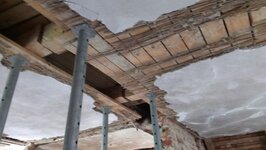
There wasn't any steel mesh and I didn't know what type of lathe that was underneath. He had a hard time explaining the lathe material. We eventually decided on the common term "cattail reeds".
I asked if they were going to remove all the plaster.
His response was "Why, it's fine?"
I then asked if they were going to patch with the same material. The response was somewhat random. Apparently there are no swamps left in the area and it would be too much work to find someone that cuts and dries reeds. Plain ol normal plastering was going in for the repairs because the home wasn't a historic building.
Our communication on the topic was tough because of language/word differences. The building wasn't anything fancy and I didn't know if there was a reason why it would be historic. I asked how long ago they used reeds. There was no definitive timeline? People used whatever was available.
We eventually got around to the age of the old farmhouse. It had been built roughly 250 years ago and sat empty for the last 30 years.
Whatever was available was pretty good stuff if it lasted that long.
BTW, their main demo tools are a whole variety pack of mini jack hammers. Those things are running on every site. Most of the old building updating is done with wire and plumbing runs cut into the plaster, mortar, and brick walls.
There wasn't any steel mesh and I didn't know what type of lathe that was underneath. He had a hard time explaining the lathe material. We eventually decided on the common term "cattail reeds".
I asked if they were going to remove all the plaster.
His response was "Why, it's fine?"
I then asked if they were going to patch with the same material. The response was somewhat random. Apparently there are no swamps left in the area and it would be too much work to find someone that cuts and dries reeds. Plain ol normal plastering was going in for the repairs because the home wasn't a historic building.
Our communication on the topic was tough because of language/word differences. The building wasn't anything fancy and I didn't know if there was a reason why it would be historic. I asked how long ago they used reeds. There was no definitive timeline? People used whatever was available.
We eventually got around to the age of the old farmhouse. It had been built roughly 250 years ago and sat empty for the last 30 years.
Whatever was available was pretty good stuff if it lasted that long.
BTW, their main demo tools are a whole variety pack of mini jack hammers. Those things are running on every site. Most of the old building updating is done with wire and plumbing runs cut into the plaster, mortar, and brick walls.
Uncle murph
Well-known member
This.There’s no comparison to the angle grinder although some skill is required to keep it straight.A diamond blade on an angle grinder will go through that like butter and make a very clean cut. Have a helper hold the shop vac or you'll need to vacate the premises for a day so the dust can settle. Handheld sawzall or hacksaw blade can finish/square up any ends the angle grinder can't reach.
I have a few unrenovated rooms in a 1940s build that are still rock lathe and I've had good results with DeWalt Wood/Metal HSS blades for access holes and outlet boxes. Very clean cuts overall, and the side to side motion is better than in and out for keeping the plaster coat from delaminating from sheetrock. My plaster had no asbestos present and led paint test on walls and ceiling came back negative for at least two layers and the back side of the base layer but YMMV so use a mask.
Lumpy102
Well-known member
I'm a bit late to the party here, I've done renovations on 3 houses now with the gyproc lathe, a coat of very sandy plaster and a finish coat over top, steel mesh in all the corners. The ONLY thing I've found that works well/cheaply is a 5 inch grinder with the thin cut off wheels, a couple of shop vacs catching the discharge, plastic on the doors isolating the room and a box fan discharging out the closest window. Oscillating tool blades are f____ expensive and very short life, recip. saw blades last about 3 minutes, jig saw no better. Just wear a full face mask if you can get one, or a half mask and goggles, either with P100 filters, tyvec coveralls are a good choice too. and vacuum yourself off before you unmask/strip off the coveralls.
paredown
Well-known member
Our house is a '60s modern with those first generation 'drywall' planks covered with skim coat plaster. All of the corners and ceiling joints are reinforced with mesh. Harder than hell. And of course, I took down all the ceilings to insulate.I did a job in a condo apartment, we opened all the doors to 36" to make it accessible . it was 2" thick plaster walls with wire mesh in the middle . by time we were done it looked like there was an inch of dust on everything.
Some blood was shed...
For cutting large cuts, a cheap cut off wheel on an angle grinder works pretty well. For finer work I used a HF cheap multi tool, thinking that if I killed it I would not be too upset. It turned out to be unkillable. For blades I bought bulk pack Oshlun blades on Amazon--they used to be cheaper but are now about $4 a blade--and much better quality than the price would suggest. Tool three is the ever faithful Miwaukee Sawzall with a metal blade. Where I was taping in new drywall, I did a shallow score cut and chipped off the paster to the edge to give me some depth to bed the new tape.
Dust is a huge problem though. I recenty saw someone's Youtube where they modified a light snap lid clear storage container by cutting hand holes/vac connection and jury-rigged some wrist collars so they could put the container up against the wall and operate the tool inside. I have some doors to move, so I may try this out...
Amazon.com: Oshlun MMC-0110 1-1/3-Inch Universal Bi-Metal Oscillating Tool Blade with Quick-Fit Arbor for Standard and Quick Change Tools, 10-Pack
Amazon.com: Oshlun MMC-0110 1-1/3-Inch Universal Bi-Metal Oscillating Tool Blade with Quick-Fit Arbor for Standard and Quick Change Tools, 10-Pack
www.amazon.com
Last edited:
Fav Onefour
Well-known member
Are you talking about cutting holes in plaster or sheetrock?I use carbide blade from harbor freight, item 70230. I've cut 20+ outlet/switch holes in addition to access holes and misc. over the last year. Still cuts well on the first blade. Hold a vacuum nozzle with the other hand.
I use beat up blades in sheetrock and they still work great for that stuff. Funny thing about that. I used to throw out the blades when they quit cutting hard stuff. Now, I keep them in a separate pile and use them in sheetrock.
I have 1940s plaster over drywall, about 1/2" of each. Just like OP. The cheaper non-carbide bits do not cut the plaster at all.Are you talking about cutting holes in plaster or sheetrock?
I use beat up blades in sheetrock and they still work great for that stuff. Funny thing about that. I used to throw out the blades when they quit cutting hard stuff. Now, I keep them in a separate pile and use them in sheetrock.
steves_001
Well-known member
These work very well. Obviously not a buzz blade but if you have a reciprocating saw these are the solution.
LENOX® 6" x 6-TPI Specialty Plaster Reciprocating Saw Blade - 5 Pack
Menards sku 2528084
No idea why Menards won’t give me a direct link…
These things cut plaster and the lath wire quick. I demo’d a whole house full of plaster with maybe 15 blades total.
LENOX® 6" x 6-TPI Specialty Plaster Reciprocating Saw Blade - 5 Pack
Menards sku 2528084
No idea why Menards won’t give me a direct link…
These things cut plaster and the lath wire quick. I demo’d a whole house full of plaster with maybe 15 blades total.
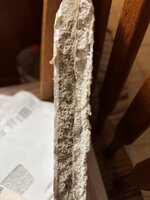
Just for the record, here is a photo of the stuff I'm working with. The top layer (plaster, I think) is around 1/8", second layer is kind of like Duroc, but harder and last layer looks/acts like sheetrock. It's ridiculously heavy and you sure wouldn't want to try and punch a hole through it! I know the house was built in 1956. We don't have Menards around here but I'll check if I can order them on-line. Thanks.
Attachments
DGersic
Well-known member
Just for the record, here is a photo of the stuff I'm working with. The top layer (plaster, I think) is around 1/8", second layer is kind of like Duroc, but harder and last layer looks/acts like sheetrock. It's ridiculously heavy and you sure wouldn't want to try and punch a hole through it! I know the house was built in 1956. We don't have Menards around here but I'll check if I can order them on-line. Thanks.
Yep, that’s the same stuff I have here. I’m no expert, but I believe you’re looking at rock lath, a scratch coat of plaster, and a finish coat of plaster.
yes, that is gypsum lath board , scratch coat or rough coat , then plaster veneer finish
Fav Onefour
Well-known member
Thanks @steves_001 , for the tip on those blades. I'd never noticed them before. I'm surprised, they have a funky tooth design.
@MikeC55 , I've worked with plaster, I've worked with stucco, and I've worked with a variety of sheet rock. I have not worked with a sandwich layer like you are fighting.
I'm glad the other guys chimed in on the topic.
@MikeC55 , I've worked with plaster, I've worked with stucco, and I've worked with a variety of sheet rock. I have not worked with a sandwich layer like you are fighting.
I'm glad the other guys chimed in on the topic.
steves_001
Well-known member
Just to expand on my method a bit. Cut the corners (inside corners) on the ceiling and walls. Then take a crowbar, hooked end, punch it thru the wall and give a few sharp yanks. that will loosen the inner layer off the nails used to hold that stuff on and it will come off in pretty big chunks. Crowbar open a vertical line in the wall between studs and that should get it going. Just be aware of wires and pipes.