I want to buy a new soldering iron. I want to know what the best brand of soldering iron is? I have really old worn out ones and need a new one that will last. I do solder a lot on projects like i am ding now on my car. I was doing some surching and seen that weller is a popular brand.


You are using an out of date browser. It may not display this or other websites correctly.
You should upgrade or use an alternative browser.
You should upgrade or use an alternative browser.
Best Soldering Iron
- Thread starter GSX
- Start date
HAP
Well-known member
I ahve the Weller WD1 solder station. Really fast heat and control.
rshadd
Well-known member
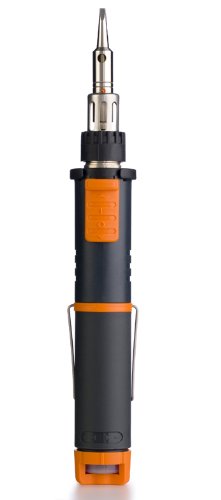
I use my Weller Portasol for most automotive tasks.

If I'm doing electronics or LED work, I get out the Weller WESD51 soldering station. It heats up really fast and the tips are less expensive ($4) than other brands.
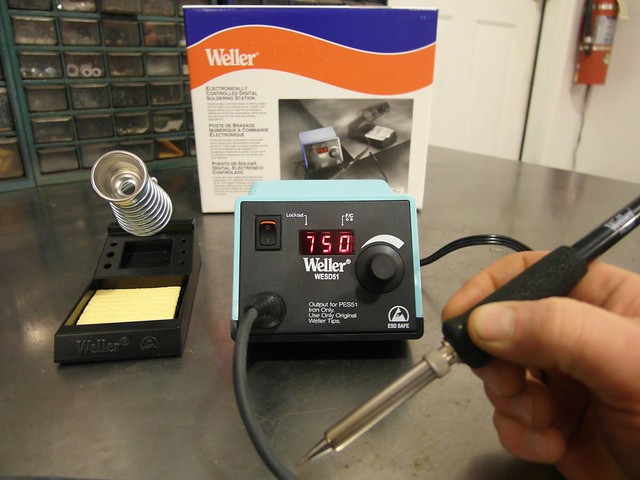
The Hakko FX888D is also a nice buy, but I liked the dial knob on the Weller better.
If I'm doing electronics or LED work, I get out the Weller WESD51 soldering station. It heats up really fast and the tips are less expensive ($4) than other brands.
The Hakko FX888D is also a nice buy, but I liked the dial knob on the Weller better.
Last edited:
kaffine
Well-known member
Depends on the type of work. For bench work I like Pace stations although they are a bit expensive. Hakko also makes some nice equipment but tend to be more setup for production vs maintenance. Temp controlled stations are really nice if doing board work but kind of inconvenient if working away from the bench.
For working wire harnesses on the car I really like the butane powered ones. No cord to worry about and fast warm up times. I can't remember the brand that the shop had when I was a mechanic though.
For working wire harnesses on the car I really like the butane powered ones. No cord to worry about and fast warm up times. I can't remember the brand that the shop had when I was a mechanic though.
Robert Hall
Well-known member
I like weller for working at my electronics bench. I have some old radio shack models for anything heavier but I do have an old weller gun type that has been in good shape for over 35 years.
Here is a link to my weller 85 watt... http://goo.gl/plbRWg
Here is a link to my weller 85 watt... http://goo.gl/plbRWg
quattrojon
Well-known member
Either Portasol pro (Branded Weller in U.S.A), or Power probe. Both are very good.
I have two of the cheap Radio Shack versions of the Portasol, and a 40 year old Weller with the magnetic tips (controls heat). Keep the tips clean, heat the part you want the solder to flow to.
Not sure I still have it, but American Beauty monster for tin work.
Maybe sometime soon I plan to pick up something newer for desoldering and smd work.
Not sure I still have it, but American Beauty monster for tin work.
Maybe sometime soon I plan to pick up something newer for desoldering and smd work.
I want to buy a new soldering iron. I want to know what the best brand of soldering iron is? I have really old worn out ones and need a new one that will last. I do solder a lot on projects like i am ding now on my car. I was doing some surching and seen that weller is a popular brand.
I'll be the one to say it. For the most part you should be using weather proof insulated crimp connectors on your cars wiring. Far more durable than any soldered connection.
If you're talking board joints I personally prefer a solder station IF you can either remove the component or have access. It just gives you far better heat control and the iron itself is lighter.
Last edited:
MattPersman
Well-known member
Portosol is what I use most of the time because the manufacturer I work for likes soldering instead of crimp connections. I think they worry about poor crimp connections? There is one process where I have seen them say use crimp band and then solder. So the crimp may catch on at some point.
theoldwizard1
Well-known member
The little battery operated ones are great for some electronics work and solder wire smaller than 18 gauge.
Portasol's are great for heavier wire and with the proper accessories can handle heat shrink well !
Dozens of bech model to choose from. Stick with Weber and you won't go wrong !
Portasol's are great for heavier wire and with the proper accessories can handle heat shrink well !
Dozens of bech model to choose from. Stick with Weber and you won't go wrong !
Stooge
Well-known member
For work i have an Oki mfr2220, which replaced a weller wesd51. Not sure why my boss bought the oki's for us to use, they work great but are stupid expensive at $450+ unless he just wanted to buy some new toys. At home i have the analog weller station wes51 along with a radio shack digital welding station that is actually pretty great and easy to use especially for the price. At the shop i have another digital weller wesd51 along with a simple no adjustments weller plug in iron.
Can never have to many soldering irons
Can never have to many soldering irons
AV tinker er
Well-known member
I use wellers at work and home, I'll post a picture later.
Tarheelgarage
Well-known member
Steinmetz
Well-known member
I want to buy a new soldering iron. I want to know what the best brand of soldering iron is? I have really old worn out ones and need a new one that will last. I do solder a lot on projects like i am ding now on my car. I was doing some surching and seen that weller is a popular brand.
The "best" depends upon what type of work you want to do. "Car" projects isn't descriptive enough.
Not all soldering irons are created equal. I own probably thirty of them, of all types.
Brownsfan
Well-known member
I'll be the one to say it. For the most part you should be using weather proof insulated crimp connectors on your cars wiring. Far more durable than any soldered connection.
If you're talking board joints I personally prefer a solder station IF you can either remove the component or have access. It just gives you far better heat control and the iron itself is lighter.
Not always practical. Try doing a remote start that way. You would not be able to get column Shrouds back on with all those but connectors. Also some require tapping into data wires and a crimp connection may cause issues. Every remote start manufacturer recommends soldering for those reasons.
Brownsfan
Well-known member
Now as far as soldering irons go. I use the snap on badged weller portosol shown above. On thicker ign switch wires I use use the craftsman pro soldering gun.
I've been using a Wall Lenk Soldering Gun 150/400W for over 10 yrs. These are sold by Sears and Mac or Matco. Heats up really fast and then switches to the lower setting.
I've had wellers before and they just didn't heat up enough. The light even works unlike the 3 wellers I had.
http://www.sears.com/shc/s/p_10153_..._sku=SPM7446236510&sid=IDx20131030xMPTLxCPA25
I've had wellers before and they just didn't heat up enough. The light even works unlike the 3 wellers I had.
http://www.sears.com/shc/s/p_10153_..._sku=SPM7446236510&sid=IDx20131030xMPTLxCPA25
scaron
Well-known member
any electrical engineering laboratory or electronics shop i've ever been in has used either pace or hakko. i will second they are excellent instruments. i have a hakko 936 in my home lab and it has been a great investment. you should be able to find them NIB on eBay for $60-80 all day.
tool_scrounge
Well-known member
Metcal is really good. Sold all my Wellers after using a Metcal. They heat up about instantly and regulate temperature very well. These characteristics mean that you can make a good quick solder joint without overheating the parts, insulation, etc.
Not always practical. Try doing a remote start that way. You would not be able to get column Shrouds back on with all those but connectors. Also some require tapping into data wires and a crimp connection may cause issues. Every remote start manufacturer recommends soldering for those reasons.
That's why I said "for the most part". You can find endless tutorials of guys solder repairing wires on cars and that's simply the wrong way, that's all I was getting at.
retrobuilder
Well-known member
A Weller or Hakko is good. If you do a variety of small gauge and larger discrete car wiring a soldering iron with variable wattage is best. If simpler electric type portability is key then a quality 40 watt minimum to 60 watt is good. The ceramic heating tip often are more efficient vs the wattage output. I use a 63/37 alloy solder. Also having access for replacement tips are part of selection.
tip- if soldering in 40F and colder weather is not recommended- the solder cools so fast you get weak solder joints.
tip- if soldering in 40F and colder weather is not recommended- the solder cools so fast you get weak solder joints.
Brownsfan
Well-known member
I concur. The solder vs crimp battle has been beat to death here any way. I always use the heat shrink connectors(crimp) under the hood. Best possible weather protection.
I'll be the one to say it. For the most part you should be using weather proof insulated crimp connectors on your cars wiring. Far more durable than any soldered connection.
If you're talking board joints I personally prefer a solder station IF you can either remove the component or have access. It just gives you far better heat control and the iron itself is lighter.
I have to ask. I've always wonder since learning that crimping is better for car wiring if it would it be better to put a small drop of solder (tinning) on the end of the wire before using a crimp connector?
Curt.
James_B
Well-known member
I've been using Weller TCP series irons (the Curie point tip models) at home and work since the mid 70s.
As we had to work on live -48V DC control systems, we modified all our Weller TCP series irons with a resistor in series with the ground line to the tip. Still gave grounding for working on static sensitive devices, but meant that we weren't constantly operating relays when soldering connections on operational circuits.
I had 4 WTCPL models at home that I rescued from a dumpster at work and repaired (cracked cases or frayed leads), and had a WTCPN at work. After I retired, I took my WTCPN home. I had lots of spare heating elements, magnetic switches, and tips, but I gave away everything, except for a decent selection of tips, when I moved to Canada (they were all 240 volt models).
As I brought those spare tips with me to Canada, I'm looking for a cheap used TCP series unit to use here. I didn't like the 3-pin iron connector on the WTCPN as it was terribly unreliable, so when I left work, I replaced the plug and socket on my WTCPN with better quality fittings.
For cordless use, I have a Portasol Pro-Pak, but I found that when up on an aircraft hangar roof in Newfoundland, in late December, trying to terminate solder type UHF connectors, the Portasol just couldn't generate enough heat. I bought a higher output Ronson Tech-Torch, to do the job and it worked fine.
As we had to work on live -48V DC control systems, we modified all our Weller TCP series irons with a resistor in series with the ground line to the tip. Still gave grounding for working on static sensitive devices, but meant that we weren't constantly operating relays when soldering connections on operational circuits.
I had 4 WTCPL models at home that I rescued from a dumpster at work and repaired (cracked cases or frayed leads), and had a WTCPN at work. After I retired, I took my WTCPN home. I had lots of spare heating elements, magnetic switches, and tips, but I gave away everything, except for a decent selection of tips, when I moved to Canada (they were all 240 volt models).
As I brought those spare tips with me to Canada, I'm looking for a cheap used TCP series unit to use here. I didn't like the 3-pin iron connector on the WTCPN as it was terribly unreliable, so when I left work, I replaced the plug and socket on my WTCPN with better quality fittings.
For cordless use, I have a Portasol Pro-Pak, but I found that when up on an aircraft hangar roof in Newfoundland, in late December, trying to terminate solder type UHF connectors, the Portasol just couldn't generate enough heat. I bought a higher output Ronson Tech-Torch, to do the job and it worked fine.
Last edited:
theoldwizard1
Well-known member
I've been using Weller TCP series irons (the Curie point tip models) at home and work since the mid 70s.
I still think these are the "Gold Standard" !
Stuart in MN
Well-known member
I have to ask. I've always wonder since learning that crimping is better for car wiring if it would it be better to put a small drop of solder (tinning) on the end of the wire before using a crimp connector?
Curt.
With a proper splice and crimper, no - the whole point is to get what is called a "gas tight" connection between the wires, and solder would get in the way of making a full crimp.
flippin
Well-known member
With a proper splice and crimper, no - the whole point is to get what is called a "gas tight" connection between the wires, and solder would get in the way of making a full crimp.
Not to mention that the flux associated with the solder will wick into the insulation and immediately start corroding the wires prematurely. That why soldered connections so often break where the insulation meets the joint.
James_B
Well-known member
In a past life, I used to teach "High Reliability Hand Soldering" (NASA-STD-8739-3-2). The standard and associated course is the result of NASA discovering that the people employed by contractors didn't know how to solder correctly, and many components were failing due to poor soldering techniques. We'd spend a full week, teaching people that had been soldering for years, the correct way to do things. With examination of the student's practical tasks being done under a high powered binocular microscope.Not to mention that the flux associated with the solder will wick into the insulation and immediately start corroding the wires prematurely. That why soldered connections so often break where the insulation meets the joint.
There's a number of factors involved in the wires breaking right where the insulation meets the joint. Corrosive flux residue is one of them, the other is the solder itself wicking up the wire and causing a weakening of the wire at that point due to alloying.
Mechanical and chemical precleaning the wires and lug is important, as is the choice and amount of flux used (we used only rosin dissolved in isopropyl alcohol or pure rosin as flux), but the item that also helps the most is a set of the correct sized anti-wicking tweezers that will minimize the wicking of the solder.
Rosin flux is virtually nonreactive and noncorrosive at normal temperature, mildly reactive to metal oxides when molten. The fluxes to look for are "Type R (non-activated rosin)" and "Type RMA (mildly-activated rosin)". Type R fluxes don't require cleaning, and type RMA fluxes are not significantly corrosive, with post soldering cleaning being preferred but optional.
For a look at the proper process, grab this PDF:
NASA Training Program Student Workbook for Hand Soldering
soloz2
Well-known member
I love my Hakko station! They can get pretty spendy, but even the non digital ones are very good.
Sent from my SAMSUNG-SGH-I747 using Tapatalk
Sent from my SAMSUNG-SGH-I747 using Tapatalk
With a proper splice and crimper, no - the whole point is to get what is called a "gas tight" connection between the wires, and solder would get in the way of making a full crimp.
Thanks for the reply,
Curt.
Outlawmws
Well-known member
Great post and a good place (The student Handbook) to start, or to un-learn bad practices! 
In a past life, I used to teach "High Reliability Hand Soldering" (NASA-STD-8739-3-2). The standard and associated course is the result of NASA discovering that the people employed by contractors didn't know how to solder correctly, and many components were failing due to poor soldering techniques. We'd spend a full week, teaching people that had been soldering for years, the correct way to do things. With examination of the student's practical tasks being done under a high powered binocular microscope.
There's a number of factors involved in the wires breaking right where the insulation meets the joint. Corrosive flux residue is one of them, the other is the solder itself wicking up the wire and causing a weakening of the wire at that point due to alloying.
Mechanical and chemical precleaning the wires and lug is important, as is the choice and amount of flux used (we used only rosin dissolved in isopropyl alcohol or pure rosin as flux), but the item that also helps the most is a set of the correct sized anti-wicking tweezers that will minimize the wicking of the solder.
Rosin flux is virtually nonreactive and noncorrosive at normal temperature, mildly reactive to metal oxides when molten. The fluxes to look for are "Type R (non-activated rosin)" and "Type RMA (mildly-activated rosin)". Type R fluxes don't require cleaning, and type RMA fluxes are not significantly corrosive, with post soldering cleaning being preferred but optional.
For a look at the proper process, grab this PDF:
NASA Training Program Student Workbook for Hand Soldering
James_B
Well-known member
Once a teacher ... always a teacher.Great post and a good place (The student Handbook) to start, or to un-learn bad practices!
Getting my skills to the point where I could teach that course was an interesting challenge. I had to unlearn a lot of bad habits.
While we weren't building hardware for NASA to fire into space, we were working in the aviation industry, so at least dome of the people took it seriously. There was a lot of resistance from the old-timers who considered most of the process a waste of time and effort. I had similar resistance from the same group of people when I taught anti-static handling procedures for sensitive components.
Five years later, I was in France doing quality control on the first training course for our new French built RADAR systems, and was dismayed to see the poor quality soldering and lack of correct static handling procedures exhibited by the manufacturer's workers in the factory while working on our equipment. I saw correct procedures used on other equipment in other parts of the factory. I was told that on some contracts they use those procedures, but only if it's an agreed part of the contract, and the contract price will be higher to compensate them for the extra time needed to do it the right way.
the contract price will be higher to compensate them for the extra time needed to do it the right way.
Man you really have a way with words. I laughed at that sentence for about 8 minutes. You deserve a cookie.
James_B
Well-known member
Exactly the words that were used by the native French speaking plant supervisor. He saw no problem in telling us exactly that. If we'd wanted the processes done right, we should have specified it in the contract.Man you really have a way with words. I laughed at that sentence for about 8 minutes. You deserve a cookie.
The quote was in one of the many reports I wrote 24 years ago. To say I was scathing in my reports would be an understatement, and I received feedback from our head office that my reports on the factory visit and training were "entertaining".
It was an interesting game of espionage we played with the French while we were in the factory. We discovered that there were two different sets of English language manuals for the equipment we had bought. One set had been specifically written for us, and they started out next to useless, and progressively got worse. The contract for the manual production had been given to an external company run by a retired French General, and the originally French manuals were poorly translated into English by university students on their summer breaks (the first manuals we saw were hand written). There was also a really good set of manuals that was written by a specialist internal arm of the French company to meet a NATO contract. These manuals were also in English. I managed to have a few of the NATO manuals fall onto a photocopier.
The goal of the French company was to undertrain our staff so they would be incapable of keeping the equipment running. This was combined with critical information that had been left out of the manuals. The plan was for the French company to wait a couple of years until the equipment was barely operational, send in a specialist team to tweak everything, and use that as proof that the equipment was too complex for the unskilled Australian technical staff to maintain. At this point they'd offer a maintenance contract. Every time a revision came out for our manuals, we were required to return the old ones before we would be given the updated manuals. I illegally produced copies of each revision, and could show our management the information that was being progressively removed from our manuals with each revision.
Outlawmws
Well-known member
Yeah the French are probably the dirtiest of all our "free world allies" I've a few stories of their underhandedness myself...
James_B
Well-known member
My experience with some of the inside workings of a 9 figure project, gave me some interesting insights into the way they work. Their standard threat was that they'd close their company offices in Australia, and all technical information requests and contract problems would have to be dealt with through the French Embassy.Yeah the French are probably the dirtiest of all our "free world allies" I've a few stories of their underhandedness myself...
In a past life, I used to teach "High Reliability Hand Soldering" (NASA-STD-8739-3-2).
There's a number of factors involved in the wires breaking right where the insulation meets the joint. Corrosive flux residue is one of them, the other is the solder itself wicking up the wire and causing a weakening of the wire at that point due to alloying.
[/URL]
I have not read this version of the NASA handbook for sometime, the NASA handbook in the link was obsoleted following change 5 in 2011. You make a number of good points about solder electrical joints. I just want to clarify a couple of points.
The root cause of wires breaking where the conductor strands enter the insulating sheath is most frequently caused by damage to one or more of the conductors from the stripping operation. The small nicks in the conducting strands result in stress concentration during vibration or shock producing a stress fracture. The NASA handbook refers to the use of hot tweezers for stripping operations rather than the stripping tools most people on GJ are familiar with: even so damage to the strands can and do happen with this technique. Soft solder is and electrical joint and is not considered a mechanical joint, for space applications a mechanical attachment is also required between wires/components and the printed wiring boards - normally a two part epoxy although other methods are used.
I am not sure how the Sn93 or Sn96 solder weakens the wire by "alloying". These soft solders have melting points of 183c or 186c respectively which do not produce an alloy of the silver plated copper wire with. The Sn93 or Sn96 tin/lead solders are associated with electronic assembly work that would use the NASA handbook. The wire used for space assemblies is copper with an overplate of silver. Cold alloying of solid metals only occurs when the metals are soluble with each other in the solid phase - this is not the situation with the metals involved here.
BTW the NASA soldering standards are intended for high reliability space applications involving vacuum, shock, vibration and extreme temperature ranges these are very specific requirements that are dictated by the application. If you apply these requirements for commercial work you will find there are very few people who are willing to pay you for your work.
BTW the European Space Agency soldering requirements are more rigorous than the NASA requirements. At work our trainers are certified at the ESA training school and we have our own in-house training school for our staff.
nicksnothereman
Well-known member
When it comes to electronics there is no such thing as a bad solder job! Hahahahahahaha. For most automotive stuff you could just use taps honestly (for cereal); I've used taps in my car before in a location that I probably shouldn't have (tapped into a coil wire) and it's lasted something like 6 years without any issues and that's a supercharged application.
Sure, if you want to look the part you can get an expensive soldering iron or station but you probably don't need it for automotive work if it's just a simple tap or wire-to-wire solder job. My main duty is a weller from the 90s that has needed a new tip for years. I'm definitely a bad solder guy because doing it dirty has worked out so well for everything I've done.
If you do other stuff, get a moderately priced solder station I suppose. I don't own one but have considered it in the past.
Sure, if you want to look the part you can get an expensive soldering iron or station but you probably don't need it for automotive work if it's just a simple tap or wire-to-wire solder job. My main duty is a weller from the 90s that has needed a new tip for years. I'm definitely a bad solder guy because doing it dirty has worked out so well for everything I've done.
If you do other stuff, get a moderately priced solder station I suppose. I don't own one but have considered it in the past.
Next time I'm wiring up something with Saturn V level mission critical joints, I'll brush up on the NASA soldering guide. But it might be a tad overkill when wiring up a car stereo or some driving lights...
And while I've seen plenty of ugly solder joints (yes, even some of my own), I think it is even more common for garage mechanics to make terrible and failure prone crimp connections, largely due to the super-cheesy terminals and ultra cheap crimpers that are commonly used. All combined with the same exact nicked-strands-during-stripping problem that causes solder failures.
And while I've seen plenty of ugly solder joints (yes, even some of my own), I think it is even more common for garage mechanics to make terrible and failure prone crimp connections, largely due to the super-cheesy terminals and ultra cheap crimpers that are commonly used. All combined with the same exact nicked-strands-during-stripping problem that causes solder failures.
Last edited: