To avoid these ads, REGISTER NOW!

Best threads for aluminum sheet??

MatBirch

Well-known member
Joined
Oct 10, 2013
Messages
419
Location
Filer, Idaho
The company I work for builds primarily out of aluminum sheet. 14ga up thru 1/4" plate. We very often need threads, and the solution is usually nutserts. I HATE nutserts. Even when properly installed with a high quality Siuox pnuematic setter, the failure rate is screaming high, and that's before the end product is even sold and put into service by the customer!! Our design team has come to spec them as a primary build technique, when I believe they are more of a last resort/repair type of a product. I have seen other threaded inserts, one in particular is a plate riveted to the surface, that has a captured nut in it. Anybody have any ideas for better products/ ideas? Speed/labor will play a roll, as will price, but there has to be something better! I have aproached my bosses, and everybody agrees, but noone will take the ball and run with it...
 
To avoid these ads, REGISTER NOW!

Kevin54

MEMBER EMERITUS
Joined
Jan 12, 2005
Messages
29,341
Location
Urbana, Ohio
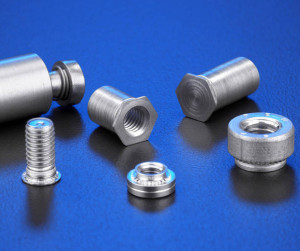
On thin aluminum, when I worked in the aircraft industry, we used Pem-serts, up to a certain thickness. After a certain thickness it was heli-coils. The Pem-serts we used had a hex head and they get pressed flush into the aluminum.

PEM-Inserts-e1380612928183-300x251.jpg


pb_ftlj1200131351.jpg


But there is a lot of inserts out there. It just all depends on the applications that you are doing to figure what sort of insert you need. Check into Penn Engineering and see if you can get one of their catalogs. Here you go. This is their website http://www.aerospacesw.com/pem-fasteners
 

Kevin54

MEMBER EMERITUS
Joined
Jan 12, 2005
Messages
29,341
Location
Urbana, Ohio
Last edited:

retrobuilder

Well-known member
Joined
Oct 18, 2012
Messages
408
Location
Alpharetta GA
Have you tried "extruded punched pilot holes" which form a cylindrical boss about the thickness of the sheet and works with type 25 screws or similar sheet metal thread tapping screws.
 

larry_g

Well-known member
Joined
Apr 28, 2007
Messages
16,858
Location
oregon
I'll second the Pem nuts. We used a lot of them with few failures.

lg
no enat sig line
 

theoldwizard1

Well-known member
Joined
Feb 22, 2011
Messages
43,072
Location
SE MI
I don't know how well these would work for thin metal, but for thicker metal look into threaded, self piercing rivets.
 

EdT

Well-known member
Joined
Sep 21, 2010
Messages
1,104
Location
North Georgia
+3 on PEM fasteners or similar self clinching nuts. One caution if you decide to try them, is that they must be pressed in nice an perpendicular to the material or the just don't work. ie, you can't put them in with a hammer . Had a vendor try that once on a big panel that he couldn't get to the middle of with his press. For the 1/4" aluminum you might look at thread forming or thread cutting screws. I have no idea what you're making so neither may be a good idea.
 

mark18mwm

Well-known member
Joined
Feb 13, 2014
Messages
57
Location
northern WI.
By the way, the ones that are riveted to the plate are "floating anchor nuts" I have made thousands of tools for use with these and the rivets that goes with them. If you need any help with anything, let me know.

And look at this search page for what they show http://www.bing.com/images/search?q...8C2BA77312EC73AAFA2CFB14E073EE0&FORM=IQFRBA#a

th


Then there are also ones called fixed nut plates

th

The "floating anchor nut" (in the Air Force we called them nut plates) where the bane of my existence when I was in the AF. I was a crew cheif on C-130 aircraft and for a while I worked in the inspection docks in the cargo compartment. We had to remove the floor panels to inspect and repair the plane. the floors where held down by maybe a thousand 10/32" countersunk Phillips head screws with those nut plates riveted to the cross members and floor frame work. I guarantee, at least a couple would be broke every time, requiring the screw to be drilled out. Ever try to drill out a screw spinning with the drill bit? lol. Thanks for the memories, I had almost forgot about them, 30 years ago! Ha-Ha.
 
OP
M

MatBirch

Well-known member
Joined
Oct 10, 2013
Messages
419
Location
Filer, Idaho
Thanks guys,
Is there a tool that will press the pem nuts? Usually our uses are for hatch covers and such. We build custom truck bodies and trailers. My dept builds generator enclosures. Often the snow hoods are mounted to the walls with nutserts, as there isn't a way to acces the back of the wall panel, once the unit built and lined. Some of the spots I was fighting today are 15-20' from any edge, on a vertical wall of a 105,000 lb portable building. No way to put that into a press, have to take the tool to the work...
 

IronCleveland

Member
Joined
Nov 7, 2013
Messages
8
Location
Pinon Hills, CA
I have to agree with mark. Sometimes the rivets would break, but 9 times out of 10 the nut spins inside of the steel shell. Then again, they see a lot of use on aircraft
 

EdT

Well-known member
Joined
Sep 21, 2010
Messages
1,104
Location
North Georgia
Well you didn't here this from me, but I installed a bunch of flush mount Pem inserts into 1/8" 6061-T6 plate using a screw that fit the insert and a big fat washer on BOTH sides. Hardly a production method, but it was a prototype build. I suspect that PEM has a way to install their inserts in the center of big panels. I just don't know what it is exactly. There is, after all, some limit on how far your press can reach. The biggest burden here is nothing to do with an alternative technology, it's convincing management to invest the money it will take to run qualification tests and change all the documentation over to something else. The Engineering guys will fight it too because it probably means a lot of busy work for them and, if for some reason it doesn't work out, they'll take the heat and have to fix it.
 
OP
M

MatBirch

Well-known member
Joined
Oct 10, 2013
Messages
419
Location
Filer, Idaho
Screws are not often an option, as usually the application is in wall panels that are 12ga. At times fabbed cabinets and such will be 1/8"-1/4". Looking over the pem site, their stuff seemingly requires specialized presses. Maybe I can get one of the designers to call a rep...
 
To avoid these ads, REGISTER NOW!
OP
M

MatBirch

Well-known member
Joined
Oct 10, 2013
Messages
419
Location
Filer, Idaho
You didn't say how they fail.
If they are spinning a little epoxy increases their resistance to torque about a thousand times....
Or they stake easily with a notch and a screw. You said "no.screws" but didn't say why not.

We need to know how they fail before anything can be recommended.

Lots of spinning out, pulling out, threads getting buggered (usually due to a slight amount of tearing that occurs during install) often times they get deformed under compression during install. Too little force, it will spin, too much force it will deform, strip completely, or gall causing the first bolt installed to bind, followed by stripping or spinning. All of this does not even delve into my personal pet peeve of most other employees failure to use the install tool properly. It never fails to be broken when I grab it from the cabinet.

No screws for a few reasons- machine threads don't hold or last on 1/8" thick material on a fastener larger than maybe #6-8. Sheet metal screws are not designed for repeated removal and reinstall. They tend to loosen under vibration.
Whereever possible we use a compression fastener like rivits, monobolts/mag bulbs and huck bolts, but when we need threads, unless we can plan ahead and put steel behind the wall panel which can either be tapped or get welded nuts, we're stuck with nutserts

I'll get some pics today of what we do and some of the problems. I spent all day yesterday and will be most of the day today on a manlift chasing threads in over 300 of the stupid things...
 

A_Pmech

Well-known member
Joined
May 8, 2007
Messages
8,002
Location
IL
All of this does not even delve into my personal pet peeve of most other employees failure to use the install tool properly. It never fails to be broken when I grab it from the cabinet....

Sounds to me like this is an employee issue, not a fastener issue. If they employees can't use the tool correctly, there's a 0% chance they're installed correctly.
 

Beemer533

Well-known member
Joined
May 9, 2014
Messages
2,057
Location
Syracuse, NY
Sounds more like installation or training issues.. We build aluminum frames to create 19" racks for our equipment; all the rack components are secured with 10-32 SS nutserts.. We do use some anti seize on the screws to prevent galling. We rarely have issues.

You might want look at hydraulic or automated installation equipment..

http://www.avdel-global.com/en/products/automation-equipment.html
 

Macrosloth

Well-known member
Joined
Apr 27, 2012
Messages
86
Location
Van
Maybe not appropriate in your case, but I've placed split lock washers behind the material and the nutsert prior to squishing. Its kept the nutserts from spinning when the material was thin.
 
OP
M

MatBirch

Well-known member
Joined
Oct 10, 2013
Messages
419
Location
Filer, Idaho
Thanks guys!
Here are some pictures and info of what our troubles are

Here's the tool used- (we do have a hand press as well)
02d50694a5fa34d41a8cc4dee2edefed.jpg


And the inserts themselves-
b66bfe5d609f946e97a421bd9fe76dad.jpg


A finished insert that I had to replace yesterday. This one looks great-
5b4d183d2d99778c1dde64c2b5e2b808.jpg


This one looks ok, but you can see the deformation that occured during install-
8a170f6a665e1837536c0ea2105a91d6.jpg


More to come-
 
OP
M

MatBirch

Well-known member
Joined
Oct 10, 2013
Messages
419
Location
Filer, Idaho
Here's one that appears to be just fine, but the slightest bit of who knows what caused the bolt to sieze and the nutsert to spin. Resulted in having to grind it off and replace. Unable to drill it, so now more paint work is required as well!
b62d73569310be720c900207b0ad64f4.jpg


b5c46d1cde9024bd54b3ea145b3ef769.jpg


Here's a good example of what we use them for- as you can see, there wouldn't be a way laser cut, or press, or ???. Everything has to be measured out and drilled and installed by hand on site
619965dbfaf69d9feadd7be829e2db4f.jpg


cbc85e7dcfbfb24d8671be5ad5c948ad.jpg


Here is a true "employee problem". There is a rib cavity behind that nutsert which limits the depth. The tool bottomed out, but the employee just kept right on going. The piece just kind of balled up. Of course this should have been replaced properly long before it went to paint!:mad:
e621094cd497bd8f54b62907a3a39908.jpg


There is also, most often urethane expanding foam insulation behind the wall panel. It doesn't usually interfere with installation, but when it goes south, it makes welding up a hole a real treat! It would also prevent anything like the Flowdrill from working, or the awesome idea of the lockwasher!!! I will try that on accessible panels!

On the current project there are three gen enclosures, each with four hoods and three canopies. Totaling almost 500 nutserts of 3/8" and 1/4". The units were fully assembled for testing, and now are being torn down for shipping and delivery to the customer. On initial installation of the nutserts, I'd have to guess maybe a total of 20 caused problems from the get-go. Now that I'm tearing down, I have fixed another dozen or so. (Only the one example above is rework from bad work initially). These are all caused by inherent challenges to the system as designed. All of my current repair work has yet to include the involvement of the paint dept. the stuff is going to hit the fan when those guys see what I had to do to their painted units!!!
 

rslaback

Well-known member
Joined
Jul 24, 2010
Messages
4,061
Location
Westcentral Wisconsin
Any chance you could use a tinnerman speed nut? It would be a bit tedious to drill the extra hole to slide in the nut but it shouldn't be impossible.
 

thetool

Well-known member
Joined
Mar 5, 2014
Messages
133
Location
seatac wa.
ive pulled a ton of this type rivnut and they dont look like yours do after they are pulled, it looks to me like you have to few serations in the head of your gun because that type of rivnut should be virtually flat on the top if its pulled correctly and not have the slits in it, you have the wrong gun.
 
OP
M

MatBirch

Well-known member
Joined
Oct 10, 2013
Messages
419
Location
Filer, Idaho
ive pulled a ton of this type rivnut and they dont look like yours do after they are pulled, it looks to me like you have to few serations in the head of your gun because that type of rivnut should be virtually flat on the top if its pulled correctly and not have the slits in it, you have the wrong gun.

We are under the impression that the cleats are there to stake the nut and help keep it from spinning?? The gun also drives a screw into the rivnut and pulls it in, so it needs to hold the nut from spinning while it's pulling. Our hand pull guns are flat. They pull in a direct linear motion compressing the nut. The hand pulled ones always spin out far worse than the pnuematic gun set ones.
 

thetool

Well-known member
Joined
Mar 5, 2014
Messages
133
Location
seatac wa.
We are under the impression that the cleats are there to stake the nut and help keep it from spinning??

the compression of the rivnut is what keeps it from spinning it shouldnt have to be staked in, the cleats on the guns that we use are real fine and the only reason they are there is to keep the rivnut from spinning when you put it in, looks like sioux offers flat and serrated end pieces, you should call them and tell them the nutserts you are using and see what they say, also, you arnt using the same rivnut for all the thicknesses are you ?, there are different pull ranges for different material thickness.

http://www.siouxtools.com/ind_specialty_clinchnuttools.php
 
OP
M

MatBirch

Well-known member
Joined
Oct 10, 2013
Messages
419
Location
Filer, Idaho
you arnt using the same rivnut for all the thicknesses are you ?, there are different pull ranges for different material thickness.

http://www.siouxtools.com/ind_specialty_clinchnuttools.php

Well... No... I don't, nor do the bulk of our guys. However, when they throw a bunch of middle schoolers at us over summer break... Not to mention the "know it all" who won't take directions...

As for the spinning, I understand how it's supposed to work, it just frustrating when it doesn't. I think the aluminum that our wall panels are made from is pretty low quality. It welds porous, fluffs when ground... It's fairly soft.
 
To avoid these ads, REGISTER NOW!
Top Bottom