To avoid these ads, REGISTER NOW!

Best Tool for Weld Prep?

aptdweller

Well-known member
Joined
Apr 16, 2013
Messages
95
Location
Ottawa, ON
Hi everyone,
After an incident with an angle grinder, I'm re-thinking how I do a few things in the garage. Normally I would use an angle grinder for scale removal, angling corners, and griding down ugly welds. I'm looking for a safer way to do this, and have come across a couple options:

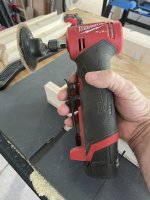
1. Milwaukee 2nd Gen Right Angle Die Grinder
Pros: Seems to fit the bill, very portable
Cons: very expensive in Canada, I don't have any other Milwaukee tools

2. New air compressor for a right angle die grinder
Pros: Could use the air for more air tools like HVLP sprayers etc.
Cons: A new compressor is both expensive and takes up a lot of garage space, louder

The plan would be to use mostly 2" roloc-compatible disks. How big of a compressor do I need to run a die grinder? I have a "2 HP" 10 gallon quiet compressor that's fine for air nailers, but clearly can't hack with a die grinder. Can I get away with a 20 gallon 110 V compressor, or do I really need that 60 gallon 2/3 hp compressor?

Any thoughts? Am I missing anything?
 
To avoid these ads, REGISTER NOW!

dnschmidt

Well-known member
Joined
Oct 3, 2014
Messages
7,260
Location
Phoenix, AZ
Oddly, you need a big (5 HP minimum 80 gallon two-stage) air compressor to power a small angle die grinder. Any air tool that simply shoots air at an impeller has the same issue. Intermittent impact wrenches are far less air hogs than angle grinders. Metabo electric angle grinders can be had that have safety clutches that stop the motor in a bind up situation. Also electric die grinders, not cordless, are safer options that have a lot more power than the air versions. The Milwaukee M12 right angle series 2 die grinder with the 5.0 battery is pretty sweet and I have one but since I have at least 100 Milwaukee M18 and M12 batteries I don't face the problem you do with respect to starting a whole new cordless system. I too like flap wheels over rocks. Less change of binding.
 
OP
A

aptdweller

Well-known member
Joined
Apr 16, 2013
Messages
95
Location
Ottawa, ON
@DNeinstadt I didn't know you could get corded angle die grinders. I don't see much on Amazon, any chance you have a link?

@Rockable Love the idea, but there's no way I can fit a cabinet and a compressor that will run one in my current shop.
 

strutaeng

Well-known member
Joined
Dec 12, 2011
Messages
2,243
Location
Dallas, TX
I've got an old Emglo true 2HP (like 19A @ 120V nameplate) that produces 8.1 @125 psi according to the specs. It will run a die grinder or needle scaler continuously. You need to compare CFM primarily. Once the compressor kicks in, then tank size doesn't matter. My Emglo is a 17 gallon.

But a right angle pneumatic grinder is gonna need a true 5HP, I think (I don't have one of those, just plenty of electric ones).

Is this for hobby work or production? Air will be better for production.

Air spraying is where an air compressor will give the edge for the air compressor option, plus cheaper/lighter tool. Just probably cost more in electricity, if that matters. And noise as you pointed out.

Have you considered a sander of some type for some of that work? Maybe with some course sanding paper like #24 or #36. Maybe one of those fiber resin discs? I bought a few of those fiber resin discs, but have yet to try them. Some guys that do automotive body work use them for stripping paint and light welding grinding.
 
OP
A

aptdweller

Well-known member
Joined
Apr 16, 2013
Messages
95
Location
Ottawa, ON
@strutaeng Thanks - looks like I'm better off with an electric die grinder. A 240 V compressor is doable, but isn't likely going to get enough use to make it worthwhile. This is a home workshop, so evenings and weekends only.

I was planning on using roloc style sanding disks for weld prep. The name brand aren't too bad, and the no-name versions are cheap. I like the scotchbrite pads, but they're best for polishing or paint removal.
 

CGT80

Well-known member
Joined
Aug 29, 2014
Messages
861
Location
IE, SoCal, USA
Flap wheels on an air angled die grinder used to be how I did a lot of prep. A real 3hp air compressor will not keep up, unless your hoses are restricted or the tool is small. My real 5hp 20 cfm compressor does keep up very well.

By accident, I ended up with a makita 4" angle grinder. Now, I have 3 of them with a cut off wheel, aluminum only flap wheel and a steel only flap wheel. The body is very small and easy to grip, they are light weight, and they far outperform a die grinder. The price is also low.

4.5" would be better, but the body gets larger in diameter and I really like the small body for my medium hands. It is easier to control for doing prep and detail work. I will NOT use grinders with the guard removed. There is no reason for it.....well, once in 25+ years of doing it professionally and as a hobby.

My old 5" magnum milwaukee variable speed grinder got my welding jacket with a 5" cup brush. It twisted and wrenched my back hard. It is a great grinder for heavy grinding or smoothing bigger areas.

Many people have no common sense with how to hold a grinder to the work when working on edges. Work with the grinder.....have the flap wheel turn off the edge of the material rather than into a sharp edge. Go the wrong way and it tears up the flap disc and wants to grab under the flaps.

Cut off wheels take some consideration as well to not twist them and to predict where the grinder will gonif it does bind.

I use an air powered da sander and 80 grit paper to clean up rusted steel plate after cnc plasma cutting, and after removing slag with a flap wheel. The da removes mill scale. Need a 5hp compressor or good electric da sander.

100 grit aluminum oxide in my blast cabinet is the fastest for rust and mill scale, but 5hp compressor is required to not have to constantly wait for air. I can blast non stop with a large skat blast tip (20-25 cfm size).

Pool acid is good for mill scale and plasma slag. I have a plastic container with a lid, outside, for soaking parts. Vinegar might work on scale....I don't recall for sure.

Stop making ugly welds, then you won't need to grind them. Caulk or body filler can smooth out welds before paint, especially fillet welds.
 

ctandc72

Well-known member
Joined
Sep 19, 2020
Messages
1,085
Location
VA
By accident, I ended up with a makita 4" angle grinder. Now, I have 3 of them with a cut off wheel, aluminum only flap wheel and a steel only flap wheel. The body is very small and easy to grip, they are light weight, and they far outperform a die grinder. The price is also low.

snip
That reminds me - when I helped my FIL clear his shop out (of 40 years) I ended up with an old Makita 4" angle grinder that looks new, but it's missing the backing plate and the lock nut. Maybe I'll remember now to finally search out the parts so I can use it.
 

GeoBruin

Well-known member
Joined
May 5, 2018
Messages
3,732
Don't forget the bandfile as an option. I have pneumatic and cordless die grinders and a gaggle of angle grinders and I still find the 3/8 and 1/2" band files to be very useful for weld prep and cleanup.
 

dnschmidt

Well-known member
Joined
Oct 3, 2014
Messages
7,260
Location
Phoenix, AZ
Don't forget the bandfile as an option. I have pneumatic and cordless die grinders and a gaggle of angle grinders and I still find the 3/8 and 1/2" band files to be very useful for weld prep and cleanup.
Only problem with that thought is they are true air hogs. Now the Milwaukee and Dewalt cordless versions do work well.
 

mark-NJ

Well-known member
Joined
Apr 1, 2019
Messages
769
Location
new jersey
Normally I would use an angle grinder for scale removal,

I don't think I can add much to what's been said in the previous posts about tools....but I will add this:

Using a flap disc for mill scale removal just smears the mill scale and clogs up the flap disc really fast. It took me a bit of time to figure this out but...speaking only for me...I find that a 15 minute soak in HCl (aka hydrochloric acid....aka muriatic acid) completely removes mill scale with zero effort. A fast neutralization with baking soda solution followed by a water rinse leave the steel almost ready for welding. A fast hit with a wire-wheel, and that steel is as clean as can be. Better living through chemistry!!
 
To avoid these ads, REGISTER NOW!

MOS3522

Well-known member
Joined
Nov 6, 2022
Messages
1,767
Location
Colorado
A die grinder is good for small stuff if you don't do a lot. But an angle grinder is still the way if you fab or work on a lot of stuff.

Can you brush up on your PPE, technique and safety to make it attractive again?
 

RTM

Well-known member
Joined
May 13, 2019
Messages
13,061
Location
SF Bay Area
Don't forget the bandfile as an option. I have pneumatic and cordless die grinders and a gaggle of angle grinders and I still find the 3/8 and 1/2" band files to be very useful for weld prep and cleanup.
I was gonna ask where these stood for weld work. I bought an older B&D electric from a welder, then a Bauer when on sale. Both move fast, and seems like they would work for anything except tight inside corners.

I plan on using mine for woodwork.
 

CGT80

Well-known member
Joined
Aug 29, 2014
Messages
861
Location
IE, SoCal, USA
If by band file, you mean belt sander, I have an astro pneumatics 1/2 x 18 that I bought to clean weld seams inside square tube for parts used to build my 3hp 2x72 belt grinder. It isn't something I use often and is better for detailed areas an angle grinder doesn't work for.

Right over my bench where all the grinders live, are a full face shield that is clear and ear muffs. For cut off wheels, the shield is always used and for heavy flap wheel use or if the sparks will end up at me. My prescription glasses aren't cheap and neither are my eyeballs.

For heavy grinding and nasty welding, a p100 half respirator is great. It is easier to breathe than using a dust mask. It is almost always warm or hot in socal so it is easy to turn on my evaporative cooler to blow out dust and fumes. When I rebuilt the small garage, ac wasn't really a choice because of all the dust and fumes and the cooler was already a very efficient solution for that and it keeps it cool enough. The power usage is also better with a cooler.

There is a gray, maybe sait, disc that is curved and hard. It looks like a thin hard disc with grit glued to it. It eats millscale and welds like crazy but it has been a while since I used them. It is more aggressive than I like for doing cnc cut parts and nicely finished items. The job I used it on was structural in nature, capping a tilt up concrete wall for a dumpster area where the wall was cracked. It was 1/4" a36 steel plate and I finished with a 60 grit flap wheel then used bondo and caulk before priming it (I am, or was a building painter as my primary trade, but only do paint occasionally now, and added many trades over the last 30 years).

There is a scar across my thumb from a new 3/4 diameter double cut carbide cylindrical bur that was on my straight die grinder. It walked out of a 2" hole in aluminum sheet and across my thumb, the first time I used the new bur. The corner cut out a little v groove the thickness of my skin. The shavings are also awful from carbide burs. They are very useful but have risks and I prefer abrasives when possible.

Most of my prep is on relatively flat material or edges, so angle grinders and the 2x72 are the most used. Angle grinders are pretty low risk with how I use them.

I don't think I mentioned my makita gv5000 5 inch disc sander/grinder. Itbis a 90 degree hand held and I normally run 7" resin discs. This is what I use to sand houses with flat areas like eaves and fascias. It is made for prepping and blending steel and welds. 18 grit looks like coke bottles broken and glued on but 24 and 36 are what I normally use on painted (peeling) wood. Sometimes, I will use it to remove rust on steel.

The gv5000 can be quite dangerous if the disc gets pinched between boards when doing eaves. The 7" disc has to be balanced but is great for feathering and covering large areas. They aren't that expensive or heavy, so could be another option for welding work, but angle grinders are more versatile and normally get the job done for me.

Edit: pferd cc-grind-solid 125 sg steel. This is a 5" disc. They are expensive bit claimed to last a really long time. I don't recall if fireball tool showed them off or if I saw them somewhere else. It is worth buying one to see if they are good for what you do.
 
Last edited:
OP
A

aptdweller

Well-known member
Joined
Apr 16, 2013
Messages
95
Location
Ottawa, ON
Thanks everyone, I have a few ideas to try. A band file and electric angle die grinder should be able to do most of what I want to do here.
 

jives

Well-known member
Joined
Jan 4, 2013
Messages
2,803
Location
Central NY
Why is a die grinder safer than an angle grinder? Is it just the smaller size that makes it easier to handle?
 

b-dog

Well-known member
Joined
Apr 24, 2015
Messages
238
Location
Lakewood, CO
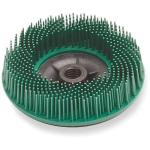
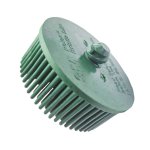
I use bristle discs on an angle grinder for removing mill scale, they are way more efficient than flap wheels. If you don't want to use an angle grinder, they make small versions that you could put in a die grinder. It's probably a bit less risk running a die grinder but who has the time?!

1776002669628.png1776002696088.png
 

larry4406

Well-known member
Joined
Jan 27, 2006
Messages
18,974
Location
Northern Virginia
I use bristle discs on an angle grinder for removing mill scale, they are way more efficient than flap wheels. If you don't want to use an angle grinder, they make small versions that you could put in a die grinder. It's probably a bit less risk running a die grinder but who has the time?!

1776002669628.png1776002696088.png
I’ve never tried those.

Will need to look into them.
 
To avoid these ads, REGISTER NOW!
Top Bottom